
lovethailand home >Northeastern Travel Attractions >Nong Khai Travel Attractions >Muang Nongkhai >Kuan Wan > Kham Yat Boat
TL;DR: Kham Yat Boat, Nong Khai attractions : Art, Culture and Heritage, Historical Sites and Monuments.

Kham Yat Boat
Open Days: No fixed public boat-viewing days have been announced. Contact Wat Sutham Nimit before travelling.
Opening Hours: No official boat-viewing hours are published. Call Wat Sutham Nimit at +66 88 550 4589 to arrange a visit.
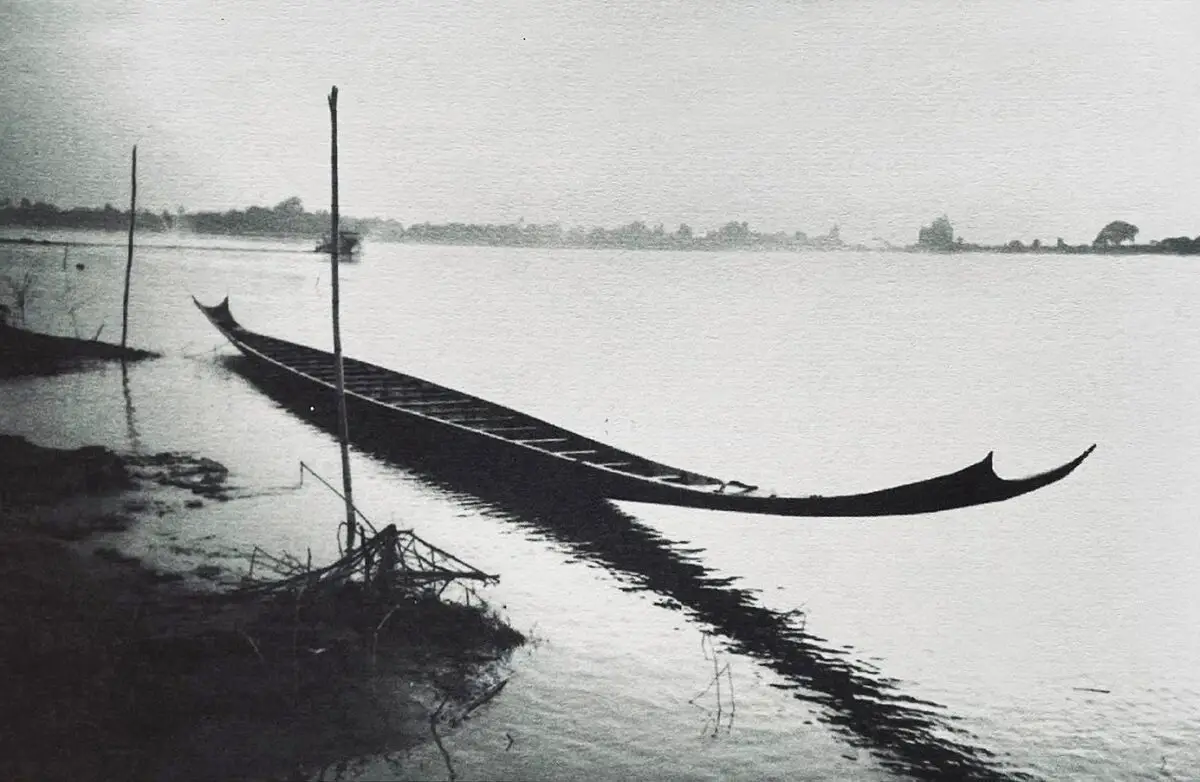
Kham Yat Boat in Nong Khai is an ancient dugout vessel preserved in a protective boat shed at Wat Sutham Nimit, also locally known as Wat Kuan Wan Tha, in Ban Kuan Wan Yai, Kuan Wan Subdistrict, Mueang Nong Khai District, Nong Khai Province. Carved from a single takhian hin hardwood tree, the vessel served as the official boat of Phra Pathum Thewaphiban, also known as Bunma Na Nong Khai, the first governor of Nong Khai. It accommodated approximately 40 paddlers and was used for government duties, security patrols, wartime logistics, river travel and traditional boat racing. The boat remains at the temple and has not been permanently closed to visitors, but advance contact is essential because it is not operated as a museum with regular public hours.
The importance of Kham Yat lies not only in its age or impressive size. Its story connects the political history of Nong Khai, the administration of Mekong frontier towns, traditional dugout-boat craftsmanship, beliefs surrounding large forest trees, wartime transportation and the collective memory of riverside communities. The vessel demonstrates that the Mekong was once far more than a scenic international river. It was a primary route for government communication, trade, military movement, public security and everyday travel between settlements that could not yet be reached efficiently by road.
The boat is stored west of central Nong Khai in Ban Kuan Wan Yai, an old community along the route linking Nong Khai with Tha Bo District. The display area is a local temple boat shed rather than a staffed museum building. Visitors should therefore not expect a ticket office, scheduled guided tours or unrestricted access throughout the day. Calling the temple before departure allows the monks or local caretakers to confirm whether the shed can be opened and to explain where visitors should park and whom they should contact on arrival.
Wat Sutham Nimit is an active community Buddhist temple of the Mahanikaya tradition. Its current abbot is Phra Maha Aphisit Phuripanyo. Religious ceremonies, merit-making activities, funerals, community meetings and monastic routines continue to take place within the temple grounds. Anyone visiting the boat should therefore behave as a guest in a sacred place. Appropriate clothing, restrained voices and respect for restricted areas are expected. Permission should be obtained before entering the boat shed, approaching the vessel closely or arranging professional photography.
The origins of the boat are associated with Phra Pathum Thewaphiban, or Bunma Na Nong Khai, remembered in local history as the first governor of Nong Khai. Following major political upheavals in the early Rattanakosin period, Nong Khai developed into an important administrative centre on the Mekong. A strong and fast official boat was essential for inspecting settlements, carrying orders, transporting officials and responding to security problems along waterways that formed the principal transport network of the region.
Before the construction of modern highways, the Mekong and its tributaries connected villages, agricultural communities and administrative centres. Boats carried people, rice, forest products, government documents, medicine and military supplies. A governor’s boat needed enough capacity for passengers and cargo while remaining manoeuvrable in strong currents. Kham Yat was designed to fulfil these practical requirements and became an official vessel capable of undertaking long-distance journeys and urgent assignments.
The boat was made from takhian hin, sometimes locally identified as mai khaen hin, a dense hardwood suitable for carving large dugout vessels. Boat builders required an exceptionally straight and wide trunk without severe internal defects, because almost the entire hull would be formed from one tree. The quality of the wood determined the vessel’s strength, balance, resistance to water and potential working life. Selecting the tree was therefore a technical decision as well as an event carrying ritual and social importance.
The tree came from Dong Sakhu, a forest area now associated with present-day Tha Bo District. According to local history, elephants were used to drag the massive trunk from the forest. Moving a tree of this size before the introduction of trucks and powered machinery required coordinated labour, trained elephants, carefully chosen routes and substantial community resources. The transportation of the trunk from Dong Sakhu to the Nong Khai area was itself an undertaking that reflected the authority and organisational capacity of the provincial administration.
A traditional ceremony was performed before the tree was felled. Local oral history names a senior monk or ritual leader from Ban Na Rong as the person who conducted the rite. During the felling, drops of water were said to fall continuously from the tree. This event inspired the name “Kham Yat.” In the Lao–Isan linguistic tradition, kham can mean gold, while yat refers to a drop or something falling in droplets. The name is therefore commonly interpreted as “golden drops.”
The name reflects an older tradition in which important vessels were not named merely for convenience. Names could preserve a remarkable event, express auspicious meaning and establish a symbolic relationship between the craft, its owner and the community. By linking the boat to the unusual drops observed during the ritual, Kham Yat became more than a piece of transportation equipment. It acquired an identity associated with authority, good fortune, natural abundance and the sacred dimensions of the forest from which its timber came.
After the trunk reached Nong Khai, it was carved and hollowed in the area of the present post-office alley, once part of the governor’s compound. Dugout construction began by marking the centre line, opening the upper surface and gradually removing the interior wood. The builders had to maintain consistent thickness along both gunwales while shaping the bow, stern and bottom to move efficiently through the river. A serious mistake at any stage could ruin the entire trunk, making the work exceptionally demanding.
Traditional boat builders worked without modern engineering drawings, laser measurements or powered cutting machines. Their knowledge came from practical apprenticeship, observation and experience with wood and water. They understood grain direction, moisture, weight distribution and the way a hull would react when launched. If one side became too thin, the hull could crack or lose balance. If too much material remained, the boat would become heavy and slow. Kham Yat represents this highly developed body of practical craftsmanship.
When completed, the vessel could accommodate approximately 40 paddlers. This capacity shows that it was considerably larger than an ordinary family or fishing boat. Forty paddlers had to be positioned carefully along both sides, maintaining balance and moving their paddles in a coordinated rhythm. The steersman and rhythm leader played crucial roles, particularly when the boat travelled through changing currents, narrow passages or rough water. Speed depended on collective discipline rather than individual strength alone.
Community memory describes Kham Yat as one of the fastest vessels on the Mekong in its time. Its performance resulted from the combination of a streamlined hull, carefully distributed weight, skilled steering and strong, experienced paddlers. As an official vessel, it could draw upon crews familiar with the river’s seasonal behaviour. The boat’s reputation for speed later contributed to its association with competitive rowing, although its original purpose was government service rather than sport.
Kham Yat initially functioned as the governor’s official transport. The territory administered from Nong Khai was connected by rivers and streams, and many communities could be reached more effectively by water than by land. The vessel carried officials, government instructions and essential supplies, enabling the governor’s administration to operate across a wide area. In practical terms, it served as both a means of transportation and a mobile administrative platform on the waterways.
Navigation on the Mekong demanded considerable skill. During the rainy season, strong currents, floating debris and flooded banks created hazards. In the dry season, exposed sandbars, rocks and shallow channels presented different problems. Boatmen read the colour of the water, the formation of waves, wind direction and the location of navigable channels. For a large dugout carrying many people, a collision or grounding could cause severe damage, so knowledge of the river was as important as the construction of the vessel itself.
The boat also supported public security along the river. Water transport enabled officials to reach frontier settlements faster than travelling through forests and undeveloped land routes. A single large vessel could carry personnel, provisions and official equipment, while its speed allowed messages and reports to move between communities. Kham Yat was therefore part of the broader security infrastructure of a Mekong administrative town at a time when rapid communication was difficult.
One of the most significant chapters in the boat’s history occurred during the Haw suppression campaigns in 1885, corresponding to B.E. 2428. Siamese forces operated in the Thung Chiang Kham region under Prince Prachak Silapakhom. Mountainous terrain and difficult forest routes made logistical support a major challenge. Rivers and connected waterways became essential for transporting food, medicine, personnel and information, and Kham Yat was employed as part of this supply network.
Accounts passed down through local history state that the boat could carry approximately ten sacks of rice per journey, together with medicines, provisions and official messages. Supplying soldiers in the field was fundamental to military operations. Without reliable food and medical materials, forces stationed far from Nong Khai could not maintain their position. The boat’s speed and cargo capacity allowed it to function as an important logistical link between the town and the operational area.
On return journeys, Kham Yat was used to carry wounded personnel and information back to Nong Khai. Transporting injured people by river reduced some of the hardship of overland travel, although the crew had to keep the vessel stable and minimise violent movement. Following the end of the fighting, the boat was also associated with transporting prisoners and the remains of those who had died. Its history therefore records not only official achievement but also the suffering and human cost of conflict.
From a military-history perspective, Kham Yat illustrates why logistics can be as decisive as combat. A fast boat with substantial carrying capacity shortened delivery times, maintained communication and connected commanders with troops operating in difficult terrain. Its historical value rests on reliable service under demanding conditions. The vessel was not a ceremonial object kept safely away from danger; it was a working craft entrusted with tasks that affected the survival and effectiveness of people in the field.
After the wartime period, the boat continued to serve government and community purposes. As roads, motor vehicles, railways and powered boats gradually transformed transportation in Nong Khai, the practical importance of a large paddled dugout declined. Kham Yat’s role consequently shifted from active official transport to a vessel preserved through community memory. This transition mirrors the broader development of Nong Khai from a river-dependent administrative town into a modern border province connected by road, rail and international bridge.
The boat’s reputation for speed also connected it with traditional racing on the Mekong. Boat racing combines physical strength, steering skill, disciplined rhythm and community pride. In a vessel carrying 40 paddlers, every participant must respond to the same command. Even a small loss of timing can reduce speed or pull the boat away from its course. The memory of Kham Yat as a fast craft therefore reinforces its place within the rowing culture of Mekong communities.
Traditional races in the region often take place during the high-water season and around the end of Buddhist Lent. Although Kham Yat is no longer launched for competition, its history allows visitors to understand the scale and organisation required for large racing boats. The same qualities that served government transport—speed, balance, strong crews and skilled steering—also made a vessel respected in competitive settings.
Throughout its long life, Kham Yat passed through the care of several individuals, families and communities. Local historical accounts refer to periods when the boat was kept in the Tha Bo area, including an association with Wat Tha Khok Ruea, before it was eventually transferred to the Kuan Wan community. Each change of custody carried the risk of neglect, damage or loss, yet successive caretakers recognised the vessel’s importance and continued to protect it.
Chaiyo Na Nong Khai is frequently mentioned in later accounts as a descendant connected with the first governor’s family and as a former custodian of the vessel. His recollections helped preserve details about the boat’s construction, service and movements between communities. Such personal testimony is especially valuable when written government records are incomplete. Family and community memory provide context that enables historians to understand why the boat survived and how its significance was interpreted by later generations.
An old wooden boat faces many forms of deterioration. Changes in humidity can cause cracking and distortion, while termites, other insects and fungi may attack weakened areas. Repeated relocation can place additional stress on the hull. Keeping the vessel under a roof reduces direct exposure to sun and rain, but conservation also requires ventilation, stable support, regular inspection and careful management of moisture. Preserving such a large single-log hull is a continuing responsibility rather than a one-time repair.
Kham Yat was previously described as a “seven-reign boat,” referring to its survival from the reign of King Rama III through that of King Rama IX. As it remains extant during the reign of King Rama X, the expression “eight-reign boat” is now increasingly appropriate. This method of counting does not establish an exact construction date, but it provides an accessible sense of the vessel’s longevity. With its construction placed around 1827–1828, the boat is approaching two centuries of age.
Its physical condition naturally differs from the day it was launched. The hull has experienced work, repairs, transportation and changing environments. Cracks, repaired sections and aged surfaces should be understood as evidence of the vessel’s biography. Visitors should not expect the polished appearance of a reconstructed boat. The surviving material itself is valuable because it has passed through real historical use rather than being newly manufactured for display.
Today, the boat is housed at Wat Sutham Nimit in Ban Kuan Wan Yai. Its care takes place within the practical context of a temple and community, not within a climate-controlled museum. There is no permanent ticket desk, multilingual exhibition hall or full-time guide. A visit is therefore an encounter with locally protected heritage. The experience depends upon respectful communication with those responsible for the temple and recognition that access must fit around religious and community activities.
The boat shed protects Kham Yat from direct sunlight and rain, both of which can accelerate the deterioration of old timber. Conditions around the shed may nevertheless change during temple repairs, festivals or community events. Travellers should not rely solely on opening times copied from general tourism websites. Contacting the temple before departure is the most reliable way to confirm that someone can provide access and that no ceremony or maintenance work will interfere with the visit.
The absence of fixed opening hours does not mean that the site is permanently closed. It means that the boat is not managed as a commercial attraction. The temple continues to serve religious and community functions, and there may be occasions when funerals, merit-making ceremonies or monastic duties make boat viewing inconvenient. Arranging a visit in advance respects these responsibilities and greatly reduces the possibility of arriving when the shed cannot be opened.
Wat Sutham Nimit is closely associated with Ban Kuan Wan Yai and was historically known locally as the village temple. Its grounds contain Buddhist ceremonial areas, a preaching hall, monastic quarters and the Kham Yat boat shed. Visitors should first locate a monk or authorised caretaker, introduce themselves politely and ask which areas may be entered. This simple procedure protects both the privacy of the monastic community and the security of the historic vessel.
The current abbot is Phra Maha Aphisit Phuripanyo, and the temple’s contact number is +66 88 550 4589. Calls should be made during reasonable daytime hours. Visitors should state their intended date, group size and purpose. School groups, researchers, documentary teams and large tour parties should provide more advance notice than individual travellers, allowing the temple to assess whether the visit can be accommodated safely.
No official admission charge for viewing Kham Yat has been published. It would therefore be inaccurate to invent a price or to describe entry as unconditionally free. Visitors should ask the temple directly when arranging access. Anyone wishing to make a voluntary contribution for temple maintenance or local preservation should follow the method specified by the temple rather than assuming that a donation is a compulsory entrance ticket.
Getting There from central Nong Khai is easiest by private car, rental vehicle or hired driver. Travel west along the route connecting Nong Khai with Tha Bo District, then enter Kuan Wan Subdistrict and Ban Kuan Wan Yai. The temple is near Highway 211. From the Tha Sadet riverfront area, the driving distance is approximately 10–11 kilometres, depending on the starting point and route used.
From Nong Khai Railway Station, travellers can use a local taxi or pre-arranged vehicle. The distance is approximately 6–7 kilometres. Showing the Thai name “วัดสุธรรมนิมิต บ้านกวนวันใหญ่” to the driver is useful, because temples with similar names exist elsewhere and some residents may know this temple as Wat Kuan Wan Tha or Wat Ban Kuan Wan Yai. Keeping the temple telephone number available allows the driver or traveller to request final directions.
Travellers arriving at Nong Khai Bus Terminal should arrange a taxi or local vehicle, as no published public-transport timetable runs directly to the boat shed. For a group, hiring a driver for several hours makes it easier to combine Kham Yat with the Thai–Lao Friendship Bridge, Wat Pho Chai, Tha Sadet Market and other attractions without repeatedly searching for transport.
The principal commercial airport serving the region is Udon Thani International Airport. From the airport, visitors may rent a car, use a transfer service or travel first to Nong Khai and continue to Wat Sutham Nimit. The boat visit should be scheduled for daylight hours after confirmation with the temple. It is unwise to treat the temple as an unscheduled first stop immediately after a flight, because access to the shed cannot be guaranteed without prior communication.
The approximate coordinates are 17.84945, 102.68573. When using an online map, search for Wat Sutham Nimit Nong Khai and verify that the pin is in Kuan Wan Subdistrict, Mueang Nong Khai District. This prevents confusion with similarly named temples. On arrival, park only where directed and avoid blocking ceremonial buildings, gates, emergency access or paths used by monks and local residents.
A daytime visit after confirmation with the temple offers the best conditions for observing the hull’s shape and surface. During the hot season, travellers should carry drinking water and wear breathable but respectful clothing. During the rainy season, check weather and road conditions before departure. Heavy rain may affect access or temple activities even though the boat itself is stored under a roof.
Photography must never involve climbing onto, sitting on or placing equipment against the boat. A nearly two-century-old wooden structure can be damaged by concentrated pressure, especially around cracks or repaired sections. Visitors should not scrape the surface, apply water or cleaning products, or use high-heat lighting for extended periods. Tripods, professional video equipment and commercial photography should be discussed with the temple beforehand.
Families travelling with children should explain that Kham Yat is an authentic historic object rather than a replica designed for play. The visit can become a lesson about hardwood trees, traditional craftsmanship, transportation before modern roads, the history of Nong Khai and the importance of the Mekong. Children can study the hull’s form and imagine how 40 paddlers were positioned without touching the vessel.
For students and researchers, the boat offers topics ranging from upper Isan political history and dugout technology to military logistics, community memory and wood conservation. Detailed measurement, scientific examination, timber sampling or the use of specialised equipment requires formal permission from the temple and any relevant cultural authorities. Ordinary visitor access should not be treated as authorisation for research intervention.
Nearby attractions can be arranged into a practical route. Wat Phra Chai Chetthathirat lies within the Kuan Wan area. Travellers may then continue to the First Thai–Lao Friendship Bridge and Nong Thin Public Park before entering central Nong Khai to visit Wat Pho Chai, walk through Tha Sadet Market and enjoy the Mekong riverfront. With additional time, the route can extend east to Sala Keoku, Nong Khai’s celebrated religious sculpture park.
Dining options range from local breakfast restaurants and Isan cuisine to Vietnamese food and riverside international menus. Ban Mae Slow Bar Coffee is located close to the temple area. In central Nong Khai, Pordee Breakfast, Macky’s Riverside Kitchen and Daeng Naem Nueang are established choices. River Chill offers another riverside dining option. Opening hours should always be checked on the day of travel, particularly on public holidays or during seasonal closures.
Accommodation is concentrated around the railway station, Friendship Bridge and central riverfront. Park & Pool Resort, Panlaan Boutique Resort and Nongkhai Tavilla Hotel & Convention Center provide convenient access to the western side of the city. Amanta Hotel Nongkhai and Mut Mee Garden Guest House are useful for travellers focusing on central Nong Khai and the Mekong riverfront. The best choice depends on whether the itinerary prioritises the bridge and railway or Tha Sadet Market and central attractions.
A half-day itinerary can begin with a pre-arranged morning or late-morning visit to Kham Yat, followed by Wat Phra Chai Chetthathirat and lunch. The afternoon may be used for the Friendship Bridge or Nong Thin Public Park. This plan suits travellers with limited time who want to concentrate on the western side of Nong Khai without rushing through too many unrelated destinations.
A full-day route can continue from Wat Sutham Nimit into central Nong Khai. Visitors may pay respect to Luang Pho Phra Sai at Wat Pho Chai, learn about the city’s religious heritage, explore Tha Sadet Market and walk beside the Mekong in the afternoon. Dinner can be taken along the river, or the journey can continue to Sala Keoku. Travelling from west to east reduces unnecessary backtracking and reveals different layers of Nong Khai’s development.
Visitors gain more from the boat when they ask questions beyond its age. Why did a governor require an official vessel? Why was a single tree chosen? How did builders regulate the thickness of the hull? How could 40 paddlers maintain rhythm? How did one boat influence government missions or wartime supply? These questions transform Kham Yat from an old object into an entry point for understanding the political, technological and environmental history of the Mekong region.
The vessel also expresses the relationship between forest and river. A takhian tree from Dong Sakhu was converted through specialised craftsmanship into a boat that travelled across the Mekong system. Selecting the tree, performing the ritual, moving the trunk, carving the hull, training the crew and maintaining the vessel required the cooperation of many people. Kham Yat is therefore the product of an entire community system of knowledge and labour rather than the work of a single individual.
Its intangible heritage is as important as the surviving timber. If the hull remains but knowledge of its name, service, caretakers and wartime duties disappears, the boat loses much of its meaning. Recording the recollections of elders, members of the Na Nong Khai family, monks and the Kuan Wan community should therefore accompany physical conservation. Oral accounts need to be preserved while the people who inherited them can still explain their context.
Future preservation should include professional assessment of the timber, humidity management, protection from insects, properly distributed structural support and regular photographic documentation. Clear interpretive panels in Thai and English could distinguish documented historical information from oral tradition while preserving the character of both. Such improvements would help visitors understand the boat without requiring constant physical contact or movement around fragile sections.
Kham Yat could serve as the centre of a wider learning route covering Nong Khai’s urban history, traditional boat racing, Mekong navigation and local boatbuilding. Tourism development, however, should remain within the capacity of the small boat shed. Advance booking, controlled group sizes and clear photography rules would allow visits to support conservation rather than accelerate deterioration.
For the people of Nong Khai, Kham Yat shows how local history intersects with regional and national events. The boat served a governor, supported military operations, travelled through interconnected waterways and was later protected by families, monks and villagers. Its transformation from an instrument of government into shared cultural heritage represents the transfer of responsibility from one generation to the next.
Kham Yat is therefore best suited to travellers interested in history rather than a brief photo stop. Reading its story before visiting, observing the timber and studying traces of use reveal how a single dugout could preserve almost two centuries of memory. Contacting the temple in advance and following the caretaker’s instructions are essential parts of responsible travel and contribute directly to the continued survival of the vessel.
Standing before Kham Yat means encountering an object that has passed through the era of provincial governors, wartime mobilisation, changing frontiers, transportation modernisation and the transformation of Nong Khai into a contemporary border city. The name inspired by falling drops during the tree-felling ceremony still connects the vessel to its forest origin. Kham Yat deserves recognition as living Mekong heritage, not merely as an old boat stored beneath a roof.
| Name | Kham Yat Boat at Wat Sutham Nimit |
| Thai Name | เรือคำหยาด ณ โรงเรือวัดสุธรรมนิมิต |
| Category | Ancient Dugout Boat and Mekong Historical Heritage |
| Location | Boat shed inside Wat Sutham Nimit, also known locally as Wat Kuan Wan Tha, Ban Kuan Wan Yai, Kuan Wan Subdistrict, Mueang Nong Khai District, Nong Khai Province |
| Address | Moo 5, Ban Kuan Wan Yai, Kuan Wan Subdistrict, Mueang Nong Khai District, Nong Khai 43000, Thailand |
| Coordinates | 17.84945, 102.68573 |
| Current Status | The boat remains preserved in the temple boat shed. The site is not permanently closed, but viewing must be arranged with the temple in advance. |
| Open Days | No fixed public boat-viewing days have been announced. Contact the temple before travelling. |
| Opening Hours | No official boat-viewing hours are published. Advance appointment is required. |
| Admission Fee | No official admission charge has been announced. Confirm directly with the temple. |
| Original Patron | Built as the official boat of Phra Pathum Thewaphiban, or Bunma Na Nong Khai, the first governor of Nong Khai |
| Construction Period | Placed around B.E. 2370–2371, corresponding to 1827–1828 during the reign of King Rama III |
| Material | Carved from a single takhian hin or mai khaen hin hardwood tree brought from Dong Sakhu in present-day Tha Bo District |
| Paddling Capacity | Approximately 40 paddlers |
| Name Origin | Drops of water reportedly fell during the tree-felling ceremony. Kham means gold and yat means a drop, producing the meaning “golden drops.” |
| Highlights | A nearly 200-year-old dugout used for government service, public security, wartime logistics and traditional rowing activities on the Mekong |
| Major Historical Role | Transported rice, medicine, official messages, wounded personnel, prisoners and human remains during the Haw suppression campaign of 1885 |
| Main Areas / Zones | 1. Kham Yat Boat Shed 2. Buddhist Ceremonial Area 3. Preaching Hall 4. Monastic Area |
| Abbot / Caretakers | Phra Maha Aphisit Phuripanyo, Abbot of Wat Sutham Nimit, together with the temple community and residents of Ban Kuan Wan Yai |
| Main Contact Number | +66 88 550 4589 |
| Official Page | Facebook: Wat Sutham Nimit, Nong Khai Province |
| Travel Information | Drive west from central Nong Khai toward Tha Bo District, follow the Highway 211 corridor into Kuan Wan Subdistrict and Ban Kuan Wan Yai, and navigate to Wat Sutham Nimit. Contact the temple before departure. |
| Visitor Guidelines | Dress respectfully, obtain permission before entering the shed, do not touch, climb, sit on or place equipment against the boat, and request approval for commercial photography. |
| Nearby Tourist Attractions | 1. Wat Phra Chai Chetthathirat, approximately 1 km 2. First Thai–Lao Friendship Bridge, approximately 6 km 3. Nong Thin Public Park, approximately 7 km 4. Wat Pho Chai, approximately 10 km 5. Tha Sadet Market, approximately 11 km 6. Sala Keoku, approximately 15 km |
| Nearby Restaurants | 1. Ban Mae Slow Bar Coffee, approximately 1 km 2. Pordee Breakfast, approximately 8 km, Tel. +66 82 739 5247, +66 85 886 5531 3. Macky’s Riverside Kitchen, approximately 10 km, Tel. +66 80 464 9536, +66 97 109 1022 4. Daeng Naem Nueang, approximately 11 km, Tel. +66 42 411 961, +66 42 411 234 5. River Chill Cafe & Restaurant, approximately 15 km, Tel. +66 85 570 3396 |
| Nearby Accommodations | 1. Park & Pool Resort, approximately 5 km, Tel. +66 88 568 2300 2. Panlaan Boutique Resort, approximately 6 km, Tel. +66 80 408 7289, +66 42 412 878 3. Nongkhai Tavilla Hotel & Convention Center, approximately 6 km, Tel. +66 87 427 5111 4. Amanta Hotel Nongkhai, approximately 8 km, Tel. +66 42 412 899, +66 88 561 2929 5. Mut Mee Garden Guest House, approximately 9 km, Tel. +66 42 460 717 |
Frequently Asked Questions (FAQ)
Q: Where is Kham Yat Boat located?
A: The boat is preserved in a protective shed inside Wat Sutham Nimit, also locally known as Wat Kuan Wan Tha, in Ban Kuan Wan Yai, Kuan Wan Subdistrict, Mueang Nong Khai District, Nong Khai Province.
Q: Is Kham Yat Boat currently open to visitors?
A: The boat remains at Wat Sutham Nimit and the site is not permanently closed. However, there is no fixed public schedule, so visitors must call +66 88 550 4589 before travelling.
Q: Is there an admission fee for Kham Yat Boat?
A: No official admission fee has been published. Confirm directly with the temple when arranging the visit. Any voluntary contribution should follow the method specified by the temple.
Q: Why is the vessel called Kham Yat?
A: Local tradition states that drops of water fell during the tree-felling ceremony. Kham means gold and yat means a drop, giving the name the meaning “golden drops.”
Q: When was Kham Yat built and how old is it?
A: Its construction is placed around 1827–1828, during the reign of King Rama III. The surviving vessel is therefore approaching 200 years of age and has existed from the reign of Rama III through Rama X.
Q: What historical role did Kham Yat perform?
A: It served as the official boat of Nong Khai’s first governor, supported public administration and security, and carried food, medicine, messages, wounded personnel, prisoners and human remains during the Haw suppression campaign of 1885.
Q: May visitors touch or climb onto the boat?
A: No. Visitors should not touch, climb onto, sit on or place objects against the hull. The old timber contains cracks and repaired areas and must be viewed from the position designated by the caretaker.
Q: Which attractions can be combined with Kham Yat in one day?
A: A practical route can include Wat Phra Chai Chetthathirat, the First Thai–Lao Friendship Bridge, Nong Thin Public Park, Wat Pho Chai, Tha Sadet Market and Sala Keoku.
 Category: ●Art, Culture and Heritage
 Group: ●Historical Sites and Monuments
Last Update : 2 MonthAgo
 Last Update : 2 MonthAgo
 Click to Access the Navigation Map GPS
 Historical Sites and Monuments(1)
 Landmarks and Memorials(2)
 Art, Craft Centres, Tradition(1)
 Educational Places
 Educational Gardens, Farm(1)
 Places of Worship
 Temple(16)
 Mosque(1)
 Other Sacred Sites(8)
 Suburban Living
 Village, Community(3)
 Local Market(4)
 Nature and Wildlife
 National Parks and Marine Reserves(2)
 Dam, Reservoir, Lake(2)
 Waterfalls(4)
 River, Canal(8)
 Bays and Beaches(1)
 Entertainment and Agricultural
 Farms, Parks and Ecotourism(2)
 Shopping
 Shopping and Night Market(1)


