
lovethailand home >Northeastern Travel Attractions >Nong Khai Travel Attractions >Muang Nongkhai >Kuan Wan > Hat Chommani
TL;DR: Hat Chommani, Nong Khai attractions : Nature and Wildlife, Bays and Beaches.
Hat Chommani
Open Days: Daily, with the sand beach appearing most clearly during the dry season
Opening Hours: Accessible throughout the day; best visited during daylight hours, especially in the morning and late afternoon
Hat Chommani, also known as Chommani Beach in Nong Khai Province, is one of the best-known seasonal sand beaches along the Mekong River in northeastern Thailand. Located at Ban Chommani, Village No. 1, Mi Chai Subdistrict, Mueang Nong Khai District, the beach is only about 2 km from Nong Khai city and can be reached easily by following the riverside road. Unlike a seaside beach, Hat Chommani is a natural Mekong sandbank that appears only during the dry season, when the river level drops and reveals a sandy stretch along the riverbank. Because of its relaxed beach-like atmosphere, it has long been nicknamed the “Pattaya of Isan.”
The charm of Hat Chommani lies in its seasonal nature. During the rainy season and high-water period, much of the beach is covered by the Mekong River. When the dry season arrives, especially from March to April, the water level falls and a strip of sand about 200 meters long becomes visible. Local residents and visitors then use the area as a riverside leisure space for walking, sitting, eating, taking photographs, and enjoying the breeze from the Mekong. This seasonal transformation gives Hat Chommani a character that changes from year to year according to the water level.
Hat Chommani is especially convenient because it is close to Nong Khai city. Travelers do not need to go far to experience a beach atmosphere. From the city center, the route follows the Mekong riverside and passes local communities, temples, restaurants, and views of the river. In the dry season, the beach becomes a popular place for families, groups of friends, local residents, and travelers from nearby provinces. The atmosphere is casual, lively, and strongly connected with local life rather than being a polished commercial resort area.
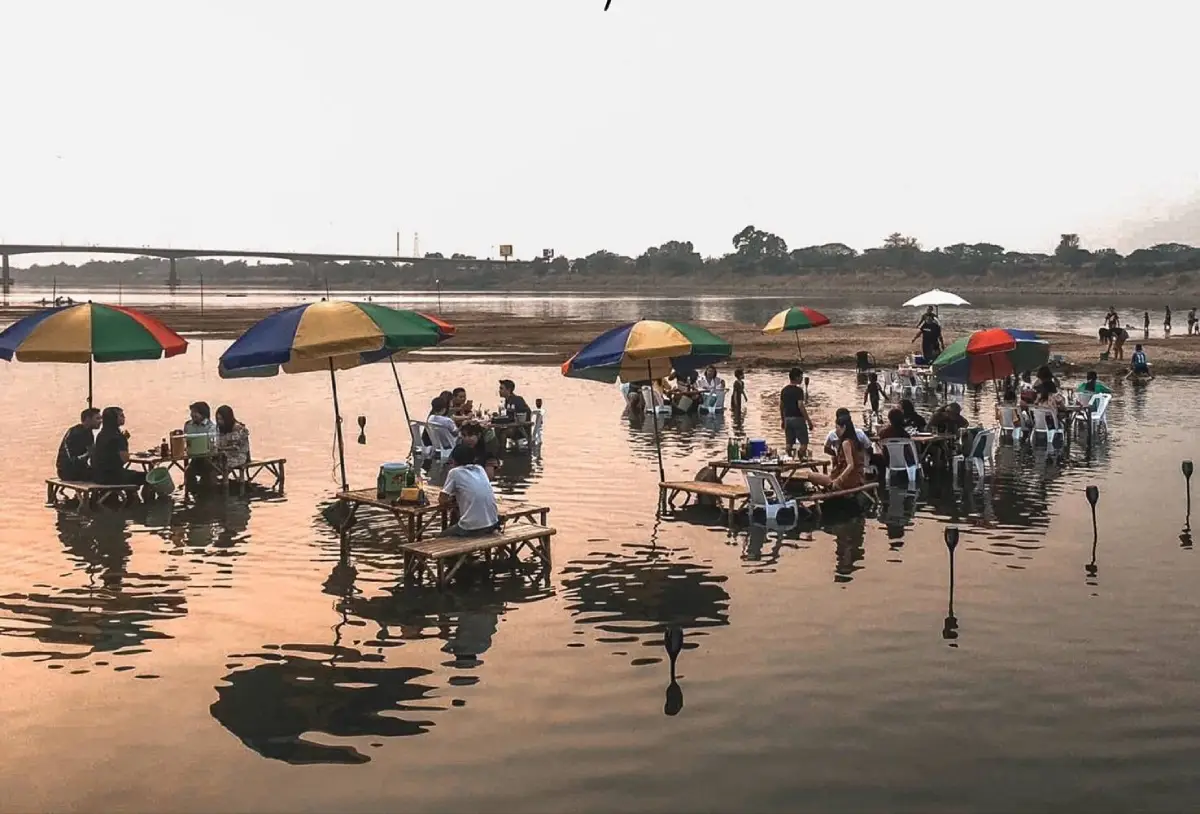
April is the most popular month to visit Hat Chommani. The weather is hot, the Mekong level is usually low, and the sandbank becomes clearer. During this period, the beach often becomes livelier with riverside food vendors, seasonal floating platforms, and seating areas arranged according to local conditions each year. Visitors come to relax beside the river, eat local food, enjoy the open-air setting, and experience a version of beach leisure that belongs to the Mekong rather than the sea.
Although Hat Chommani feels like a beach, visitors should remember that it is part of the Mekong River, a large river with changing water levels and currents. The beach is best for walking, resting, photography, and eating by the riverside. Swimming or entering the water in unfamiliar areas should be avoided, especially where the riverbed is uneven or the current is not visible from the surface. Children should be supervised closely, and visitors should stay away from the water’s edge after dark or when the river level changes quickly.
One of the most distinctive views from Hat Chommani is the First Thai-Lao Friendship Bridge. The bridge can be seen clearly from the beach area, creating a memorable background of sand, river, and international connection. The bridge is one of the major landmarks of Nong Khai Province and symbolizes the relationship between Thailand and Lao PDR. From Hat Chommani, this view gives the beach a stronger sense of place, reminding visitors that Nong Khai is both a riverside town and an important border province.
For photography, Hat Chommani offers several useful angles. Morning is suitable for quieter photographs of the sand, water, and bridge. Late afternoon gives a warmer light and a more relaxed atmosphere, especially when people begin to gather for food and riverside leisure. Visitors can photograph the exposed sand, the Mekong River, the Thai-Lao Friendship Bridge, local food scenes, family gatherings, and the soft evening light over the river. The best images often combine the beach, local life, and the bridge in one frame.
Geographically, Hat Chommani is created by the seasonal movement of the Mekong River. Sand and sediment accumulate along the riverbank, and when the water level drops during the dry season, the sand becomes visible. This means that the beach is not permanent in the same way as a sea beach. In some years the sand may appear broader and more attractive. In other years, the visible beach may be narrower or appear later, depending on the river level. This natural variability is part of the identity of the place.
Hat Chommani also plays an important role as a local leisure space. When the beach appears, Nong Khai gains an additional public riverside area where people can rest, meet friends, eat with family, and cool down during the hot season. The beach is informal and friendly. It feels less like a designed attraction and more like a seasonal community gathering space. This is one of the reasons local people remember it fondly as the “Pattaya of Isan.”
The nickname does not mean Hat Chommani is the same as a sea resort. Instead, it reflects the feeling of relaxation that local people experience when they sit by the sand, feel the wind, order food, and spend time beside the water. For a province without a coastline, a Mekong sand beach becomes a meaningful seasonal escape. It offers the feeling of a beach holiday without leaving the northeast of Thailand.
Food is an important part of the Hat Chommani experience. During the busier dry-season period, visitors may find seasonal food vendors, local restaurants, and floating or riverside seating depending on the year’s arrangement. Dishes that fit the setting include grilled fish, Isan food, Thai dishes, Vietnamese-style food associated with Nong Khai, som tam, grilled chicken, and freshwater fish dishes. Eating beside the Mekong while looking toward the bridge is one of the classic ways to enjoy the beach.
The best times of day to visit are morning and late afternoon. Morning offers cooler air and softer light, while late afternoon is better for riverside dining, photography, and a more relaxed social atmosphere. Midday visits are possible, but the sand can be hot and shade may be limited. Visitors should bring drinking water, a hat, sun protection, and footwear suitable for sand.
Families can enjoy Hat Chommani, but care is necessary. Children can learn about the Mekong River, seasonal water levels, sandbanks, and public-space etiquette. However, adults should keep children away from the water’s edge and avoid allowing them to enter the river without proper local supervision. Older visitors should choose stable seating areas or accessible parts of the beach rather than walking far across soft sand.
The visitor experience at Hat Chommani can be divided into several zones. The first is the Mekong sand beach zone, where visitors walk, sit, and relax. The second is the Thai-Lao Friendship Bridge view zone. The third is the seasonal food and floating-platform zone. The fourth is the family recreation zone. The fifth is the riverside road and Ban Chommani community zone. The sixth is the connection zone linking the beach with major Nong Khai city attractions.
The Mekong sand beach zone is the heart of Hat Chommani. This is where the seasonal sandbank becomes a leisure area. Visitors should check the ground before walking because some areas may be firm while others may be soft or damp. Sand near the river can change quickly, so travelers should avoid walking too close to the water or crossing shallow channels that may be unstable.
The Thai-Lao Friendship Bridge view zone is one of the reasons Hat Chommani is visually memorable. The bridge gives the beach a clear landmark and connects the view with Nong Khai’s border identity. Photographs from this zone often show the river, sand, and bridge together, making the scene immediately recognizable as Nong Khai.
The seasonal food and floating-platform zone makes the beach more lively during the dry season. Visitors can sit, eat, and enjoy the atmosphere when local services are available. Guests should keep the area clean, avoid throwing food waste onto the sand or into the river, and follow the local rules for seating and service areas.
The family recreation zone is where visitors gather for casual leisure. People come to rest, talk, take photographs, and cool down in the hot season. The atmosphere is friendly and relaxed, but visitors should still respect others by avoiding excessive noise, keeping personal areas tidy, and sharing public space politely.
The riverside road and Ban Chommani community zone gives the journey to the beach its local character. The area includes homes, roads, temples, and shops along the Mekong. Visitors should drive slowly, park without blocking local access, and respect community life. This is a living riverside neighborhood, not only a tourist stop.
The city-connection zone makes Hat Chommani easy to combine with other Nong Khai attractions. A visitor can start with Wat Chommani, continue to Hat Chommani in the dry season, then visit the First Thai-Lao Friendship Bridge, Wat Pho Chai, Tha Sadet Market, the Mekong riverside cultural area, Sala Keoku, or Nong Khai Aquarium. This makes the beach suitable for a half-day or full-day route in Nong Khai.
Getting There is easy from Nong Khai city. Follow the road along the Mekong River toward Ban Chommani in Mi Chai Subdistrict. The distance from the city area is about 2 km. A private car or motorcycle is the most convenient option, but local hired vehicles can also be used. Visitors should tell the driver they are going to Hat Chommani at Ban Chommani, Mi Chai Subdistrict, to avoid confusion with other riverside spots.
Travelers arriving from other provinces can use Nong Khai city as their base. From Udon Thani, follow the main road into Nong Khai and continue toward the riverside area near the Thai-Lao Friendship Bridge. Travelers arriving by train can continue from Nong Khai Railway Station by local vehicle. During holiday periods, especially in April, visitors should allow extra time for traffic and parking.
Good visitor etiquette is important. Travelers should not leave rubbish on the sand, throw waste into the Mekong, damage seating areas, enter unsafe water zones, or block local roads. Hat Chommani remains attractive because it is a shared seasonal space. Keeping it clean and respectful helps preserve the beach for both local residents and visitors.
For international travelers, Hat Chommani offers a different way to understand Nong Khai. It is not only a border town with temples, markets, and a bridge. It is also a place where the Mekong River creates seasonal public landscapes. The beach shows how local people adapt to the river’s changing level and turn a natural sandbank into a temporary place for rest, food, family time, and riverside life.
In summary, Hat Chommani in Ban Chommani, Mi Chai Subdistrict, Mueang Nong Khai District, is a seasonal Mekong River sand beach about 2 km from Nong Khai city. It appears during the dry season, is especially popular in April, stretches for about 200 meters, and is known as the “Pattaya of Isan.” Its highlights include the Mekong sand beach, relaxed local atmosphere, seasonal restaurants and floating platforms, and a clear view of the First Thai-Lao Friendship Bridge. It is best visited during the dry season, especially in the morning or late afternoon, with attention to river safety and respect for the local community.
| Name | Hat Chommani / Chommani Beach |
| Location | Ban Chommani, Village No. 1, Mi Chai Subdistrict, Mueang Nong Khai District, Nong Khai Province |
| Address | Mekong Riverside Sand Beach Area, Ban Chommani, Village No. 1, Mi Chai Subdistrict, Mueang Nong Khai District, Nong Khai Province 43000, Thailand |
| Highlights | Seasonal Mekong sand beach, about 200 meters long, popular in April, relaxed “Pattaya of Isan” atmosphere, and clear views of the First Thai-Lao Friendship Bridge |
| History / Area Context | A natural Mekong River sand beach that appears when the river level drops during the dry season, used as a local leisure space by Nong Khai residents and nearby visitors |
| Name Origin | The name comes from Ban Chommani, the riverside community in Mi Chai Subdistrict where the seasonal beach appears |
| Distinctive Features | A dry-season sand beach along the Mekong River, with changing size and shape depending on the water level, suitable for walking, photography, riverside food, and relaxation |
| Travel Information | About 2 km from Nong Khai city along the Mekong riverside road. Best reached by private car, motorcycle, or local hired vehicle |
| Current Status | Open as a seasonal natural Mekong riverside beach and leisure area; the visible beach depends on the Mekong water level each year |
| Open Days | Daily, with the beach appearing most clearly during the dry season |
| Opening Hours | Accessible throughout the day; morning and late afternoon are best for relaxation and photography |
| Best Season | Dry season, especially April, when the sandbank is clearly visible and the beach atmosphere is most active |
| Admission Fee | No ticket gate for general access; food, seating, and local services depend on operators in the area |
| Facilities | Mekong sand beach, Thai-Lao Friendship Bridge viewpoint, seasonal restaurants and floating platforms, riverside road access, local community shops, and restaurants in Nong Khai city |
| Main Areas / Zones | 1. Mekong Sand Beach Zone For Walking And Relaxation 2. Thai-Lao Friendship Bridge View Zone 3. Seasonal Floating Platform And Riverside Food Zone 4. Family Leisure And Recreation Zone 5. Mekong Riverside Road And Ban Chommani Community Zone 6. Nong Khai City Attraction Connection Zone |
| Caretaker | Nong Khai Municipality, Mueang Nong Khai District, Nong Khai Province, and local authorities responsible for the Mekong riverside area |
| Main Contact Number | Nong Khai Municipality, Tel. 042-420574 |
| Official Website / Official Page | Nong Khai Municipality / Tourism Authority of Thailand |
| Nearby Tourist Attractions | 1. Wat Chommani, about 1 km 2. First Thai-Lao Friendship Bridge, about 2 km 3. Mekong Riverside Cultural Plaza In Front Of Wat Lam Duan, about 4 km 4. Wat Pho Chai, about 5 km 5. Tha Sadet Market, about 5 km 6. Sala Keoku, about 8 km 7. Nong Khai Aquarium, about 10 km |
| Nearby Restaurants | 1. Shabu Indy Talay Pao Nong Khai Rim Khong Chommani, about 1 km, Tel. 091-0609077 2. Krua Boonchu, about 2 km, Tel. 042-420024 3. Daeng Namnuang, about 5 km, Tel. 042-411961 / 042-421202 / 042-411234 4. Lang Juan Restaurant, about 5 km, Tel. 042-412558 5. Khong Cafe & Bistro Nongkhai, about 5 km, Tel. 098-4022971 |
| Nearby Accommodations | 1. Tanzeno Hotel, about 2 km, Tel. 097-3016777 2. Royal Nakhara Hotel & Convention Centre Nongkhai, about 4 km, Tel. 042-422889 3. HOP INN Nong Khai, about 4 km, Tel. 065-9459008 4. Park & Pool Resort, about 5 km, Tel. 088-5682300 5. Bualinn Resort, about 7 km, Tel. 091-8670056 / 091-8675554 |
Frequently Asked Questions (FAQ)
Q: Where is Hat Chommani located?
A: Hat Chommani is located at Ban Chommani, Village No. 1, Mi Chai Subdistrict, Mueang Nong Khai District, Nong Khai Province, about 2 km from Nong Khai city along the Mekong riverside road.
Q: Is Hat Chommani open to visitors?
A: Yes. It is accessible as a natural Mekong riverside area, but the sand beach appears most clearly during the dry season when the Mekong River level drops.
Q: When is the best time to visit Hat Chommani?
A: The dry season is the best period, especially April, when the sandbank is usually more visible and the beach atmosphere is most active.
Q: Is there an admission fee for Hat Chommani?
A: There is no ticket gate for general access. Food, seating, or local services depend on operators in the area.
Q: What is special about Hat Chommani?
A: Its highlights include a seasonal Mekong sand beach, a relaxed “Pattaya of Isan” atmosphere, seasonal riverside food, and a clear view of the First Thai-Lao Friendship Bridge.
Q: Is Hat Chommani suitable for swimming?
A: It is better for walking, relaxing, photography, and riverside dining. Swimming in unfamiliar areas should be avoided because it is part of the Mekong River, where depth and current can change.
Q: How do travelers get to Hat Chommani?
A: From Nong Khai city, follow the road along the Mekong River toward Ban Chommani in Mi Chai Subdistrict. The distance is about 2 km, and private car, motorcycle, or local hired vehicle is convenient.
Q: What nearby attractions can be combined with Hat Chommani?
A: Nearby attractions include Wat Chommani, the First Thai-Lao Friendship Bridge, Wat Pho Chai, Tha Sadet Market, the Mekong riverside cultural area, Sala Keoku, and Nong Khai Aquarium.
 Category: ●Nature and Wildlife
 Group: ●Bays and Beaches
Last Update : 2 MonthAgo
 Last Update : 2 MonthAgo
 Click to Access the Navigation Map GPS
Hat Chommani Map
Recommend

 Art, Culture and Heritage
 Historical Sites and Monuments(1)
 Landmarks and Memorials(2)
 Art, Craft Centres, Tradition(1)
 Educational Places
 Educational Gardens, Farm(1)
 Places of Worship
 Temple(16)
 Mosque(1)
 Other Sacred Sites(8)
 Suburban Living
 Village, Community(3)
 Local Market(4)
 National Parks and Marine Reserves(2)
 Dam, Reservoir, Lake(2)
 Waterfalls(4)
 River, Canal(8)
Bays and Beaches(1)
River, Canal(8)
Bays and Beaches(1)
 Entertainment and Agricultural
 Farms, Parks and Ecotourism(2)
 Shopping
 Shopping and Night Market(1)


