
lovethailand home >Northeastern Travel Attractions >Nong Khai Travel Attractions >Bueng Kan >Khok Kong > Nong Kut Thing
TL;DR: Nong Kut Thing is located at Non Sombun Subdistrict, Mueang Bueng Kan District, Bueng Kan Province, Thailand, open Daily, hours 06.00 – 18.00.
Nong Kut Thing
Open Days: Daily
Opening Hours: 06.00 – 18.00
Nong Kut Thing in Bueng Kan Province is one of the most important freshwater wetlands in upper northeastern Thailand. Located in Non Sombun Subdistrict, Mueang Bueng Kan District, about 5 kilometers south of Bueng Kan town, this large wetland covers approximately 22,000 rai and has water depths ranging from about 2 to 10 meters. Although older travel information may still refer to the place as “Nong Kut Thing, Nong Khai,” the correct present-day location is Bueng Kan Province. Bueng Kan was formerly part of Nong Khai before becoming Thailand’s 77th province, which explains why the old provincial name still appears in older records. Today, Nong Kut Thing should be identified as a major natural attraction and Ramsar wetland of Bueng Kan.
Nong Kut Thing is not a highly commercialized tourist park. It is a living wetland where water, plants, fish, birds, local communities, and seasonal change all shape the travel experience. The wetland is recognized as Thailand’s 11th Ramsar Site, a Wetland of International Importance. This designation reflects its ecological value and its role as a habitat for aquatic life, wetland plants, resident birds, migratory birds, and local fisheries. For foreign travelers, Nong Kut Thing offers a quieter and more locally rooted experience than many mainstream attractions. It is a place for slow travel, birdwatching, nature photography, environmental learning, and understanding how rural communities live with water.
The name Nong Kut Thing carries local meaning. In the regional language, “kut” refers to an area where water from streams gathers and forms a pond, marsh, swamp, or large wetland. “Thing” is believed to be associated with “krathing,” meaning wild gaur, suggesting a local memory of a water source where wild animals once came to drink. The name therefore reflects both landscape and story. Even though the surrounding environment has changed over time with settlement and agriculture, the name still preserves a sense of the area’s natural abundance and its historical connection with wildlife.
When viewed from above, Nong Kut Thing is often described as having a shape similar to butterfly wings. This unusual form adds visual identity to the wetland, but the real importance of the area lies in its biodiversity. The site supports more than 250 species of aquatic animals, more than 200 species of aquatic plants, and over 40 species of birds. These numbers show that Nong Kut Thing is not simply a large body of water. It is a complex ecosystem made up of open water, shallow zones, aquatic vegetation, channels, fish habitats, feeding areas for birds, and community-use areas.
The wetland is connected with the broader water system near the Mekong River. During the rainy season, it functions as a natural water-retention area and helps support local hydrology. During drier periods, it remains important as a source of water, food, fish, and livelihood. Changes in water level create changing habitats. Some areas become open water, some become shallow feeding grounds, and some support dense aquatic vegetation. These seasonal changes are essential to the ecological character of Nong Kut Thing and help explain why so many species can live there.
One of the most important features of Nong Kut Thing is its freshwater life. The wetland is known for its richness in aquatic species, including many kinds of fish associated with local ecosystems. For the communities around the wetland, fish are not only wildlife; they are also food, income, and cultural identity. Local fishing knowledge has developed from long experience with water levels, fish behavior, seasonal patterns, and wetland habitats. This makes Nong Kut Thing both an ecological site and a living cultural landscape.
Birdlife is another strong reason to visit Nong Kut Thing. The wetland supports both resident birds and migratory birds. Open water, aquatic plants, shallow edges, and quiet areas make it suitable for many species to feed and rest. Early morning and late afternoon are the best times for birdwatching because birds are usually more active and the light is softer. Visitors should use binoculars or a telephoto lens and observe from a respectful distance. Good birdwatching does not require getting close. It requires patience, silence, and respect for the birds’ feeding and resting space.
Nong Kut Thing is also a good place to observe aquatic plants. Lotus, floating plants, grasses, reeds, and other wetland vegetation change the appearance of the landscape through the year. In some seasons, the presence of flowers and aquatic plant communities makes the water surface especially photogenic. These plants are not only beautiful; they are part of the wetland’s biological system. They provide shelter for small fish, insects, and other aquatic life, while also supporting birds that depend on the wetland for food.
The best time to visit depends on the traveler’s interest. The cool season is comfortable for birdwatching and photography. The late rainy season to early cool season is often attractive because the wetland looks fresh, water levels are higher, and vegetation is more abundant. The dry season may reveal more shallow areas, grasslands, and local land-use patterns. Nong Kut Thing changes from season to season, so the experience is never exactly the same. Travelers who appreciate natural landscapes will find that each period offers a different view of the wetland.
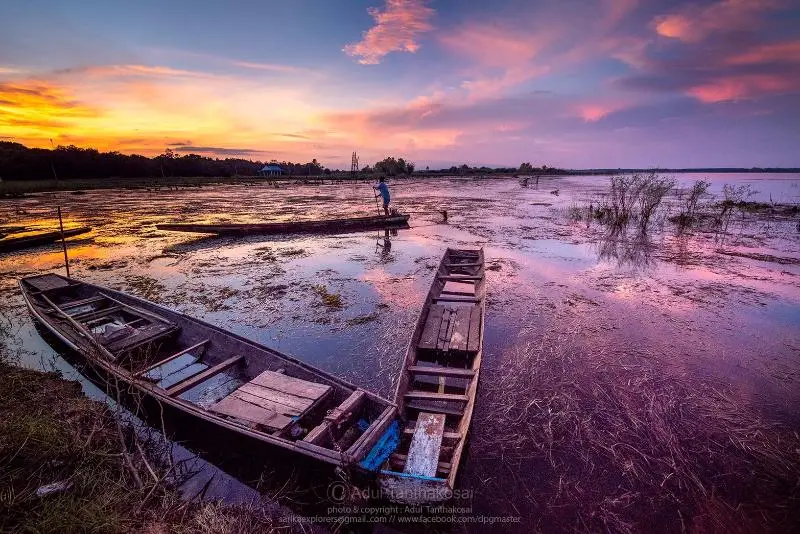
The most suitable time of day is early morning or late afternoon. In the morning, the light is gentle, the air is cooler, and birds are more likely to be active. In the evening, the wetland becomes peaceful, with warm light reflecting on the water surface. Although the general wetland area can be visited daily, 06.00 to 18.00 is the most suitable and safest visiting period for ordinary travelers. Daylight makes it easier to see trails, water edges, vegetation, and local access points clearly.
Activities at Nong Kut Thing are simple but meaningful. Visitors can walk or stop along safe lakeside viewpoints, observe wetland scenery, watch birds, photograph sunrise or sunset, look at aquatic plants, learn about local fisheries, and see rural life around the water. In some periods, local boat services or community-based activities may be available, depending on water levels and local conditions. The best way to experience Nong Kut Thing is not to rush. The longer visitors observe quietly, the more they will notice: birds feeding, fish movement, floating plants, changing light, and the rhythm of community life.
For photographers, Nong Kut Thing offers a wide range of natural compositions. Wide-angle scenes can capture open water, sky, vegetation, and reflections. Telephoto shots can capture birds, boats, buffalo, or details of aquatic life. The most rewarding photographs often come from waiting rather than chasing subjects. Bird photographers should keep a safe distance, avoid loud movement, and never disturb birds for the sake of a photo. Travelers photographing local people should also be respectful and avoid intrusive close-up shots without permission.
For families, Nong Kut Thing can function as an outdoor learning space. Children can learn what a wetland is, why birds migrate, how fish and plants depend on water, and why clean natural areas matter. Parents should supervise children closely near the water because wetland edges can be uneven, muddy, or slippery. Children should not run near the water, throw objects into the wetland, or disturb birds and fish. A visit here can teach environmental respect in a direct and practical way.
For older travelers or visitors who prefer an easy trip, Nong Kut Thing is suitable for scenic viewing and gentle nature observation rather than strenuous activity. Bringing a hat, drinking water, mosquito repellent, binoculars, and comfortable footwear will make the visit easier. Visitors should choose safe viewpoints, avoid overgrown or muddy edges, and avoid walking into areas where the ground is unclear. Because this is a natural wetland rather than a fully built tourist complex, simple preparation makes the experience more comfortable.
Nong Kut Thing can easily be combined with attractions in Bueng Kan town because it is only about 5 kilometers from the city area. Travelers can begin the morning at the wetland, return to town for food, visit Chao Mae Song Nang Shrine, walk along the Mekong riverfront, or visit Wat Photharam to pay respect to Luangpho Phra Yai. With more time, they can continue to Wat Ahong Silawas, Kaeng Ahong, Hin Sam Wan, or Phu Sing. This makes Nong Kut Thing a practical starting point for a nature-and-culture route in Bueng Kan.
Hin Sam Wan and Phu Sing are especially good nearby destinations to combine with Nong Kut Thing. The wetland offers flat water scenery and ecological richness, while Hin Sam Wan offers dramatic sandstone formations and high viewpoints. Seeing both places in one itinerary gives travelers a broader understanding of Bueng Kan’s landscape: wetlands, river systems, sandstone hills, forested areas, and local communities. Travelers with one full day can visit Nong Kut Thing in the morning and Phu Sing later in the day. Travelers with more time can add Bueng Khong Long, Naka Cave, or Phu Thok to a wider Bueng Kan route.
Food options are easiest to find in Bueng Kan town and along the Mekong riverside area. After visiting Nong Kut Thing, travelers can return to town for Isan food, Thai food, fish dishes, riverside restaurants, cafés, or family-style eateries. Local food often pairs well with a nature-based trip, especially grilled fish, spicy salads, soups, and northeastern dishes. Since attractions around Bueng Kan are spread out, it is best to plan meals according to the day’s route rather than drive back and forth unnecessarily.
Accommodation is also most convenient in Bueng Kan town or near the Mekong riverside. Staying in town allows easy access to Nong Kut Thing in the early morning while still being close to restaurants, markets, convenience stores, and other attractions. Travelers planning to continue toward Bueng Khong Long or Naka Cave can stay in Bueng Kan for one night and move onward the next day. Choosing accommodation based on the actual itinerary will make the trip smoother, especially for travelers using a private car or rental vehicle.
Safety around the wetland should not be overlooked. Nong Kut Thing has varying depths, from shallow edges to deeper water. Ground conditions near the water may be muddy or slippery, especially after rain. Visitors should not swim in unmanaged areas and should not enter dense vegetation or conservation zones. If using a boat, they should choose local operators familiar with the wetland and follow safety instructions. The goal is to enjoy the wetland without creating risks for oneself, local people, or wildlife.
Responsible travel is essential at a Ramsar wetland. Visitors should not litter, should not leave food waste, should not collect plants, should not catch aquatic animals, and should not disturb birds. Plastic bags, bottles, food containers, fishing line, and other waste can harm fish, birds, and water quality. Carrying rubbish out of the area is a basic but important action. Nong Kut Thing remains beautiful and ecologically valuable only when visitors, local residents, and caretakers help protect it together.
The deeper value of Nong Kut Thing is that it shows how a wetland can be many things at once: a habitat, a water reservoir, a food source, a community landscape, a birdwatching site, and a place of international ecological importance. It does not need large buildings or entertainment facilities to be meaningful. Its strength lies in water, biodiversity, silence, and the relationship between people and nature. For travelers who slow down and observe carefully, Nong Kut Thing offers one of the clearest views of Bueng Kan’s natural character.
Getting There is easiest by private car, rental car, or motorcycle. From Bueng Kan town, drive south toward Non Sombun Subdistrict for about 5 kilometers and follow local access roads toward the wetland area around Ban Don Kaeo and nearby communities. Travelers arriving from other provinces should first navigate to Bueng Kan town, then continue to Nong Kut Thing. Having a private vehicle is the most convenient option because it allows flexible timing for sunrise, sunset, birdwatching, and nearby attractions such as Wat Photharam, Chao Mae Song Nang Shrine, Wat Ahong Silawas, Hin Sam Wan, Phu Sing, and Bueng Khong Long.
In summary, Nong Kut Thing is a major wetland destination in Bueng Kan Province that deserves careful and respectful travel. With an area of about 22,000 rai, depths of about 2 to 10 meters, rich aquatic life, more than 200 species of wetland plants, over 40 species of birds, and Ramsar recognition as Thailand’s 11th Wetland of International Importance, it is far more than a scenic pond near the city. It is a living ecological landscape that connects water, wildlife, local livelihoods, and conservation. For foreign travelers seeking a quieter and more meaningful experience in northeastern Thailand, Nong Kut Thing is a valuable stop on any Bueng Kan itinerary.
| Name | Nong Kut Thing |
| Location | Non Sombun Subdistrict, Mueang Bueng Kan District, Bueng Kan Province, Thailand |
| Address | Nong Kut Thing Wetland Area, Non Sombun Subdistrict, Mueang Bueng Kan District, Bueng Kan Province 38000 |
| Coordinates | 18.30130, 103.66733 |
| Highlights | Thailand’s 11th Ramsar wetland, large freshwater marsh near Bueng Kan town, birdwatching area, aquatic plant habitat, local fisheries, and ecotourism landscape |
| History | An important wetland of Bueng Kan Province designated as Thailand’s 11th Wetland of International Importance under the Ramsar framework |
| Name Origin | “Kut” refers to a place where water from streams gathers into a pond or marsh, while “Thing” is believed to relate to wild gaur, suggesting a water source once associated with wildlife |
| Distinctive Features | Approximately 22,000 rai in size, about 2 – 10 meters deep, butterfly-wing shape from above, more than 250 aquatic species, over 200 aquatic plant species, and over 40 bird species |
| Travel Information | From Bueng Kan town, drive south toward Non Sombun Subdistrict for about 5 km. Private car, rental car, or motorcycle is the most convenient option |
| Current Status | Open as a natural wetland, local water body, and ecotourism attraction in Bueng Kan Province |
| Open Days | Daily |
| Opening Hours | 06.00 – 18.00 |
| Fees | No general admission fee |
| Facilities | Local access roads, natural viewing points, nearby community areas, and restaurants/accommodations in Bueng Kan town |
| Main Areas / Zones | Open water area, aquatic plant zones, birdwatching areas, wetland viewpoints, Ban Don Kaeo community area, local fishing zones, and water-system connections near the Mekong River |
| Caretaker | Non Sombun Subdistrict Municipality, Mueang Bueng Kan District, Bueng Kan Province, with related local and natural resource agencies |
| Main Contact Number | Non Sombun Subdistrict Municipality, Tel. 0-4249-2859 |
| Official Website / Official Page | Non Sombun Subdistrict Municipality Website: bknonsomboon.go.th |
| Nearby Tourist Attractions | 1. Chao Mae Song Nang Shrine, Bueng Kan, about 7 km 2. Wat Photharam / Luangpho Phra Yai, Ban Tha Khrai, about 8 km 3. Bueng Kan Mekong Riverside And Town Area, about 8 km 4. Wat Ahong Silawas / Kaeng Ahong, about 25 km 5. Hin Sam Wan, Phu Sing, about 30 km 6. Phu Sing Viewpoint, about 32 km 7. Tham Phra Waterfall, about 65 km |
| Nearby Restaurants | 1. Riverside Restaurant&Bar Bungkan, about 8 km 2. Krua Khun Yai, about 8 km, Tel. 042-491-772 3. The King Kong Bueng Kan, about 8 km 4. Krua Lang Ban Made-To-Order Food Bueng Kan, about 8 km, Tel. 096-382-1879 5. Som Tam Yai Jai Phan Lam, about 12 km, Tel. 087-713-6191 6. Bueng Kan Mekong Riverside Restaurant Zone, about 8 km |
| Nearby Accommodations | 1. The One Hotel Bueng Kan, about 8 km 2. BK Place Hotel, about 8 km, Tel. 095-670-5595 3. The Wisdom Residence Bueng Kan, about 8 km, Tel. 042-086-977 4. Surocha Hotel & Resort, about 9 km 5. Retro 77 Bueng Kan, about 8 km 6. Kongkhamkoon Hotel, Pak Khat District, about 45 km, Tel. 089-712-8598 |
Frequently Asked Questions (FAQ)
Q: Is Nong Kut Thing in Nong Khai or Bueng Kan?
A: Nong Kut Thing is now in Non Sombun Subdistrict, Mueang Bueng Kan District, Bueng Kan Province. Older references to Nong Khai come from the period before Bueng Kan became a separate province.
Q: Is Nong Kut Thing open every day?
A: Yes. The general wetland area is open daily, and the most suitable visiting time is 06.00 to 18.00.
Q: Is there an entrance fee for Nong Kut Thing?
A: There is no general admission fee for the main public wetland area. Local boat or community activities, if available, may have separate service charges.
Q: What is special about Nong Kut Thing?
A: It is Thailand’s 11th Ramsar wetland, a large freshwater marsh near Bueng Kan town with rich aquatic life, wetland plants, resident birds, migratory birds, and local fishing culture.
Q: When is the best time to visit Nong Kut Thing?
A: Early morning and late afternoon are best for scenery, photography, and birdwatching. The cool season and the period from late rainy season to early cool season are especially pleasant.
Q: Is Nong Kut Thing good for birdwatching?
A: Yes. The wetland is suitable for birdwatching because it supports resident and migratory birds. Visitors should use binoculars or a telephoto lens and avoid approaching birds too closely.
Q: What nearby attractions can be combined with Nong Kut Thing?
A: Travelers can combine it with Wat Photharam, Chao Mae Song Nang Shrine, Bueng Kan riverside, Wat Ahong Silawas, Hin Sam Wan, and Phu Sing.
Q: Who manages Nong Kut Thing?
A: The area is under Non Sombun Subdistrict Municipality, Mueang Bueng Kan District, Bueng Kan Province, together with related local and natural resource agencies.
 Category: ●Nature and Wildlife
 Group: ●Dam, Reservoir, Lake
Last Update : 2 MonthAgo
 Last Update : 2 MonthAgo
 Click to Access the Navigation Map GPS
 Art, Culture and Heritage
 Historical Sites and Monuments(1)
 Landmarks and Memorials(2)
 Art, Craft Centres, Tradition(1)
 Educational Places
 Educational Gardens, Farm(1)
 Places of Worship
 Temple(16)
 Mosque(1)
 Other Sacred Sites(8)
 Suburban Living
 Village, Community(3)
 Local Market(4)
 National Parks and Marine Reserves(2)
Dam, Reservoir, Lake(2)
National Parks and Marine Reserves(2)
Dam, Reservoir, Lake(2)
 Waterfalls(4)
 River, Canal(8)
 Bays and Beaches(1)
 Entertainment and Agricultural
 Farms, Parks and Ecotourism(2)
 Shopping
 Shopping and Night Market(1)


