
lovethailand home >Northeastern Travel Attractions >Nong Khai Travel Attractions >Si Chiang Mai >Phra Phut Bat > Wang Nam Mok Waterfall
TL;DR: Wang Nam Mok Waterfall is located at Ban Wang Nam Mok, Village No. 5, Phra Phutthabat Subdistrict, Si Chiang Mai District, Nong Khai Province, Thailand, open Daily, hours Monday – Friday And Sunday 08.00 – 16.00 / Saturday 07.00 – 16.00.
Wang Nam Mok Waterfall
Open Days: Daily
Opening Hours: Monday – Friday And Sunday 08.00 – 16.00 / Saturday 07.00 – 16.00
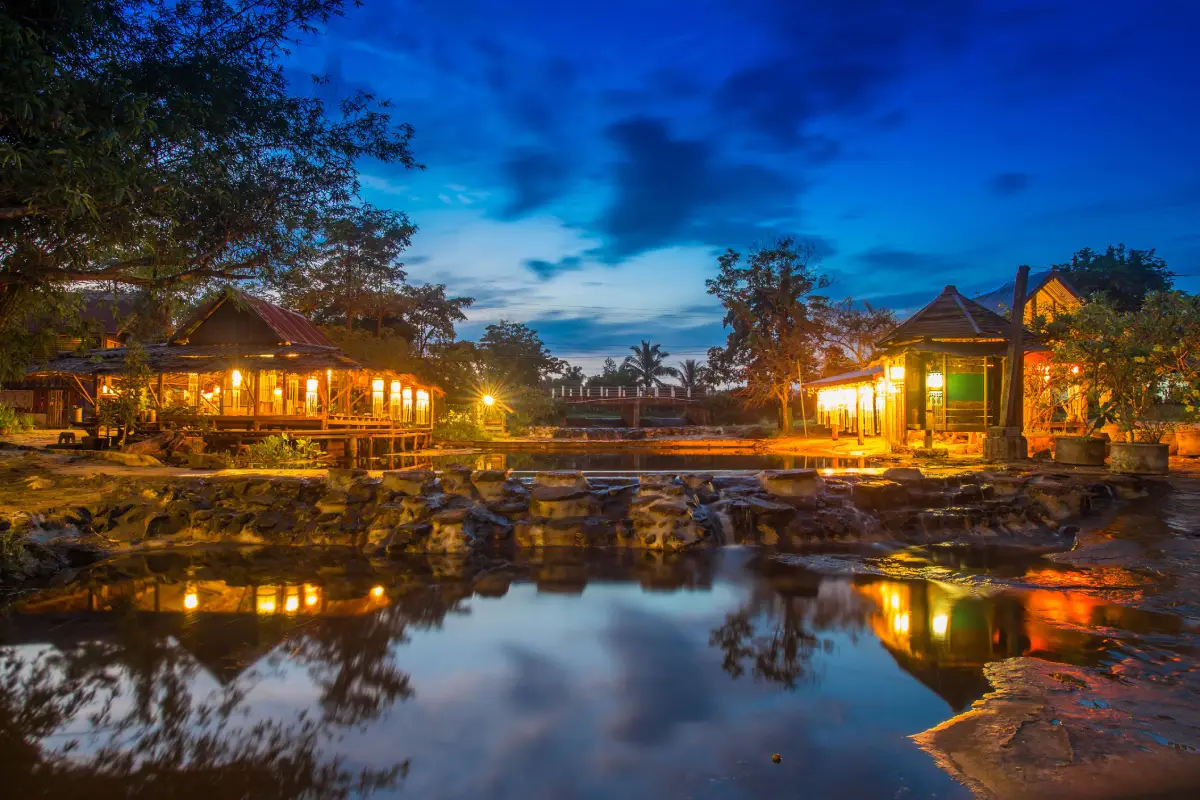
Wang Nam Mok Waterfall in Nong Khai Province is a nature-based and community-based destination located in Ban Wang Nam Mok, Village No. 5, Phra Phutthabat Subdistrict, Si Chiang Mai District. The waterfall sits within a forested community landscape surrounded by hills, streams, rock terraces, and local farming areas. It is known for its accessible natural setting, where visitors can drive close to the waterfall without a long trek. During the rainy season, water flows over unusual rock formations and down into a broad natural pool and stone platform below, making it suitable for relaxing, playing in the water, photographing nature, and experiencing the quiet atmosphere of a rural Thai community.
Some travel descriptions mention Wang Nam Mok Waterfall in connection with Sangkhom District because the access route follows Highway 211 toward Sangkhom and passes near Wat Hin Mak Peng. The actual location of the waterfall and the nearest community, however, is in Phra Phutthabat Subdistrict, Si Chiang Mai District, Nong Khai Province. This position makes the destination especially interesting for travelers following the Mekong riverside route between Nong Khai, Tha Bo, Si Chiang Mai, and Sangkhom. A visit combines river scenery, mountain roads, forested areas, rural settlements, and community tourism in one route.
Wang Nam Mok Waterfall is not a large commercial waterfall park. Its charm comes from its natural simplicity and the way it is connected with the nearby village. The waterfall is about 30 meters high and flows across a distinctive rocky ridge and unusual cliff-like formations. The stream descends in small steps before reaching a larger lower pool and rock terrace. In the right season, visitors can enjoy the water and rest by the rocks under the shade of surrounding forest. The setting feels local, peaceful, and less crowded than many heavily developed tourist sites.
The best time to visit the waterfall is from June to October, when rainfall feeds the streams and the waterfall has a stronger flow. During this period, the forest is green, the rock surfaces are wet and fresh, and the lower pool becomes more attractive for resting and playing in the water. Late rainy season to early cool season is also pleasant because the air becomes more comfortable. In the dry season, the waterfall may have less water, but Ban Wang Nam Mok can still be visited for homestays, community activities, forest learning, local food, and quiet rural scenery.
The strength of Wang Nam Mok is not only the waterfall itself. The surrounding village is an important community tourism destination that developed from forest conservation and local self-management. The community forest around Phu Phi Pop and Phu Pak Paen covers about 3,500 rai and serves as the source of several streams. In the past, the area faced pressure from illegal logging and unsustainable use of forest resources. Local residents later worked together to restore and protect the forest, turning it into the foundation for ecotourism, homestay services, local food, and forest-based learning activities.
Ban Wang Nam Mok is now recognized for community-based tourism that connects nature, culture, food, and local knowledge. Visitors can stay in homestays, learn village life, walk through community forest trails, join nature study activities, cycle through farmland and river-view routes, observe local handicrafts, learn weaving, join food preparation, and experience warm local hospitality. These activities make the destination far more meaningful than a simple waterfall stop. Travelers are able to see how forest, water, livelihoods, food, and culture support one another.
The name “Wang Nam Mok” is believed to have developed from “Wang Nam Mok” or “Wang Nam Mok” in the sense of misty water, reflecting the cool and fertile natural environment of the area. The community began to form around 1964, when a small group of families moved into the area for farming. In 1969, Ban Wang Nam Mok was officially established as Village No. 5 of Phra Phutthabat Subdistrict, Si Chiang Mai District. The village history gives the waterfall and community a deeper local identity, making a visit here different from a place where travelers only stop for photos.
The natural environment around Ban Wang Nam Mok includes forest, hills, streams, agricultural land, and several waterways such as Huai Hin Siu, Huai Chang, Huai Thon, and Huai Tham Tao. The area is also associated with the upper Nam Thon royal development project. The local forest includes many useful plants and trees such as yang, pradu, chingchan, takhian, makha, teng rang, tabaek, bamboo, rattan, grasses, medicinal plants, and other forest species. Wildlife and forest animals reported in the broader community forest environment include wild boar, jungle fowl, squirrels, porcupines, monkeys, monitor lizards, and many kinds of birds.
For nature travelers, Wang Nam Mok is best experienced slowly. The sound of running water, the shape of the rocks, the humidity of the forest, the quiet village road, and the atmosphere of the homestay community all contribute to the experience. Visitors should bring footwear suitable for slippery ground, clothes that can get wet, a towel, drinking water, and a waterproof bag for important belongings. Even though access is easy, this is still a natural waterfall, so visitors should pay attention to water level, rock surfaces, and weather conditions.
Swimming or playing in the water should be done carefully. The waterfall and pool change according to rainfall. Rocks may be slippery, especially after rain. Children should be supervised closely at all times. Visitors should not jump into unknown pools, climb on unsafe rock edges, or enter the water when it is muddy, fast-moving, or unusually strong. A safe visit depends on reading the natural conditions rather than treating the waterfall as a controlled swimming pool.
One of the most memorable experiences at Ban Wang Nam Mok is staying in a community homestay. Homestay guests stay with local households, learn about daily life, share meals, and join community activities. This is suitable for travelers who want a deeper rural experience rather than a standard hotel stay. The accommodation is simple and local, but it offers something more valuable: direct contact with the community, local stories, fresh air, and a slower rhythm of travel.
The bai si su khwan welcoming ceremony is one of the community’s signature activities. It is performed to welcome visitors, bless them, and create a sense of friendship between hosts and guests. After the ceremony, travelers may join “sum khao laeng,” a shared evening meal with the community. Local dishes may include bamboo shoot curry, pineapple salad, crispy herb-fried fish, and seasonal forest or garden ingredients. These meals are not only food; they are part of the village’s way of expressing hospitality.
Food at Ban Wang Nam Mok reflects the relationship between forest, farmland, water, and household life. Bamboo shoots, herbs, local vegetables, fish, and seasonal ingredients are used in simple but distinctive dishes. Bamboo shoot curry carries the flavor of the forest. Pineapple salad gives a fresh sweet-sour character. Fried fish with herbs reflects the use of local ingredients in everyday cooking. Eating with villagers or as part of a homestay program helps foreign travelers understand the place through taste as well as scenery.
Nature study walks are another important part of the Wang Nam Mok experience. Community guides can explain plants, herbs, forest use, stream systems, and conservation practices. The walking routes are not only about reaching a viewpoint or waterfall. They are about learning how the forest supports village life as a water source, food source, herbal resource, and shared community responsibility. For travelers interested in community-based ecotourism, this is one of the strongest reasons to stay longer than a quick visit.
The village also has a distinctive cultural atmosphere. Ban Wang Nam Mok has traces of Lanna influence within an Isan setting, giving it a cultural identity that differs from many other northeastern villages. Local beliefs, festivals, village rituals, craft traditions, and hospitality practices reflect a blend of northeastern Thai and northern cultural elements. This makes the community appealing not only for nature lovers but also for travelers interested in local culture and living traditions.
Visitors may also see or join activities related to local crafts and household production. These include mat weaving, textile work, broom-making from local grasses, use of bamboo, forest product processing, and food preparation. Such activities show that community tourism is connected with household economies and local skills. It gives value to knowledge that has long existed in the village and helps create income without separating tourism from everyday life.
For photographers, Wang Nam Mok offers several types of scenes: flowing water over rocks, forest shade, unusual stone formations, village roads, homestay houses, community ceremonies, food preparation, and local crafts. Morning is suitable for softer light and fresh air. Afternoon can be useful for waterfall and community activity photos. When photographing people or ceremonies, visitors should ask for permission and behave respectfully. The best photographs here come from trust, patience, and genuine engagement with the place.
Wang Nam Mok Waterfall can be combined easily with Wat Hin Mak Peng, one of the important meditation temples along the Mekong in Nong Khai. The temple is connected with Luang Pu Thet Thetrangsi and is known for its peaceful riverside setting. A route combining Wang Nam Mok with Wat Hin Mak Peng allows travelers to experience both forest-waterfall nature and Mekong-side Buddhist culture. With more time, visitors can continue toward Sangkhom District, Wat Pha Tak Suea, the Nong Khai Skywalk, Than Thong Waterfall, and Phu Huai Isan.
Travel from Nong Khai town usually follows Highway 211 along the Mekong River through Tha Bo and Si Chiang Mai districts, then continues toward Sangkhom. Near Wat Hin Mak Peng, a side road leads into Ban Wang Nam Mok. From the main road junction, it is about 7 kilometers to the village and waterfall area. A private car, rental car, or hired van is the most practical choice because nearby attractions are spread along the riverside and mountain route.
From Si Chiang Mai town, the journey to Ban Wang Nam Mok is about 29 kilometers along the riverside road toward Sangkhom. From Sangkhom, travelers can drive back toward Si Chiang Mai and watch for the junction near Wat Hin Mak Peng. The route itself is part of the experience, with views of the Mekong, hills, local farms, and small communities. Travelers who enjoy scenic drives will find the road especially pleasant in the cool season and during the green months after rain.
Staying overnight in Ban Wang Nam Mok is the best way to understand the destination fully. Guests can experience the evening meal, community welcome, morning atmosphere, local stories, forest routes, and village life without rushing. Day-trip visitors can still enjoy the waterfall, local food, and nearby attractions, but an overnight stay gives a much fuller sense of the relationship between the waterfall, forest, and community.
Visitors should respect both nature and local life. Litter should not be left at the waterfall. Loud music should not be brought into forest areas. Plants, aquatic animals, and natural materials should not be collected without permission. When joining ceremonies or entering homes, travelers should dress and behave respectfully. Wang Nam Mok is a community-managed landscape, and responsible behavior helps local residents continue to protect the forest and welcome visitors in a sustainable way.
In summary, Wang Nam Mok Waterfall is one of the most meaningful nature-and-community destinations in Nong Khai Province. Its appeal lies in an accessible waterfall, a living community forest, homestays, local food, bai si su khwan ceremony, shared evening meals, forest walks, handicrafts, and a travel route connected with the Mekong. It is not the size of the waterfall that makes Wang Nam Mok special, but the completeness of the experience. For travelers who want a quieter and more culturally grounded view of northeastern Thailand, this is a destination worth at least half a day, and best experienced with an overnight homestay.
| Name | Wang Nam Mok Waterfall / Ban Wang Nam Mok |
| Location | Ban Wang Nam Mok, Village No. 5, Phra Phutthabat Subdistrict, Si Chiang Mai District, Nong Khai Province, Thailand |
| Address | No. 2, Village No. 5, Ban Wang Nam Mok, Phra Phutthabat Subdistrict, Si Chiang Mai District, Nong Khai Province 43130, Thailand |
| Coordinates | Wang Nam Mok Waterfall 17.993871, 102.374000 / Ban Wang Nam Mok Homestay 17.987341, 102.378083 |
| Highlights | Accessible community waterfall, forest setting, natural pool, homestay village, local food, bai si su khwan ceremony, shared evening meal, forest walk, and community-based ecotourism |
| History | Ban Wang Nam Mok began forming around 1964 and became Village No. 5 in 1969. The community later developed conservation-based tourism built around local forest, food, homestays, and cultural activities |
| Name Origin | The name Wang Nam Mok is connected with the idea of misty water, reflecting the cool, fertile, and misty natural setting of the village area |
| Distinctive Features | A waterfall about 30 meters high with unusual rock ridges, flowing stream, lower pool, stone terrace, forest shade, and the best water conditions from June to October |
| Travel Information | From Nong Khai town, follow Highway 211 through Tha Bo and Si Chiang Mai toward Sangkhom. Near Wat Hin Mak Peng, turn toward Ban Wang Nam Mok. The road from the junction to the waterfall area is about 7 km |
| Current Status | Open as a natural waterfall and community-based tourism destination of Ban Wang Nam Mok |
| Open Days | Daily |
| Opening Hours | Monday – Friday And Sunday 08.00 – 16.00 / Saturday 07.00 – 16.00 |
| Fees | No general admission fee for the waterfall area. Homestay, local meals, community activities, and guided tours are charged separately by the community package |
| Facilities | Road access to the waterfall, parking area, natural water-play area, community homestays, local meals, community guides, and forest-learning activities |
| Main Areas / Zones | Waterfall area, lower pool and stone terrace, Phu Phi Pop–Phu Pak Paen community forest, Ban Wang Nam Mok homestay zone, community visitor center, nature-study trails, local craft and food areas |
| Caretaker | Phra Phutthabat Subdistrict Administrative Organization and Ban Wang Nam Mok community tourism/homestay group |
| Main Contact Number | Ban Wang Nam Mok Tourism Group, Tel. 086-232-5300, 083-357-7035 / Phra Phutthabat SAO, Tel. 0-4241-4626 |
| Official Website / Official Page | Facebook: Wang Nam Mok |
| Nearby Tourist Attractions | 1. Ban Wang Nam Mok Homestay, about 2 km 2. Wat Hin Mak Peng, about 8 km 3. Upper Nam Thon Royal Development Project Area, about 3 km 4. Than Thong Waterfall, Sangkhom District, about 25 km 5. Lan Boeng Wiang, Si Chiang Mai, about 29 km 6. Wat Pha Tak Suea / Nong Khai Skywalk, about 38 km 7. Phu Huai Isan, about 42 km |
| Nearby Restaurants | 1. Ban Wang Nam Mok Local Food, about 2 km, Tel. 086-232-5300, 083-357-7035 2. Khong Eyes Restaurant, Si Chiang Mai District, about 28 km, Tel. 089-474-3428 3. Berng Khong Restaurant, about 29 km, Tel. 083-140-3154 4. Kaokuek Cafe, Si Chiang Mai District, about 29 km, Tel. 042-451-206 5. Sunflower Restaurant, Sangkhom District, about 30 km 6. Kin Im Rim Khong Restaurant, Sangkhom District, about 30 km, Tel. 084-339-0957 |
| Nearby Accommodations | 1. Ban Wang Nam Mok Homestay, about 2 km, Tel. 086-232-5300, 083-357-7035 2. Khongeyes Resort And Spa, Si Chiang Mai District, about 28 km, Tel. 095-181-4111 3. Panwiman Resort, Si Chiang Mai District, about 30 km, Tel. 089-619-0666 4. Chom Khong Resort, Sangkhom District, about 30 km, Tel. 081-739-2042, 042-441-143 5. Wixky Hotel, Sangkhom District, about 31 km, Tel. 094-435-5079 6. Baan Tawan Yim, Sangkhom District, about 35 km, Tel. 094-257-9393 7. Bann Loft Cafe & Resort, about 38 km, Tel. 091-050-4425 |
Frequently Asked Questions (FAQ)
Q: Where is Wang Nam Mok Waterfall located?
A: Wang Nam Mok Waterfall is located in Ban Wang Nam Mok, Village No. 5, Phra Phutthabat Subdistrict, Si Chiang Mai District, Nong Khai Province, along the route toward Sangkhom District.
Q: Is Wang Nam Mok Waterfall open every day?
A: Yes. It is open daily. The opening hours are Monday to Friday and Sunday from 08.00 to 16.00, and Saturday from 07.00 to 16.00.
Q: Is there an entrance fee for Wang Nam Mok Waterfall?
A: There is no general admission fee for the waterfall area. Homestay stays, local meals, community activities, and guided tours are charged separately by the community package.
Q: When is the best time to visit Wang Nam Mok Waterfall?
A: June to October is the best period because the waterfall has more water, the forest is green, and the natural pool is more suitable for relaxing.
Q: Can cars reach Wang Nam Mok Waterfall?
A: Yes. Cars can reach the waterfall area without a long walk. From the junction near Wat Hin Mak Peng, the route into Ban Wang Nam Mok and the waterfall area is about 7 kilometers.
Q: Are there homestays at Ban Wang Nam Mok?
A: Yes. The community offers homestays for travelers who want to stay overnight, learn village life, eat local food, join the bai si su khwan ceremony, and take part in forest-learning activities.
Q: What nearby attractions can be combined with Wang Nam Mok Waterfall?
A: Travelers can combine it with Wat Hin Mak Peng, Than Thong Waterfall, Lan Boeng Wiang, Wat Pha Tak Suea, Nong Khai Skywalk, and Phu Huai Isan.
Q: Who should travelers contact for homestays or community activities?
A: Travelers can contact the Ban Wang Nam Mok Tourism Group at 086-232-5300 or 083-357-7035, or Phra Phutthabat Subdistrict Administrative Organization at 0-4241-4626.
 Category: ●Nature and Wildlife
 Group: ●Waterfalls
Last Update : 4 WeekAgo
 Last Update : 4 WeekAgo
 Click to Access the Navigation Map GPS
Wang Nam Mok Waterfall Map
Recommend

 Art, Culture and Heritage
 Historical Sites and Monuments(1)
 Landmarks and Memorials(2)
 Art, Craft Centres, Tradition(1)
 Educational Places
 Educational Gardens, Farm(1)
 Places of Worship
 Temple(16)
 Mosque(1)
 Other Sacred Sites(8)
 Suburban Living
 Village, Community(3)
 Local Market(4)
 National Parks and Marine Reserves(2)
 Dam, Reservoir, Lake(2)
Waterfalls(4)
Dam, Reservoir, Lake(2)
Waterfalls(4)
 River, Canal(8)
 Bays and Beaches(1)
 Entertainment and Agricultural
 Farms, Parks and Ecotourism(2)
 Shopping
 Shopping and Night Market(1)


