
lovethailand home >Northeastern Travel Attractions >Nong Khai Travel Attractions >Bueng Kan >Bueng Kan > Laos Market
TL;DR: Laos Market is located at Rim Bueng Yai Road, Mueang Bueng Kan District, Bueng Kan Province 38000, Thailand, open Tuesday And Friday, hours 06.00 – 12.00.
Laos Market
Open Days: Tuesday And Friday
Opening Hours: 06.00 – 12.00
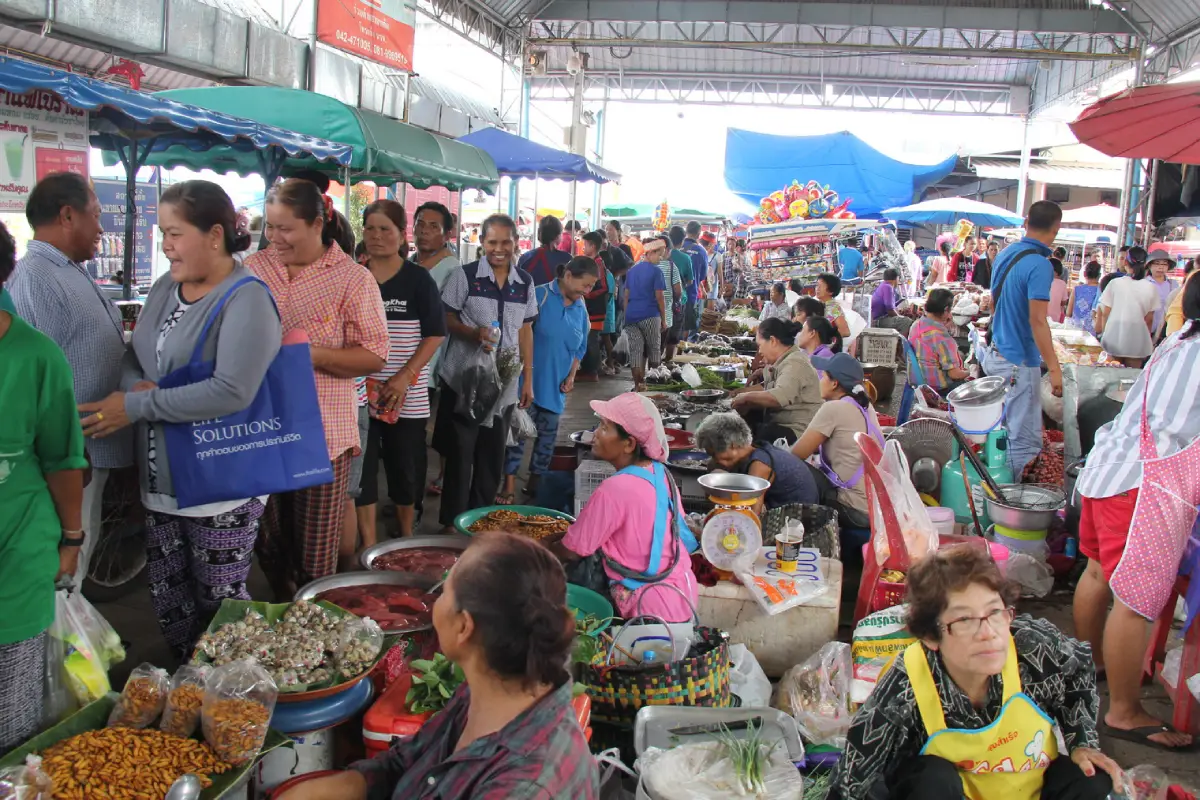
Lao Market in Bueng Kan, often searched under the older name Lao Market Nong Khai, is a lively morning market along the Mekong River in Mueang Bueng Kan District, Bueng Kan Province. The market is also known as Thai–Lao Market because it brings together Thai and Lao vendors in one riverside trading area. It opens only on Tuesdays and Fridays from 06.00 to 12.00, making timing very important for travelers who want to experience the market at its best. This is not a modern tourist shopping complex, but a real local morning market where people come to buy fresh vegetables, dried food, river fish, seasonal forest products, local ingredients, clothes, household items, and ready-to-eat breakfast food. Its value lies in the way it reflects daily life along the Thai–Lao Mekong border.
The name “Lao Market” comes from the market’s most recognizable character: many vendors from the Lao side of the Mekong traditionally bring their products to sell here. These include local vegetables, herbs, bamboo shoots, mushrooms, fish, frogs, small river animals, dried foods, and other seasonal ingredients that are part of everyday cooking in Mekong communities. The official tourism name is Thai–Lao Market, but local people and travelers often use the shorter name Lao Market because the presence of Lao vendors gives the place its identity.
Some travelers still search for this place as Lao Market Nong Khai because Bueng Kan was formerly part of Nong Khai Province. Since 2011, Bueng Kan has been a separate province, and the market is now located in Mueang Bueng Kan District, Bueng Kan Province. This distinction matters for trip planning. The market is not in Nong Khai town. It belongs to a Bueng Kan travel route, and visitors should plan accommodation and transportation around Bueng Kan if they want to arrive early enough to enjoy the morning market.
The market is located around Rim Bueng Yai Road near the Mekong riverside area in Bueng Kan town. The surrounding atmosphere is calm in the early morning, with the river landscape close by and local residents beginning their day. Stalls are arranged in a simple market style, with fresh produce, fish, herbs, dried goods, and local food placed on tables, mats, or low displays. The market is not heavily staged for tourism. It functions as a real weekly market for local people, which makes it especially interesting for travelers who want to see authentic border-town life.
One of the strongest reasons to visit Lao Market is food culture. This market shows how Thai Isan and Lao food traditions overlap along the Mekong. Travelers can see ingredients that are rarely found in ordinary city markets: local herbs, seasonal greens, bamboo shoots, mushrooms, river fish, grilled fish, preserved ingredients, sticky rice, spicy dips, wild vegetables, and simple breakfast dishes prepared by local vendors. The products change with the season, so the market can feel different at different times of the year.
The market is especially suitable for travelers interested in local ingredients. In many tourist destinations, food is experienced only as a finished dish in restaurants. At Lao Market, visitors can see the ingredients before they become meals. Fish from the Mekong, vegetables from nearby communities, dried foods from household production, and seasonal products from forest or riverside areas are all part of the market’s identity. This gives the place educational value as well as cultural value.
The walking distance of the market area is about 500 meters, which makes it comfortable for a slow morning visit. Most visitors can spend 1 to 2 hours walking through the stalls, tasting local snacks, taking photos, and observing everyday trade. Those who enjoy photography should arrive early, when the market is active and the light is soft. Those who want to buy fresh food should also come early because some items sell out quickly, especially river fish, local vegetables, and seasonal ingredients.
The market is open only on Tuesdays and Fridays. Visitors who arrive on other days will not see the full market atmosphere. The surrounding town and riverside area can still be visited, but the true Lao Market experience depends on coming on the correct market day. The most active period is early morning. By late morning, many vendors begin to close or have already sold their main products. For the best experience, plan to arrive between 06.00 and 09.00.
Lao Market is suitable for several types of travelers. Cultural travelers can observe the everyday relationship between Thai and Lao communities. Food travelers can learn about local ingredients and border cuisine. Photographers can capture morning market scenes, river-town life, produce stalls, and people buying food. Foreign visitors can see a side of northeastern Thailand that is very different from large cities and mainstream tourist areas. Families can also visit, as the market is easy to walk through and offers many simple food experiences.
The cultural importance of Lao Market comes from its role as a meeting place between two sides of the Mekong. National borders divide Thailand and Laos politically, but daily life along the river has always involved trade, food exchange, language, kinship, and shared habits. A market like this shows that relationship in a very practical way. People do not need formal ceremonies to express cross-border connection. They do it through selling vegetables, buying fish, choosing herbs, bargaining politely, and preparing food for the family kitchen.
For travelers exploring Bueng Kan, Lao Market is a strong starting point. After visiting the market in the morning, visitors can continue to Wat Photharam at Ban Tha Khrai, where the revered Luang Pho Phra Yai Buddha image is enshrined, or visit Nong Kut Ting, an important wetland area near town. Other nearby places include the Living Community Museum, the riverside walking area, Chao Mae Song Nang Shrine, Wat Ahong Silawat, and Kaeng Ahong, widely known as the Navel of the Mekong. A good route can begin with Lao Market in the morning, continue with local lunch, visit temples or wetlands in the afternoon, and end with the Mekong riverside in the evening.
Getting There is easiest by private car, rental car, tuk-tuk, or local hired vehicle within Bueng Kan town. Travelers staying in the town center or near the Mekong riverside can reach the market without difficulty. Those coming from Nong Khai or Udon Thani should plan carefully because the market opens early and only twice a week. Staying overnight in Bueng Kan is the most practical choice for travelers who want to experience the market at the right time without rushing.
There is no admission fee for Lao Market. Visitors can walk around freely and pay only for food, drinks, fresh ingredients, souvenirs, or transportation. This makes it a budget-friendly attraction, but the experience is richer than a simple shopping stop. The market offers direct contact with community life, local food culture, and Mekong border trade. Travelers who enjoy meaningful local experiences will find it more rewarding than a typical souvenir market.
Visitors should follow basic market etiquette. Always ask before photographing people or individual stalls. Avoid touching fresh products without permission. Bargain politely when appropriate, but remember that many vendors are small local sellers. Keep the walking paths clear, watch for motorcycles and handcarts, and be careful when carrying drinks or food in crowded areas. Respectful behavior helps preserve the friendly atmosphere between visitors and the local community.
Lao Market also reveals the local economy at a small but important scale. Many products sold here come from households, small farms, local fishing, seasonal gathering, and small-scale food preparation. Buying from the market supports local sellers more directly than buying from large retail stores. This is one reason the market remains meaningful for both residents and travelers. It is not only a place to shop; it is a living economic space for border communities.
Seasonality is another part of the market’s charm. Different ingredients appear at different times of the year depending on rain, river conditions, forests, gardens, and local harvests. In some seasons, visitors may find bamboo shoots and mushrooms. In others, river fish or wild vegetables may be more visible. This changing rhythm makes the market feel alive and gives repeat visitors a different experience each time.
Compared with famous tourist markets in larger cities, Lao Market is simpler, quieter, and more grounded in everyday life. That simplicity is its strength. Visitors can see how people really buy food, how ingredients are arranged, how vendors communicate with buyers, and how the Mekong region’s food culture remains part of daily routines. The market does not need elaborate decoration to be memorable. Its authenticity comes from ordinary life.
For foreign travelers, Lao Market is one of the clearest places to understand Mekong border life in Bueng Kan. Even without many English signs, the experience is easy to follow through observation. The fresh vegetables, river fish, food stalls, Lao and Thai vendors, morning rhythm, and nearby riverfront all communicate the identity of the place. Travelers who take time to walk slowly, observe respectfully, and try local food will understand Bueng Kan more deeply.
Accommodation in Bueng Kan town makes visiting the market much easier. Several hotels and guesthouses are located within a short drive of the market area, including riverside hotels, city hotels, and budget accommodation. Staying in town allows travelers to wake up early, visit the market, return to rest, and continue the day with other attractions. This is the most comfortable approach for visitors who want to enjoy the market properly.
If visiting on a Friday, Lao Market can be combined with Bueng Kan Walking Street in the evening. This creates a full-day experience of local life in two different moods. In the morning, the city shows its traditional market side through fresh ingredients and community trade. In the evening, the riverside becomes a leisure space with food, walking, and a relaxed social atmosphere. Together, they show why Bueng Kan is a small but culturally rich Mekong city.
Lao Market in Bueng Kan is therefore a worthwhile destination for travelers who want to experience Thailand beyond famous landmarks. It tells the story of river trade, local ingredients, food traditions, small community economies, and Thai–Lao connection through everyday market life. For anyone seeking an authentic morning market along the Mekong, this is one of the most meaningful places to visit in Bueng Kan.
| Name | Lao Market Bueng Kan / Thai–Lao Market / Lao Market Nong Khai |
| Location | Rim Bueng Yai Road, Mueang Bueng Kan District, Bueng Kan Province 38000, Thailand |
| Address | Around Rim Bueng Yai Road near the Mekong riverside area, Bueng Kan / Wisit Subdistrict, Mueang Bueng Kan District, Bueng Kan Province |
| Highlights | A morning Mekong riverside market where Thai and Lao vendors sell local vegetables, fresh food, dried food, Mekong river fish, seasonal forest products, clothes, and household items |
| History / Importance | A morning market in Mueang Bueng Kan that reflects trade and everyday life between Thai and Lao communities along the Mekong. Bueng Kan was formerly part of Nong Khai Province before becoming a separate province in 2011 |
| Name Origin | The market is called Lao Market because many Lao vendors traditionally bring local goods and food ingredients to sell together with Thai vendors |
| Distinctive Features | An authentic early morning border-town market with seasonal produce, local ingredients, Isan–Lao food culture, and a natural community atmosphere |
| Travel Information | Accessible by private car, rental car, tuk-tuk, or local hired vehicle from Bueng Kan town. Staying in town is recommended for travelers who want to arrive early |
| Current Status | Open as a morning market in Bueng Kan town on Tuesdays and Fridays |
| Open Days | Tuesday And Friday |
| Opening Hours | 06.00 – 12.00 |
| Fees | No admission fee |
| Facilities | Nearby parking areas, breakfast food stalls, local shops, market walking area, and nearby Mekong riverside area |
| Main Areas / Zones | Local Vegetable Zone, Fresh Food Zone, Mekong River Fish Zone, Dried Food Zone, Seasonal Forest Product Zone, Clothing And Household Goods Zone, Breakfast Food Zone, Rim Bueng Yai Market Walk, and nearby Mekong Riverside Area |
| Caretaker | Bueng Kan Municipality, Mueang Bueng Kan District, Bueng Kan Province |
| Main Contact Number | Bueng Kan Municipality, Tel. 042-490-878 |
| Nearby Tourist Attractions | 1. Bueng Kan Walking Street And Mekong Riverside Area, about 1 km 2. Chao Mae Song Nang Shrine And Bueng Kan City Pillar Shrine, about 1 km 3. Wat Photharam, Ban Tha Khrai, Luang Pho Phra Yai, about 5 km 4. Nong Kut Ting Wetland, about 6 km 5. Living Community Museum Bueng Kan, about 7 km 6. Wat Ahong Silawat / Kaeng Ahong, Navel Of The Mekong, about 21 km, Tel. 042-492-321 7. Thai–Lao Friendship Bridge No. 5, about 12 km |
| Nearby Restaurants | 1. Riverside Restaurant&Bar Bungkan, about 1 km, Tel. 042-082-082, 087-222-9899 2. Steak Rim Khong, about 1 km, Tel. 096-587-4256 3. PP Som Tum Rim Khong, about 1 km, Tel. 093-541-4990 4. Rim Khong Restaurant, about 1 km, Tel. 094-285-6322 5. Dee Na Shabu, about 2 km, Tel. 090-295-6395 6. Chakangrao Ahan Tam Sang Bueng Kan, about 2 km, Tel. 098-827-5099, 081-263-6299 7. Krua Rim Khong Bueng Kan, about 2 km, Tel. 061-056-8964 |
| Nearby Accommodations | 1. Maenam Hotel Bueng Kan, about 1 km, Tel. 042-491-051, 042-491-052 2. Rachavadee Residence, about 1 km, Tel. 089-836-4498 3. Yuu Sabai Bueng Kan, about 2 km, Tel. 091-371-4449 4. Finn Hotel, about 2 km, Tel. 091-061-3888 5. The One Hotel Bueng Kan, about 3 km, Tel. 042-492-234 6. BK Place Hotel, about 3 km, Tel. 082-495-2125 7. Tosaeng Pruksa Hotel, about 3 km |
Frequently Asked Questions (FAQ)
Q: What days is Lao Market in Bueng Kan open?
A: Lao Market opens only on Tuesdays and Fridays. It is a morning market, so visitors should arrive early for the best atmosphere.
Q: What time does Lao Market open?
A: The market opens from 06.00 to 12.00. The best time to visit is between 06.00 and 09.00 when fresh food, vegetables, and breakfast items are still widely available.
Q: Is Lao Market in Nong Khai or Bueng Kan?
A: The market is currently in Mueang Bueng Kan District, Bueng Kan Province. Some people still search for it as Lao Market Nong Khai because Bueng Kan was formerly part of Nong Khai Province before becoming a separate province in 2011.
Q: What can visitors buy at Lao Market?
A: Visitors can buy local vegetables, fresh food, dried food, Mekong river fish, frogs, bamboo shoots, mushrooms, seasonal forest products, clothes, household items, and Thai–Lao local food.
Q: Is there an admission fee?
A: No. There is no admission fee. Visitors pay only for food, drinks, fresh ingredients, souvenirs, or transportation.
Q: Is Lao Market suitable for foreign travelers?
A: Yes. It is a good place for foreign travelers to experience Mekong border life, Thai–Lao food culture, local trade, and an authentic morning market atmosphere.
Q: What attractions can be visited after Lao Market?
A: Nearby attractions include Bueng Kan Walking Street, Chao Mae Song Nang Shrine, Wat Photharam at Ban Tha Khrai, Nong Kut Ting, the Living Community Museum, and Wat Ahong Silawat.
Q: What should visitors prepare before going?
A: Arrive early, bring small cash, carry a reusable bag, be careful when buying fresh food, and ask permission before taking photos of people or individual stalls.
 Category: ●Suburban Living
 Group: ●Local Market
Last Update : 2 MonthAgo
 Last Update : 2 MonthAgo
Recommend

 Art, Culture and Heritage
 Historical Sites and Monuments(1)
 Landmarks and Memorials(2)
 Art, Craft Centres, Tradition(1)
 Educational Places
 Educational Gardens, Farm(1)
 Places of Worship
 Temple(16)
 Mosque(1)
 Other Sacred Sites(8)
 Village, Community(3)
Local Market(4)
Village, Community(3)
Local Market(4)
 Nature and Wildlife
 National Parks and Marine Reserves(2)
 Dam, Reservoir, Lake(2)
 Waterfalls(4)
 River, Canal(8)
 Bays and Beaches(1)
 Entertainment and Agricultural
 Farms, Parks and Ecotourism(2)
 Shopping
 Shopping and Night Market(1)


