
lovethailand home >Northeastern Travel Attractions >Nakhon Phanom Travel Attractions >Renu Nakhon >Renu > Phra That Renu Nakhon
TL;DR: Phra That Renu Nakhon is located at 59 Kaew Komol Road, Ban Renu Community, Renu Nakhon District, Nakhon Phanom Province 48170, Thailand, open Daily, hours Generally 05:00–19:00; individual religious buildings may follow shorter.
Phra That Renu Nakhon
Open Days: Daily
Opening Hours: Generally 05:00–19:00; individual religious buildings may follow shorter ceremonial schedules
Admission Fee: Free admission; voluntary donations for temple maintenance are welcome
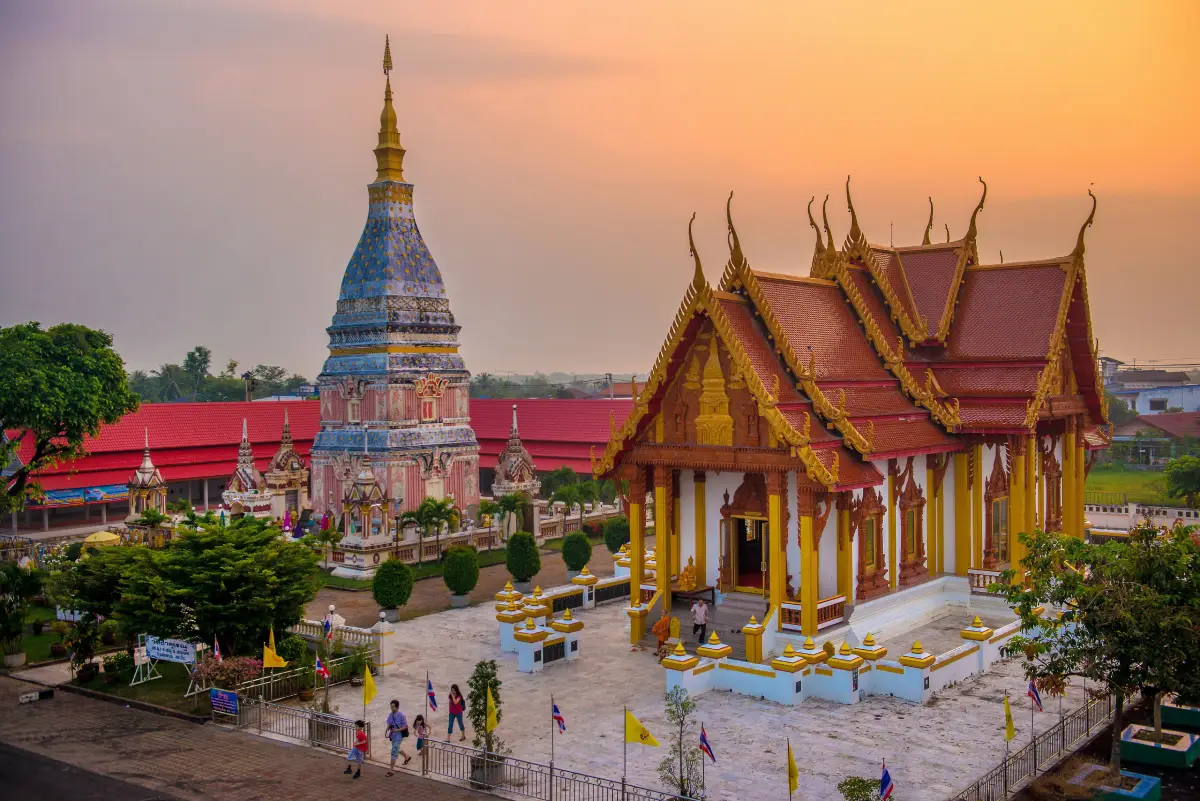
Phra That Renu in Nakhon Phanom Province is enshrined within Wat That Renu in Renu Nakhon District. It is an important Buddhist monument for the people of Nakhon Phanom and the Phu Tai communities of the middle Mekong region. The stupa is particularly known as the sacred monument associated with people born on Monday. Its architectural form was modeled on the former appearance of Phra That Phanom before that monument collapsed, but Phra That Renu was constructed on a smaller scale suited to the local temple grounds. The stupa rises approximately 35 meters, has a square base measuring about 8.37 meters on each side, and features four simulated entrance niches. Its slender form, pale pink-and-white surface, and gold decoration create a graceful appearance that distinguishes it from other stupas in the province.
Wat That Renu is located at 59 Kaew Komol Road in the Ban Renu community, Renu Nakhon District, Nakhon Phanom Province 48170. It lies approximately 50–52 kilometers by road from Nakhon Phanom city and about 15 kilometers from Wat Phra That Phanom Woramahawihan. The temple is close to the district community, local markets, restaurants, accommodation, and Phu Tai cultural attractions. It can therefore serve as the principal stop on a cultural journey through southern Nakhon Phanom. Travelers may worship at the stupa, study its architecture, learn about Phu Tai history, and continue to Phra That Phanom or attractions in nearby Na Kae District within the same day.
The importance of Phra That Renu extends beyond its association with Monday-born visitors. It is a spiritual center for Renu Nakhon, a setting for Buddhist ceremonies, evidence of a community’s collective devotion, and a symbol connecting present residents with the Phu Tai ancestors who established settlements in this part of Nakhon Phanom. The monument consequently possesses religious, historical, architectural, artistic, and social value. Its significance remains visible in annual ceremonies, community gatherings, traditional dance, local textiles, merit-making, and the everyday relationship between the temple and surrounding residents.
The history of Phra That Renu began in 1918 under the leadership of Phra Upatchaya In Phumiyo, who worked with monks, community leaders, craftspeople, and local Buddhists to establish a sacred monument for Renu Nakhon. The architectural concept was inspired by the earlier form of Phra That Phanom, the most revered Buddhist relic monument in the region. Reproducing that form within Renu Nakhon was not simply an attempt to copy an attractive building. It expressed the community’s religious and cultural connection with the principal sacred center of the Mekong basin.
During the first construction, the monument was struck by lightning and suffered serious damage. The community did not abandon the project. Monks, residents, and craftspeople rebuilt it using a stronger approach, and the completed stupa was formally celebrated in 1920. This episode reflects the determination and solidarity of Renu Nakhon. The monument was not created by one wealthy patron alone but by the cooperation of the Sangha, local leadership, skilled workers, and families who understood the value of establishing a permanent sacred center for their town.
The project took place during a period when the temple functioned as the heart of religious and social life. Temples were used for merit-making, education, festivals, community meetings, conflict resolution, and the transmission of knowledge between generations. Constructing the stupa was therefore part of the broader formation of local identity. Visible from a distance, the monument became both a physical and spiritual landmark, announcing that travelers were entering a community with its own history, devotion, artistic traditions, and cultural memory.
The architecture consists of a tall square brick-and-mortar stupa. Each side of the base measures approximately 8.37 meters, while the monument reaches a height of about 35 meters. Its overall proportions were adapted from the former Phra That Phanom but reduced in a balanced manner. The substantial lower base conveys stability and supports a vertically layered central body. The upper stages gradually narrow toward the sky, leading the eye upward and symbolically suggesting a movement from ordinary worldly concerns toward Buddhist teaching and inner peace.
The stupa has four simulated door niches facing the cardinal directions. Although they do not all function as entrances to an accessible interior, they articulate each façade and express the idea that devotion approaches from every direction. The symmetrical plan allows the monument to appear balanced from the front, back, and sides. Visitors should walk around it slowly to observe how sunlight, shadows, decorative profiles, and visual proportions change from one direction to another.
Traditional construction employed a local mortar known as “chathai,” prepared from lime, sand, tree resin, and other natural ingredients that improved strength and adhesion. The technique represents the expertise of regional builders before modern cement became widely available. Craftspeople needed a precise understanding of material proportions, fermentation, weather, brick bonding, and structural weight. Although the stupa has undergone maintenance over time, the knowledge and workmanship represented by its traditional construction remain essential to its architectural value.
The upper section resembles a layered lotus bud or banana blossom. Its progressively narrower profile softens the weight of the square base and gives the monument an elegant vertical rhythm. Pale white and pink surfaces create a calm, welcoming appearance, while gold details reflect morning and evening light. Travelers interested in photography should visit shortly after sunrise or before sunset, when angled light reveals the depth of the niches and the layered upper structure more effectively than harsh midday light.
Objects enshrined inside the stupa traditionally include Buddhist scriptures, gold and silver Buddha images, valuables, devotional objects, and ceremonial regalia associated with former local rulers. These items possess both religious and historical meaning. Enshrining the Tripitaka emphasizes the central place of the Buddha’s teachings, while sacred images and offerings preserve evidence of the devotion of people from different social backgrounds who contributed valuable objects to support Buddhism.
The interior is hollow but is not normally open as a passage for visitors. Worship should take place from the external courtyard, and no one should attempt to approach restricted openings or cross protective barriers. The inability to see the enshrined objects does not diminish the meaning of worship. The value of the monument lies in its religious purpose, the intention of its founders, and its role as the spiritual center of the community. Respecting restricted areas also protects the structure and its contents for future generations.
The Fine Arts authorities and related agencies have contributed to the stabilization and conservation of the monument and its surroundings. Conservation must protect the historic form, traditional materials, structural safety, and the temple’s continuing religious use. It is not simply a process of making the surface look new. Responsible work must preserve historical evidence and avoid alterations that erase the characteristics through which the monument’s age and development can be understood.
Phra Ong Saen is the revered Buddha image housed in the temple’s ordination hall. The image is made from a copper-alloy material such as brass or bronze and follows a Lao artistic style. It represents the Buddha seated in meditation, with a peaceful expression and balanced proportions. The title “Phra Ong Saen” reflects the extraordinary reverence and value assigned to the image by the community. It should not be interpreted as evidence that the entire image is made from solid gold, as some older travel descriptions have incorrectly suggested.
Phra Ong Saen measures approximately 50 centimeters across the lap and about 50 centimeters in height. Although physically modest in size, the image is deeply important to local residents. People commonly worship before beginning a new undertaking, traveling, entering the monkhood, marrying, taking examinations, or dedicating merit to ancestors. Visitors may pay respect when the ordination hall is open. Shoes must be removed, mobile phones silenced, voices lowered, and feet kept from pointing toward the principal Buddha image.
The artistic character of Phra Ong Saen illustrates the long relationship between Renu Nakhon, Laos, and the wider Mekong cultural world. Its facial expression, hair treatment, robe, and meditation posture reflect the influence of Lan Xang art. The image is therefore both an object of devotion and evidence that communities on the two banks of the Mekong exchanged religious ideas, craftsmanship, language, and ritual practices over many generations.
Phra That Renu is associated with people born on Monday. Many Monday-born visitors believe that worship supports calmness, kindness, personal charm, emotional stability, and harmony in daily life. A pilgrimage should, however, be accompanied by wholesome conduct, moral discipline, gentle speech, compassion, and responsibility. The Buddhist purpose of visiting a temple is not limited to requesting favorable outcomes. It is also an opportunity to examine the mind and carry ethical principles back into ordinary life.
People born on other days are equally welcome. The system of monuments associated with days of birth is a regional cultural tradition that helps individuals connect pilgrimage with personal identity. It is not a rule restricting worship to one group. Wat That Renu welcomes Buddhists, families, students, cultural travelers, and international visitors who wish to understand the site while respecting the practices of an active monastery.
Worship at Phra That Renu may begin with flowers, candles, incense, or a garland, according to temple guidance. Visitors should calm the mind, recollect the Buddha, the Dhamma, and the Sangha, and make a respectful aspiration. Three clockwise circuits around the stupa may then be completed while keeping the sacred monument on the right. Visitors with physical limitations do not need to force themselves to walk. Sitting quietly and paying respect from an accessible position is equally appropriate.
During circumambulation, visitors should walk mindfully, avoid overtaking elderly worshippers, and refrain from stopping in narrow places for photography. Voices and mobile-phone sounds should be reduced when prayers or ceremonies are taking place. The walk is not a competition. It is a period for reflection. Some pilgrims recollect the qualities of the Buddha during the first circuit, the Dhamma during the second, and the Sangha during the third, while others use the rhythm of breathing as a meditation practice.
Offerings should be modest in quantity. Large numbers of incense sticks or candles are unnecessary, and designated lighting areas must be used to reduce smoke and fire risk. Flowers, bottles, and ritual materials must not be placed directly on historic bases. Donations should be made through official temple boxes or counters. Visitors do not need to hand money to unofficial individuals who approach them outside the temple’s organized system.
Appropriate clothing should cover the shoulders and knees. Transparent clothing, sleeveless tops, and very short skirts or shorts are unsuitable. Shoes must be removed before entering the ordination hall, sermon hall, or other buildings where signs require it. Visitors should not climb the stupa base, touch decoration, lean against sacred walls, or use a ceremonial area as a setting for inappropriate poses. Respectful appearance and behavior show consideration for Buddhism, the Sangha, and the community that cares for the site.
Photography is generally possible in publicly accessible areas, but flash should be avoided inside buildings. Visitors should not photograph worshippers at close range, block pathways, or interrupt processions. Tripods, large lighting equipment, documentary production, advertising shoots, and commercial photography should be arranged with the temple in advance. Drone operation requires legal and local permission and must never create noise or danger above the stupa, monks, ceremonies, or crowds.
The stupa and circumambulation courtyard form the central zone of the temple. Visitors can examine the square base, the four directional niches, and the graceful upper stages from several angles. The courtyard is used for prayer, circumambulation, and ceremonies on important dates. Temporary barriers may be installed for maintenance or ritual organization. These barriers must not be crossed even when no attendant is standing nearby, as they protect both visitor safety and the dignity of religious activities.
The ordination hall and Phra Ong Saen zone provide a quieter space for worship and meditation. Visitors should check whether monks are conducting a formal ceremony before entering. When a ritual is in progress, guests should remain toward the rear and avoid crossing in front of the monastic assembly. Children should be supervised so that they do not run or speak loudly. Photographs should be taken discreetly and without flash when restrictions are displayed.
The sermon-hall zone is used for merit-making, Dhamma teaching, temple meetings, and annual events. The hall represents the development of Wat That Renu from a local religious center into a temple capable of receiving worshippers from many provinces. Some sections may remain closed on ordinary days but become important ceremonial and organizational spaces on Buddhist observance days and during the annual festival.
Viharns and supporting religious buildings allow visitors to understand that the temple includes more than the principal stupa. Each building may house Buddha images, support chanting, store religious objects, or accommodate rituals. Access depends on temple activities. Visitors should not open doors or enter spaces without signs indicating public access, even when a door appears unlocked, because some areas are reserved for monks or the protection of sacred property.
Merit-making and Sangha-offering areas are provided for donations, memorial merit, and offerings to monks. Groups planning a formal ceremony should telephone the temple in advance so that an appropriate time, place, and number of monks can be arranged. Offerings should consist of useful, unexpired items. Large prepackaged sets are not essential. Temple staff can advise visitors about current needs.
The Phu Tai cultural and Renu Nakhon community zone extends into the neighborhood surrounding the temple. It includes the Phu Tai cultural ground, Mueang We Theater, textile shops, local restaurants, and activity spaces. Walking beyond the temple allows travelers to understand the stupa more deeply, since Phra That Renu grew from the devotion of the Phu Tai community. Clothing, dance, language, food, handicrafts, and temple traditions form parts of the same cultural landscape.
Visitor-service areas include parking, toilets, flower and offering shops, food outlets, and local businesses according to their daily operating schedules. More vendors may be present during weekends and festivals, when traffic and parking also become more congested. Drivers should use designated spaces and avoid blocking temple gates, homes, businesses, pavements, or emergency routes. Personal belongings should be protected during crowded events.
Phra Ratcharattanakon, formally Phra Ratcharattanakon Thawat Dhammatecho, Pali Studies Grade 4, is the abbot of Wat That Renu and a senior monk involved in the ecclesiastical administration of Nakhon Phanom. His responsibilities include supervision of monks and novices, care of the monument and temple buildings, organization of Buddhist activities, restoration work, and cooperation with public agencies and the community. Groups seeking ceremonies, filming access, or special use of the grounds should contact the temple office rather than approach the abbot without an appointment.
The temple’s public contact number is +66 42 579 132. It may be used to ask about the opening of internal buildings, ceremonies, group visits, merit-making, and conditions during festivals. Calls should be made during reasonable daytime hours with a clear statement of purpose. Staff may not answer immediately during large ceremonies. Individual visitors do not normally require a reservation, but large groups should provide advance notice.
The annual Phra That Renu Worship Festival, also connected with the fourth lunar month merit tradition, is one of the district’s principal events. Its dates follow the lunar calendar and change from year to year. In 2026, the festival was held from March 1 to March 3. Travelers planning a later visit must consult a new announcement from the temple, district, or provincial authorities rather than treating the 2026 dates as permanent.
The festival combines Buddhist ceremonies with local cultural activities. The opening day includes the ceremonial reception of Phra Upakut, the offering of a cloth around the stupa, merit dedicated to former teachers, and a meal for monks. The following day features khan mak beng offering processions from local communities and an opening ceremony. The final day includes alms-giving, breakfast offerings, meditation, and cultural activities. Programs may be adjusted each year.
The Phra Upakut ceremony reflects a belief found throughout northeastern Thailand and the Mekong region. Phra Upakut is regarded as an arahant who protects major merit-making events from disruption. The procession generally begins in the morning and carries the symbolic representation into the festival grounds. Participants should dress modestly, remain behind designated lines, and avoid crossing the procession simply to take photographs.
Khan mak beng are elaborate offerings made from banana leaves, flowers, and natural materials arranged in several levels. Communities work together to construct and carry them to the stupa. The tradition displays devotion, craftsmanship, and the transfer of knowledge from older residents to younger generations. Its importance lies not only in size or beauty but also in the cooperation and intention involved in making each offering.
Wrapping the stupa with a ceremonial cloth is another prominent ritual. The long cloth is presented as an offering and as a symbol of collective support for Buddhism. Individuals or groups wishing to participate should coordinate with the temple. Cloth must not be attached to the structure without authorization, and no one should climb or enter restricted areas. Uncontrolled access could damage the historic surface and endanger participants.
The festival also features Phu Tai performances, traditional clothing, local food, woven textiles, and community products. These activities reveal the close relationship between Buddhism and everyday cultural life. The event is not organized solely as entertainment. It allows residents to honor ancestors, transmit language and dance, preserve handicrafts, and generate income for local households.
Festival visitors should reserve accommodation, allow extra travel time, and arrive at least one hour before major ceremonies. Roads near the temple may be temporarily redirected, and parking may be located farther away than usual. Water, personal medication, a hat or umbrella, and an agreed meeting point are useful. Elderly people and families with small children may prefer to avoid the most crowded opening processions.
Phu Tai culture in Renu Nakhon gives the journey a distinctive character. The Phu Tai have a long history of migration and settlement in Nakhon Phanom and maintain recognizable traditions of language, clothing, dance, music, food, and weaving. Women’s ceremonial dress commonly includes dark blouses, locally patterned skirts, and brightly colored shoulder cloths. Phu Tai dance expresses grace, coordination, and pride in community identity.
The Phu Tai cultural ground and Mueang We Theater are used for performances, ceremonies, and local activities. The name Mueang We recalls the ancestral homeland remembered by the community. A visit helps travelers understand that Phu Tai identity is not limited to costumes or a stage performance. It also includes kinship, language, food, ancestor respect, merit-making, and the continuing relationship between the monastery and the community.
Local dining includes Isan food, Phu Tai dishes, and cuisine influenced by the Mekong cultural region. Travelers may find som tam, larb, regional soups, river fish, khanom chin rice noodles, Vietnamese dishes, and local sweets. Many restaurants are family businesses and may adjust opening hours according to ingredients and holidays. Groups should telephone ahead, while visitors with allergies should ask specifically about fermented fish, fish sauce, dried shrimp, peanuts, and fermented seasonings.
Phu Tai textiles are meaningful souvenirs that preserve both practical and cultural value. Patterns, colors, and techniques reflect knowledge transmitted within families. Purchasing directly from weaving groups or community shops supports local income. Buyers should ask about care instructions and the meaning of patterns and avoid bargaining in a manner that devalues skilled labor. Permission should be requested before photographing weavers or private homes.
The most comfortable visiting periods are approximately 05:30–08:30 and 16:00–18:30. Morning air is cooler, the environment is quiet, and local merit-making may be observed. Late-afternoon light warms the color of the stupa and reveals architectural depth. The temple may be visited at midday, but the open courtyard becomes hot, especially from March to May.
The cool season from approximately November to February is generally the most comfortable, although a light jacket may be useful in the morning. During the hot season, travelers should carry water and sun protection and avoid standing in the courtyard for long periods. Rain brings greener surroundings but can make tiled and concrete surfaces slippery. Weather forecasts should be checked, and open courtyards should be avoided during thunderstorms.
Weekdays are preferable for travelers seeking quiet. Visitors who wish to experience community culture and collective devotion may choose the annual festival, Buddhist holy days, or major ceremonies. These occasions bring larger crowds, and building access may change according to the ritual schedule. Selecting a time that matches the purpose of the visit helps create a better experience while avoiding disruption to religious practice.
Travel from Nakhon Phanom city follows Highway 212 south before connecting with the road to Renu Nakhon District. The road distance is approximately 50–52 kilometers, and the journey normally takes about 55–70 minutes, depending on traffic. Navigation systems should search for “Wat That Renu” or “Phra That Renu” and confirm that the destination is in Renu Nakhon District, Nakhon Phanom Province.
From Wat Phra That Phanom Woramahawihan, the journey to Phra That Renu is approximately 15 kilometers and generally takes 20–30 minutes. This makes it practical to visit both monuments in one day. Travelers may begin at Phra That Phanom in the morning, continue to Renu Nakhon for lunch, worship at Phra That Renu, and explore the Phu Tai community during the afternoon.
From Nakhon Phanom Airport, rental cars, taxis, and prearranged private transport are the most practical choices because frequent direct public transportation is not available throughout the day. Travelers should confirm the fare, waiting time, additional stops, and return journey before departure. Rental-car users should check fuel, weather, and phone connectivity, as parts of the route pass through rural areas.
Public buses and songthaews may change their schedules and fares. The approximate fare of 40 baht found in older travel guides should not be treated as a current fixed price without confirmation. Travelers using public transport should ask Nakhon Phanom Bus Terminal, the transport point in That Phanom, or local operators shortly before traveling. The final return service should be confirmed in advance, particularly for an evening visit.
Travelers from Mukdahan may follow Highway 212 north toward That Phanom before connecting to Renu Nakhon. From Sakon Nakhon, routes through Na Kae District provide access to the area. Journey times depend on the starting point and road conditions. Drivers should slow down through communities, where motorcycles, agricultural vehicles, schoolchildren, and numerous turning points require additional attention.
A half-day itinerary may begin with an early visit to the stupa, clockwise circumambulation, worship before Phra Ong Saen, and time to study the monument’s history. Travelers can then continue to the Phu Tai cultural ground, Mueang We Theater, textile shops, and a local restaurant. This plan is suitable for visitors staying in That Phanom or passing through Renu Nakhon.
A full-day itinerary may combine Phra That Renu with Wat Phra That Phanom Woramahawihan, Ban Na Bua, and Ho Pu Thala. Begin at Phra That Phanom in the morning, continue to Phra That Renu, have lunch in the district, and spend the afternoon learning about local history or Phu Tai culture. Sufficient time should be allowed at each place rather than reducing every stop to a photograph at the entrance.
Ban Na Bua is a community with an important place in Thailand’s modern political and social history. Community-based tourism introduces visitors to local life, historical memory, and regional products. Travelers seeking organized activities or a local guide should contact the community in advance, since not every program operates continuously throughout the day.
Ho Pu Thala is associated with ancestor belief and the spiritual protection of the Phu Tai community. Visitors should behave respectfully, avoid touching offerings, and follow local guidance. Respect for Pu Thala demonstrates how the community combines Buddhism with ancestor traditions. These practices reinforce solidarity and remind residents of their obligations toward the wider community.
Restaurants near Phra That Renu include Phu Tai and Isan food, family restaurants, and cafés. Khoe Phu Tai Family is located close behind the temple and is convenient for travelers who wish to try local food without driving far. H-Kin Cafe & Bistro and The Kong Cafe offer drinks, simple meals, and air-conditioned rest. Restaurants outside the central community suit travelers with private transport who want countryside views.
Restaurant schedules may change according to holidays, ingredients, and seasonal demand. Groups should call ahead, particularly during the annual festival. Small businesses may close after ingredients are sold out. Visitors with dietary restrictions should ask directly about fermented fish, fish sauce, dried shrimp, peanuts, and fermented seasonings.
Accommodation near Phra That Renu consists mainly of small hotels, resorts, and locally operated properties. Muangway Garden Ville is close to the temple and convenient for early-morning worship. KONG INN Renunakhon and The P.J. House Resort offer alternatives within the district, while Renu Garden and The Wisteria suit travelers with private transport seeking a quieter environment.
Before booking, travelers should ask about room availability, parking, ground-floor rooms, elevators, hot water, breakfast, and cancellation conditions. Elderly guests should select rooms with minimal walking and few steps. Rooms near the temple may fill quickly during festivals and long weekends, so reservations should be made and confirmed directly with the property.
Facilities and accessibility vary across the temple. Several outdoor areas are relatively level, but some religious buildings have stairs, thresholds, and uneven surfaces. Wheelchair users and elderly visitors may require assistance. Visitors needing close parking or group access should contact the temple. Those unable to complete circumambulation may worship from a comfortable position with a clear view of the stupa.
Families should prevent children from running on ceremonial courtyards or approaching stairs and monument edges. Drinking water is useful in hot weather, but food should not be consumed inside the ordination hall or active ceremonial areas. Toilets and local shops are available nearby according to operating hours. Carrying a reasonable amount of cash is useful for small offering, food, and community-product purchases.
Responsible travel begins with placing flowers, incense, candle remains, bottles, and packaging in designated areas. Visitors should not pick plants, mark walls, or climb historic structures. Single-use plastic should be reduced, and ritual materials should be purchased in reasonable quantities. The value of worship is determined by sincere intention and ethical conduct rather than the volume of physical offerings.
Using local restaurants, accommodation, transport, and textile shops distributes tourism income within the community. Bargaining should remain polite, and the working time of local people should be respected. Permission should be obtained before photographing residents, weavers, monks, or participants in ceremonies. Content creators should not ridicule local beliefs or exaggerate miraculous stories, as this can distort cultural meaning.
Phra That Renu demonstrates that the value of a sacred monument comes from the relationship between architecture and people. Although smaller than Phra That Phanom, it holds profound meaning for Renu Nakhon. Its architectural resemblance connects the community with the principal sacred center of the region, while the history of rebuilding after the lightning strike illustrates cooperation, resilience, and sustained devotion.
Worshipping before Phra Ong Saen, learning about chathai mortar, examining the four directional niches, and walking into the Phu Tai cultural district transform the journey into more than a photographic visit. They reveal the relationship among belief, history, art, craftsmanship, and everyday community life. A visit that allows time for observation and reflection is more meaningful than a rapid stop made only for a check-in photograph.
Before traveling, visitors should check the opening of internal buildings, weather, and current ceremonial schedules. Modest clothing, easily removable shoes, drinking water, personal medication, and some cash should be prepared. Public-transport users must confirm current schedules and fares rather than relying on old price information. Groups should notify the temple and restaurants in advance.
Phra That Renu is suitable for Buddhist pilgrims, people born on Monday, cultural travelers, families, students, and international visitors seeking to understand Nakhon Phanom beyond its Mekong scenery. The temple brings together Buddhism, Lan Xang artistic influence, Phu Tai memory, weaving, food, and living traditions within one community.
Whether arriving to make merit, request a blessing, study history, or pause from a busy journey, visitors will find a calm and welcoming atmosphere. Time should be taken to sit quietly, consider the meaning of devotion, and carry that calmness into daily life. Worship becomes complete when respect shown inside the temple is transformed into compassion, responsibility, and beneficial action after returning home.
| Part 1: Essential Information About Phra That Renu and Wat That Renu | |
| Place Name | Phra That Renu at Wat That Renu |
| Category | Buddhist stupa, active monastery, and Phu Tai religious and cultural attraction |
| Address | 59 Kaew Komol Road, Ban Renu Community, Renu Nakhon District, Nakhon Phanom Province 48170, Thailand |
| Open Days | Daily |
| Opening Hours | Generally 05:00–19:00; internal buildings may follow ceremonial schedules |
| Admission Fee | Free admission; voluntary donations are welcome |
| Construction Period | Construction began in 1918, with the rebuilt monument formally celebrated in 1920 |
| Founder | Phra Upatchaya In Phumiyo, together with monks and the people of Renu Nakhon |
| Architectural Form | A square brick-and-mortar stupa modeled on the former Phra That Phanom, with four simulated directional door niches |
| Dimensions | Approximately 35 meters high, with a base measuring about 8.37 meters on each side |
| Enshrined Objects | Buddhist scriptures, gold and silver Buddha images, valuables, devotional objects, and regalia of former local rulers |
| Principal Buddha Image | Phra Ong Saen, a Lao-style copper-alloy Buddha image in meditation posture, approximately 50 centimeters high and across the lap |
| Associated Birth Day | Monday |
| Abbot | Phra Ratcharattanakon Thawat Dhammatecho, Pali Studies Grade 4 |
| Main Areas | 1. Stupa and circumambulation courtyard 2. Ordination hall and Phra Ong Saen 3. Sermon hall 4. Viharns and supporting religious buildings 5. Merit-making and Sangha-offering points 6. Phu Tai cultural and Renu Nakhon community area 7. Parking, toilets, and visitor services |
| Annual Festival | The Phra That Renu Worship Festival follows the lunar calendar; in 2026 it was held from March 1 to March 3 |
| Recommended Visiting Times | 05:30–08:30 and 16:00–18:30 |
| Facilities | Parking, toilets, flower and offering shops, restaurants, and local community businesses nearby |
| Distance From Nakhon Phanom City | Approximately 50–52 kilometers by road, with a driving time of around 55–70 minutes |
| Distance From Phra That Phanom | Approximately 15 kilometers or 20–30 minutes by road |
| Temple Contact | +66 42 579 132 |
| Current Status | Open to worshippers and visitors |
| Part 2: Practical Travel Information Around Phra That Renu | |
| Management | Wat That Renu under the supervision of Phra Ratcharattanakon Thawat Dhammatecho, the temple’s abbot; telephone +66 42 579 132 |
| Nearby Attractions | 1. Phu Tai Renu Nakhon Cultural Ground, approximately 0.8 km; local information: +66 42 579 416 2. Mueang We Theater, approximately 0.8 km; local information: +66 42 579 416 3. Ho Pu Thala, approximately 1.5 km; community information: +66 42 579 747 4. Ban Na Bua Tourism Community, approximately 15 km; +66 93 079 2970 5. Wat Phra That Phanom Woramahawihan, approximately 15 km; +66 63 004 9049 |
| Nearby Restaurants and Cafés | 1. Khoe Phu Tai Family, approximately 0.4 km; +66 86 461 2634, +66 88 564 9766 2. H-Kin Cafe & Bistro, approximately 1.8 km; +66 92 858 5565 3. The Kong Cafe, approximately 2 km; +66 85 743 4491 4. The Wisteria Cafe & Bistro, approximately 4.5 km; +66 93 649 1466 5. Hi Na View, approximately 6 km; +66 64 827 0871 |
| Nearby Accommodation | 1. Muangway Garden Ville, approximately 0.4 km; +66 89 181 9190 2. KONG INN Renunakhon, approximately 1.2 km; +66 85 743 4491 3. The P.J. House Resort, approximately 2.5 km; +66 64 636 5262 4. Renu Garden, approximately 3 km; +66 87 237 3340 5. The Wisteria, approximately 4.5 km; +66 93 649 1466 6. Hongsa Resort, approximately 5 km; +66 63 585 1511 |
| Distance Note | Distances are approximate road distances from Wat That Renu and may vary according to the selected route, traffic, and the entrance used by each establishment. |
Frequently Asked Questions (FAQ)
Q: On which days and at what times is Phra That Renu open?
A: Wat That Renu is open daily, generally from 05:00 to 19:00. Internal buildings such as the ordination hall and sermon hall may follow shorter schedules based on ceremonies and temple operations.
Q: Is there an admission fee to visit Phra That Renu?
A: Admission is free. Visitors may make a voluntary donation, offer useful items to the Sangha, or support temple maintenance according to their faith.
Q: Which day of birth is associated with Phra That Renu?
A: Phra That Renu is associated with people born on Monday. Worship is traditionally linked with calmness, kindness, personal charm, and harmony, but visitors born on any day are welcome.
Q: When was Phra That Renu built, and who initiated its construction?
A: Construction began in 1918 under Phra Upatchaya In Phumiyo with support from monks and the people of Renu Nakhon. The first structure was damaged by lightning, after which it was rebuilt and formally celebrated in 1920.
Q: Is Phra Ong Saen made entirely from gold?
A: No. Phra Ong Saen is a Lao-style copper-alloy Buddha image, generally described as brass or bronze, in the meditation posture. It measures approximately 50 centimeters in height and across the lap.
Q: When is the annual Phra That Renu Worship Festival held?
A: The festival follows the lunar calendar, so its dates change each year. In 2026 it was held from March 1 to March 3. Travelers visiting in a later year should consult a new announcement from the temple or Renu Nakhon authorities.
Q: How far is Phra That Renu from Phra That Phanom?
A: The road distance is approximately 15 kilometers, and driving normally takes about 20–30 minutes. Both monuments can be included in a one-day itinerary.
Q: How much time should visitors allow at Phra That Renu?
A: Allow at least one to two hours to worship at the stupa, complete clockwise circumambulation, visit Phra Ong Saen, and explore the nearby Phu Tai cultural area. Additional time is recommended during the annual festival.
 Category: ●Places of Worship
 Group: ●Other Sacred Sites
Last Update : 3 MonthAgo
 Last Update : 3 MonthAgo
 Click to Access the Navigation Map GPS
Phra That Renu Nakhon Map
Gellery
Recommend

 Art, Culture and Heritage
 Historical Sites and Monuments(3)
 Landmarks and Memorials(2)
 Art, Craft Centres, Tradition(3)
 Museums(3)
 Educational Places
 Library(1)
 Temple(23)
 Church(1)
Other Sacred Sites(11)
Church(1)
Other Sacred Sites(11)
 Suburban Living
 Village, Community(5)
 Nature and Wildlife
 National Parks and Marine Reserves(1)
 Dam, Reservoir, Lake(5)
 Waterfalls(2)
 River, Canal(3)
 Bays and Beaches(3)
 Other natural attractions(2)
 Entertainment and Agricultural
 Zoos and Aquariums(1)
 Farms, Parks and Ecotourism(2)
 Shopping
 Shopping and Night Market(1)
 Travel Articles, Recipes
 Travel Review, Food Review(1)


