
lovethailand home >Northeastern Travel Attractions >Nakhon Phanom Travel Attractions >That Phanom >That Phanom > Phra That Phanom
TL;DR: Phra That Phanom is located at 183 Moo 13, Chayangkun Road, That Phanom Subdistrict, That Phanom District, Nakhon Phanom Province 48110, Thailand, open Daily, hours 05:00 – 21:00.
Phra That Phanom
Open Days: Daily
Opening Hours: 05:00 – 21:00
Admission Fee: Free admission; voluntary donations for the temple are welcome
Phra That Phanom in Nakhon Phanom Province stands within Wat Phra That Phanom Woramahawihan in That Phanom District. It is one of the most sacred Buddhist monuments in northeastern Thailand and the central Mekong region. The stupa is traditionally believed to enshrine the Urangkhathat, the Buddha’s sacred breastbone relic. Phra That Phanom is associated with people born on Sunday and those born in the Year of the Monkey, but the temple welcomes visitors of every background. It is revered by Buddhists from across Thailand, Laos, and communities on both sides of the Mekong River. Visitors may enter free of charge every day, although modest dress, quiet behavior, and respect for active religious ceremonies are required. At least one to two hours should be allowed to worship, walk around the stupa, visit the temple’s principal buildings, and understand the site’s historical and cultural significance.
Wat Phra That Phanom Woramahawihan is located at 183 Moo 13, Chayangkun Road, That Phanom Subdistrict, That Phanom District, Nakhon Phanom Province 48110. Its approximate coordinates are 16.9436 latitude and 104.7262 longitude. The stupa is situated about 600 meters west of the Mekong River and approximately 52–53 kilometers south of Nakhon Phanom city via Highway 212. The surrounding town developed through centuries of pilgrimage, river trade, cross-border movement, and community life connected with the sacred monument.
Phra That Phanom is far more than an individual religious structure. It is a center of collective memory, archaeology, sacred tradition, architecture, ritual, and regional identity. Its tall white square form, rising to a gold finial, has become one of the defining images of Nakhon Phanom. The stupa appears in local prayers, the Urangkhathat chronicle, annual merit-making ceremonies, ceremonial dances, traditional textiles, local emblems, and the province’s pilgrimage route linking stupas with the days of the week.
Understanding legend and archaeology is essential for appreciating the site responsibly. The Urangkhathat tradition connects the foundation of Phra That Phanom with the period shortly after the Buddha’s passing. It tells how the Venerable Mahakassapa, accompanied by 500 arahants, carried the Buddha’s sacred breastbone relic to Phu Kamphra, where rulers from surrounding kingdoms helped construct an ubmung, or sacred reliquary chamber. Archaeological investigation, by contrast, places the earliest known architectural phase at approximately the 7th to 9th centuries CE. These two perspectives do not need to cancel each other. The legend explains the spiritual meaning given to the monument, while archaeology reveals the physical development of the site through historical periods.
According to the Urangkhathat narrative, the Buddha had visited the middle Mekong region and foretold that his breastbone relic would eventually be enshrined at Phu Kamphra. Following the Buddha’s Parinirvana, Mahakassapa brought the relic to the sacred hill. Five rulers learned of its arrival: Suwan Phingkhan of Nong Han Luang, Kham Daeng of Nong Han Noi, Inthapattha of Inthapattha City, Nanthasen of Si Khotrabun, and Chulani Phrommathat of the Chulani realm. They gathered to support the construction of the reliquary with deep devotion.
The account of the five rulers reflects a wider network of historic settlements connected by waterways, trade routes, kinship, and Buddhist belief. Although the chronicle contains miraculous elements, its central message is that Phra That Phanom belonged to a broad cultural region rather than to a single community. This regional character remains visible today. During major ceremonies, pilgrims arrive from Nakhon Phanom, Sakon Nakhon, Mukdahan, Ubon Ratchathani, Nong Khai, Bueng Kan, other Thai provinces, and neighboring Laos.
Phu Kamphra is the name traditionally given to the low raised ground on which the monument stands. Studies of the historic landscape explain that the area was once a plain near an older course of the Mekong River. Ditches were dug on the western, northern, and southern sides, and the removed earth was piled in the center to create a platform approximately two meters higher than the surrounding ground. The former watercourse formed a natural boundary to the east. This arrangement suggests an intentionally planned sacred landscape that elevated the monument above its setting before modern roads and urban development altered the original terrain.
The location was highly accessible from the Mekong, one of mainland Southeast Asia’s most important corridors. Travelers could approach by boat from settlements to the north and south or cross from the Lao side of the river. The site consequently became a meeting place for different ethnic and cultural communities, including Lao-speaking groups, Phu Tai, Tai Yo, Kaleung, Tai Kuan, and other populations of the middle Mekong basin. Their interaction contributed to the architecture, ceremonies, languages, textiles, music, and beliefs surrounding Phra That Phanom.
Archaeological evidence indicates that the earliest structure was a square brick sanctuary decorated with carved bricks. Its ornament has relationships with local northeastern traditions, Dvaravati art, Cham architecture, and ancient Khmer sanctuaries. Surviving motifs include human figures, warriors riding elephants and horses, animals, curling foliage, fern-like designs, and divine figures associated with religious cosmology. These features demonstrate that the site stood at the intersection of several artistic traditions before it developed into the explicitly Buddhist relic stupa known today.
The monument was enlarged, repaired, and reshaped repeatedly. Rulers, monks, craftspeople, and communities from both sides of the Mekong participated in different restoration campaigns. Each period introduced construction methods, sacred concepts, and artistic preferences. The present appearance is therefore not the work of a single date or patron. It represents a long sequence that began with an early square brick sanctuary and continued through the addition of upper stages, plaster decoration, carved-brick panels, a gold finial, and the modern reconstruction following the 1975 collapse.
The Urangkhathat refers to the Buddha’s sacred breastbone or chest relic. Within regional Buddhist tradition, this relic is the spiritual heart of Phra That Phanom. Worship is consequently directed not merely toward an impressive building but toward the Buddha, his teachings, and the monastic community. Pilgrims commonly offer flowers, maintain moral precepts, meditate, dedicate merit, and walk clockwise around the stupa while recollecting the qualities of the Triple Gem.
After the collapse of the stupa in 1975, a large bronze casket and several nested gold reliquaries were recovered from the debris, together with offerings and valuable objects. Their discovery was significant for both public faith and historical research. The relics were carefully protected while specialists, monks, government representatives, and the public prepared for reconstruction. They were later ceremonially re-enshrined in the rebuilt stupa, reinforcing the understanding that Phra That Phanom is a national and regional heritage monument held in collective trust.
The present stupa has a tall square composition. Its lower stages are faced with red carved-brick panels depicting people, animals, floral scrolls, and other historic motifs. Central niches and simulated doorways articulate the four sides. Above them, layered moldings rise toward a slender, square lotus-bud form, followed by progressively smaller ornamental elements and a gold ceremonial umbrella at the summit. The heavy lower mass conveys stability, while the narrowing upper section directs the eye upward, symbolically suggesting the movement from the material world toward spiritual liberation.
Information published by That Phanom Municipality describes the monument as approximately 12.33 meters wide on each side and 53.60 meters high, with a gold finial weighing around 110 kilograms and decorated with precious stones. Some archaeological documents use different measurement methods for architectural components, so visitors may encounter alternative dimensions. The best way to appreciate the structure is to observe it from several distances: close to the base for the carved-brick details and from the outer courtyard for the complete vertical proportions.
The carved bricks should not be treated as simple surface decoration. Human figures, animals, deities, and plant designs preserve evidence of changing artistic systems and religious ideas. They illustrate how an ancient sanctuary was reinterpreted as a Buddhist relic monument. Visitors must remain on designated paths, avoid touching the surfaces, and never scrape, mark, or remove material. Even a small fragment forms part of a protected archaeological monument.
Royal-monastery status was granted in 1942, when the temple became a first-class royal monastery of the Woramahawihan rank and adopted the formal name Wat Phra That Phanom Woramahawihan. This status reflects its national religious and historical importance. The temple has also been connected with royal ceremonies and offerings. Sacred water from the area has been associated with state rituals, while ceremonial cloth, candles, and other offerings have been presented on significant Buddhist and royal occasions.
At 7:38 p.m. on August 11, 1975, Phra That Phanom collapsed after prolonged heavy rain and storms, combined with the age and structural condition of the monument. The event caused profound grief throughout Nakhon Phanom and the country. People did not regard the stupa as an old building alone; it was a spiritual center, a symbol of the region, and a physical link with generations of ancestors. Fallen bricks and architectural components were therefore documented, collected, and studied with exceptional care.
Following the collapse, multidisciplinary teams investigated the foundations, soil, building materials, archaeological deposits, relic containers, and earlier architectural form. People across Thailand donated money, gold, and other resources. The government, Sangha, Fine Arts authorities, engineers, and local communities worked together to reproduce the historic appearance while strengthening the internal structure. Reconstruction became both a technical conservation project and a national act of shared devotion.
The rebuilding was completed on March 23, 1979. The sacred relics and important objects were ceremonially returned to the new structure. The rebuilt monument preserved the principal proportions and decorative character of its predecessor while incorporating a more stable engineered framework. The entire episode—from collapse to re-enshrinement—remains an important lesson in heritage conservation, demonstrating how scientific knowledge can work together with faith and public participation.
Phra That Phanom is associated with Sunday-born people. Many visitors born on Sunday come to worship in the belief that the pilgrimage supports dignity, merit, respect, and stability in life. Prayers vary, but the central purpose should be recollection of the Buddha’s qualities and a sincere commitment to ethical conduct. People born on other days are equally welcome, since the temple is not restricted by birth day, ethnicity, nationality, or religious background.
The stupa is also associated with the Year of the Monkey within the tradition of worshipping a relic monument linked to one’s birth year. This practice connects the cultural worlds of Lanna, Lan Xang, and the Mekong basin. A pilgrimage should not be understood only as a means of requesting good fortune. It is also an opportunity to make merit, dedicate wholesome actions to relatives, examine one’s conduct, and renew a commitment to compassion and responsibility.
A local belief holds that a person who worships Phra That Phanom seven times becomes a “luk phra that,” literally a child of the sacred stupa. The expression conveys spiritual attachment and a feeling of protection. It is not a religious rule stating that merit is received only after seven visits. A single respectful pilgrimage may be meaningful. The deeper value lies in gratitude, generosity, moral discipline, and the practical application of Buddhist principles rather than in counting visits.
Worshipping at Phra That Phanom may begin with flowers, candles, incense, or a garland, according to temple guidance. Visitors commonly recite Namo Tassa three times, recollect the Buddha, Dhamma, and Sangha, and make a respectful aspiration. They may then walk three clockwise circuits around the stupa. During busy periods, pilgrims should move slowly, avoid overtaking, and refrain from stopping in narrow sections to take photographs or use mobile phones.
During clockwise circumambulation, the sacred monument remains on the visitor’s right. Some people recollect the qualities of the Buddha, the Dhamma, and the Sangha during the three rounds; others use the walk as quiet meditation. Elderly visitors, wheelchair users, and people with health limitations may worship from a suitable seated position. Physical proximity is not the measure of devotion, and no one should risk injury in order to complete a ritual.
Appropriate clothing should cover the shoulders and knees. Transparent, excessively tight, or revealing clothing is unsuitable for an active monastery. Shoes must be removed before entering buildings where signs require it. Visitors should not point their feet toward Buddha images, monks, or sacred objects. Loud conversation, disruptive posing, and touching ancient materials are inappropriate. Women should avoid handing objects directly to monks and may place offerings on a receiving cloth or ask temple staff for guidance.
Photography is generally possible in publicly accessible areas, but visitors should not photograph worshippers at close range, block a ceremony, or use flash where prohibited. Tripods, large lighting equipment, documentary production, advertising shoots, and commercial photography should be arranged with the temple in advance. Drone operation requires permission and compliance with Thai aviation law. Drones must not be flown over monks, crowds, ceremonial processions, or the stupa in a manner that creates danger or disturbance.
The stupa courtyard and circumambulation zone form the spiritual center of the complex. The stupa stands within its sacred enclosure, surrounded by paths used for prayer and clockwise walking. This area may be crowded on Buddhist holy days, weekends, and during the annual festival. Temporary barriers may be installed for ceremonies, maintenance, or conservation. Visitors must follow the designated route even when a closed section appears unattended.
The ordination hall is used for formal monastic ceremonies and houses Luang Pho Ong Saen Satsada, the principal Buddha image. Visitors may enter when the building is open, but phones should be silenced and voices kept low. When monks are conducting a ceremony, visitors should wait quietly or avoid crossing the front of the assembly. The ordination hall reminds travelers that Wat Phra That Phanom remains a functioning monastery rather than a monument preserved solely for tourism.
Ho Phra Kaeo Viharn is another important devotional space. It contains revered Buddha images and is associated with the ceremonial reception of Phra Upakut during the annual festival. Visitors should observe the sculpture and interior architecture without touching images or ritual objects. Access may be controlled during ceremonies, and the instructions of monks and temple attendants should take priority over sightseeing.
North of the main cloister is an area connected with the tradition of the Buddha relic’s early placement. It includes a reclining Buddha and a replica Buddha footprint. This area helps visitors understand that the sacred landscape extends beyond the central stupa. Those with sufficient time should walk slowly, read available information, and consider how subsidiary buildings, water features, legends, and processional routes create a unified religious environment.
Historical displays and archaeological materials explain the monument’s development, collapse, and reconstruction. Depending on the building and the day, visitors may see archival photographs, historic bricks, decorative fragments, or interpretive information. These spaces may not remain open for exactly the same hours as the main temple gates. Flash photography and touching objects should be avoided whenever prohibited. The displays should be approached as evidence of history, not merely as decorative curiosities.
Merit-making and offering areas are provided for donations, Sangha offerings, memorial merit, and temple support. Visitors should use official donation boxes and counters rather than respond to unofficial solicitation. Groups planning large offerings, ceremonies, robe presentations, or special activities should contact the temple in advance to receive instructions on timing, space, and appropriate procedure.
Visitor-service areas include parking, toilets, seating, shops selling flowers and offerings, food stalls, souvenir shops, and community businesses around the temple. The number and operating hours of vendors vary by day and season. More services are available during the annual festival, but traffic and crowd levels also increase. Visitors should carry a reasonable amount of cash, protect personal belongings, and choose vendors that display prices clearly.
Parking is available within and around the temple according to capacity. On major Buddhist days, long weekends, and festival dates, roads may become one-way or temporary parking areas may be introduced. Drivers must not block temple gates, emergency access, private houses, shops, or pavements. Staying within That Phanom town can make it possible to walk to the temple and avoid parking difficulties.
Wheelchair users, elderly visitors, and families with small children should select entrances with relatively level surfaces and avoid the busiest periods. Some buildings have steps, thresholds, and uneven flooring. A companion may be necessary. Visitors who require specific information about ramps or close parking should telephone the temple before traveling. Worship from a visible, accessible location is entirely appropriate when walking around the stupa is difficult.
The annual Phra That Phanom Worship Festival follows the lunar calendar during the third lunar month and lasts several days. Dates change each year. In 2026, Nakhon Phanom Province and the temple held the festival from January 26 to February 3, a total of nine days and nine nights, corresponding to the eighth waxing day through the first waning day of the third lunar month. Travelers planning to attend in a later year must check a new official announcement rather than reuse the 2026 dates.
Major activities include bringing Phra Upakut from the Mekong River to Ho Phra Kaeo Viharn, offering elaborate khan mak beng floral arrangements, presenting agricultural produce, participating in community merit rites, attending the opening ceremony, walking with candles around the stupa, evening chanting, listening to sermons, joining merit processions, offering a ceremonial cloth to the stupa, making age-paired alms offerings, giving sticky rice to monks, and watching the great worship dance. Exhibitions on World Heritage preparation, Five-Precept communities, local culture, and OTOP products are also organized.
The Phra Upakut ceremony reflects a widespread Mekong belief in an arahant whose spiritual power protects major merit-making events from disruption. The procession commonly begins before sunrise near the river and continues toward the temple. Participants should consult the exact schedule, prepare for cool early-morning temperatures, and avoid entering the ceremonial route merely to obtain a closer photograph.
Khan mak beng are carefully constructed offerings made from natural materials such as banana leaves and flowers. Their layered form expresses devotion, skill, and patience. Preparing the offerings allows younger residents to learn directly from elders and craft specialists. The tradition therefore survives not only through the final ceremony but through the collaborative process of making the objects.
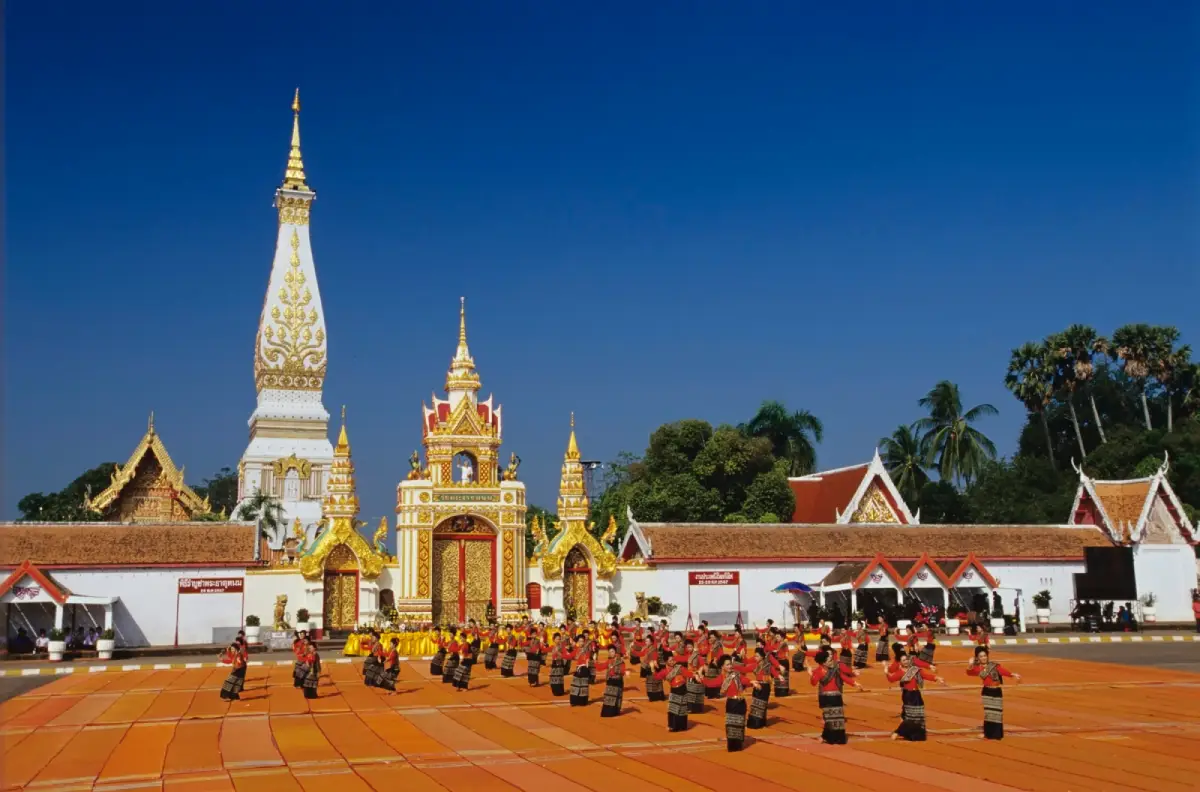
The mass worship dance is one of the festival’s most memorable scenes. Large numbers of performers wear local textiles and move in coordinated formations as an offering to the sacred stupa. It is an expression of community identity and intergenerational cultural transmission, not simply a tourist performance. Spectators should remain behind designated lines, avoid crossing the dancers’ route, and never ask performers to interrupt the ceremony for private photographs.
The festival is the best time to experience the full scale of regional devotion, but it requires careful planning. Accommodation may sell out well in advance, roads may close temporarily, and parking can take considerable time. Visitors should book early, arrive at least one or two hours before major ceremonies, carry water and essential medication, and agree on a meeting point when traveling in a group. Families with small children or elderly members may prefer less crowded times.
Outside the principal festival, the temple observes other events in the Buddhist calendar, including Makha Bucha, Visakha Bucha, Asalha Bucha, Buddhist Lent, the end of Lent, Kathina, Songkran, and regular lunar observance days. Programs vary according to temple announcements. A normal weekday offers a quieter experience, making it easier to study the carved bricks, sit in meditation, and appreciate the architecture without large crowds.
The most comfortable visiting times are generally around 05:30–08:30 and 16:30–19:00. Morning temperatures are cooler, the light is soft, and visitors may observe local merit-making. In the late afternoon, the stupa receives warm light and the temperature falls. After dark, illumination emphasizes its tall form. Photographers generally obtain better results during early or late light than under the harsh midday sun.
The cool season from November to February is usually pleasant, although mornings can be cold enough to require a light jacket. March to May is hot, so water, a hat, and sun protection are important. During the rainy season, approximately May to October, the landscape becomes greener, but visitors should carry rain protection and be cautious on wet stone or tiled surfaces.
Weather forecasts and air-quality information should be checked before traveling, especially during late winter and the hot season. During thunderstorms, visitors should not remain in exposed courtyards near tall structures or large trees. Temporary closures may occur for safety, conservation, or ceremonies even while the temple complex remains open during its regular hours.
The current abbot is Phra Dhamma Wachirasophon, also known as Luang Pu Samli Panyavaro, adviser to the Ecclesiastical Governor of Region 10. His responsibilities include monastic administration, care of the sacred stupa and temple buildings, supervision of monks and novices, organization of religious traditions, and cooperation with government agencies and local communities. Visitors seeking to arrange ceremonies or group activities should contact the temple office rather than attempt to approach the abbot without an appointment.
The temple’s public contact number is +66 63 004 9049, and its email address is watthatphanom@gmail.com. These contacts may be used to ask about internal-building access, current ceremonies, group visits, Sangha offerings, filming permission, or festival arrangements. Calls should be made during reasonable daytime hours, with the purpose stated clearly. Staff may not always respond immediately when they are assisting ceremonies or large numbers of pilgrims.
Travel from Nakhon Phanom city follows Highway 212 south toward That Phanom District. The road distance is approximately 52–53 kilometers, and driving normally takes around 50–70 minutes, depending on traffic. Most of the route is paved and clearly signed. On entering That Phanom Municipality, drivers should follow local signs and any temporary traffic arrangements. Navigation systems should use the full name “Wat Phra That Phanom Woramahawihan” to avoid confusion with similarly named temples.
From Nakhon Phanom Airport, the road journey is approximately 65–75 kilometers, depending on the chosen route. Rental cars, prearranged taxis, and private transfers are the most practical options because direct public transport from the airport is limited. Travelers should agree on the fare, return pickup time, waiting arrangement, and any additional stops before departure.
From Mukdahan, Highway 212 leads north for approximately 50–55 kilometers. Travelers from Sakon Nakhon may use routes through Na Kae District or connect with Highway 212 near Nakhon Phanom. Long-distance drivers should check fuel, rest when tired, and remain alert for motorcycles, agricultural vehicles, local traffic, and turning points through settlements.
Bus and minivan services between Nakhon Phanom, Mukdahan, and That Phanom may change their timetables and operating patterns. Public-transport users should confirm details with the bus terminal or operator shortly before travel. After arriving in That Phanom town, the temple can be reached on foot, by motorcycle taxi, or by local transport. The last return service should be confirmed in advance, especially for evening visits.
A half-day itinerary may begin with an early visit to the temple, worship at the stupa, clockwise circumambulation, and visits to the ordination hall, Ho Phra Kaeo, and historical areas. Travelers can then walk through the old community, visit the Ruang Aram Ratsadakorn Gate and Mekong riverfront, and enjoy Vietnamese or local northeastern food before returning.
A full-day itinerary can add Wat Phra That Renu in Renu Nakhon District, associated with Monday-born people, or Wat Maruk Khanakhon, connected with the history of an earlier settlement. Visiting both requires an early start and a realistic lunch break. Temple travel is more meaningful when sufficient time is allowed for worship, interpretation, and observation rather than treating each location as a rapid photo stop.
That Phanom Walking Street and the Mekong riverfront are pleasant in the evening, although market days and the number of vendors vary according to local events. Travelers planning specifically for the market should confirm its current schedule with That Phanom Municipality. Local food, sweets, woven textiles, clothing, and souvenirs are available, and buying from community businesses helps circulate tourism income locally.
Dining around the temple includes Vietnamese cuisine, Thai and Isan dishes, Mekong fish, cafés, and hotel restaurants. Daothong is a long-established Vietnamese restaurant close to the temple, serving dishes such as Vietnamese rice-noodle soup, steamed rice rolls, Vietnamese sausage, and shared family plates. Krua Rim Khong View, approximately two kilometers away, offers a riverside atmosphere. Hotel cafés and restaurants provide air-conditioned alternatives for visitors who need a longer rest.
Restaurant hours may change due to weekly closing days, ingredient availability, and seasonal demand. Small restaurants and establishments serving tour groups can become busy. Groups should telephone ahead and state the number of diners. Travelers with allergies should ask about fish sauce, peanuts, dried shrimp, fermented ingredients, and cooking oils, as several Vietnamese and northeastern dishes contain ingredients that are not immediately visible.
Accommodation near Phra That Phanom ranges from guesthouses and small hotels to heritage properties and riverside hotels. Several are located within approximately 500 meters to two kilometers of the temple. Staying in That Phanom makes an early-morning visit easy and allows travelers to explore the community on foot. During the annual festival, rooms should be reserved weeks in advance, and cancellation conditions should be checked before payment.
Elderly travelers should ask hotels about ground-floor rooms, elevators, bathroom rails, parking, and the actual walking distance from the room to the entrance. A hotel name containing “River View” does not guarantee that every room faces the Mekong, so the room category should be confirmed. Drivers should also ask whether parking is private, roadside, or located in a separate nearby area.
Responsible travel begins with respect for the monastery, the community, and the environment. Flowers, incense, candle remains, plastic, and food should be placed only in designated containers. Visitors should avoid single-use packaging, never climb archaeological bases, and never touch or mark carved surfaces. A modest offering presented with a calm mind is more appropriate than excessive ritual materials that later become waste.
Supporting local restaurants, accommodation, transport providers, textile makers, and community products helps distribute the benefits of tourism. Bargaining should remain polite, and people should not be photographed in ways that violate their privacy. Documentary makers and content creators should obtain consent before interviews or filming ceremonies and must avoid exaggerating miraculous claims merely to attract attention.
Phra That Phanom is included on Thailand’s UNESCO World Heritage Tentative List under the title “Phra That Phanom, its related historic buildings and associated landscape.” Tentative-list status recognizes the potential importance of the stupa, its historic architectural development, living rituals, and relationship with the Mekong landscape. It does not mean that the site has already received full World Heritage inscription. Accurate communication should describe it as a property on Thailand’s Tentative List.
The value of Phra That Phanom lies not only in age or architectural beauty but also in the generations that have built, repaired, worshipped, and protected it. The 1975 collapse and the completion of reconstruction in 1979 demonstrate that cultural heritage can suffer catastrophic loss yet recover through public cooperation, professional knowledge, and sustained devotion.
Visitors should therefore allow more time than a brief photograph at the entrance. Walking slowly around the monument, studying the carved bricks, sitting quietly in a viharn, learning about Phu Kamphra, and speaking respectfully with local residents reveal the many layers of meaning. Phra That Phanom is simultaneously a Buddhist relic stupa, an archaeological monument, a ritual center, a symbol of Nakhon Phanom, and a cultural bridge between communities on both banks of the Mekong.
Whether arriving as a Buddhist pilgrim, historian, international traveler, photographer, or family, each visitor can encounter the site differently. Devotees may worship and make merit; art lovers may examine its form and ornament; social historians may observe the strength of community traditions; and children may learn that conservation does not mean freezing a monument in the past. It means caring for an active sacred place so that it remains meaningful to future generations.
Before traveling, visitors should check current ceremonies, weather, traffic, and accommodation. Groups should contact the temple, and everyone should prepare modest clothing, easily removable shoes, drinking water, personal medication, and some cash. Festival visitors should reserve accommodation and allow additional travel time. Those seeking a quieter experience should choose a weekday morning.
Phra That Phanom brings legend, archaeology, architecture, ritual, landscape, and community life together in one place. A single visit can introduce travelers to the history of the middle Mekong, the diversity of local peoples, and the role of faith in building towns, preserving traditions, and uniting communities. The stupa is therefore not simply a destination to be seen. It is a place that encourages reflection on mindfulness, gratitude, ethical conduct, and responsibility for a shared cultural inheritance.
| Part 1: Essential Information About Phra That Phanom and Wat Phra That Phanom Woramahawihan | |
| Name | Phra That Phanom at Wat Phra That Phanom Woramahawihan |
| Category | Buddhist relic stupa, archaeological monument, and first-class royal monastery of Woramahawihan rank |
| Address | 183 Moo 13, Chayangkun Road, That Phanom Subdistrict, That Phanom District, Nakhon Phanom Province 48110, Thailand |
| Coordinates | 16.9436, 104.7262 |
| Open Days | Daily |
| Opening Hours | 05:00–21:00; individual buildings and exhibitions may follow different schedules |
| Admission Fee | Free admission; voluntary donations are welcome |
| Sacred Relic | The Urangkhathat, traditionally identified as the Buddha’s sacred breastbone relic |
| Archaeological Date | The earliest known architectural phase dates approximately to the 7th–9th centuries CE |
| Foundation Legend | Mahakassapa, 500 arahants, and rulers of surrounding Mekong kingdoms constructed a reliquary for the Urangkhathat |
| Architecture | A tall square stupa decorated with carved-brick panels reflecting local, Dvaravati, Cham, and ancient Khmer artistic relationships |
| Dimensions | Approximately 12.33 meters wide on each side and 53.60 meters high, with a gold finial weighing around 110 kilograms |
| Major Historical Event | Collapsed on August 11, 1975, at 19:38 and was reconstructed in its historic form, with completion on March 23, 1979 |
| Royal-Monastery Status | First-class royal monastery of Woramahawihan rank since 1942 |
| Associated Birth Day and Year | Sunday and the Year of the Monkey |
| Abbot | Phra Dhamma Wachirasophon, also known as Luang Pu Samli Panyavaro, adviser to Ecclesiastical Region 10 |
| Main Areas | 1. Phra That Phanom stupa and circumambulation courtyard 2. Ordination hall and Luang Pho Ong Saen Satsada 3. Ho Phra Kaeo Viharn 4. Reclining Buddha and replica Buddha footprint area 5. Historical and archaeological displays 6. Merit-making and Sangha-offering areas 7. Visitor-service and community-shopping areas |
| Facilities | Parking, toilets, seating, flower and offering shops, food vendors, souvenir shops, and community services in the surrounding area |
| Annual Festival | The Phra That Phanom Worship Festival during the third lunar month; the 2026 festival was held from January 26 to February 3 for nine days and nine nights |
| Recommended Visiting Times | 05:30–08:30 and 16:30–19:00 |
| Travel Information | From Nakhon Phanom city, follow Highway 212 south for approximately 52–53 kilometers; normal driving time is about 50–70 minutes |
| Temple Contact | +66 63 004 9049 |
| watthatphanom@gmail.com | |
| Current Status | Open to worshippers and visitors; included on Thailand’s UNESCO World Heritage Tentative List |
| Part 2: Practical Travel Information Around Phra That Phanom | |
| Nearby Attractions | 1. That Phanom Walking Street and Old Community, approximately 1 km; That Phanom Municipality: +66 42 199 688 2. Ruang Aram Ratsadakorn Gate and Mekong Riverfront, approximately 1 km; That Phanom Municipality: +66 42 199 688 3. Phra That Noi Si Bun Rueang, approximately 2 km; local information: +66 42 199 688 4. Wat Phra That Renu, approximately 15 km; +66 42 579 132 5. Wat Maruk Khanakhon, approximately 25 km; +66 61 152 2571 |
| Nearby Restaurants and Cafés | 1. Daothong Vietnamese Restaurant, approximately 0.5 km; +66 98 595 5352 2. Sangthong Heritage Café, approximately 0.8 km; +66 81 578 7960 3. That Phanom River View Hotel Restaurant, approximately 1.1 km; +66 42 541 555 4. Krua Rim Khong View, approximately 2 km; +66 63 428 9415 5. Soda Café That Phanom, approximately 3 km; +66 95 919 5164 |
| Nearby Accommodation | 1. Baan Sabaijai Resort & Omsorgssenter, approximately 0.5 km; +66 96 023 9623 2. Na That Panom Place Hotel, approximately 0.7 km; +66 81 504 7899 3. Sangthong Heritage, approximately 0.8 km; +66 81 578 7960 4. That Phanom River View Hotel, approximately 1.1 km; +66 42 541 555 5. Thatphanom View Hotel, approximately 1.9 km; +66 62 479 5558 6. Zone Stations Thatphanom, approximately 2.6 km; +66 97 165 7999 |
| Distance and Service Note | Distances are approximate road distances from the temple. Confirm the route, current opening hours, room availability, and telephone details before traveling, particularly during the annual festival and public holidays. |
Frequently Asked Questions (FAQ)
Q: On which days and at what times is Phra That Phanom open?
A: Wat Phra That Phanom Woramahawihan is open daily from 05:00 to 21:00. Individual halls, exhibition areas, and restricted religious spaces may follow different schedules.
Q: Is there an admission fee to visit Phra That Phanom?
A: Admission is free. Visitors may make a voluntary donation, support temple maintenance, or purchase appropriate offerings according to their faith.
Q: Which birth day and zodiac year are associated with Phra That Phanom?
A: Phra That Phanom is associated with people born on Sunday and in the Year of the Monkey. Visitors born on other days and in other years are equally welcome.
Q: Which Buddha relic is enshrined inside Phra That Phanom?
A: According to regional Buddhist tradition, the stupa enshrines the Urangkhathat, identified as the Buddha’s sacred breastbone or chest relic.
Q: When is the annual Phra That Phanom Worship Festival held?
A: The festival follows the lunar calendar during the third lunar month, so the Gregorian dates change each year. In 2026 it was held from January 26 to February 3. Visitors planning a later trip should consult a new official announcement.
Q: How long should visitors spend at Wat Phra That Phanom?
A: Allow at least one to two hours to worship, walk clockwise around the stupa, visit the ordination hall and Ho Phra Kaeo, and explore the historical areas. More time is necessary during ceremonies and the annual festival.
Q: How can travelers reach Phra That Phanom from Nakhon Phanom city?
A: Follow Highway 212 south toward That Phanom District for approximately 52–53 kilometers. Driving normally takes about 50–70 minutes. Private cars, rental vehicles, taxis, and public transport passing through That Phanom may be used.
Q: What clothing and behavior are appropriate at the temple?
A: Cover the shoulders and knees, remove shoes where required, speak quietly, avoid pointing the feet toward Buddha images or monks, do not touch archaeological materials, and never disrupt worshippers or ceremonies for photography.
 Category: ●Places of Worship
 Group: ●Other Sacred Sites
Last Update : 3 MonthAgo
 Last Update : 3 MonthAgo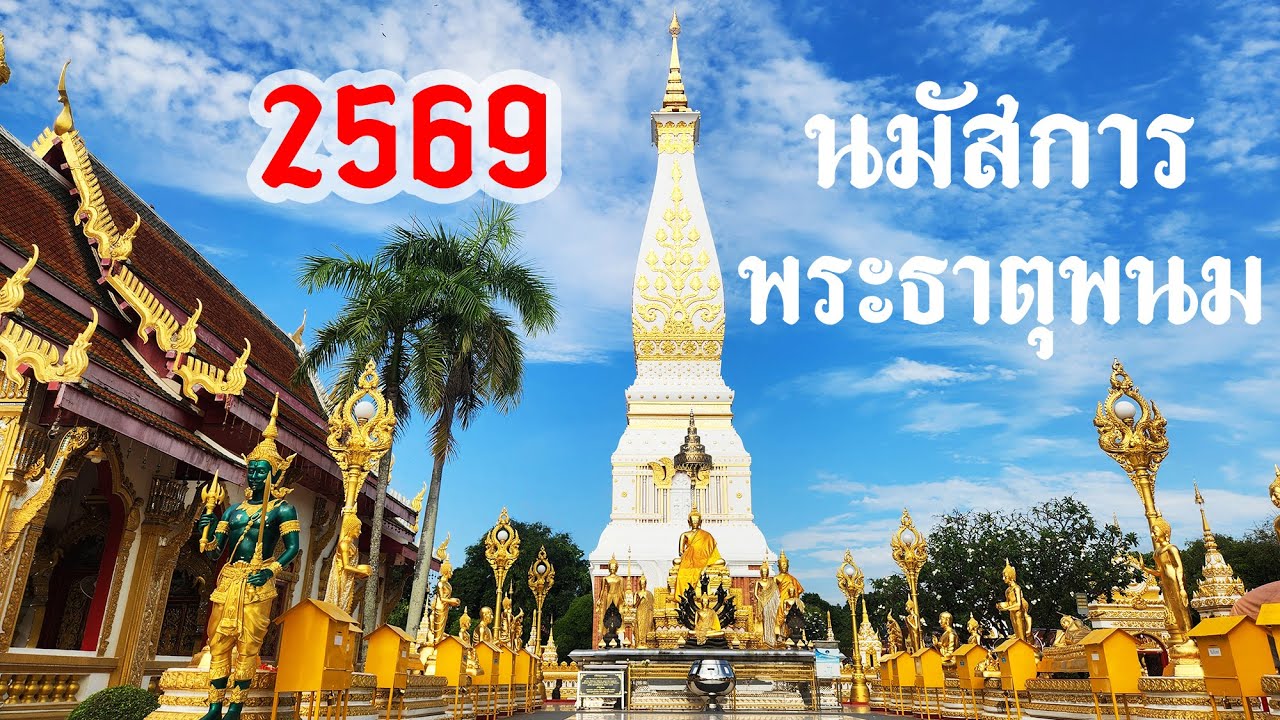
 Click to Access the Navigation Map GPS
Phra That Phanom Map
Recommend

 Art, Culture and Heritage
 Historical Sites and Monuments(3)
 Landmarks and Memorials(2)
 Art, Craft Centres, Tradition(3)
 Museums(3)
 Educational Places
 Library(1)
 Temple(23)
 Church(1)
Other Sacred Sites(11)
Church(1)
Other Sacred Sites(11)
 Suburban Living
 Village, Community(5)
 Nature and Wildlife
 National Parks and Marine Reserves(1)
 Dam, Reservoir, Lake(5)
 Waterfalls(2)
 River, Canal(3)
 Bays and Beaches(3)
 Other natural attractions(2)
 Entertainment and Agricultural
 Zoos and Aquariums(1)
 Farms, Parks and Ecotourism(2)
 Shopping
 Shopping and Night Market(1)
 Travel Articles, Recipes
 Travel Review, Food Review(1)


