
lovethailand home >Northeastern Travel Attractions >Maha Sarakham Travel Attractions >Wapi Pathum >Dong Yai > Ya Pho Pu Shrine
TL;DR: Ya Pho Pu Shrine is located at Dong Yai Subdistrict, Wapi Pathum District, Maha Sarakham Province, open Daily, hours 08.00 – 17.00.
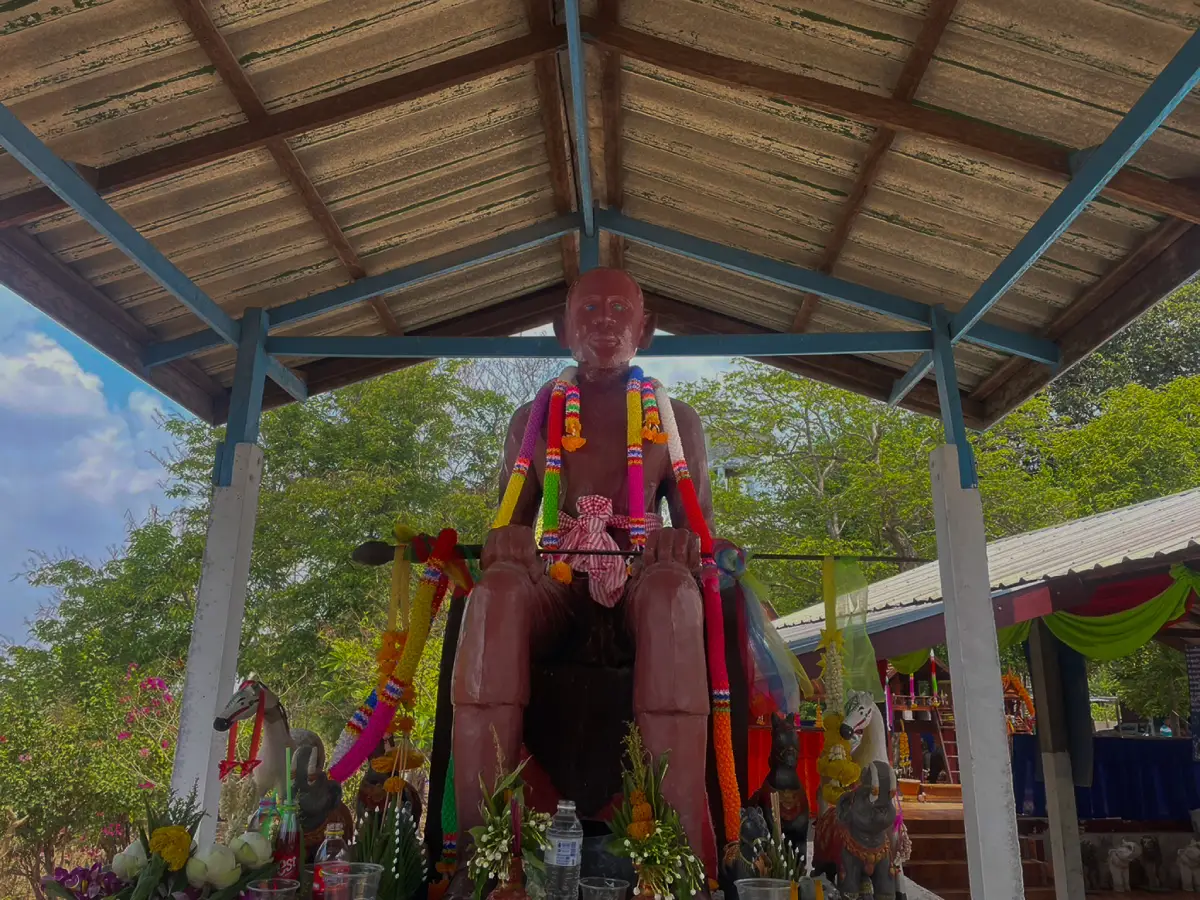
Ya Pho Pu Shrine
Open Days: Daily
Opening Hours: 08.00 – 17.00
Ya Pho Pu Shrine in Maha Sarakham Province is an important sacred community site in Dong Yai Subdistrict, Wapi Pathum District. It is deeply respected by the people of Dong Yai as a spiritual center of the community, a place where villagers pay homage, ask for blessings, and express gratitude to the guardian spirit believed to protect the village. Ya Pho Pu is part of the Isan belief system connected with pu ta, or village guardian ancestor spirits, who are believed to protect local people, safeguard community life, and maintain harmony between humans, nature, farmland, forests, and the unseen world.
For travelers who want to understand Maha Sarakham beyond well-known temples and city landmarks, Ya Pho Pu offers a deeper view of local Isan spirituality. It is not a large tourist attraction created for entertainment. It is a sacred place that belongs to the community, shaped by inherited belief, agricultural life, forest resources, annual ceremonies, and the memory of local ancestors. The shrine is especially meaningful because the people of Dong Yai hold a worship ceremony for Ya Pho Pu every Buddhist Lent Day, preserving a tradition that connects Buddhism, village guardian belief, and community unity.
Dong Yai Subdistrict is located in Wapi Pathum District, Maha Sarakham Province. The area consists of upland and lowland terrain, rice fields, open forests, dry dipterocarp woodland, community forests, ponds, streams, and agricultural land. Local people have long lived with rice farming, livestock, vegetables, community forest use, and seasonal natural resources. In such an environment, belief in a guardian spirit is not abstract. It is tied to real life, rainfall, rice cultivation, forest products, health, safety, and community well-being.
In Isan culture, the words pu ta or ya pho pu refer to sacred guardian ancestor spirits. The word “pu” relates to elder ancestors on the father’s side, while “ta” relates to elder ancestors on the mother’s side. Over many generations, when the names of individual ancestors can no longer be clearly remembered, the community honors them collectively as guardian spirits. These spirits are believed to protect the village, watch over descendants, and bless the land with peace and fertility. Ya Pho Pu of Dong Yai belongs to this broader cultural tradition.
Many pu ta shrines in northeastern Thailand are located on raised ground, in old woodland, near community forests, or in quiet sacred areas. These places are often treated with care. People may avoid cutting trees, disturbing the land, or behaving improperly near the shrine. This makes the shrine not only a spiritual place, but also part of a local system of environmental respect. At Dong Yai, this relationship is especially important because the subdistrict is known for community forests such as Dong Yai Community Forest and Khok Yai Community Forest.
Ya Pho Pu is one of the respected local sites of Dong Yai Subdistrict, together with conservation-oriented places and community resources such as Dong Yai Community Forest, Khok Yai Community Forest, and the local mushroom festival. These elements show that local belief and natural landscapes are closely connected. Forests provide seasonal food, herbs, mushrooms, bamboo shoots, red ant eggs, wild vegetables, firewood, and useful plants. The guardian shrine provides spiritual order, reminding the community to respect land, ancestors, and shared resources.
Ban Dong Yai is a community with strong local customs. The people have their own traditions inherited from earlier generations. Most villagers have historically depended on rice farming, while supplementary occupations include livestock raising, making traditional energy-saving stoves, mulberry and silk-related activities, and growing vegetables. Social life in the village is based on mutual support, kinship-like relationships, and community cooperation. Beliefs such as soul-calling ceremonies, village spirit rituals, and the annual worship of Ya Pho Pu remain part of this local cultural system.
The annual worship ceremony for Ya Pho Pu on Buddhist Lent Day is one of the key expressions of community respect. The ceremony carries several meanings. It asks for blessings, peace, protection, and good fortune for the village. It also brings community members together at an important moment in the Buddhist calendar. At another level, it shows how Isan communities integrate Buddhist practice with older local beliefs in guardian ancestors. This combination is one of the most distinctive features of spiritual life in northeastern Thailand.
Buddhist Lent marks the beginning of the three-month rainy-season retreat for monks. Thai Buddhists usually make merit, offer candles, offer bathing cloths, listen to sermons, and make personal commitments to moral discipline. When Dong Yai villagers perform the Ya Pho Pu worship ceremony during this period, the ritual becomes a way to begin the season with purity, blessing, and shared intention. The community asks the guardian spirit to protect the village while people also renew their Buddhist commitments.
The belief in Ya Pho Pu is also closely connected with agriculture. Dong Yai is a farming area where rice cultivation depends heavily on seasonal rain. In Isan culture, rituals before and during the rainy season often express concern for water, crops, soil, and community well-being. The worship of Ya Pho Pu helps villagers feel spiritually prepared for the farming cycle. It is not only about asking for supernatural help; it is also about gathering the community and affirming shared responsibility for the year ahead.
Dong Yai Subdistrict consists of several villages, including Ban Dong Yai, Ban Don Charoen, Ban Kut Khaen, Ban Thap Khrua, Ban Ko, Ban Nong No, Ban Don Han, Ban Nong Nok Khian, Ban Nam Jok, and Ban Ko Noi. The belief in Ya Pho Pu is connected to the wider community network of the subdistrict. In particular, the tradition of Bun Ya Pho Pu and Bun Bang Fai dedicated to Ya Pho Pu in the Nong Khun, Ban Don Han, and Ban Don Charoen area shows how the guardian spirit functions as a shared sacred figure within the local cultural landscape.
Bun Bang Fai, or the rocket festival, is an important Isan tradition connected with asking for rain. When it is offered to Ya Pho Pu, the ceremony brings together the idea of requesting rainfall from the sky and honoring the guardian spirit of the village. The festival is therefore not only a celebration. It is an agricultural, spiritual, and communal practice that expresses hope for timely rain, fertile fields, and a good rice-growing season.
From an anthropological perspective, a pu ta shrine defines the spiritual boundary of a village. People know that the area should be treated with respect. Improper behavior, rude speech, careless disturbance of trees, and disrespect toward sacred objects are avoided. This belief system helps maintain social discipline. It reminds villagers and visitors that community life requires respect for elders, ancestors, land, water, forests, and unseen guardians.
Many Isan communities have a ritual specialist, often known locally as thao cham, who helps communicate with the guardian spirit and leads important ceremonies. The specific details vary from village to village, but the core idea is to inform the spirit, ask permission, make offerings, and request protection. The Ya Pho Pu ceremony is therefore not casual entertainment. It is a structured sacred practice guided by local tradition.
Visitors should approach Ya Pho Pu with respect. This is a sacred local shrine, not a tourist site designed for amusement. Visitors should dress modestly, speak quietly, avoid touching offerings or sacred objects without permission, and refrain from intrusive photography. During annual rituals, the community and ritual participants should be given priority. If visitors wish to take close-up photos or observe the ceremony more closely, they should ask local people or caretakers first.
Offerings for Ya Pho Pu may vary according to the custom of each village. In many Isan communities, offerings can include flowers, incense, candles, ritual trays, food, sweets, or ceremonial items determined by elders. General visitors can pay respect quietly and sincerely. During the annual ceremony, it is best to follow the instructions of local villagers and allow the ritual leaders to proceed according to community tradition.
The surrounding environment of Dong Yai makes a visit to Ya Pho Pu more meaningful. This is a place where faith, forests, farming, and local livelihood come together. Dong Yai Community Forest and Khok Yai Community Forest are important natural resources. They provide seasonal foods such as wild mushrooms, bamboo shoots, herbs, red ant eggs, wild vegetables, and other forest products. The belief in Ya Pho Pu reinforces the importance of respecting these shared natural areas.
The mushroom festival of Dong Yai also reflects the richness of local forest resources. Wild mushrooms are seasonal products known through local knowledge: where to find them, when to collect them, and how to use them safely. The relationship between Ya Pho Pu, the community forest, and local forest products shows how spiritual belief can support environmental awareness and community identity.
Cultural travelers should see Ya Pho Pu as an entry point into the wider world of Isan village culture. Understanding this shrine helps visitors understand other traditions as well, including Heet Sip Song, village spirit rituals, soul-calling ceremonies, offerings to field spirits, rain-seeking rituals, Buddhist Lent merit-making, and the annual cycle of agricultural life. These traditions form a cultural network that gives Isan communities their moral and social structure.
Nearby sites in Wapi Pathum and the surrounding area can be combined with a visit to Ya Pho Pu. These include Dong Yai Community Forest, Khok Yai Community Forest, Nong Khun, Ban Don Han, Ban Don Charoen, Phra That Huam Haeng, Wat Pa Kung or Wat Prachakhom Wanaram, and Ku Ban Sanam or Wat Ku Sunthararam. Together, these places offer a route that combines guardian-spirit belief, community forest, agricultural life, Buddhist architecture, and local history.
Phra That Huam Haeng is an important religious site in Wapi Pathum District, while Wat Pa Kung is known for its impressive Buddhist architecture inspired by Borobudur. Ku Ban Sanam, located at Wat Ku Sunthararam in Suea Kok Subdistrict, is an ancient site connected with local history and ritual tradition. By connecting these places with Ya Pho Pu, travelers can see the diversity of faith in Maha Sarakham: Buddhist temples, local shrines, ancient sites, and living community traditions.
For foreign travelers, Ya Pho Pu can be described as a village guardian ancestor spirit shrine or the sacred guardian shrine of Dong Yai community. It is not a Buddhist temple and not a Chinese shrine. It belongs to the local Isan belief system, where guardian ancestors protect the village and preserve harmony between people and place. This explanation helps foreign visitors understand why a small shrine can carry great cultural meaning.
When explaining Ya Pho Pu to foreign visitors, it is important to use respectful language. The ceremony should not be presented as something strange or exotic. For Dong Yai villagers, Ya Pho Pu is a real spiritual presence in community life. The shrine is a place of prayer, ritual, memory, and identity. Good cultural tourism should help local people feel that visitors understand and respect their sacred place.
The best time to visit Ya Pho Pu is in the morning or late afternoon, when the weather is more comfortable and the atmosphere is calmer. Those who want to experience the annual ceremony should visit during Buddhist Lent Day, when villagers perform the worship ritual. Travelers interested in Bun Ya Pho Pu or Bun Bang Fai dedicated to Ya Pho Pu should check the schedule with the local community or Dong Yai Subdistrict Administrative Organization before traveling, as the date may follow the lunar calendar and local arrangements.
Getting There is most convenient by private car. From Maha Sarakham city, travel toward Wapi Pathum District and continue to Dong Yai Subdistrict. The distance from Maha Sarakham city is approximately 45 km. A private car is recommended because it allows travelers to continue easily to Dong Yai Community Forest, Khok Yai Community Forest, Nong Khun, Ban Don Han, Ban Don Charoen, and other nearby places in Wapi Pathum District.
Visitors who are unfamiliar with the area should use online maps together with local directions. Community shrines may not always have large tourist signs like major attractions. Asking local people can also help visitors learn proper manners, suitable visiting times, and important ritual guidelines.
A visit to Ya Pho Pu can be planned as a half-day or full-day cultural route. A half-day route may include the shrine, Dong Yai village, and nearby community forest areas. A full-day route can continue to Phra That Huam Haeng, Wat Pa Kung, Ku Ban Sanam, and the Wapi Pathum town area for food and rest. This type of route is suitable for travelers interested in local faith, community forest, agricultural life, and cultural history.
Visitors should prepare modest clothing, comfortable walking shoes, drinking water, a hat or umbrella, and simple offerings if they wish to pay respect. During the Buddhist Lent ceremony, visitors should arrive early, observe respectfully, avoid walking in front of ritual leaders, keep noise low, and take photos carefully. Visiting a guardian shrine is not just sightseeing; it is entering a sacred community space.
Wapi Pathum District has local restaurants, cafés, and accommodations that can support a visit to Dong Yai. Food options include local Isan food, casual Thai restaurants, cafés, and community eateries. Accommodation options include homestays in Dong Yai, resorts in Wapi Pathum, and hotels in Maha Sarakham or nearby towns. Travelers who want a close community experience may stay near Dong Yai, while those who prefer more services can stay in Wapi Pathum or Maha Sarakham city.
Ya Pho Pu may not be physically large, but it is spiritually important to the people of Dong Yai. Its value lies in faith, memory, annual ritual, community continuity, and respect for ancestors. Places like this show that meaningful cultural destinations do not need to be monumental. They need to be alive, respected, and rooted in the lives of local people.
Overall, Ya Pho Pu in Maha Sarakham Province is an important cultural destination in Wapi Pathum District. It connects guardian ancestor belief, Buddhist Lent worship, Bun Ya Pho Pu, Nong Khun, Dong Yai Community Forest, Khok Yai Community Forest, rice farming, mushroom traditions, and the cultural identity of Dong Yai Subdistrict. Visitors who want to understand Maha Sarakham more deeply should come with respect and patience, allowing the shrine to reveal the spiritual roots of an Isan farming community.
| Name | Ya Pho Pu Shrine |
| Location | Dong Yai Subdistrict, Wapi Pathum District, Maha Sarakham Province |
| Address | Dong Yai Subdistrict, Wapi Pathum District, Maha Sarakham 44120, Thailand |
| Highlights | Sacred guardian ancestor shrine of Dong Yai community, with an annual worship ceremony held on Buddhist Lent Day |
| History / Background | Connected with Isan pu ta belief, in which a sacred guardian ancestor spirit protects the village and serves as a spiritual center for the community |
| Name Origin | Ya Pho Pu is a local term for a sacred guardian ancestor spirit in the Isan pu ta belief system. |
| Distinctive Features | Community shrine and sacred ceremonial area connected with Buddhist Lent worship, local forest culture, rice farming, and community guardian belief |
| Local Belief | Local people believe Ya Pho Pu protects the community, keeps villagers safe, brings peace, and serves as the spiritual center of Dong Yai. |
| Related Tradition / Ritual | Annual worship ceremony on Buddhist Lent Day, and Bun Ya Pho Pu or Bun Bang Fai dedicated to Ya Pho Pu in the Nong Khun, Ban Don Han, and Ban Don Charoen area |
| Travel Information | Private car is the most convenient option. From Maha Sarakham city, travel toward Wapi Pathum District and continue to Dong Yai Subdistrict, about 45 km from the city. |
| Current Status | Open for worshippers and visitors as a sacred community site of Dong Yai Subdistrict |
| Open Days | Daily |
| Opening Hours | 08.00 – 17.00 |
| Facilities | Worship area, ceremonial space, surrounding community area, and routes linking Dong Yai Community Forest, Khok Yai Community Forest, and Ban Don Han-Ban Don Charoen |
| Main Areas / Zones | Ya Pho Pu shrine or sacred worship area, ceremonial courtyard, offering area, annual ritual space, and surrounding Dong Yai community area |
| Caretaker / Related Authority | Dong Yai community, village committee, local ritual specialist according to community tradition, and Dong Yai Subdistrict Administrative Organization |
| Local Authority Contact | Dong Yai Subdistrict Administrative Organization, Tel. 043-706-731 |
| Official Website / Official Page | Dong Yai Subdistrict Administrative Organization, Wapi Pathum District, Maha Sarakham Province |
| Nearby Tourist Attractions | 1. Dong Yai Community Forest, about 1 km 2. Khok Yai Community Forest, about 3 km 3. Nong Khun, Ban Don Han-Ban Don Charoen, about 5 km 4. Wat Ban Dong Yai, about 1 km 5. Ban Don Han-Ban Don Charoen, about 5 km 6. Phra That Huam Haeng, Wapi Pathum District, about 12 km 7. Wat Pa Kung or Wat Prachakhom Wanaram, about 25 km 8. Ku Ban Sanam or Wat Ku Sunthararam, about 28 km |
| Nearby Restaurants | 1. Khun Yai Pu Cafe, Ban Dong Yai, about 1 km, Tel. 089-612-2131 2. Krua Ban Term Fan, Wapi Pathum, about 11 km, Tel. 084-852-8954 3. Ban Khun Yai Pu Cafe, about 1 km, Tel. 089-612-2131 4. Ran Det Wapi Pathum Moo Kratha, about 12 km, Tel. 094-415-5514 5. Madam Zapp Wapi Pathum, about 12 km, Tel. 095-387-4545 6. Chom Chan Lanna Wapi Pathum, about 15 km |
| Nearby Accommodations | 1. Ban Dong Yai Homestay, about 1 km 2. Baan Ai-Aun Resort Wapi Pathum, about 12 km, Tel. 081-193-3142 3. Ban Pruksa Hotel Wapi Pathum, about 12 km, Tel. 091-150-5559 4. Praiyanan Place Maha Sarakham, about 40 km, Tel. 043-777-339, 097-223-9923 5. Baan Charnchol Resort Maha Sarakham, about 41 km, Tel. 094-929-6201 6. Top Inn Hotel Maha Sarakham, about 45 km, Tel. 043-711-979 |
Frequently Asked Questions (FAQ)
Q: Where is Ya Pho Pu Shrine located?
A: Ya Pho Pu Shrine is located in Dong Yai Subdistrict, Wapi Pathum District, Maha Sarakham Province.
Q: Why is Ya Pho Pu important?
A: It is the spiritual center of Dong Yai community. Local people believe that Ya Pho Pu protects the village, safeguards descendants, and brings peace to the community.
Q: What are the opening hours of Ya Pho Pu Shrine?
A: The shrine is open daily from 08.00 to 17.00.
Q: When is the annual Ya Pho Pu worship ceremony held?
A: The annual worship ceremony is held on Buddhist Lent Day every year, when villagers gather to pay respect and ask for blessings.
Q: Is Ya Pho Pu a Buddhist temple?
A: No. It is not a Buddhist temple. It is a sacred community shrine connected with Isan guardian ancestor spirit belief.
Q: How can travelers get to Ya Pho Pu Shrine?
A: A private car is the most convenient option. From Maha Sarakham city, travel toward Wapi Pathum District and continue to Dong Yai Subdistrict, about 45 km from the city.
Q: How should visitors behave at the shrine?
A: Visitors should dress modestly, speak quietly, pay respect properly, avoid touching sacred objects without permission, and ask local people before taking close-up photos or joining rituals.
Q: What nearby places can travelers visit after Ya Pho Pu Shrine?
A: Travelers can continue to Dong Yai Community Forest, Khok Yai Community Forest, Nong Khun, Ban Don Han-Ban Don Charoen, Phra That Huam Haeng, Wat Pa Kung, and Ku Ban Sanam.
 Category: ●Places of Worship
 Group: ●Other Sacred Sites
Last Update : 2 MonthAgo
 Last Update : 2 MonthAgo
 Click to Access the Navigation Map GPS
 Art, Culture and Heritage
 Historical Sites and Monuments(4)
 Art, Craft Centres, Tradition(5)
 Museums(3)
 Temple(17)
Other Sacred Sites(7)
Temple(17)
Other Sacred Sites(7)
 Research and Development
 Royal Project(2)
 Suburban Living
 Village, Community(5)
 Nature and Wildlife
 National Parks and Marine Reserves(3)
 Dam, Reservoir, Lake(10)
 River, Canal(2)
 Bays and Beaches(2)
 Other natural attractions(2)
 Entertainment and Agricultural
 Farms, Parks and Ecotourism(3)
 Travel Articles, Recipes
 Food Menu, Northeastern Recipes(1)


