
lovethailand home >Northeastern Travel Attractions >Maha Sarakham Travel Attractions >Borabu >Nong Ko > Rong Hua Chang Reservoir
TL;DR: Rong Hua Chang Reservoir is located at Ban Nong Tup, Nong Ko Subdistrict, Borabue District, Maha Sarakham Province, open Daily, hours 08.00 – 17.00.

Rong Hua Chang Reservoir
Open Days: Daily
Opening Hours: 08.00 – 17.00
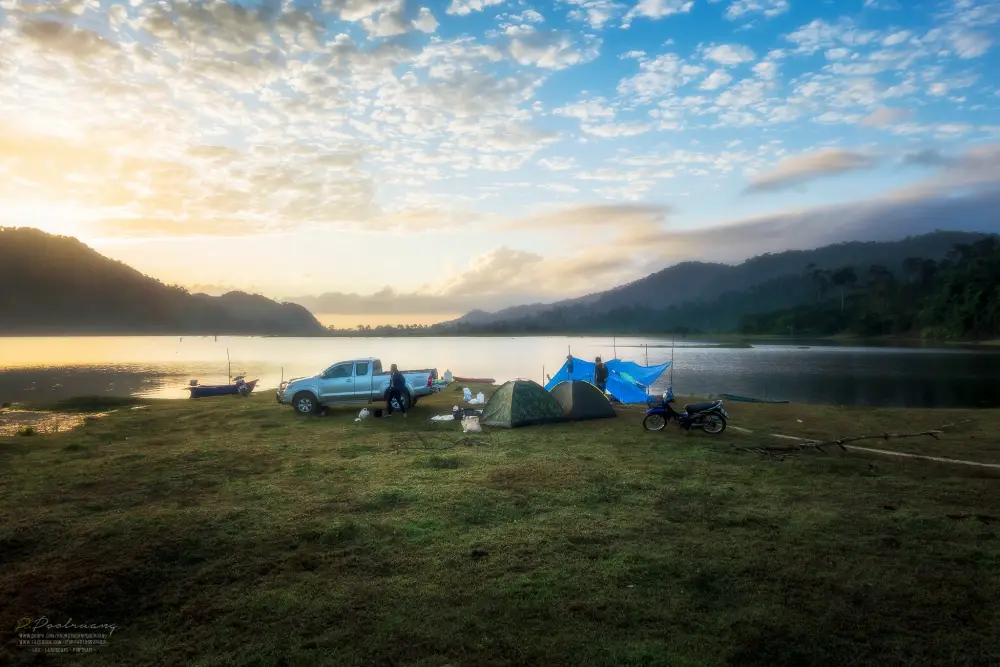
Rong Hua Chang Reservoir in Maha Sarakham Province is a medium-sized reservoir located around Ban Nong Tup, Nong Ko Subdistrict, Borabue District. It is an important local water source and a quiet natural place for travelers who enjoy calm rural scenery, wide water views, open sky, and a peaceful atmosphere away from crowded tourist areas. The reservoir covers approximately 1.780 square kilometers, or about 1,125 rai, and has a watershed area of about 16.75 square kilometers. It is closely connected with local agriculture, irrigation, and community life in Nong Ko Subdistrict.
For foreign travelers, Rong Hua Chang Reservoir is best understood as a local countryside reservoir rather than a commercial tourist attraction. It does not have large entertainment facilities or a busy tourist center. Instead, it offers water, wind, rural roads, agricultural scenery, and a sense of quietness that reflects everyday life in rural northeastern Thailand. Visitors can stop here to rest, take photos, enjoy the breeze, observe the water landscape, and experience a slower side of Maha Sarakham Province.
The reservoir is located at Ban Nong Tup in Nong Ko Subdistrict, Borabue District, Maha Sarakham Province. From Maha Sarakham city, travelers can take Chaeng Sanit Road toward Borabue District. The route continues toward the local road near Baan Suan Kitchen, then passes Ban Plueai and Ban Nong Tup before reaching Rong Hua Chang Reservoir. Because the final section passes through local communities, private car or motorcycle is the most convenient way to visit.
The landscape around Rong Hua Chang Reservoir reflects the agricultural character of Borabue District. The surrounding area includes villages, fields, rural roads, and open land. In this setting, the reservoir plays an important role as a water storage area and as a calm public landscape. The wide water surface softens the heat of the countryside and creates a refreshing atmosphere, especially in the morning and late afternoon. The area is suitable for people who prefer natural and quiet destinations rather than highly developed attractions.
The main value of Rong Hua Chang Reservoir lies in its function as a real community water resource. It is under the responsibility of irrigation authorities and is used as a water source for agriculture in nearby areas. This makes the place meaningful beyond tourism. The reservoir supports the relationship between water, farming, villages, and local livelihoods. Travelers who visit should therefore see the reservoir not only as a viewpoint but also as an important part of the local landscape.
The name “Rong Hua Chang” is distinctive and strongly local. In Thai, “rong” often refers to a channel, watercourse, or low-lying water passage, while “Hua Chang” is a local place name. The official and commonly used tourism name is “Rong Hua Chang Reservoir.” Because Thai place names are sometimes passed on through spoken directions, minor spelling variations may appear, but the name used for this article follows irrigation and tourism references.
The most interesting area for visitors is the reservoir edge and dam crest zone. From this area, travelers can see the water surface, open sky, and rural surroundings. The view is simple but relaxing. In the morning, the light is soft and the air is more comfortable. In the late afternoon, the sun becomes warmer and the water reflects the changing sky. These times are better for photography and relaxation than the hotter midday period.
Rong Hua Chang Reservoir is suitable for a short scenic visit of about 1 to 2 hours. Visitors can stop to rest, take photos, observe the landscape, and enjoy the quiet air. If you want to explore the surrounding area more fully, plan a half-day route that includes Ban Plueai, Borabue town, local temples, restaurants along Chaeng Sanit Road, and nearby accommodations. This kind of itinerary gives travelers a broader impression of Borabue District, combining water, rural communities, local food, and small-town life.
The main zones around the reservoir can be understood in several parts. The first is the main water area, which forms the visual heart of the reservoir. The second is the dam crest or reservoir edge, where visitors can enjoy the broadest view. The third is the irrigation canal and water management area, which reflects the reservoir’s practical role. The fourth is the access route through Ban Nong Tup, which connects the reservoir with the local community. The fifth is the Ban Plueai and Nong Ko community zone, which gives the journey its rural context.
Driving through Ban Plueai and Ban Nong Tup is part of the experience. These villages show the rural character of Nong Ko Subdistrict. Travelers will see local houses, agricultural land, community roads, and a slower pace of life before reaching the reservoir. For visitors who want to understand Thailand beyond major cities and famous destinations, this route offers a quiet glimpse of daily life in an Isan farming community.
Photography at Rong Hua Chang Reservoir is best planned around natural light. Wide shots from the reservoir edge can capture the water, sky, and rural background. The dam crest can be used as a leading line in photos. Morning light gives a calm and clean feeling, while late afternoon light adds warmth to the water and sky. Visitors who want peaceful images should come on weekdays or during quieter hours.
The recommended visiting time is 08.00 to 17.00. Although reservoirs in rural areas often feel open and informal, visiting during daylight is safer and more convenient. Daylight makes it easier to follow the route through local villages, observe the road conditions, and avoid isolated areas after dark. This is especially important for travelers who are not familiar with Ban Plueai, Ban Nong Tup, or Nong Ko Subdistrict.
Families can use Rong Hua Chang Reservoir as a short rest stop, especially when traveling along the Maha Sarakham–Borabue route. Children can learn about reservoirs, irrigation, water use, and farming communities, while adults can relax and take photos. Parents should keep children away from the water’s edge, irrigation canals, and sloped areas. Elderly visitors should choose easy-access viewpoints and avoid walking on uneven surfaces.
Because this is a functional reservoir, visitors should behave responsibly. Do not throw rubbish into the water, do not enter restricted irrigation areas, and do not swim in places without safety supervision. Travelers should also avoid disturbing local residents, blocking local roads, or making loud noise. The reservoir is both a community resource and a natural resting place, so respectful use is essential.
Food options are not concentrated directly at the reservoir, so travelers should plan meals along the main road or in Borabue town. Nearby options include local restaurants and cafés such as Baan Roi Sin Restaurant in Borabue, small made-to-order food shops in the district, and cafés along the Chaeng Sanit route. It is practical to eat before or after visiting the reservoir rather than expecting many shops beside the water.
Accommodation options are available in Borabue District and Maha Sarakham city. Travelers who want to stay closer to the district can consider Piman Inn Grand Hotel Mahasarakham Borabue. Those who prefer more city services may stay in Maha Sarakham city at places such as Baan Kula Mahasarakham, PK Condotel, Waranyoo House & Resort, or other city hotels. Staying in the city provides more restaurants and services, while staying in Borabue is more convenient for exploring the local district.
Nearby places that can be combined with Rong Hua Chang Reservoir include Ban Nong Tup, Ban Plueai, Wat Ban Plueai, Borabue town center, Wat Borabue Sararam, Wat Pa Tham Uthayan, and Wat Ban Sam Haet. These places allow visitors to combine nature, village scenery, local temples, and small-town atmosphere in one trip. A half-day route is enough for a relaxed visit, while a full-day route can include more stops in and around Borabue.
Getting There from Maha Sarakham city is straightforward. Take Chaeng Sanit Road toward Borabue District. Near the route into Nong Ko Subdistrict, turn back around the Baan Suan Kitchen area and continue through Ban Plueai and Ban Nong Tup to reach Rong Hua Chang Reservoir. Travelers can search for “Rong Hua Chang Reservoir,” “Ban Nong Tup,” or “Nong Ko Subdistrict, Borabue District” in a navigation app. Private car or motorcycle is the most convenient option.
If you do not have a private vehicle, take public transport toward Borabue District and continue by local hired transport to Ban Nong Tup. It is best to confirm the local transport arrangement in advance because the reservoir is not located in a dense urban area and public transport may not run directly to the water area throughout the day. For most travelers, self-driving gives the best flexibility.
The rainy season and the period after the rains can make the reservoir landscape look fresher, with fuller water and greener surroundings. The cool season is comfortable for sightseeing and photography. During the hot season, morning and late afternoon are preferable because the area can be exposed to strong sunlight. Travelers should bring drinking water, sun protection, and comfortable shoes for a short outdoor visit.
For foreign travelers interested in slow travel, Rong Hua Chang Reservoir offers a quiet view of rural Maha Sarakham. It is not a polished international attraction, but it shows how reservoirs, farming, local roads, and village communities are connected in northeastern Thailand. This makes it suitable for travelers who want to see real local landscapes beyond the main tourist route.
In summary, Rong Hua Chang Reservoir at Ban Nong Tup, Borabue District, Maha Sarakham Province is a peaceful medium-sized reservoir of more than 1,000 rai. It is suitable for nature lovers, photographers, families seeking a short rest stop, and travelers who want to experience the rural side of Borabue. Its wide water views, quiet landscape, irrigation role, and connection with nearby villages make it a meaningful stop along the Maha Sarakham–Borabue route.
| Name | Rong Hua Chang Reservoir |
| Location | Ban Nong Tup, Nong Ko Subdistrict, Borabue District, Maha Sarakham Province |
| Address | Nong Ko Subdistrict, Borabue District, Maha Sarakham 44130, Thailand |
| Highlights | Medium-sized reservoir of more than 1,000 rai, wide water views, quiet rural atmosphere, dam crest scenery, and a peaceful stop along the Maha Sarakham–Borabue route |
| History | A medium-sized reservoir under the responsibility of the Royal Irrigation Department, used as a water source for agriculture and nearby communities in Nong Ko Subdistrict |
| Distinctive Features | Watershed area of about 16.75 sq. km and reservoir area of about 1.780 sq. km, or approximately 1,125 rai |
| Travel Information | From Maha Sarakham city, take Chaeng Sanit Road toward Borabue District, turn near the Baan Suan Kitchen area, then continue through Ban Plueai and Ban Nong Tup to the reservoir |
| Current Status | Open as a reservoir and local natural recreation area, used for irrigation and agriculture-related water management |
| Open Days | Daily |
| Opening Hours | 08.00 – 17.00 |
| Facilities | Reservoir viewpoint, dam crest, local access road, rest stops along the route, and restaurants/accommodations in Borabue town and along Chaeng Sanit Road |
| Main Areas / Zones | Main water area, dam crest zone, reservoir edge zone, irrigation canal zone, Ban Nong Tup access route, Ban Plueai and Nong Ko community zone |
| Caretaker / Related Agencies | Royal Irrigation Department / Maha Sarakham Irrigation Project and Nong Ko Subdistrict Administrative Organization as the related local agency |
| Main Contact Number | Nong Ko Subdistrict Administrative Organization, Tel. 043-983564, 043-983565 |
| Nearby Tourist Attractions | 1. Ban Nong Tup, about 1 km 2. Ban Plueai, Nong Ko Subdistrict, about 4 km 3. Wat Ban Plueai, about 4 km 4. Borabue Town Center / Borabue Market, about 8 km 5. Wat Borabue Sararam, about 9 km 6. Wat Pa Tham Uthayan, Borabue District, about 11 km 7. Wat Ban Sam Haet, about 13 km |
| Nearby Restaurants | 1. Krua Baan Suan, near the reservoir access route, about 4 km 2. Baan Roi Sin Restaurant, Borabue, about 8 km, Tel. 043-770811 3. Je Tum Made-To-Order Food, Borabue, about 8 km 4. Laan Kub Khao, Chaeng Sanit Road, about 9 km 5. BALLY CAFE Miang Kham To, about 9 km 6. Meekhwamsook Cafe’, about 10 km |
| Nearby Accommodations | 1. Piman Inn Grand Hotel Mahasarakham Borabue, about 8 km, Tel. 098-1043989 2. Baan Kula Mahasarakham, about 21 km, Tel. 043-777356 3. PK Condotel, about 24 km, Tel. 088-5304820 4. Waranyoo House & Resort, about 27 km, Tel. 043-711960 5. Sataya Apartment Mahasarakham, about 28 km 6. Accommodations In Maha Sarakham City, about 30 km |
Frequently Asked Questions (FAQ)
Q: Where is Rong Hua Chang Reservoir located?
A: Rong Hua Chang Reservoir is located at Ban Nong Tup, Nong Ko Subdistrict, Borabue District, Maha Sarakham Province.
Q: What are the opening hours of Rong Hua Chang Reservoir?
A: The reservoir is open daily from 08.00 to 17.00. Morning and late afternoon are the best times for relaxing, photography, and enjoying the water view.
Q: What is special about Rong Hua Chang Reservoir?
A: It is a medium-sized reservoir of more than 1,000 rai with wide water views, a quiet rural atmosphere, and an important role in irrigation and agriculture in Nong Ko Subdistrict.
Q: How do travelers get to Rong Hua Chang Reservoir?
A: From Maha Sarakham city, take Chaeng Sanit Road toward Borabue District, turn near the Baan Suan Kitchen area, then continue through Ban Plueai and Ban Nong Tup to the reservoir.
Q: How much time should visitors spend at Rong Hua Chang Reservoir?
A: A short scenic visit usually takes 1 to 2 hours. A half-day trip is better if you combine the reservoir with Ban Plueai, Borabue town, local temples, and restaurants.
Q: What kind of travelers will enjoy Rong Hua Chang Reservoir?
A: It is suitable for nature lovers, slow travelers, families looking for a quiet rest stop, photographers, and visitors interested in rural community landscapes.
Q: Are there restaurants or accommodations near Rong Hua Chang Reservoir?
A: Most restaurants and accommodations are located in Borabue town or along Chaeng Sanit Road, including Baan Roi Sin Restaurant and Piman Inn Grand Hotel Mahasarakham Borabue.
Q: What should visitors be careful about at Rong Hua Chang Reservoir?
A: Visitors should avoid the water’s edge, irrigation canals, and restricted water management areas. They should not swim in unsupervised areas and should keep the reservoir clean.
Tel : 043983564
 Tel : 043983564
 Category: ●Nature and Wildlife
 Group: ●Dam, Reservoir, Lake
Last Update : 2 MonthAgo
 Last Update : 2 MonthAgo
 Click to Access the Navigation Map GPS
 Art, Culture and Heritage
 Historical Sites and Monuments(4)
 Art, Craft Centres, Tradition(5)
 Museums(3)
 Places of Worship
 Temple(17)
 Other Sacred Sites(7)
 Research and Development
 Royal Project(2)
 Suburban Living
 Village, Community(5)
 National Parks and Marine Reserves(3)
Dam, Reservoir, Lake(10)
National Parks and Marine Reserves(3)
Dam, Reservoir, Lake(10)
 River, Canal(2)
 Bays and Beaches(2)
 Other natural attractions(2)
 Entertainment and Agricultural
 Farms, Parks and Ecotourism(3)
 Travel Articles, Recipes
 Food Menu, Northeastern Recipes(1)


