
lovethailand home >Northeastern Travel Attractions >Maha Sarakham Travel Attractions >Kae Dam >Kae Dam > Nong Kae Dam Reservoir
TL;DR: Nong Kae Dam Reservoir is located at Ban Kae Dam, Moo 1, Kae Dam Subdistrict, Kae Dam District, Maha Sarakham Province, open Daily, hours Open 24 Hours.

Nong Kae Dam Reservoir
Open Days: Daily
Opening Hours: Open 24 Hours
Nong Kae Dam Reservoir in Maha Sarakham Province is a peaceful natural reservoir in Kae Dam District, about 25 km from Maha Sarakham city. It is a relaxing stop for travelers who want fresh air, open water views, local rural scenery, and a slower experience of northeastern Thailand. The reservoir is known together with Kae Dam Wooden Bridge, a traditional wooden bridge crossing the water and connecting local villages. For visitors, this place offers a simple but meaningful travel experience: a wide reservoir, lotus areas, aquatic plants, a historic wooden bridge, local temples, and the everyday life of an Isan community.
Nong Kae Dam Reservoir is located at Ban Kae Dam, Moo 1, Kae Dam Subdistrict, Kae Dam District, Maha Sarakham Province. The area covers about 1,000 rai and extends across 3 villages: Ban Kae Dam, Ban Hua Khua, and Ban Pho Si. It is not only a natural attraction but also an important community water source. Local people have long used this reservoir for agriculture, fishing, freshwater fish breeding, daily life, and community activities. This makes Nong Kae Dam more than a scenic location; it is a living landscape that continues to support the surrounding villages.
For foreign travelers, the easiest way to understand Nong Kae Dam is to see it as a natural reservoir, a community wetland, and a cultural viewpoint in one place. It is suitable for a short stop, a half-day trip, photography, quiet walking, and learning about rural Isan life. From Maha Sarakham city, the journey takes about 30 minutes by private car or motorcycle. Public buses or local transport to Kae Dam District may also be used, followed by local transport to the reservoir area. Because the site is simple and open, it is best visited in the morning or late afternoon when the weather is more comfortable.
The atmosphere at Nong Kae Dam is calm, natural, and spacious. Visitors will see broad water views, aquatic plants, lotus areas, wetlands, fields, and a rural horizon. The charm of the place is not luxury or commercial entertainment, but the quiet connection between water, land, and community life. The breeze over the reservoir makes the area feel cooler and more relaxing, especially in the late afternoon. For travelers who want a break from busy urban areas, Nong Kae Dam provides a gentle and authentic outdoor experience.
The reservoir is important ecologically because it supports freshwater plants, fish, and other aquatic life. Aquatic vegetation such as lotus, duckweed, and submerged plants helps create a wetland environment. During suitable seasons, the area becomes especially attractive for nature observation. In the cool season, visitors may see water birds using the reservoir area. This gives Nong Kae Dam value as a local ecological site, not just a viewpoint for photography.
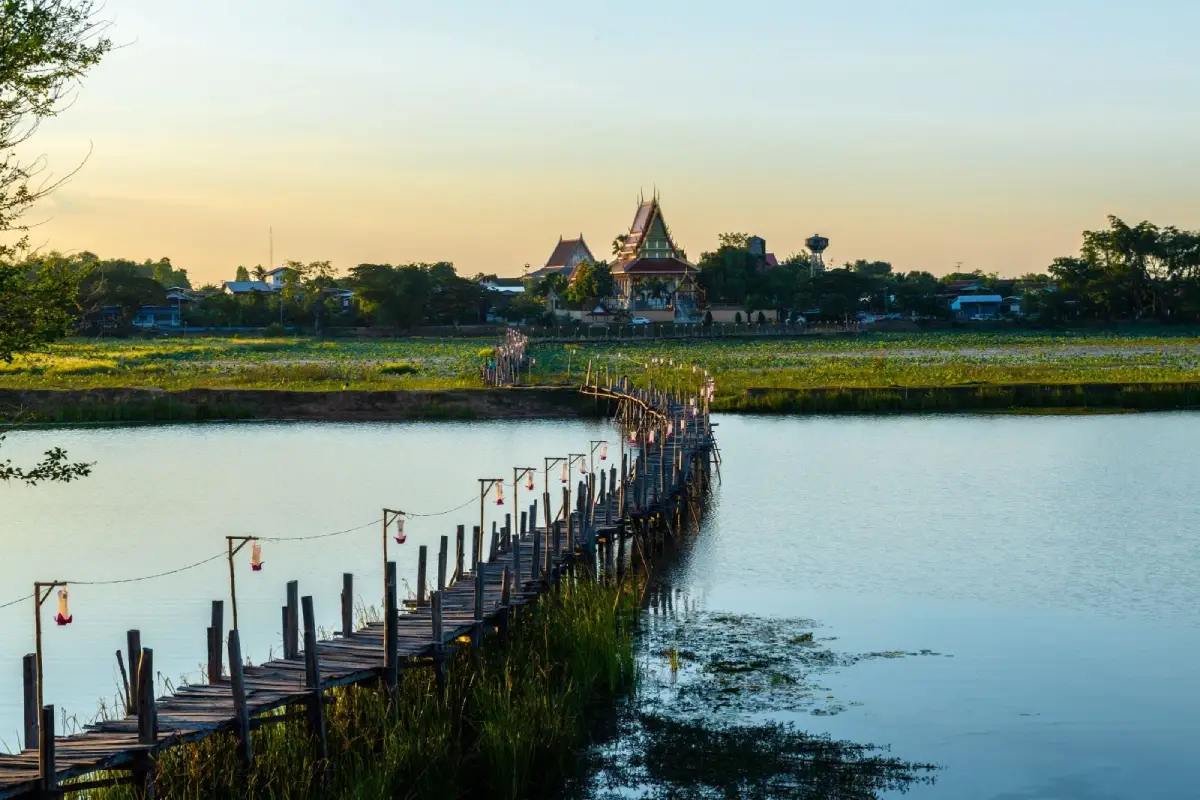
The most famous feature of the area is Kae Dam Wooden Bridge. This old wooden bridge crosses Nong Kae Dam Reservoir and connects Ban Kae Dam with Ban Hua Khua. It was originally built by villagers as a practical crossing route over the wetland and reservoir. The bridge reflects local wisdom: simple materials, direct use, and a strong relationship with the landscape. Although modern roads now provide easier transportation, the wooden bridge remains a symbol of the community and has become one of the most recognized landmarks in Maha Sarakham Province.
Walking on Kae Dam Wooden Bridge gives visitors a close view of the wetland environment. Instead of seeing the reservoir only from the edge, travelers can walk into the landscape, surrounded by water, lotus leaves, aquatic plants, and open sky. The experience feels rustic and local. The bridge is not polished or overly modern, which is exactly why it is meaningful. It preserves the character of rural Isan and allows visitors to feel the pace of community life in a way that many commercial attractions cannot provide.
The bridge is also a favorite photography spot. Wide-angle shots can capture the wooden path leading across the water, while close-up angles show the texture of the old planks and posts. In the morning, soft light gives the reservoir a calm and natural look. In the late afternoon, warm light creates a more dramatic atmosphere, especially when reflected on the water. The best photos often combine the wooden bridge, lotus areas, water surface, and the surrounding village scenery.
Nong Kae Dam is strongly connected with local traditions. The reservoir area has been used for community events such as Loy Krathong and Bun Bang Fai, or the Rocket Festival. These events show the social role of the reservoir as a gathering place, not only a water source. During festivals, the area can become livelier, with local food, community products, and cultural activities. For travelers interested in Thai local culture, visiting during a community event can add another layer of meaning to the trip.
The reservoir also reflects the importance of water in Isan life. Northeastern Thailand has a strong relationship with seasonal rain, agriculture, rice fields, fish, and natural water sources. Places like Nong Kae Dam help support everyday life, food resources, and community identity. A visit here allows travelers to see how water is connected with farming, local movement, temple life, village relationships, and traditional festivals.
The best time to visit Nong Kae Dam Reservoir is early morning or late afternoon. Morning is suitable for walking, photography, and enjoying cool air. Late afternoon is ideal for resting, taking photos, and feeling the breeze over the water. Midday can be hot and bright because many areas are open, so visitors should bring water, a hat, sunscreen, or an umbrella if visiting during the day. The site is open all day, but daylight hours are the most comfortable and safest for general travelers.
Although the area is open 24 hours, visitors are advised to plan their trip during daylight, especially if traveling with children or elderly family members. The wooden bridge and wetland surroundings should be used carefully. Visitors should walk slowly, avoid running or jumping on the bridge, and keep children close. This helps ensure safety and helps preserve the bridge for local use and future visitors.
The main zones of interest around Nong Kae Dam include the reservoir and lakeside area, the Kae Dam Wooden Bridge zone, Wat Daowadueng Kae Dam near the bridge, the local community and market area, and the surrounding fields and agricultural landscape. Each zone gives a different impression. The reservoir provides open views and relaxation. The bridge gives cultural and photographic value. The temple adds a spiritual dimension. The community area shows local products and village life when activities are held. The surrounding fields complete the rural Isan atmosphere.
Wat Daowadueng Kae Dam is located close to the bridge and can easily be included in the same visit. For travelers who want a simple route, visiting the temple, walking across the wooden bridge, and relaxing by the reservoir can take 1 to 2 hours. If you want a fuller half-day trip, you can add nearby attractions such as Wat Nong Hu Ling, Ku Mahathat Ban Khwao, or local restaurants and cafés in Kae Dam District.
A short visit to Nong Kae Dam can be very rewarding. Spend time walking slowly, observing the water plants, taking photos from the bridge, and watching local life. The place is best enjoyed without rushing. Its beauty is found in simple details: the sound of wind, the reflection of the sky, the movement of aquatic plants, the texture of the wooden bridge, and the quiet rhythm of village life.
For families, Nong Kae Dam is a practical place to stop because there is no entrance fee and the visit can be adjusted to your schedule. Children can learn about water, plants, fish, and rural community life. Adults can rest, take photos, and enjoy the cooler air near the reservoir. Elderly visitors should choose safe and easy walking areas and avoid walking too far on the bridge during very hot or crowded times.
For solo travelers and photographers, the reservoir offers peaceful compositions and a less commercial travel experience. It is a place where you can take your time, watch the light change, and capture images that reflect local Thailand. The wooden bridge is the main visual highlight, but the surrounding water, fields, and temple atmosphere are equally important to the story of the place.
Visitors should treat the reservoir respectfully. Nong Kae Dam is a community water source and an ecological area. Do not throw rubbish into the water, do not damage lotus plants or aquatic vegetation, and avoid disturbing birds or aquatic life. Travelers should carry their own waste out of the area when bins are not available. Responsible behavior helps keep the reservoir clean and meaningful for both residents and visitors.
There is no admission fee for the general reservoir and wooden bridge area. Visitors may only need money for food, drinks, local products, or transportation. When local markets or community events are active, visitors may find local food, vegetables, handmade products, or seasonal goods. Buying from local vendors is a good way to support the community while enjoying the place.
Facilities around Nong Kae Dam are simple and local in character. Visitors may find parking areas, lakeside viewpoints, the wooden bridge, nearby temples, small shops, and local restaurants. It is not a large commercial attraction with extensive tourist facilities, so travelers should prepare essential items such as drinking water, sun protection, mosquito repellent, tissues, and comfortable walking shoes. Those visiting with children or elderly people should plan carefully and avoid very hot periods.
Getting There from Maha Sarakham city is straightforward. The distance from the city to Nong Kae Dam Reservoir is about 25 km, and the journey usually takes around 30 minutes. Travelers can use a private car, motorcycle, or local public transport to Kae Dam District. If using public transport, continue with local transport to the reservoir or Kae Dam Wooden Bridge. For navigation, search for “Nong Kae Dam Reservoir” or “Kae Dam Wooden Bridge.”
Travelers coming from nearby provinces such as Roi Et, Kalasin, or Khon Kaen can also use Nong Kae Dam as a peaceful stop along the way. It is suitable for stretching, taking photos, resting by the water, and experiencing a quieter side of Maha Sarakham. Because it is not far from the city, it can be included easily in a wider Isan travel route.
A recommended half-day route starts with Wat Daowadueng Kae Dam, continues to Kae Dam Wooden Bridge and Nong Kae Dam Reservoir, and ends with a local restaurant or café in Kae Dam District. If you have more time, add Wat Nong Hu Ling, a temple known for its distinctive boat-shaped ordination hall, or Ku Mahathat Ban Khwao, an important ancient Khmer-style site in Maha Sarakham. This route combines nature, local religion, community culture, and history in one day.
Nearby food options include local Isan restaurants, hot pot restaurants, cafés, and small community eateries. Examples include Chim Chum Fai Daeng Kae Dam 2, Glam Cafe Kae Dam, Ponlaom Cafe, and Na Go Coffee in the wider nearby area. Some places are very local, so opening times may vary. If you want more restaurant choices, continue toward Maha Sarakham city after visiting the reservoir.
Accommodation choices are available both in Kae Dam District and in Maha Sarakham city. Travelers who want to stay near the reservoir may consider local resorts in Kae Dam such as Jinnapha Garden & Resort or Baan Suan Damrong Sap. Travelers who prefer more city convenience can stay in Maha Sarakham city at places such as Praiyanan Place, Baan Charnchol Resort, Top Inn Hotel, or Tong Hotel. Staying near Kae Dam is better for a quiet rural experience, while staying in the city is better for restaurants, shops, and wider transport options.
For foreign visitors, Nong Kae Dam Reservoir offers a rare chance to see a local attraction that remains closely tied to everyday community life. It is not designed as a polished tourist complex. Instead, it shows how water, bridges, temples, villages, and local traditions are connected in rural northeastern Thailand. This makes the visit valuable for travelers who want to go beyond famous destinations and understand a more authentic part of Isan.
The meaning of Nong Kae Dam lies in its simplicity. A reservoir, a bridge, a village, a temple, lotus plants, fish, birds, and people using the space together create a quiet but complete travel experience. Visitors who slow down and observe carefully will find that the place tells a rich story about local life, natural resources, community memory, and rural identity.
In summary, Nong Kae Dam Reservoir in Maha Sarakham Province is a natural reservoir and community landmark in Kae Dam District. It is suitable for relaxation, photography, walking, cultural observation, and a short nature escape from Maha Sarakham city. The reservoir is open daily, accessible 24 hours, free to enter, and best visited in the morning or late afternoon. With Kae Dam Wooden Bridge, Wat Daowadueng Kae Dam, nearby temples, local restaurants, and simple accommodations, it is a rewarding stop for travelers who want to experience a peaceful and genuine side of northeastern Thailand.
| Name | Nong Kae Dam Reservoir |
| Location | Ban Kae Dam, Moo 1, Kae Dam Subdistrict, Kae Dam District, Maha Sarakham Province |
| Address | Kae Dam Subdistrict, Kae Dam District, Maha Sarakham 44190, Thailand |
| Coordinates | 16.01803, 103.38869 |
| Highlights | Natural reservoir of about 1,000 rai, Kae Dam Wooden Bridge, lotus areas, aquatic plants, local rural scenery, and a peaceful Isan community atmosphere |
| History | An important natural water source for Kae Dam communities, covering Ban Kae Dam, Ban Hua Khua, and Ban Pho Si. The area has supported water use, agriculture, fishing, fish breeding, village travel, and local festivals for many years. |
| Distinctive Features | Wide reservoir views, wetlands, aquatic plants, an old wooden bridge connecting Ban Kae Dam and Ban Hua Khua, and a quiet rural atmosphere suitable for photography and relaxation |
| Travel Information | From Maha Sarakham city, travel about 25 km to Kae Dam District. The journey takes around 30 minutes by private car or motorcycle. Public transport to Kae Dam District can be used, followed by local transport to the reservoir area. |
| Current Status | Open as a natural attraction and community recreation area. The reservoir and Kae Dam Wooden Bridge can be visited daily. |
| Open Days | Daily |
| Opening Hours | Open 24 Hours |
| Fees | No Admission Fee |
| Facilities | Some parking areas, photo spots, wooden bridge, lakeside viewpoints, nearby small shops or local restaurants, and nearby temple area |
| Main Areas / Zones | Reservoir and lakeside zone, Kae Dam Wooden Bridge zone, Wat Daowadueng Kae Dam zone, local community and market zone, surrounding rice fields and agricultural landscape |
| Caretaker / Related Agencies | Royal Irrigation Department, Kae Dam Municipality, and Kae Dam Subdistrict Administrative Organization as related local agencies for the area and public information |
| Main Contact Number | Kae Dam Municipality, Tel. 043-787043, 043-787459 / Kae Dam Subdistrict Administrative Organization, Tel. 043-029539 |
| Nearby Tourist Attractions | 1. Kae Dam Wooden Bridge, about 0 km 2. Wat Daowadueng Kae Dam, about 1 km 3. Wat Nong Hu Ling, about 9 km 4. Wat Pa Kung, Roi Et Province, about 12 km 5. Ku Mahathat Ban Khwao, about 15 km 6. Maha Sarakham City, about 25 km |
| Nearby Restaurants | 1. Chim Chum Fai Daeng Kae Dam 2, about 2 km, Tel. 082-5847990 2. Glam Cafe Kae Dam, about 3 km, Tel. 090-2277494 3. Ponlaom Cafe, about 7 km, Tel. 099-4724666 4. Na Go Coffee, about 7 km, Tel. 098-2655752 5. Tiao Kai Nae Non, about 10 km 6. Tom Kai Ban 3 Phi Nong, about 16 km |
| Nearby Accommodations | 1. Jinnapha Garden & Resort Kae Dam, about 2 km, Tel. 086-0476263 / 097-9694359 2. Baan Suan Damrong Sap Kae Dam, about 3 km, Tel. 095-5682938 / 091-0645458 / 085-4687638 3. Baan Charnchol Resort Mahasarakham, about 19 km, Tel. 094-9296201 4. Praiyanan Place, about 17 km, Tel. 097-2239923 / 043-777339 / 093-4462464 5. Top Inn Hotel MHK, about 24 km, Tel. 043-711979 6. Tong Hotel, about 25 km, Tel. 043-706884 |
Frequently Asked Questions (FAQ)
Q: Where is Nong Kae Dam Reservoir located?
A: Nong Kae Dam Reservoir is located at Ban Kae Dam, Moo 1, Kae Dam Subdistrict, Kae Dam District, Maha Sarakham Province, about 25 km from Maha Sarakham city.
Q: What are the opening hours of Nong Kae Dam Reservoir?
A: The reservoir and Kae Dam Wooden Bridge area are open daily and accessible 24 hours. Morning and late afternoon are the most recommended times to visit.
Q: Is there an entrance fee for Nong Kae Dam Reservoir?
A: No. There is no admission fee for visiting the general reservoir and wooden bridge area.
Q: What is special about Nong Kae Dam Reservoir?
A: The reservoir is known for its wide natural water landscape, Kae Dam Wooden Bridge, lotus areas, aquatic plants, local Isan community life, and peaceful rural atmosphere.
Q: How do travelers get from Maha Sarakham city to Nong Kae Dam Reservoir?
A: From Maha Sarakham city, travel about 25 km to Kae Dam District. The journey takes around 30 minutes by private car or motorcycle. Public transport to Kae Dam District can also be used, followed by local transport to the reservoir area.
Q: When is the best time to visit Nong Kae Dam Reservoir?
A: Early morning is good for quiet walking and photography, while late afternoon is best for relaxing, enjoying the breeze, and taking photos of the wooden bridge in warm light.
Q: How much time should visitors spend at Nong Kae Dam Reservoir?
A: Visitors should allow at least 1 to 2 hours for walking, photography, and relaxing by the reservoir. A half-day trip is better if combining the visit with nearby temples or restaurants.
Q: What kind of travelers will enjoy Nong Kae Dam Reservoir?
A: It is suitable for families, nature lovers, photographers, slow travelers, people looking for a peaceful stop, and visitors interested in local Isan community life.
 Category: ●Nature and Wildlife
 Group: ●Dam, Reservoir, Lake
Last Update : 2 MonthAgo
 Last Update : 2 MonthAgo
 Click to Access the Navigation Map GPS
 Art, Culture and Heritage
 Historical Sites and Monuments(4)
 Art, Craft Centres, Tradition(5)
 Museums(3)
 Places of Worship
 Temple(17)
 Other Sacred Sites(7)
 Research and Development
 Royal Project(2)
 Suburban Living
 Village, Community(5)
 National Parks and Marine Reserves(3)
Dam, Reservoir, Lake(10)
National Parks and Marine Reserves(3)
Dam, Reservoir, Lake(10)
 River, Canal(2)
 Bays and Beaches(2)
 Other natural attractions(2)
 Entertainment and Agricultural
 Farms, Parks and Ecotourism(3)
 Travel Articles, Recipes
 Food Menu, Northeastern Recipes(1)


