
lovethailand home >Northeastern Travel Attractions >Maha Sarakham Travel Attractions >Kanthara Wichai >Tha Khon Yang > Pu Ta Khun Samran Shrine
TL;DR: Pu Ta Khun Samran Shrine is located at Ban Tha Khon Yang, Moo 4, Tha Khon Yang Subdistrict, Kantharawichai District, Maha Sarakham Province, open Daily, hours 08.00 – 17.00.
Pu Ta Khun Samran Shrine
Open Days: Daily
Opening Hours: 08.00 – 17.00
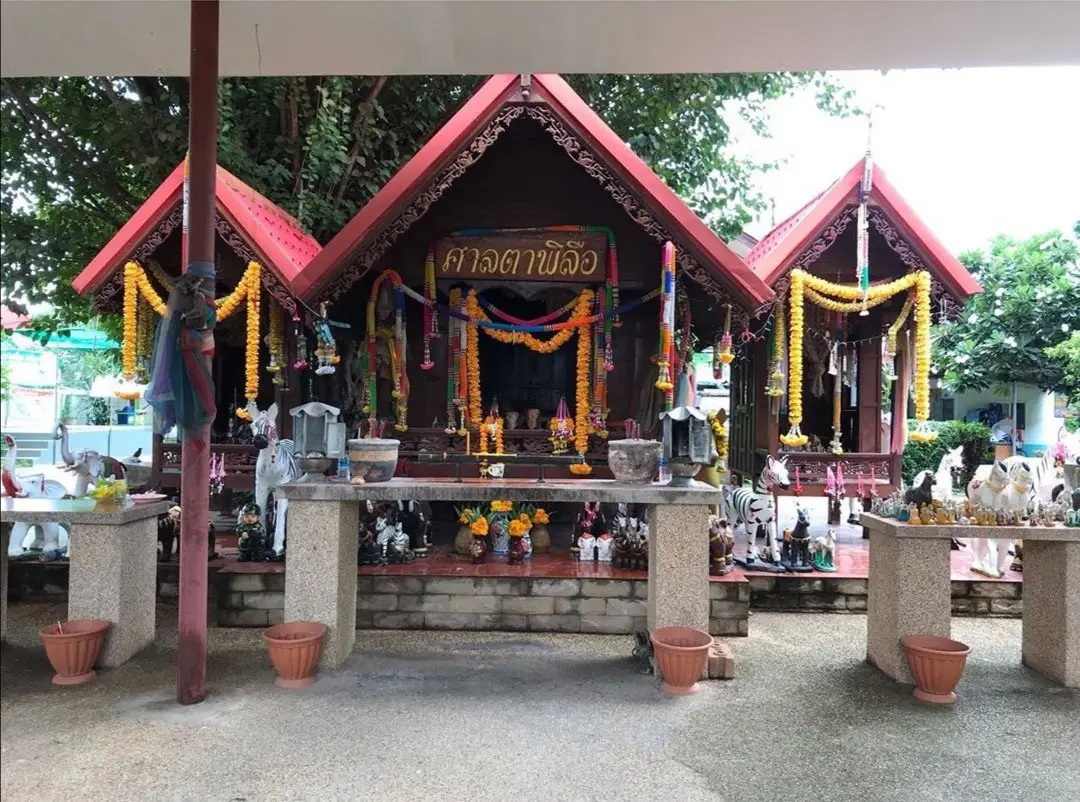
Pu Ta Khun Samran Shrine in Maha Sarakham Province is a sacred village guardian shrine located in Ban Tha Khon Yang, Tha Khon Yang Subdistrict, Kantharawichai District. The shrine is deeply respected by local people as a spiritual center of the community. Villagers believe that Pu Ta Khun Samran protects the people of Ban Tha Khon Yang, keeps them safe from danger, especially water-related danger, and blesses the village with peace, seasonal rain, and agricultural abundance.
This shrine is an important cultural site for travelers who want to understand Maha Sarakham beyond temples, city landmarks, and university life. Pu Ta Khun Samran Shrine reflects a local Isan belief in guardian ancestor spirits, known in Thai and Lao-Isan culture as phi pu ta. These spirits are believed to protect the village, safeguard local people, and maintain balance between humans, nature, water, farmland, and the unseen world. For the people of Ban Tha Khon Yang, the shrine is not merely a small sacred structure; it is a living spiritual anchor of the community.
According to local elders, Pu Ta Khun Samran is believed to protect villagers from water-related danger. This belief is closely connected with the geography of Ban Tha Khon Yang, a community located near the Chi River. In the past, the river was central to daily life, farming, travel, food, and the identity of the village. Water brought life, but it could also bring danger. Floods, river accidents, drowning, and unpredictable water conditions were part of the lived experience of riverside communities. The shrine therefore became a sacred place where people could ask for protection and peace of mind.
Pu Ta Khun Samran Shrine is also associated with an annual rain-divination ritual before the rice-growing season. Before villagers begin planting rice, they come to the shrine to seek blessings and divine signs about the coming rains. This ceremony expresses the close relationship between Isan farming life and spiritual belief. In agricultural communities, rain determines rice, food, family stability, and the future of the village. The ritual is therefore not only a matter of belief; it is a community act that gathers people together before the beginning of a new farming cycle.
Ban Tha Khon Yang is an old community in Kantharawichai District with a strong Tai Nyo or Nyo Tha Khon Yang identity. The name of the community reflects its landscape and memory. The word “tha” refers to a river landing or waterside point, while “khon yang” is connected with large yang trees that once stood near the river. This name shows how deeply the community has been tied to water, trees, landing places, and riverside settlement. The belief in Pu Ta Khun Samran grows from this same cultural environment, where people lived close to nature and relied on sacred protection.
In the past, Ban Tha Khon Yang was a rural riverside community whose people lived with farmland, the Chi River, local temples, seasonal rituals, and village-based social life. Later, the expansion of Mahasarakham University into the Kham Riang and Tha Khon Yang area transformed the community into a more urban and economically active zone. Dormitories, restaurants, cafés, shops, and services grew rapidly. Yet amid this modern change, Pu Ta Khun Samran Shrine remains a reminder of the older cultural roots of the village.
The belief in pu ta shrines is widespread in northeastern Thailand, but each village has its own local history and ritual practice. In Maha Sarakham, the belief remains closely connected with village life, annual ceremonies, and ritual specialists. Local people believe that phi pu ta are ancestor spirits who protect the village, prevent misfortune, guard sacred areas, and keep the community in peace. The shrine is therefore a cultural institution as much as a sacred place. It helps villagers maintain social unity, respect for tradition, and a shared sense of belonging.
A typical pu ta shrine in Isan is often simple in form. It may be small, locally built, and designed for worship, offerings, and ritual use rather than grand architecture. This simplicity does not reduce its sacredness. On the contrary, the power of such a shrine comes from collective belief, memory, and ritual continuity. Pu Ta Khun Samran Shrine carries this quiet strength. Its importance lies not in monumentality, but in its role as a spiritual center that the people of Ban Tha Khon Yang continue to respect.
Pu Ta Khun Samran Shrine is located in Ban Tha Khon Yang, Moo 4, within the administrative area of Tha Khon Yang Subdistrict Municipality. The area lies close to Thina Non Road and the Mahasarakham University zone, making it more accessible than many small community shrines in rural villages. Travelers can visit the shrine as part of a cultural route through Tha Khon Yang, Kham Riang, and Kantharawichai District.
The shrine is distinctive because of its strong connection with both water protection and rain divination. The water-protection belief reflects the life of a riverside community, while the rain-divination ritual reflects the agricultural worldview of Isan. Together, these 2 themes show how the shrine brings together the river, the rice field, the village, and the unseen guardian spirit. For local people, Pu Ta Khun Samran is a protector of life in the most practical sense.
The annual rain-divination ritual before rice planting has social importance as well. It is a time when villagers come together, listen to elders and ritual leaders, and begin the farming season with shared intention. Rice cultivation is not only an economic activity; it is a seasonal rhythm that shapes community life. The shrine provides a sacred space where this rhythm can begin with respect, blessing, and unity.
Cultural travelers should approach Pu Ta Khun Samran Shrine with respect. This is not a tourist attraction created for entertainment. It is a sacred place belonging to the local community. Visitors should dress modestly, speak quietly, avoid touching sacred objects unnecessarily, and observe how local people behave at the shrine. If villagers or caretakers are present, it is best to ask politely before making offerings, taking close-up photographs, or entering ceremonial areas.
Offerings at Isan guardian spirit shrines vary from village to village. Visitors may pay respect quietly and make a wish, but more specific ritual offerings should follow local guidance. Some ceremonies require the involvement of a ritual leader or thao cham, a person who acts as a mediator between the community and the guardian spirit. Because local rules differ, respectful observation and polite inquiry are the best ways to visit the shrine properly.
The shrine also reflects the relationship between belief and environmental care. In many Isan communities, pu ta shrines are associated with forests, mounds, ponds, streams, riverbanks, or old village spaces. When an area is believed to belong to the guardian spirit, people tend to treat it with caution and respect. This belief can help protect local environments, because villagers avoid careless disturbance of sacred land, trees, and natural resources.
Ban Tha Khon Yang has several sacred community places, including shrines connected with local guardian spirits. These places are part of a wider sacred landscape of the village. Pu Ta Khun Samran Shrine is one of the important points in this network of faith. It belongs not only to a physical location, but to a system of memory, kinship, ritual, and local identity that has been passed down through generations.
For the people of Ban Tha Khon Yang, Pu Ta Khun Samran Shrine is meaningful not only during major ceremonies. It is also a place where villagers can come in daily life to ask for peace, safety, family well-being, good health, safe travel, and success in work or farming. This everyday role is one reason the shrine remains relevant even as the surrounding community has become busier and more urban.
From a community-history perspective, the shrine helps connect present-day Tha Khon Yang with the older Tai Nyo identity of the village. Ban Tha Khon Yang has a history of settlement, migration, riverside livelihood, and community transformation. As new residents, students, businesses, and visitors have entered the area, the shrine continues to remind people that this place has deep roots and cultural owners whose traditions deserve respect.
A visit to Pu Ta Khun Samran Shrine can be combined with a short cultural walk or drive through Ban Tha Khon Yang. Travelers can begin at the shrine to understand the village’s spiritual center, then continue to local temples such as Wat Charoen Phon, Wat Maha Phon, or Wat Sawang Wari. From there, they can move toward the Mahasarakham University and Kham Riang area for restaurants, cafés, and accommodation. This route offers a strong contrast between old community belief and modern student-town life.
The shrine is especially valuable for visitors interested in ancestor-spirit belief in Thailand. It clearly shows that Thai spirituality is diverse. Local religious life is not limited to Buddhist temples. It may also include guardian shrines, ancestor spirits, water-related beliefs, agricultural rituals, and village ceremonies. Understanding Pu Ta Khun Samran Shrine helps foreign travelers see the layered nature of Thai culture, where Buddhism, local belief, environment, and community identity can exist together.
In anthropological terms, a pu ta shrine is a place where the living community maintains a relationship with guardian ancestors. The ritual specialist or thao cham helps connect villagers with the sacred presence. Divination, offerings, and annual ceremonies allow the community to communicate with the unseen world while also reaffirming social rules, respect, and collective responsibility. Pu Ta Khun Samran Shrine is a strong example of this cultural system in Maha Sarakham.
The rain-divination ritual at Pu Ta Khun Samran Shrine also combines belief with close attention to nature. Today, people can check weather forecasts on mobile phones, but the ritual remains meaningful because it is not only about predicting rain. It is about gathering the community, acknowledging dependence on the land, and beginning the farming season with shared hope. This makes the ritual a living cultural practice rather than a relic of the past.
For foreign travelers, the shrine may be described as a village guardian ancestor spirit shrine. It is not a Buddhist temple and not a Chinese shrine. It belongs to the local Isan belief system, where guardian spirits protect the village and maintain harmony between people and place. This distinction helps visitors understand why the shrine is small but spiritually important.
When bringing foreign visitors to the shrine, it is important to explain the belief respectfully. The rituals should not be treated as exotic entertainment. For the villagers, the shrine protects real lives and reflects real community memory. Visitors should avoid joking, loud behavior, intrusive photography, or entering ritual space without permission. Cultural tourism is most meaningful when it respects the dignity of the host community.
The best time to visit Pu Ta Khun Samran Shrine is in the morning or late afternoon, when the weather is more comfortable and the atmosphere is calmer. During annual rituals, visitors should arrive early, observe from a respectful distance, and follow local guidance. If a ceremony is taking place, the priority belongs to the community and ritual participants.
Getting There is convenient from Maha Sarakham city. Travel toward Kantharawichai District and the Mahasarakham University area, then continue to Ban Tha Khon Yang, Moo 4. The shrine is about 10 to 12 km from the city, depending on the route. A private car or local transport is the most convenient option. Because community shrines may not always have large tourist signs, using online maps together with local directions is recommended.
Travelers coming from Khon Kaen or Kalasin can also reach the area through Kantharawichai District and the Mahasarakham University zone. Tha Khon Yang is surrounded by restaurants, cafés, dormitories, and local services, making it easy to combine the shrine with nearby cultural places and food stops. The area is suitable for a half-day or full-day cultural route.
A meaningful visit should allow at least 30 minutes to 1 hour. This gives visitors enough time to pay respect, observe the shrine area, and understand the community setting. Those who want to learn more deeply about local rituals should plan their visit around the annual rain-divination or pu ta ceremony and coordinate with local community leaders or Tha Khon Yang Subdistrict Municipality in advance.
Photography should be done with care. Visitors may photograph the general atmosphere of the shrine and surrounding community, but close-up images of offerings, sacred objects, or ritual participants should be taken only with permission. Sacred community places deserve careful documentation because images can travel far beyond the local context.
Pu Ta Khun Samran Shrine is not large, but it carries great meaning for Ban Tha Khon Yang. Its value lies in its role as a source of protection, a ceremonial space, and a reminder of respect for water, nature, ancestors, and community life. Visitors who come with patience and respect will discover a quiet but powerful expression of Isan cultural identity.
Overall, Pu Ta Khun Samran Shrine is an important cultural destination in Kantharawichai District. It brings together guardian-spirit belief, protection from water danger, rain divination before rice planting, the Tai Nyo identity of Ban Tha Khon Yang, and the changing life of a riverside community near Mahasarakham University. The shrine is a sacred place, a community learning site, and a living cultural landmark that reveals the deep relationship between people, water, rice fields, and belief in northeastern Thailand.
| Name | Pu Ta Khun Samran Shrine |
| Location | Ban Tha Khon Yang, Moo 4, Tha Khon Yang Subdistrict, Kantharawichai District, Maha Sarakham Province |
| Address | Ban Tha Khon Yang, Moo 4, Tha Khon Yang Subdistrict, Kantharawichai District, Maha Sarakham 44150, Thailand |
| Community Coordinates | 16.23520039, 103.2653837 |
| Highlights | Sacred village guardian ancestor shrine of Ban Tha Khon Yang, associated with water protection and rain divination before the rice-growing season |
| History / Background | A community guardian shrine respected by Ban Tha Khon Yang villagers as a sacred place that protects the village and its people, especially from water-related danger |
| Name Origin | The name is connected with Pu Ta Khun Samran, or Chao Pho Samran, a sacred guardian spirit revered by the local community. |
| Distinctive Features | Community guardian shrine with a worship area, ceremonial courtyard, and an important role in annual rain-divination rituals before rice planting |
| Local Belief | Villagers believe Pu Ta Khun Samran protects Ban Tha Khon Yang from water-related danger and blesses the community before the farming season. |
| Related Tradition / Ritual | Rain-divination ritual before rice planting and the pu ta spirit-feeding ceremony according to Ban Tha Khon Yang community tradition |
| Travel Information | From Maha Sarakham city, travel toward Kantharawichai District and the Mahasarakham University area, then continue to Ban Tha Khon Yang, Moo 4. A private car or local transport is the most convenient option. |
| Current Status | Open for local worshippers and visitors as a sacred community guardian shrine |
| Open Days | Daily |
| Opening Hours | 08.00 – 17.00 |
| Facilities | Worship courtyard, ceremonial area, surrounding community space, and access to the Tha Khon Yang-Kham Riang service zone |
| Main Areas / Zones | Pu Ta Khun Samran shrine, worship area, offering area, rain-divination ceremonial area, and surrounding Ban Tha Khon Yang community space |
| Caretaker / Related Authority | Ban Tha Khon Yang community, local ritual specialist or thao cham according to community tradition, and Tha Khon Yang Subdistrict Municipality |
| Local Authority Contact | Tha Khon Yang Subdistrict Municipality, Tel. 043-995-620 |
| Official Website / Official Page | Tha Khon Yang Subdistrict Municipality, Kantharawichai District, Maha Sarakham Province |
| Nearby Tourist Attractions | 1. Wat Charoen Phon, Ban Tha Khon Yang, about 1 km 2. Wat Maha Phon or Wat Nuea, Ban Tha Khon Yang, about 1 km 3. Wat Sawang Wari, Ban Tha Khon Yang, about 2 km 4. Mahasarakham University, Kham Riang Campus Area, about 3 km 5. Mahasarakham University Museum, about 5 km 6. Wat Phutthamongkhon and Phra Buddha Mongkhon, about 9 km 7. Wat Suwannawat and Phra Buddha Ming Mueang, about 10 km 8. Maha Sarakham City Pillar Shrine, about 12 km |
| Nearby Restaurants | 1. Jaew Hon Tha Khon Yang, about 1 km, Tel. 098-663-2826, 095-663-6969 2. Yor Phu Thai Restaurant, Tha Khon Yang, about 2 km, Tel. 043-749331, 089-8408931 3. Less Is More Steak & Cafe, about 4 km, Tel. 094-735-1678 4. Brotherhood Bake House & Cafe, about 5 km, Tel. 086-326-9222 5. GG CAMP Maha Sarakham, about 5 km, Tel. 088-561-8060 6. Mor Mai Kai Yang Kham Riang, about 5 km, Tel. 091-061-3353 7. Harmonickoff, about 5 km, Tel. 081-590-2544 |
| Nearby Accommodations | 1. Leelawadee Dormitory near MSU by Mae Ji, about 2 km, Tel. 083-661-7450 2. Ban Boriboon Dormitory, about 2 km, Tel. 091-468-4507 3. Ingkamon Place, about 3 km, Tel. 094-107-9180 4. Perfect Living Serviced Apartment, about 5 km 5. The Orchid Resort & Relax, about 6 km, Tel. 085-517-8295 6. The Boss Green Hotel, about 6 km, Tel. 096-164-2886 |
Frequently Asked Questions (FAQ)
Q: Where is Pu Ta Khun Samran Shrine located?
A: Pu Ta Khun Samran Shrine is located in Ban Tha Khon Yang, Moo 4, Tha Khon Yang Subdistrict, Kantharawichai District, Maha Sarakham Province.
Q: Why is Pu Ta Khun Samran Shrine important?
A: It is a village guardian ancestor shrine respected by the people of Ban Tha Khon Yang, especially for protection from water-related danger and blessings for community well-being.
Q: What are the opening hours?
A: The shrine is open daily from 08.00 to 17.00.
Q: How is the shrine connected with the Chi River?
A: Ban Tha Khon Yang is a riverside community near the Chi River, and local people believe Pu Ta Khun Samran protects villagers from water-related dangers such as drowning and river accidents.
Q: What is the meaning of the rain-divination ritual?
A: The ritual is performed before rice planting to seek blessings and divine signs about seasonal rainfall. It connects local belief with the agricultural life of Isan communities.
Q: Is Pu Ta Khun Samran Shrine a Buddhist temple?
A: No. It is not a Buddhist temple. It is a village guardian ancestor spirit shrine respected by the local community.
Q: How should visitors behave at the shrine?
A: Visitors should dress modestly, speak quietly, pay respect properly, avoid touching sacred objects unnecessarily, and ask local people before taking close-up photos or joining rituals.
Q: Is Pu Ta Khun Samran Shrine suitable for foreign travelers?
A: Yes. It is suitable for foreign travelers interested in Isan local culture, guardian ancestor spirit beliefs, community rituals, and riverside village life in Maha Sarakham.
 Category: ●Places of Worship
 Group: ●Other Sacred Sites
Last Update : 2 MonthAgo
 Last Update : 2 MonthAgo
 Click to Access the Navigation Map GPS
 Art, Culture and Heritage
 Historical Sites and Monuments(4)
 Art, Craft Centres, Tradition(5)
 Museums(3)
 Temple(17)
Other Sacred Sites(7)
Temple(17)
Other Sacred Sites(7)
 Research and Development
 Royal Project(2)
 Suburban Living
 Village, Community(5)
 Nature and Wildlife
 National Parks and Marine Reserves(3)
 Dam, Reservoir, Lake(10)
 River, Canal(2)
 Bays and Beaches(2)
 Other natural attractions(2)
 Entertainment and Agricultural
 Farms, Parks and Ecotourism(3)
 Travel Articles, Recipes
 Food Menu, Northeastern Recipes(1)


