
lovethailand home >Northeastern Travel Attractions >Maha Sarakham Travel Attractions >Kae Dam >Kae Dam > Wat Ban Yang
TL;DR: Wat Ban Yang is located at Ban Yang, Moo 6, Mittraphap Subdistrict, Kae Dam District, Maha Sarakham Province, open Daily, hours 08.00 – 17.00.
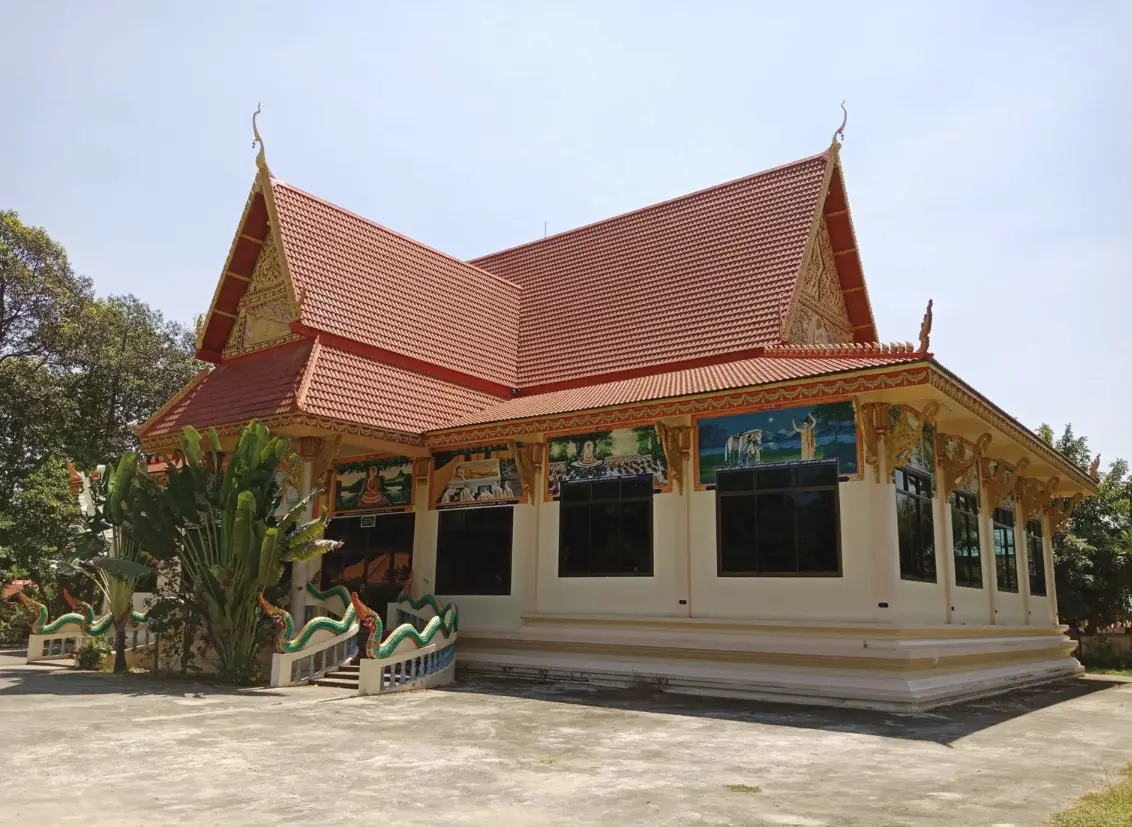
Wat Ban Yang
Open Days: Daily
Opening Hours: 08.00 – 17.00
Wat Ban Yang in Ban Yang Village, Kae Dam District, Maha Sarakham Province is a local Buddhist temple that offers a quiet and meaningful cultural experience for travelers interested in community temples, Isan art, Buddhist heritage, and rural life in northeastern Thailand. The temple’s most distinctive feature is its ordination hall, which contains old and beautiful mural paintings. These paintings make the temple more than a place of worship; they turn it into a small but valuable cultural site where faith, local craftsmanship, and community memory can still be seen within a living religious space.
Wat Ban Yang is located in Ban Yang, Moo 6, Mittraphap Subdistrict, Kae Dam District, Maha Sarakham Province. It stands within a rural community where the relationship between temple and village remains strong. Like many local temples in Isan, Wat Ban Yang functions as a spiritual center, a place for merit-making, a venue for community activities, and a cultural landmark for local residents. For visitors, the temple provides an opportunity to experience a quieter side of Maha Sarakham, beyond the better-known tourist sites and large city temples.
The charm of Wat Ban Yang lies in its sincerity as a community temple. It is not designed as a commercial tourist attraction, and that is precisely what makes it valuable. Visitors can sense the calm rhythm of village life, the simplicity of the temple grounds, and the importance of the ordination hall to the local community. The temple is best appreciated slowly, with attention to atmosphere, small details, and the old mural paintings inside the ordination hall.
The ordination hall is the heart of a visit to Wat Ban Yang. In Thai Buddhist tradition, an ordination hall is one of the most sacred buildings in a temple compound. It is used for important monastic ceremonies and represents the formal religious space of the temple. At Wat Ban Yang, the presence of old mural paintings adds an additional layer of cultural significance. The walls are not merely architectural surfaces; they become visual storytellers that preserve religious ideas, moral lessons, and local artistic expression.
Old mural paintings in Isan temples often played a major role in religious education. Before written materials were widely accessible to everyone, paintings in temples helped local people understand Buddhist stories, ethical teachings, and ideas about merit, compassion, suffering, and liberation. Through figures, colors, gestures, and narrative scenes, temple murals served as a visual classroom for the community. At Wat Ban Yang, the old paintings should be appreciated in this wider cultural context: as both art and a medium of religious communication.
When viewing the paintings, travelers should take time to observe them carefully. Instead of looking only for perfect symmetry or court-style refinement, visitors should notice the expressive lines, the use of color, the arrangement of figures, and the way stories are visually organized. Local temple murals often have a lively and human quality. Their value lies not only in technical precision but also in the cultural world they reveal. They show how local artists interpreted Buddhist teachings through a language of images familiar to village communities.
Wat Ban Yang is meaningful because it combines several layers of value. Religiously, it remains a place of worship and merit-making. Artistically, its old mural paintings are worth seeing and preserving. Socially, it continues to serve the people of Ban Yang and the surrounding area. For travelers, it provides a chance to understand how a small rural temple can hold deep cultural importance. This combination makes Wat Ban Yang an excellent stop for those who prefer thoughtful cultural travel over quick sightseeing.
Kae Dam District itself is a charming rural area of Maha Sarakham. The district is known for local temples, reservoirs, community landscapes, wooden bridges, and quiet village routes. Wat Ban Yang can be included in a broader travel route through Kae Dam, especially for visitors interested in temples, local art, and community-based tourism. A trip to Wat Ban Yang helps travelers see how Buddhist life, village settlement, agriculture, and local culture are connected in everyday Isan life.
The name “Wat Ban Yang” reflects the close link between the temple and the village. In rural Isan, temples often grew together with settlements. As people established homes, farms, and community networks, they also needed a shared place for religious ceremonies and merit-making. A temple named after a village is therefore more than a geographic label. It expresses the temple’s role as part of the village identity. Wat Ban Yang belongs to the memory and daily life of Ban Yang community.
The ordination hall’s importance comes from both its religious function and its artistic character. As a sacred building, it is a place where visitors should behave respectfully. As a space containing old paintings, it is also a fragile cultural asset. Travelers should not touch the walls, lean against painted surfaces, use strong flash photography near the murals, or place belongings against the paintings. Such simple care helps protect the artworks and allows future generations to learn from them.
Local mural paintings are valuable because they often reflect the worldview of the community that created and preserved them. Unlike formal royal-style painting, village murals can be freer, more direct, and more closely connected to everyday life. Their lines, colors, and figures may reveal local taste, local storytelling, and local understanding of Buddhist teachings. For foreign visitors, this makes the paintings especially interesting because they show Thai Buddhist culture from a local Isan perspective rather than from a heavily institutional or tourist-oriented setting.
Wat Ban Yang also helps visitors understand the role of temples in northeastern Thai society. In Isan, temples are closely connected with annual merit-making traditions, community gatherings, and local moral education. They are places where elders, monks, families, and young people meet across generations. Even when a temple is small, it can hold great importance in the community. Wat Ban Yang should therefore be seen not only as a site with old paintings but also as a living institution in Ban Yang village.
First-time visitors should allow enough time to experience the temple properly. A visit of around 30 to 60 minutes is suitable for quietly viewing the ordination hall, observing the temple grounds, paying respect to the Buddha images, and taking photographs respectfully. The beauty of a rural temple does not always reveal itself instantly. It appears through the stillness of the courtyard, the relationship between buildings and village life, the quiet presence of the ordination hall, and the old paintings that remain within it.
The best time to visit is in the morning or late afternoon, when the weather is more comfortable and the light is softer. Maha Sarakham can be hot during the day, especially in the dry season, so early or late visits are more pleasant. Visitors who want to photograph the exterior of the temple will usually find morning light useful. Those who wish to see the interior of the ordination hall should follow temple guidelines and ask permission from monks or caretakers when necessary.
Getting There is most convenient by private car, rental car, or arranged local transport. From Maha Sarakham city, travel toward Kae Dam District, then continue to Mittraphap Subdistrict and Ban Yang village. The route passes through rural roads, communities, and agricultural areas. Travelers should use an online map and search for Wat Ban Yang, Mittraphap Subdistrict, Kae Dam District, Maha Sarakham Province. Checking the route before departure is recommended, especially during the rainy season or local roadworks.
From Kae Dam town, Wat Ban Yang can be combined with other nearby attractions. Wat Nong Hu Ling is known for its striking boat-shaped ordination hall inspired by the Anantanagaraja serpent. Kae Dam Wooden Bridge and Nong Kae Dam Reservoir offer scenic views and a relaxed local atmosphere. Wat Don Ku Non Phra offers archaeological and cultural interest through its ancient prang ku ruins. Together, these places create a meaningful cultural route through Kae Dam District.
Travelers without a private vehicle can first reach Maha Sarakham city or Kae Dam District, then arrange local transport to Ban Yang. Because public transport within rural communities is limited, it is best to arrange both the outbound and return trip in advance. This is especially important for travelers who want to continue to other attractions or return to Maha Sarakham city in the evening.
Appropriate dress is important when visiting Wat Ban Yang. Visitors should wear modest clothing that covers shoulders and knees. Shoes should be removed before entering sacred buildings. Loud behavior, running, or disturbing people who are praying should be avoided. A respectful attitude will make the visit more meaningful and will show consideration for the monks and local residents who use the temple as part of their daily religious life.
For families and students, Wat Ban Yang can serve as an outdoor learning site. Children can learn how art and religion are connected, why mural paintings were important in traditional Buddhist education, and how local communities preserve cultural memory through temples. Teaching young visitors not to touch paintings, not to litter, and to behave respectfully in sacred spaces helps build awareness of cultural conservation from an early age.
For photographers, Wat Ban Yang is suitable for documentary-style travel photography rather than staged tourism photography. The ordination hall, temple courtyard, mural details, and quiet rural surroundings provide meaningful subjects. Photography should be done carefully. Avoid strong flash near the paintings, avoid photographing people without permission, and do not interrupt religious activities. When sharing images, identify the temple clearly as Wat Ban Yang in Kae Dam District to avoid confusion with other temples of the same or similar name in Maha Sarakham Province.
This point is important because Maha Sarakham has more than one temple associated with the name Wat Ban Yang. The Wat Ban Yang described here is the temple in Ban Yang, Mittraphap Subdistrict, Kae Dam District. It should not be confused with another well-known Wat Ban Yang, also known as Wat Yang Thuang Wararam, in Borabue District. Clear location naming helps travelers navigate correctly and helps preserve the identity of each temple.
The value of Wat Ban Yang is found in its role as a small but culturally meaningful community temple. Its old mural paintings, quiet ordination hall, and village setting give it an atmosphere that large tourist temples cannot easily replicate. Visitors who enjoy slow travel, cultural observation, and local Buddhist heritage will find the temple rewarding. It is a place where small details matter and where the relationship between art, faith, and community remains visible.
Conservation is essential for places like Wat Ban Yang. Old paintings can be damaged by moisture, dust, smoke, strong light, careless contact, and inappropriate restoration. Everyone who visits can help protect the temple by looking without touching, keeping the space clean, avoiding disruptive behavior, and sharing accurate information about the site. Responsible tourism is especially important for small local temples because their cultural assets are often fragile and less publicly documented than those of major heritage sites.
Wat Ban Yang can also be part of a wider cultural travel experience in Maha Sarakham. The province is known for education, local history, Buddhist sites, archaeological traces, and rural Isan life. Travelers should not look only for famous landmarks. Smaller community temples like Wat Ban Yang reveal another side of the province: quiet, local, sincere, and deeply connected with everyday faith. This makes the temple valuable for both Thai and international visitors.
A half-day itinerary can begin at Wat Ban Yang in the morning, with time to view the ordination hall and old paintings. After that, travelers can continue to Wat Nong Hu Ling, Kae Dam Wooden Bridge, or Nong Kae Dam Reservoir, then stop for a local meal in Kae Dam. With a full day, it is possible to include Wat Don Ku Non Phra and other cultural stops in the area. This route allows visitors to experience religious art, rural scenery, community life, and local food in one journey.
For those interested in art history, Wat Ban Yang can be approached as an entry point into the world of Isan temple murals. These murals are more than decoration. They are visual records of belief, morality, storytelling, and local imagination. Some temple paintings teach Buddhist values, some communicate ideas about merit and consequences, and others preserve glimpses of social life from the period in which they were painted. Even when full academic documentation is limited, the paintings deserve attention and careful preservation.
Although detailed public documentation of the murals at Wat Ban Yang in Kae Dam is limited compared with more famous mural temples, this makes the site even more worthy of respectful attention. Visiting the temple, recording observations responsibly, asking local people politely, and sharing accurate information can help bring greater awareness to this community heritage site. Greater recognition may also encourage future conservation and documentation of the ordination hall and its paintings.
Visiting Wat Ban Yang is therefore not only about seeing an old temple painting. It is about entering a living village temple with respect, understanding the role of art in Buddhist teaching, and appreciating the cultural depth of rural Maha Sarakham. The temple reminds visitors that heritage does not always appear in grand monuments. Sometimes it survives quietly on the walls of a village ordination hall, in the memory of local residents, and in the daily life of a community that continues to care for its temple.
In summary, Wat Ban Yang in Ban Yang Village, Kae Dam District, Maha Sarakham Province is a meaningful stop for travelers interested in local temples, old mural paintings, Isan culture, and slow cultural travel. Its highlight is the ordination hall with old and beautiful paintings, supported by the peaceful atmosphere of a community temple. For travelers who want to see Maha Sarakham beyond mainstream attractions, Wat Ban Yang offers a quiet but valuable cultural experience.
| Name | Wat Ban Yang |
| Location | Ban Yang, Moo 6, Mittraphap Subdistrict, Kae Dam District, Maha Sarakham Province |
| Address | Moo 6, Ban Yang, Mittraphap Subdistrict, Kae Dam District, Maha Sarakham Province 44190, Thailand |
| Highlights | Ordination hall with old and beautiful mural paintings, suitable for learning about local temple art and Isan cultural heritage |
| Distinctive Features | A peaceful community temple in Ban Yang with an ordination hall as its main point of interest |
| Cultural Importance | A local cultural site reflecting Buddhist faith, village temple life, and Isan community art |
| Main Areas / Zones | 1. Ordination hall and old mural painting area 2. Worship and merit-making area 3. Temple courtyard and community activity space 4. Monastic and religious activity area 5. Surrounding village temple area in Ban Yang |
| Travel Information | From Maha Sarakham city, travel toward Kae Dam District, then continue to Mittraphap Subdistrict and Ban Yang. Private car, rental car, or arranged local transport is recommended |
| Current Status | Open as a community temple and cultural site where visitors can make merit and view the ordination hall during opening hours |
| Open Days | Daily |
| Opening Hours | 08.00 – 17.00 |
| Visitor Guidelines | Dress respectfully, behave calmly, do not touch mural paintings, do not lean against the ordination hall walls, and avoid flash photography near the paintings |
| Caretaker | Wat Ban Yang and Ban Yang community, Mittraphap Subdistrict, Kae Dam District |
| Local Administrative Contact | Mittraphap Subdistrict Municipality, Tel. 0-4370-6714 |
| Official Local Website / Page | Mittraphap Subdistrict Municipality website: mittraphap.go.th |
| Nearby Tourist Attractions | 1. Wat Nong Hu Ling, about 7 km 2. Wat Don Ku Non Phra, about 10 km 3. Kae Dam Wooden Bridge / Nong Kae Dam Reservoir, about 13 km 4. Luang Pu Choi Shrine, about 14 km 5. Ku Maha That / Prang Ku Ban Khwao, about 30 km |
| Nearby Restaurants | 1. Jim Jum Fai Daeng Kae Dam 2, about 12 km, Tel. 082-584-7990 2. Phi Tor Restaurant, about 12 km, Tel. 096-684-3685, 086-283-7530 3. Jungle Cafe Kae Dam Branch, Maha Sarakham, about 12 km, Tel. 061-143-2590 4. Glam Cafe Kae Dam, about 12 km, Tel. 090-227-7494 5. Ponlaom Cafe, about 15 km, Tel. 099-472-4666 |
| Nearby Accommodations | 1. Ban Suan Damrong Sap Kae Dam, about 13 km, Tel. 095-568-2938 2. Jinnapha Garden & Resort Kae Dam, about 13 km, Tel. 086-047-6263 3. Siamtara Palace Hotel Maha Sarakham, about 33 km, Tel. 043-706-944, 084-470-1888 4. Ketsara Hotel, about 31 km, Tel. 095-236-2395 5. Top Inn Hotel Maha Sarakham, about 31 km, Tel. 043-711-979, 062-545-5622 |
Frequently Asked Questions (FAQ)
Q: Where is Wat Ban Yang in Kae Dam District located?
A: Wat Ban Yang is located at Moo 6, Ban Yang, Mittraphap Subdistrict, Kae Dam District, Maha Sarakham Province, Thailand.
Q: What is the main highlight of Wat Ban Yang?
A: The main highlight is its ordination hall with old and beautiful mural paintings that reflect local Buddhist art and community heritage.
Q: What are the opening days and hours of Wat Ban Yang?
A: Wat Ban Yang is open daily from 08.00 to 17.00.
Q: How should visitors behave when viewing the mural paintings?
A: Visitors should not touch the walls, lean against painted surfaces, use strong flash near the murals, or disturb religious activities inside the temple.
Q: How can travelers get to Wat Ban Yang?
A: From Maha Sarakham city, travel toward Kae Dam District, then continue to Mittraphap Subdistrict and Ban Yang. A private car, rental car, or arranged local transport is recommended.
Q: Who should visit Wat Ban Yang?
A: The temple is suitable for travelers interested in local temples, Isan mural paintings, Buddhist culture, rural community life, and quiet cultural travel.
Q: What nearby attractions can be included in the same trip?
A: Visitors can combine the trip with Wat Nong Hu Ling, Wat Don Ku Non Phra, Kae Dam Wooden Bridge, Nong Kae Dam Reservoir, and Luang Pu Choi Shrine.
Q: Why should travelers search specifically for Wat Ban Yang in Kae Dam District?
A: Maha Sarakham has more than one temple with the name Wat Ban Yang or a similar name, so specifying Kae Dam District helps travelers reach the correct temple.
 Category: ●Places of Worship
 Group: ●Temple
Last Update : 2 MonthAgo
 Last Update : 2 MonthAgo
 Click to Access the Navigation Map GPS
 Art, Culture and Heritage
 Historical Sites and Monuments(4)
 Art, Craft Centres, Tradition(5)
 Museums(3)
Temple(17)
Museums(3)
Temple(17)
 Other Sacred Sites(7)
 Research and Development
 Royal Project(2)
 Suburban Living
 Village, Community(5)
 Nature and Wildlife
 National Parks and Marine Reserves(3)
 Dam, Reservoir, Lake(10)
 River, Canal(2)
 Bays and Beaches(2)
 Other natural attractions(2)
 Entertainment and Agricultural
 Farms, Parks and Ecotourism(3)
 Travel Articles, Recipes
 Food Menu, Northeastern Recipes(1)


