
lovethailand home >Northeastern Travel Attractions >Maha Sarakham Travel Attractions >Borabu >Yang > Wat Yang Thuang Wararam
TL;DR: Wat Yang Thuang Wararam is located at Ban Yang, Moo 1, Yang Subdistrict, Borabue District, Maha Sarakham Province, open Daily, hours 08.00 – 17.00.
Wat Yang Thuang Wararam
Open Days: Daily
Opening Hours: 08.00 – 17.00
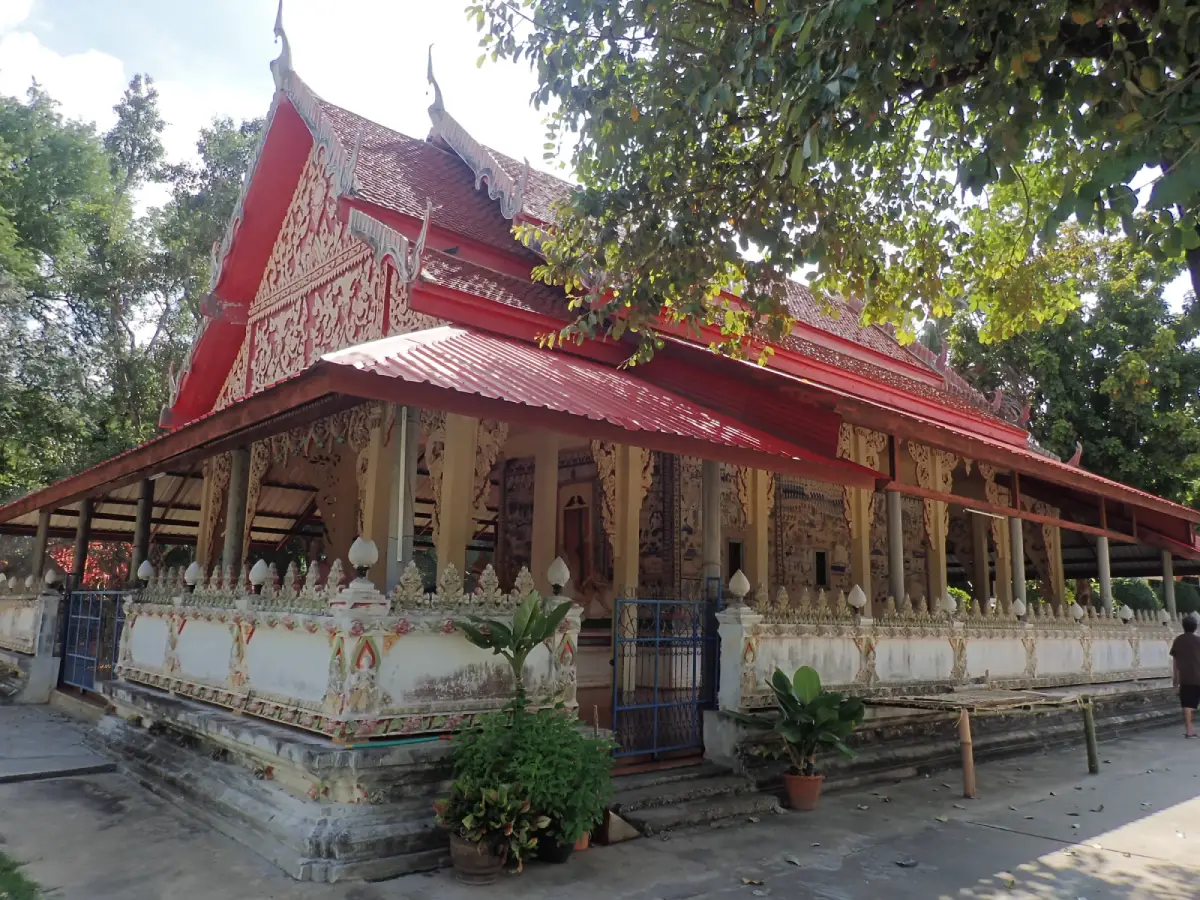
Wat Yang Thuang Wararam in Maha Sarakham Province, also known locally as Wat Ban Yang, is an important historic community temple in Ban Yang, Yang Subdistrict, Borabue District. The temple is best known for its old Isan sim, or ordination hall, and its remarkable hoop taem murals painted across both the exterior and interior walls. The brick-and-plaster sim measures 9.30 meters in length and 5.80 meters in width. Its form is closely related to the sim of Wat Sa Bua Kaeo in Nong Song Hong District, Khon Kaen Province, yet it carries its own distinctive local identity through lion-shaped stair railings, human figures in front of the lions, Buddhist narrative murals, and vivid depictions of Isan village life.
The value of Wat Yang Thuang Wararam lies in the way it preserves the artistic memory of a rural Isan community. The old sim is not only a religious building. It is also a painted archive of belief, Buddhist teaching, local storytelling, and everyday life. Its walls are filled with scenes from the life of the Buddha, Phra Malai, the Vessantara Jataka, the Pacheet-Oraphim tale, and images of villagers, animals, social activities, and local customs. For visitors, the temple offers a rare opportunity to see how Buddhist art and community memory were once woven together through mural painting.
The sim of Wat Yang Thuang Wararam is a compact brick-and-plaster ordination hall. It is not grand in scale, but it is powerful in character. The building is 9.30 meters long and 5.80 meters wide. Its roof and surrounding supporting columns have been restored in a more modern form, while the main body and the mural tradition preserve the essential character of the old building. This combination allows visitors to see both the original cultural value and the practical process of maintaining an old religious structure for the present community.
In Isan culture, the word “sim” refers to an ordination hall used for monastic rites. Many traditional Isan sims are modest in size, but they are rich in meaning. Their importance lies in the relationship between ritual function, local craftsmanship, wall painting, and community use. The sim at Wat Yang Thuang Wararam is a strong example of this tradition. It is not a royal-style temple building, but a community sacred hall that reflects the faith, skill, and imagination of local people.
The entrance of the sim is especially memorable. The front staircase has railings shaped like lions, with a human figure placed in front of each lion. In local religious architecture, guardian animals often serve as symbolic protectors of sacred space. At Wat Yang Thuang Wararam, the lion railings and human figures create a distinctive and lively entrance. They show the character of local craftsmanship, where sacred symbolism and village imagination exist side by side.
The exterior walls of the sim are fully covered with murals on all four sides. This is one of the most important features of the temple. Instead of keeping religious images only inside the building, the painters used the outside walls as a public visual teaching space. The exterior murals depict the life of the Buddha, Phra Malai, and the Vessantara Jataka. These stories were familiar to Isan communities through sermons, merit-making events, and oral tradition. By painting them on the temple walls, the artists turned the sim into a living visual classroom for the whole village.
Inside the sim, the murals have a different atmosphere. The interior walls are painted with large Buddha images alternating with flower vase motifs. This creates a calmer and more devotional mood than the narrative scenes outside. The exterior murals emphasize storytelling, while the interior murals emphasize sacred presence and worship. Together, they create a complete visual experience: the outer walls teach through stories, and the inner space supports contemplation and reverence.
The hoop taem murals at Wat Yang Thuang Wararam are appealing because they are clearly local in style. They do not follow Western ideas of realism, perspective, or anatomical accuracy. Instead, they use simple forms, clear gestures, expressive figures, symbolic colors, and continuous narrative scenes. Characters may appear larger than life, several moments of a story may be shown together, and village life may be inserted into Buddhist narratives. This is precisely what makes the murals valuable. They show the worldview of local Isan painters and the people who understood these images.
The Vessantara Jataka is one of the main stories represented in the murals. It is one of the most important Buddhist narratives in northeastern Thai culture and is closely connected with Bun Phawet, the Isan merit-making tradition centered on listening to the Mahachat sermon. The story teaches generosity, sacrifice, and the cultivation of merit. When painted on the sim walls, the Vessantara Jataka becomes part of the community’s shared religious memory.
The story of Phra Malai is also important. Phra Malai is a monk who travels to heaven and hell, witnessing the results of good and bad actions. This story teaches the law of karma and the importance of merit-making. Its presence on the sim walls reminds viewers that moral action matters in everyday life. Through images of heaven, hell, merit, and suffering, Buddhist teaching becomes accessible to people of all ages.
The Buddha’s life story provides the core religious foundation of the murals. Scenes from the life of the Buddha help viewers understand key moments in Buddhist history and teaching. Because these scenes are painted on the exterior walls, they can be viewed by anyone walking around the building. The sim therefore functions not only as a ritual hall, but also as a public space for Buddhist education.
Another fascinating element is the Pacheet-Oraphim tale and the inclusion of local Isan life. These images are valuable because they move beyond strictly religious narrative and show the social world of the community. Clothing, animals, tools, gestures, daily activities, and village scenes appear within the murals. This makes the paintings useful not only for religious study, but also for understanding local history, social life, and cultural memory.
Ban Yang itself is an old rural community with a strong local identity. The name Ban Yang is associated with an old pond that held water throughout the year and was surrounded by large yang trees. Local people called the area Nong Yang, and the name later became connected with the village. This relationship between water, trees, settlement, and temple life helps explain why Wat Yang Thuang Wararam is so closely tied to the identity of Ban Yang.
One of the most important figures associated with the temple is Luang Pu Thuang Thammachoto, also known as Ya Khru Thuang, a former abbot of Wat Ban Yang. He was remembered not only as a respected monk, but also as an important local educator. He helped establish Buddhist education and community schooling at the temple, making Wat Ban Yang a center of learning as well as worship. His legacy shows how Isan monks often served as teachers, community leaders, and preservers of knowledge.
When viewed historically, Wat Yang Thuang Wararam reveals the close relationship between temple, village, and education in rural Isan. The temple was a place where monks lived, villagers made merit, ceremonies were held, children learned, and community values were passed down. This makes the temple more than an artistic destination. It is a social and cultural center that continues to carry the memory of Ban Yang.
Visitors should not rush through the temple. The best way to appreciate the old sim is to spend at least 30 to 60 minutes walking around the building. Begin by looking at the overall form of the sim, then observe the lion railings, the human figures near the entrance, and the murals on each exterior wall. After that, enter the interior space respectfully and notice the large Buddha images and flower vase motifs. A slow visit reveals much more than a quick photo stop.
To understand hoop taem murals, visitors should look beyond simple questions of beauty or age. The images should be read as local visual storytelling. Pay attention to the order of scenes, the scale of characters, gestures, symbolic colors, and small details of village life. Some scenes may combine several moments in one painted space. Some figures may be exaggerated to show importance. Some humorous or everyday elements may appear within religious stories. These are part of the charm and depth of Isan mural tradition.
The architectural relationship with Wat Sa Bua Kaeo in Khon Kaen Province is also worth noting. The similarity suggests that local building forms and artistic ideas moved across communities in the region. Craftsmen may have shared styles, adapted forms, and responded to the needs of each village. Even though parts of Wat Yang Thuang Wararam’s sim have been restored, the building still shows a regional architectural language that is important for understanding Isan religious architecture.
Conservation should be a priority for every visitor. The old murals and sim walls are fragile cultural heritage. Visitors should not touch the walls, lean on the murals, scratch surfaces, use strong flash at close range unnecessarily, or treat the building as a casual photo backdrop. Respectful viewing helps protect the murals for future generations. The temple is both a sacred place and a cultural heritage site.
Getting There is easiest by private car, rental car, or hired local transport. From Maha Sarakham city, travel toward Borabue District, then continue to Yang Subdistrict and Ban Yang, Moo 1. The temple is located within the Ban Yang community. The coordinates 15.909676, 103.232332 can be used for navigation. Travelers using public transport should first reach Borabue town, then arrange local transport to Ban Yang.
Because Wat Yang Thuang Wararam is located in a rural community, visitors should plan the route in advance. Those traveling by private car can combine the temple with other nearby cultural sites in Borabue District. A practical route may include Wat Yang Thuang Wararam, Wat Ban Daeng, Wat Borabue Saram, Wat Pa Tham Uthayan, or local restaurants in Borabue town. For travelers interested in heritage, the route can be extended to Ku Ban Hua Na Thai or Phra That Na Dun.
The best time to visit is in the morning or late afternoon. Morning offers a quieter village atmosphere, while late afternoon light can make the exterior murals easier to view and photograph. Visitors who want to study the murals carefully should choose a time with sufficient natural light. The murals contain many details, so it is worth allowing enough time to look at each wall slowly.
Visitors should dress respectfully because this is an active Buddhist temple. Shoulders and knees should be covered. Avoid loud behavior, climbing on the staircase sculptures, touching the lion railings unnecessarily, or disturbing monks and local worshippers. If a ceremony is taking place, visitors should keep an appropriate distance and follow local guidance.
Wat Yang Thuang Wararam is suitable for many types of visitors. Cultural travelers can study Isan murals. Students can learn about local art history from a real site. Buddhist visitors can see how religious stories were taught through images. International travelers can understand how rural Thai Buddhist art differs from the grand temples of Bangkok or major tourist cities. The temple is quiet, authentic, and rich in meaning.
For international visitors, the sim at Wat Yang Thuang Wararam is an excellent example of an Isan ordination hall. It is smaller and more intimate than many central Thai ubosot buildings, but its walls are full of narrative art and community meaning. The hoop taem murals function like a village picture book, preserving Buddhist stories, moral lessons, folk tales, and local life. This makes the temple especially valuable for those who want to understand the diversity of Thai Buddhist art.
The temple can also be included in a wider route of Isan mural sites in Maha Sarakham and nearby provinces. Travelers interested in hoop taem can compare Wat Yang Thuang Wararam with other mural temples in Maha Sarakham, Na Dun, Kae Dam, or Kalasin. Such comparisons reveal differences in local painters, story selection, color, character style, and the relationship between temple and community.
Food and accommodation are available in Borabue District and Maha Sarakham city. After visiting the temple, travelers can stop at local restaurants in Borabue town, including Isan food restaurants, larb and koi shops, and larger family restaurants. Accommodation options are available in Borabue, while Maha Sarakham city offers more choices for travelers planning to visit several cultural sites in the province.
The true value of Wat Yang Thuang Wararam lies in the completeness of its local heritage. The temple preserves a compact Isan sim, murals on all sides, Buddhist stories, folk narratives, village life, the history of Ban Yang, and the memory of Luang Pu Thuang Thammachoto. These elements make the temple not just an old place, but a living cultural document of rural Isan.
In summary, Wat Yang Thuang Wararam, or Wat Ban Yang, in Borabue District, Maha Sarakham Province, is one of the province’s most meaningful destinations for visitors interested in Isan sim architecture and hoop taem murals. Its highlights include the brick-and-plaster sim measuring 9.30 by 5.80 meters, murals covering all four exterior walls, scenes from the Buddha’s life, Phra Malai, the Vessantara Jataka, Pacheet-Oraphim, Isan village life, lion stair railings, and distinctive local sculptures. Travelers who want to see Maha Sarakham through art, faith, and community memory should spend meaningful time at Wat Yang Thuang Wararam.
| Name | Wat Yang Thuang Wararam |
| Related Names | Wat Ban Yang, Sim Wat Ban Yang, Sim Wat Yang Thuang Wararam |
| Location | Ban Yang, Moo 1, Yang Subdistrict, Borabue District, Maha Sarakham Province |
| Address | Ban Yang, Moo 1, Yang Subdistrict, Borabue District, Maha Sarakham Province 44130, Thailand |
| Coordinates | 15.909676, 103.232332 |
| Site Type | Community temple, historic site, and learning site for Isan sim architecture and hoop taem murals |
| Highlights | Brick-and-plaster Isan sim with murals on both exterior and interior walls, depicting the life of the Buddha, Phra Malai, Vessantara Jataka, Pacheet-Oraphim, and Isan village life |
| History / Context | Wat Ban Yang, or Wat Yang Thuang Wararam, is an old community temple of Ban Yang. Its historic sim and hoop taem murals are recognized as important local heritage worth preserving and studying |
| Name Origin | The name Ban Yang is connected with an old pond surrounded by large yang trees. Local people called the area Nong Yang, which became associated with the village name. The temple name also preserves the memory of Ban Yang and Luang Pu Thuang Thammachoto |
| Distinctive Features Of The Sim | Brick-and-plaster Isan sim measuring 9.30 meters long and 5.80 meters wide. Its form is related to the sim of Wat Sa Bua Kaeo in Nong Song Hong District, Khon Kaen Province. The roof and surrounding support columns have been restored in a modern style |
| Important Architectural Elements | Front stair railings shaped like lions, one human figure in front of each lion, exterior murals on all four sides, and large interior murals around the room |
| Mural Subjects | Exterior murals depict the life of the Buddha, Phra Malai, Vessantara Jataka, Pacheet-Oraphim, and Isan village life. Interior murals show large Buddha images alternating with flower vase motifs |
| Important Associated Figure | Luang Pu Thuang Thammachoto, or Ya Khru Thuang, former abbot of Wat Ban Yang and an important monk associated with Buddhist education and community schooling in Ban Yang |
| Traditions / Community Activities | Bun Phawet, Bun Samha, Kathin, Buddhist holy day merit-making, and community Buddhist activities of Ban Yang |
| Travel Information | From Maha Sarakham city, travel toward Borabue District, then continue to Yang Subdistrict and Ban Yang, Moo 1. Private car, rental car, or hired local transport is recommended. Travelers using public transport should first reach Borabue town and then arrange local transport to Ban Yang |
| Current Status | Open as a community temple and learning site for Isan religious art. Visitors can worship and view the old sim during opening hours |
| Open Days | Daily |
| Opening Hours | 08.00 – 17.00 |
| Facilities | Temple courtyard, worship area, old sim viewing area, shaded resting area, and parking space around the temple or nearby community area |
| Main Areas / Zones | 1. Old Isan sim zone 2. Exterior mural zone on all four sides 3. Interior mural zone 4. Lion stair railing and entrance sculpture zone 5. Temple courtyard and merit-making zone 6. Ban Yang community and local history learning zone |
| Caretaker | Wat Yang Thuang Wararam monastic community, Ban Yang community, and Yang Subdistrict Administrative Organization |
| Local Administrative Contact | Yang Subdistrict Administrative Organization, Tel. 043-706819 |
| Official Website / Official Page | Yang Subdistrict Administrative Organization website: yang.go.th and Yang Subdistrict Administrative Organization Facebook page |
| Nearby Tourist Attractions | 1. Ban Yang Community and Nong Yang, about 1 km 2. Wat Ban Daeng, Yang Subdistrict, about 5 km 3. Wat Borabue Saram, Borabue District, about 18 km 4. Wat Pa Tham Uthayan, Borabue District, about 20 km 5. Ku Ban Hua Na Thai, Nong Khu Khat Subdistrict, about 33 km 6. Phra That Na Dun, Na Dun District, about 45 km |
| Nearby Restaurants | 1. Rabue Phochana, Borabue District, about 18 km, Tel. 098-229-2987 2. Ban Roi Sin Restaurant, Borabue District, about 18 km, Tel. 043-770-811 3. Rim Chon Kung Phao Maha Sarakham, Borabue District, about 19 km, Tel. 061-154-1394, 043-750-786 4. Jaew Hon Check-in Rim Thang Borabue, about 18 km, Tel. 096-693-3583 5. Krua P. Pla Yai (Phu Saen Khun), about 28 km, Tel. 091-065-8162 |
| Nearby Accommodations | 1. Piman Inn Grand Hotel Mahasarakham Borabue, about 18 km, Tel. 098-104-3989 2. Phuri Place Borabue, about 21 km, Tel. 043-750-777 3. Baan Kula Mahasarakam, about 35 km, Tel. 043-777-356 4. PK Condotel Maha Sarakham, about 42 km, Tel. 088-530-4820 5. Sataya Apartment Mahasarakham, about 42 km |
Frequently Asked Questions (FAQ)
Q: Where is Wat Yang Thuang Wararam located?
A: Wat Yang Thuang Wararam, also known as Wat Ban Yang, is located in Ban Yang, Moo 1, Yang Subdistrict, Borabue District, Maha Sarakham Province. The coordinates are 15.909676, 103.232332.
Q: What is Wat Yang Thuang Wararam known for?
A: The temple is known for its old brick-and-plaster Isan sim and hoop taem murals painted on both exterior and interior walls, depicting Buddhist stories, folk tales, and Isan village life.
Q: What is the size of the old sim at Wat Yang Thuang Wararam?
A: The old sim measures 9.30 meters in length and 5.80 meters in width. Its form is similar to the sim of Wat Sa Bua Kaeo in Khon Kaen Province.
Q: What stories are shown in the murals?
A: The exterior murals show the life of the Buddha, Phra Malai, the Vessantara Jataka, the Pacheet-Oraphim tale, and Isan village life. The interior murals show large Buddha images alternating with flower vase motifs.
Q: What are the opening days and hours of Wat Yang Thuang Wararam?
A: Wat Yang Thuang Wararam is open daily from 08.00 to 17.00.
Q: How can travelers get to Wat Yang Thuang Wararam?
A: From Maha Sarakham city, travel toward Borabue District, then continue to Yang Subdistrict and Ban Yang, Moo 1. A private car, rental car, or hired local transport is recommended.
Q: How should visitors behave when viewing the murals?
A: Visitors should dress respectfully, avoid touching the walls, avoid scratching or leaning on the sim, avoid unnecessary close flash photography, and take photographs respectfully.
Q: What nearby places can be visited with Wat Yang Thuang Wararam?
A: Travelers can combine the visit with Ban Yang community, Wat Ban Daeng, Wat Borabue Saram, Wat Pa Tham Uthayan, Ku Ban Hua Na Thai, and Phra That Na Dun.
 Category: ●Places of Worship
 Group: ●Temple
Last Update : 2 MonthAgo
 Last Update : 2 MonthAgo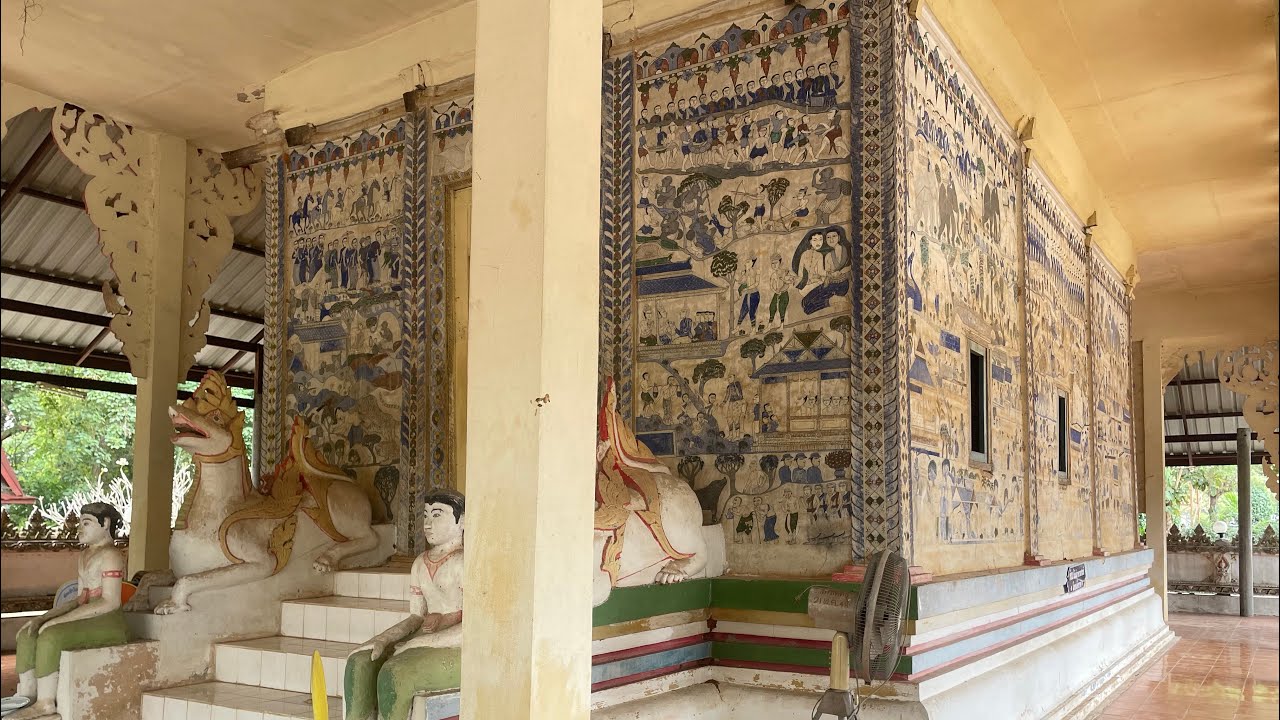
 Click to Access the Navigation Map GPS
Wat Yang Thuang Wararam Map

 Art, Culture and Heritage
 Historical Sites and Monuments(4)
 Art, Craft Centres, Tradition(5)
 Museums(3)
Temple(17)
Museums(3)
Temple(17)
 Other Sacred Sites(7)
 Research and Development
 Royal Project(2)
 Suburban Living
 Village, Community(5)
 Nature and Wildlife
 National Parks and Marine Reserves(3)
 Dam, Reservoir, Lake(10)
 River, Canal(2)
 Bays and Beaches(2)
 Other natural attractions(2)
 Entertainment and Agricultural
 Farms, Parks and Ecotourism(3)
 Travel Articles, Recipes
 Food Menu, Northeastern Recipes(1)


