
lovethailand home >Northeastern Travel Attractions >Maha Sarakham Travel Attractions >Na Dun >Dong Bang > Wat Pa Lelai
TL;DR: Wat Pa Lelai is located at Ban Nong Phok, Dong Bang Subdistrict, Na Dun District, Maha Sarakham Province, open Daily, hours 08.00 – 17.00.
Wat Pa Lelai
Open Days: Daily
Opening Hours: 08.00 – 17.00
Wat Pa Lelai in Maha Sarakham Province, also written as Wat Pa Lelai, Wat Pa Lelaiy, Wat Pa Rarai, or known historically as Wat Ban Nong Phok, is an important historic temple in Ban Nong Phok, Dong Bang Subdistrict, Na Dun District. The temple is especially valued for its old Isan sim, or ordination hall, and its vernacular hoop taem murals painted on both the exterior and interior walls. Originally a monastic residence, the site was later developed by local villagers into a temple called Wat Ban Nong Phok. It received its Wisungkham Sima on 4 June 1917 and was renamed Wat Pa Lelai in 1942. Today, the temple is one of the most meaningful cultural sites for understanding Isan mural painting, local Buddhist architecture, and the artistic memory of rural Maha Sarakham.
Wat Pa Lelai is particularly important because it belongs to the same cultural route as Wat Photharam in nearby Ban Dong Bang. The two temples are closely connected through the tradition of Isan sim architecture and mural painting. The mural painter Nai Sing, associated with Wat Pa Lelai, is also linked with the mural tradition of Wat Photharam. This connection helps visitors understand that the murals were not isolated works. They were part of a wider network of local craftsmen, Buddhist storytelling, village devotion, and regional artistic knowledge in southern Maha Sarakham.
The history of Wat Pa Lelai began when the site was a monastic residence. Local people later helped develop it into a temple known as Wat Ban Nong Phok. The old sim was built during the time of Phra Athikan Yeo as abbot, under the initiative of Phra Khru Chanthra Si Rattanakhun, who was the ecclesiastical district chief of Na Dun at that time. Later, Phra Khru Phisai Nawakan, another ecclesiastical district chief of Na Dun, changed the temple’s name to Wat Pa Lelai. The name connects the temple with the Buddhist story of Palelai, in which the Buddha stayed in the forest and was respectfully served by an elephant and a monkey. The name therefore carries meanings of solitude, compassion, forest practice, and harmony between Buddhist teaching and nature.
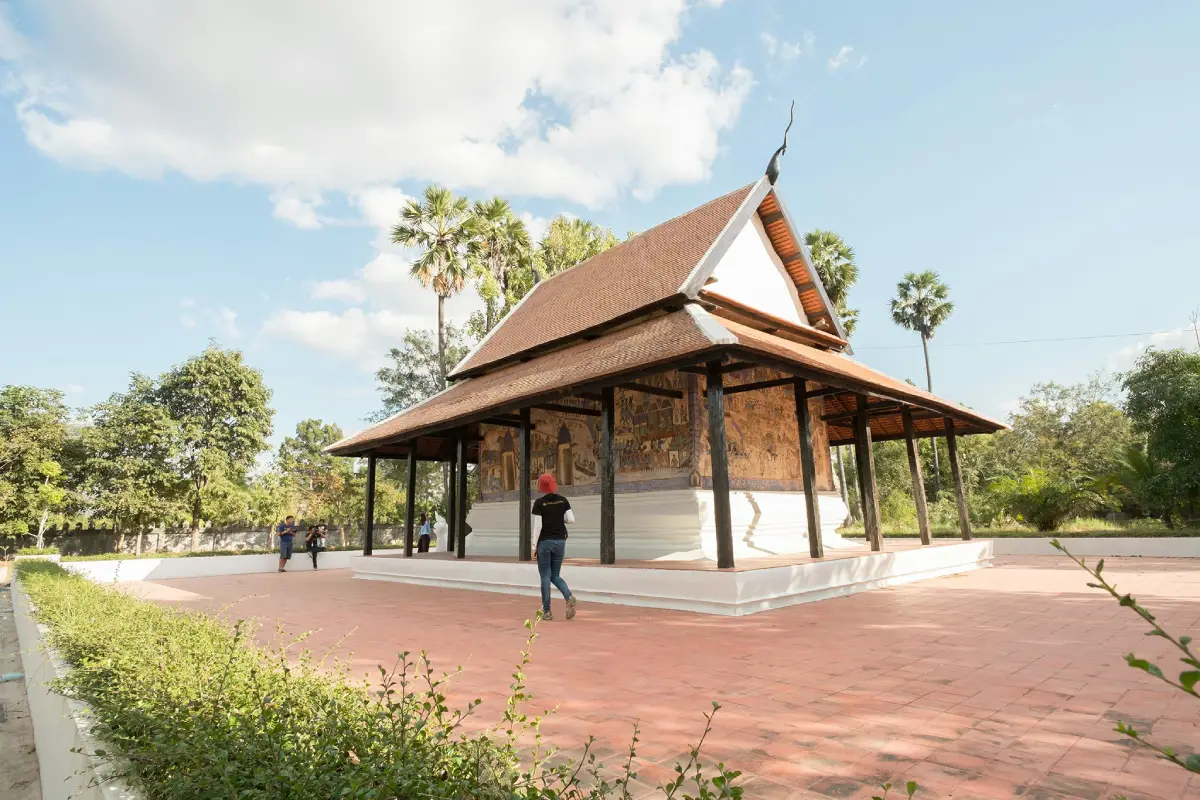
The old sim of Wat Pa Lelai is a strong example of vernacular Isan Buddhist architecture. It is a solid brick-and-plaster rectangular building with a simple but distinctive form. The structure is raised on a base with a surrounding platform. It has supporting posts for the extended eaves, a single-tier gabled roof, a surrounding wing-like roof extension, plain gable panels, and a naga staircase in local Isan style. The entrance is located on the eastern side. The side walls have two narrow light openings on each side and no window shutters. This gives the building a quiet, enclosed, and sacred atmosphere suitable for monastic rituals and worship.
The sim’s design reflects the function of a sacred community building. It is not large or grand like royal-style temples in central Thailand. Instead, it is compact, solid, and deeply connected to local use. Its walls protect the interior space, while the narrow openings allow only limited light to enter. The surrounding platform gives visitors a way to walk around the building and view the exterior murals. The naga staircase marks the symbolic transition from the ordinary world into sacred space. Every element of the sim reflects the practical and spiritual intelligence of local Isan builders.
The construction of the sim also shows the collective strength of the community. Historical accounts explain that many local people helped in the construction. Men gathered hardwood for posts, beams, rafters, roof battens, and roof materials. Women helped prepare clay for bricks. The clay was soaked and softened before being shaped. Other materials, such as animal hide and sugarcane syrup, were used in traditional mixtures. Lime came from shell materials transported from the Mun River area, while sand was brought from good river sources. Local hardwoods such as chik, teng rang, phayom, takhian, man pla, and man pao were used. These details show that the sim was not merely built by hired workers. It was created through community labor, local material knowledge, and shared Buddhist faith.
The naga staircase is one of the most meaningful architectural features. In Isan Buddhist art, the naga is not only a mythical creature. It represents protection, water, fertility, sacred power, and devotion to Buddhism. At Wat Pa Lelai, the naga staircase protects the entrance to the sim and guides worshippers toward the sacred interior. Walking up the staircase becomes a symbolic movement from the ordinary ground level into a ritual space. The raised base and surrounding platform reinforce this sense of sacred transition.
The hoop taem murals are the heart of Wat Pa Lelai. They are painted on both the outer and inner walls of the sim. The painters used the walls not as blank architectural surfaces, but as narrative fields for Buddhist teaching, literature, morality, and community memory. The mural subjects can be divided into two major groups: Buddhist religious narratives and literary or folk narratives. The exterior murals include Phra Lak-Phra Lam and the Vessantara Jataka, while the interior murals include the life of the Buddha, Phra Malai, and past Buddhas. The result is a visual world that combines religious teaching, popular literature, ethical instruction, and local imagination.
The painting technique uses powdered pigments in cool tones such as brown, green, indigo, blue, and black. Much of the work is laid over a light brown ground before the figures are drawn, colored, and outlined. The narrative structure is relatively clear. Boundaries between scenes are created through sin thao lines, ground lines, trees, walls, buildings, and natural elements. The viewing order may move from right to left, bottom to top, or clockwise depending on the wall. This system of visual storytelling is different from Western perspective-based painting, but it is highly effective for guiding local viewers through complex narratives.
The eastern front wall of the sim contains scenes from Phra Lak-Phra Lam, the Lao-Isan version of the Ramayana tradition. Important scenes include the battle of Thoraphi and Thorapha, Phra Lak and Phra Lam leaving the city and meeting a hermit, Phra Lam taking Sida back to the city, the encounter with the golden deer, Thao Raphan trying to take Sida away, the meeting with the bird Sadayu, and Phra Lam eating the fruit of a nyagrodha tree and turning into a monkey. These scenes show how the Ramayana was adapted into local Isan imagination and painted in a lively vernacular style.
The northern exterior wall continues the Phra Lak-Phra Lam story with scenes of demon armies and battles involving Phra Lak, Phra Lam, and Hanuman-like figures against Thao Raphanasuan. The battle scenes should not be judged by Western anatomical realism. Instead, they should be read as local narrative images. Movement, grouping, color, and gesture communicate the struggle between good and evil. The painters prioritized storytelling, moral clarity, and visual memory over strict physical realism.
The western and southern walls include scenes from the Vessantara Jataka. These include Chuchok asking for Kanha and Chali, the procession bringing Vessantara back to the city, the giving of the elephant and royal chariot to Brahmins, and the Chuchok episodes. The Vessantara Jataka is especially important in Isan culture because it is closely connected with Bun Phawet, or the Mahachat merit-making tradition. By painting this story on the sim walls, the temple helped the community remember the meaning of generosity, sacrifice, merit, and communal religious life.
Inside the sim, the murals focus on the life of the Buddha and Phra Malai. The inner eastern wall includes the enlightenment of the Buddha and Phra Malai visiting the beings in hell. The southern interior wall is divided into three sections, including the assault of Mara, the Earth Goddess wringing water from her hair, offerings of food to the Buddha, and the Buddha on alms round. Lower sections include past Buddhas alternating with flower vases. The western wall shows the Buddha’s passing into Parinirvana, while the northern interior wall shows Phra Malai visiting heaven and the human world to teach beings. These murals create a sacred interior atmosphere focused on karma, merit, liberation, and the cycle of existence.
Phra Malai is an important story in Thai and Isan Buddhist culture. It tells of a monk who travels to hell and heaven, witnesses the results of good and bad actions, and returns to warn human beings to do good. The Phra Malai murals at Wat Pa Lelai therefore function as direct moral instruction. They make ideas of karma, merit-making, suffering, and spiritual responsibility visible through images. For earlier village communities, such murals were powerful teaching tools because not everyone learned through written texts.
The murals also preserve details of Isan life in the past. Figures in the scenes show clothing styles, hairstyles, gestures, village processions, warfare, travel, ritual action, and everyday social behavior. These details are important because they allow modern visitors to see how local people imagined themselves within religious and literary worlds. The murals are therefore not only works of Buddhist art. They are also visual records of social history, village memory, and local identity.
The charm of Isan hoop taem lies in its directness and vitality. The paintings do not follow Western rules of perspective or realistic anatomy. Figures may be simplified, events from different moments may appear in the same visual field, and important characters may be emphasized through scale or placement. These qualities are not weaknesses. They are part of a local visual language designed to make stories memorable and meaningful for the community. Visitors should read the murals as narrative art rather than as decorative background.
The old sim of Wat Pa Lelai has been registered as a national historic site, with its protected boundary officially designated in the Royal Gazette on 22 December 1993. This recognition confirms the importance of the sim as cultural heritage beyond the local community. The building and murals should therefore be viewed with special care. Visitors should avoid touching the walls, leaning on the murals, scratching surfaces, using strong flash at close range, or climbing on architectural elements. Even small damage can harm heritage that has survived for generations.
Wat Pa Lelai remains connected with living community practice. Around the end of Buddhist Lent, local people gather near the mural-covered sim to chant, prepare sweets and dry food, and wait for monks to emerge from the sim after the rainy-season retreat. They then join in merit-making and almsgiving. This shows that the sim is not only an old monument for visitors. It continues to be part of local religious life and community memory.
Ban Nong Phok and Dong Bang Subdistrict are essential to understanding the temple. Dong Bang is an area rich in local cultural heritage, and the nearby Wat Photharam is another major mural site. Travelers interested in Isan art should visit both temples in the same trip. The short distance between them allows visitors to compare architectural form, mural subjects, painting techniques, and local craftsmanship. This makes the area one of the most valuable cultural routes in Na Dun District.
Getting There is most convenient by private car, rental car, or hired local transport. From Maha Sarakham city, travel toward Na Dun District, then continue to Dong Bang Subdistrict and Ban Nong Phok. From Phra That Na Dun, visitors can continue to Wat Photharam and Wat Pa Lelai within the same route. Public transportation into the village may be limited, so private transport is recommended for those who want to visit multiple cultural sites in one day.
A practical half-day itinerary begins at Wat Photharam in Ban Dong Bang, continues to Wat Pa Lelai in Ban Nong Phok, and then returns to Phra That Na Dun or the Champa Si Historical Study Center. A full-day itinerary can add Ku Santarat, other Na Dun temples, and local cafés or restaurants. This route combines vernacular Isan Buddhist art, Khmer-style heritage, sacred relic worship, and old community landscapes within the same district.
The best time to visit is in the morning or late afternoon. Natural light helps visitors see the exterior murals more clearly, while the weather is usually more comfortable than at midday. Those who wish to study the interior murals should choose a time with sufficient light and avoid using harsh artificial light near the old paintings. A slow visit is strongly recommended because the murals contain many narrative details.
Visitors should dress modestly, cover shoulders and knees, speak quietly, and behave respectfully. Do not touch the murals, lean on the walls, write on surfaces, climb on the naga staircase, or disturb monks and local worshippers. If a ceremony is taking place, keep an appropriate distance and follow local guidance. Responsible behavior helps preserve the temple and ensures that local people can continue using the sacred space respectfully.
For students, researchers, and cultural travelers, Wat Pa Lelai is an excellent field learning site. It provides direct evidence of Isan sim architecture, mural painting, folk literature, local construction techniques, community labor, and heritage conservation. Observing the site in person allows visitors to understand the relationship between architecture, painting, ritual, and community life more deeply than reading about the temple alone.
For international visitors, Wat Pa Lelai is an excellent example of Isan sim architecture and hoop taem murals. An Isan sim is not simply a small ordination hall. It is a sacred ritual space and a visual archive of village life. Hoop taem murals are not court paintings. They are community murals that teach Buddhism, narrate folk literature, reflect local belief, and preserve scenes of everyday life. Visiting this temple helps foreign travelers understand the regional diversity of Thai Buddhist art.
Food, cafés, and accommodation are available around Na Dun District. Travelers can stop at Thung Dok Chan Cafe & Homestay, Zaep Nua Khrua Je Bim, Khrua Na Dun, Cafe Phak Lang Ban, and 4 Naka-Cafe. Nearby accommodations include Thung Dok Chan Homestay, Luk Kaew Resort Na Dun Branch, Piang Fah Resort, Inaka Resort, and INAKA Pool Villa. Planning ahead is recommended during festivals, long weekends, or major merit-making periods around Phra That Na Dun.
The value of Wat Pa Lelai lies in the completeness of its local heritage. It preserves the story of a monastic residence that became Wat Ban Nong Phok, the granting of Wisungkham Sima in 1917, the renaming to Wat Pa Lelai in 1942, a solid brick-and-plaster Isan sim, a naga staircase, narrow light openings, exterior and interior murals, Phra Lak-Phra Lam, the Vessantara Jataka, the life of the Buddha, Phra Malai, and visual traces of Isan life. These elements make the temple a living cultural document of Na Dun District.
In summary, Wat Pa Lelai in Ban Nong Phok, Dong Bang Subdistrict, Na Dun District, Maha Sarakham Province is one of the most important temples for understanding Isan sim architecture, hoop taem murals, Lao-Isan literature, and local Buddhist art. Its highlights include the old brick-and-plaster sim, exterior and interior murals, naga staircase, Phra Lak-Phra Lam scenes, Vessantara Jataka, Buddha-life narratives, Phra Malai, and the continuing faith of the local community. Travelers who want to experience Maha Sarakham through art, Buddhism, and community memory should spend meaningful time at Wat Pa Lelai.
| Name | Wat Pa Lelai |
| Former / Related Names | Wat Pa Lelai, Wat Ban Nong Phok, Wat Pa Rarai, Sim Wat Pa Lelai, Hoop Taem Wat Pa Lelai |
| Location | Ban Nong Phok, Dong Bang Subdistrict, Na Dun District, Maha Sarakham Province |
| Address | Ban Nong Phok, Dong Bang Subdistrict, Na Dun District, Maha Sarakham Province 44180, Thailand |
| Site Type | Historic temple, national historic site, Isan sim, and vernacular mural learning site in Na Dun District |
| Highlights | Old brick-and-plaster Isan sim, exterior and interior hoop taem murals, naga staircase, Phra Lak-Phra Lam murals, Vessantara Jataka, Buddha-life scenes, and Phra Malai murals |
| History | The site was originally a monastic residence, later developed by villagers into Wat Ban Nong Phok. The sim was built during the time of Phra Athikan Yeo as abbot under the initiative of Phra Khru Chanthra Si Rattanakhun. The temple received Wisungkham Sima on 4 June 1917 and was renamed Wat Pa Lelai in 1942 |
| Name Origin | The earlier name Wat Ban Nong Phok came from the village name. The later name Wat Pa Lelai connects with the Buddhist story of Palelai, symbolizing solitude, compassion, forest practice, and harmony with nature |
| Distinctive Features Of The Sim | Solid rectangular brick-and-plaster Isan sim with a raised base, surrounding platform, supporting posts for extended eaves, single-tier gabled roof, wing-like eaves around the building, plain gable panels, naga staircase, eastern entrance, and two narrow light openings on each side without window shutters |
| Builders And Painters | Construction involved Vietnamese craftsmen from Suwannaphum and local community labor. The mural tradition is associated with Nai Sing Wongwat, Nai Champa Wongwat, and Nai Chari Wongwat, local painters from Ban Khlong Chop in Phayakkhaphum Phisai District |
| Mural Technique | Powdered pigments in cool tones such as brown, green, indigo, blue, and black. The paintings were laid on a light brown ground, then drawn, colored, and outlined. Narrative scenes are divided by sin thao lines, ground lines, trees, walls, and natural features |
| Mural Subjects | Exterior murals show Phra Lak-Phra Lam and the Vessantara Jataka. Interior murals show the life of the Buddha, Phra Malai, past Buddhas, flower vases, angels, and moral scenes related to merit, karma, heaven, and hell |
| Historic Site Status | The sim of Wat Pa Lelai was registered as a national historic site in the Royal Gazette on 22 December 1993, with a protected boundary of 1 rai, 3 ngan, and 60 square wah |
| Important Features Inside The Temple | 1. Old Isan sim 2. Exterior hoop taem murals 3. Interior hoop taem murals 4. Naga staircase 5. Principal Buddha image and worship space inside the sim 6. Sim courtyard and community activity area |
| Traditions / Community Activities | End-of-Buddhist-Lent merit-making, almsgiving after Lent, Bun Phawet, Kathin, robe-offering ceremonies, Buddhist holy days, candlelight processions, and merit-making activities of Ban Nong Phok and Dong Bang community |
| Travel Information | From Maha Sarakham city, travel toward Na Dun District, then continue to Dong Bang Subdistrict and Ban Nong Phok. From Phra That Na Dun, visitors can continue to Wat Photharam and Wat Pa Lelai in the same route. Private car, rental car, or hired local transport is recommended |
| Current Status | Open as a community temple, national historic site, and learning site for Isan sim architecture and hoop taem murals. Visitors can worship and view the murals during opening hours |
| Open Days | Daily |
| Opening Hours | 08.00 – 17.00 |
| Facilities | Temple courtyard, worship area, old sim and mural viewing area, shaded resting area, and parking space around the temple or nearby community area |
| Main Areas / Zones | 1. Old Isan sim zone 2. Exterior mural zone 3. Interior mural zone 4. Naga staircase and surrounding platform zone 5. Sim courtyard and merit-making zone 6. Ban Nong Phok community and Wat Photharam connecting route zone |
| Caretaker | Wat Pa Lelai monastic community, Ban Nong Phok community, and Dong Bang Subdistrict Municipality |
| Local Administrative Contact | Dong Bang Subdistrict Municipality, Tel. 043-706-750, 043-706-6751 |
| Official Website / Official Page | Dong Bang Subdistrict Municipality website: dongbanglocal.go.th and Dong Bang Subdistrict Municipality Facebook page |
| Nearby Tourist Attractions | 1. Wat Photharam, Ban Dong Bang, about 1 km 2. Ban Dong Bang Community, about 2 km 3. Phra That Na Dun, about 9 km 4. Champa Si Historical Study Center / Nakhon Champa Si Museum, about 9 km 5. Ku Santarat, about 13 km 6. Chang Thong Kham Elephant Conservation Center, Wapi Pathum District, about 25 km |
| Nearby Restaurants | 1. Thung Dok Chan Cafe & Homestay, about 4 km, Tel. 064-954-1598 2. Cafe Phak Lang Ban & Ja-O Beauty Hair Cafe & Restaurants, about 8 km, Tel. 092-105-1999 3. Khrua Na Dun, about 9 km, Tel. 093-474-7855, 093-475-7855 4. Zaep Nua Khrua Je Bim, Na Dun Branch, about 9 km, Tel. 098-420-4546 5. 4 Naka-Cafe 2465, about 18 km, Tel. 083-369-0694 |
| Nearby Accommodations | 1. Thung Dok Chan Cafe & Homestay, about 4 km, Tel. 064-954-1598 2. Luk Kaew Resort Na Dun Branch, about 8 km, Tel. 043-020-442 3. Piang Fah Resort, about 9 km, Tel. 081-617-1213, 043-797-051 4. Inaka Resort, about 12 km, Tel. 089-518-7526 5. INAKA Pool Villa, about 18 km, Tel. 089-518-7526 |
Frequently Asked Questions (FAQ)
Q: Where is Wat Pa Lelai located?
A: Wat Pa Lelai is located in Ban Nong Phok, Dong Bang Subdistrict, Na Dun District, Maha Sarakham Province. It is an important historic temple with an old Isan sim and vernacular hoop taem murals.
Q: What was the original name of Wat Pa Lelai?
A: The temple was originally a monastic residence and later became Wat Ban Nong Phok. It was renamed Wat Pa Lelai in 1942.
Q: What makes the sim of Wat Pa Lelai special?
A: The sim is a solid brick-and-plaster vernacular Isan ordination hall with a raised base, surrounding platform, naga staircase, eastern entrance, narrow light openings, and murals on both exterior and interior walls.
Q: What stories are shown in the murals?
A: The exterior murals show Phra Lak-Phra Lam and the Vessantara Jataka, while the interior murals show the life of the Buddha, Phra Malai, past Buddhas, and moral scenes related to merit, karma, heaven, and hell.
Q: What are the opening days and hours of Wat Pa Lelai?
A: Wat Pa Lelai is open daily from 08.00 to 17.00.
Q: How can travelers get to Wat Pa Lelai?
A: From Maha Sarakham city, travel toward Na Dun District, then continue to Dong Bang Subdistrict and Ban Nong Phok. Visitors can also combine the route with Phra That Na Dun, Wat Photharam, and the Champa Si Historical Study Center.
Q: How should visitors behave when viewing the murals?
A: Visitors should dress modestly, avoid touching or leaning on the walls, avoid writing on surfaces, avoid close flash photography, avoid climbing on the naga staircase, and take photographs respectfully.
Q: What nearby places can be visited with Wat Pa Lelai?
A: Nearby places include Wat Photharam in Ban Dong Bang, Phra That Na Dun, the Champa Si Historical Study Center, Ku Santarat, and Chang Thong Kham Elephant Conservation Center.
 Category: ●Places of Worship
 Group: ●Temple
Last Update : 2 MonthAgo
 Last Update : 2 MonthAgo
 Click to Access the Navigation Map GPS
 Art, Culture and Heritage
 Historical Sites and Monuments(4)
 Art, Craft Centres, Tradition(5)
 Museums(3)
Temple(17)
Museums(3)
Temple(17)
 Other Sacred Sites(7)
 Research and Development
 Royal Project(2)
 Suburban Living
 Village, Community(5)
 Nature and Wildlife
 National Parks and Marine Reserves(3)
 Dam, Reservoir, Lake(10)
 River, Canal(2)
 Bays and Beaches(2)
 Other natural attractions(2)
 Entertainment and Agricultural
 Farms, Parks and Ecotourism(3)
 Travel Articles, Recipes
 Food Menu, Northeastern Recipes(1)


