
lovethailand home >Northeastern Travel Attractions >Maha Sarakham Travel Attractions >Chuen Chom >Nong Kung > Wat Luang Pu Hin
TL;DR: Wat Luang Pu Hin is located at Ban Phue, Nong Kung Subdistrict, Chuen Chom District, Maha Sarakham Province, open Daily, hours 08.00 – 17.00.
Wat Luang Pu Hin
Open Days: Daily
Opening Hours: 08.00 – 17.00
Wat Luang Pu Hin in Maha Sarakham Province, also known as Wat Pho Si Ban Phue, is an important community temple in Ban Phue, Nong Kung Subdistrict, Chuen Chom District. The temple is home to Luang Pu Hin, a sacred Buddha image carved from natural laterite stone. The image is in the meditation posture, measuring about 100 centimeters across the lap and about 150 centimeters in height. Its exact period of creation remains unknown, but it has long been revered as the spiritual Buddha image of Chuen Chom District. For local people, Luang Pu Hin is not only a sacred object of worship. It is a symbol of protection, community memory, village history, and the deep Buddhist faith of Ban Phue.
The beauty of Luang Pu Hin lies in its simplicity and strength. Unlike highly polished bronze Buddha images or elaborate urban temple art, this image carries the quiet power of natural stone. The laterite material, the weathered surface, and the calm meditation posture give the image a strong sense of age and dignity. Some original details have faded through time, but this has not weakened local devotion. On the contrary, the marks of age make the image feel even more connected to the past and to the people who have protected it for generations.
The history of Luang Pu Hin is closely tied to Ban Phue and the old settlement area known as Non Ban Kao. Local accounts explain that before the present community became established, villagers discovered three Buddha images emerging from the ground in the old settlement area. The principal image was Luang Pu Hin, while the two smaller images were believed to represent attendant disciples. This discovery became central to the spiritual identity of the community. Local people came to believe that Luang Pu Hin had protected the settlement and that the image belonged to the land and the people of Ban Phue.
The settlement history of Ban Phue reflects wider migration patterns in northeastern Thailand during the early Rattanakosin period. Local stories mention Lao and Ubon Ratchathani groups moving into the area, first settling around the old forested mound before relocating to the present village. Reasons for moving included wild animals, insecurity, and local beliefs about the older site. Even after the community moved, the people continued to care for Luang Pu Hin at the old area, treating the image as a spiritual guardian of the village.
Wat Pho Si Ban Phue, where Luang Pu Hin is now enshrined, is a community Buddhist temple under the Mahanikaya order. The temple was established in 1867 and received its Wisungkham Sima on 15 May 1996. It continues to serve as a place for monastic life, merit-making, ceremonies, and local gatherings. Its importance is strengthened by the presence of Luang Pu Hin, which draws worshippers from Chuen Chom District and from nearby areas.
One of the most meaningful parts of the temple’s history is the story of Luang Pu Hin being moved away from the village and later brought back. Local accounts describe a period between 1968 and 1975 when the image was removed from its original local setting due to concerns about the safety of ancient objects and the unstable situation of the time. During that period, many villagers believed that the community suffered severe drought and a loss of spiritual protection. The return of Luang Pu Hin therefore became a turning point in local memory.
When the villagers succeeded in bringing Luang Pu Hin back to Ban Phue, devotion grew even stronger. Local stories speak of signs of rain and renewed coolness after the image returned. Whether understood as faith, memory, or symbolic history, this story shows how deeply the Buddha image is connected with the well-being of the community. Wat Pho Si Ban Phue became the place where this shared memory was preserved and where villagers continued to express gratitude and devotion.
The meditation posture of Luang Pu Hin is especially meaningful. It represents inner stillness, concentration, and mental stability. Worshippers often come to pray for success, protection, safe travel, family well-being, health, and peace of mind. For the people of Chuen Chom, Luang Pu Hin is regarded as a sacred Buddha image that brings confidence and emotional strength. The image is also part of the district’s cultural identity and is associated with the phrase “pay respect to Luang Pu Hin” in local memory.
A respectful visit should begin with quiet awareness. Visitors can pay respect to the Buddha image, make merit, offer flowers, candles, incense, or gold leaf, and sit quietly for a short moment. The most important part of worship is not the size of the offering, but sincerity, mindfulness, and respect. Luang Pu Hin serves as a reminder of the Buddha’s teaching and encourages visitors to act with honesty, calmness, and moral intention.
The most important annual event connected with the temple is the tradition of paying respect to Chao Luang Pu Hin during the Songkran period in April. The festival includes bathing the sacred image, carrying a replica image in procession around the community, and allowing people to pay respect for blessings. This tradition connects Buddhist devotion with the Thai New Year, respect for elders, community reunion, and local identity. During the festival, Ban Phue becomes especially lively as villagers and returning family members gather at the temple.
The Songkran festival around Luang Pu Hin shows that the image is not confined to the temple interior. Through procession and ritual bathing, the sacred presence of Luang Pu Hin extends into the community. People of different ages can take part, including elders, children, local leaders, monks, and visitors. The festival strengthens the relationship between temple and village, and it keeps the story of Luang Pu Hin alive through repeated annual practice.
Another local expression of faith is the practice of making vows and fulfilling them through outdoor movie screenings. Some worshippers who believe their prayers have been fulfilled arrange movie screenings as an offering of gratitude. This has become a community cultural practice around the temple. It brings people together, supports small local vendors, and shows how Buddhist faith, popular entertainment, and community economy can interact in rural Isan life.
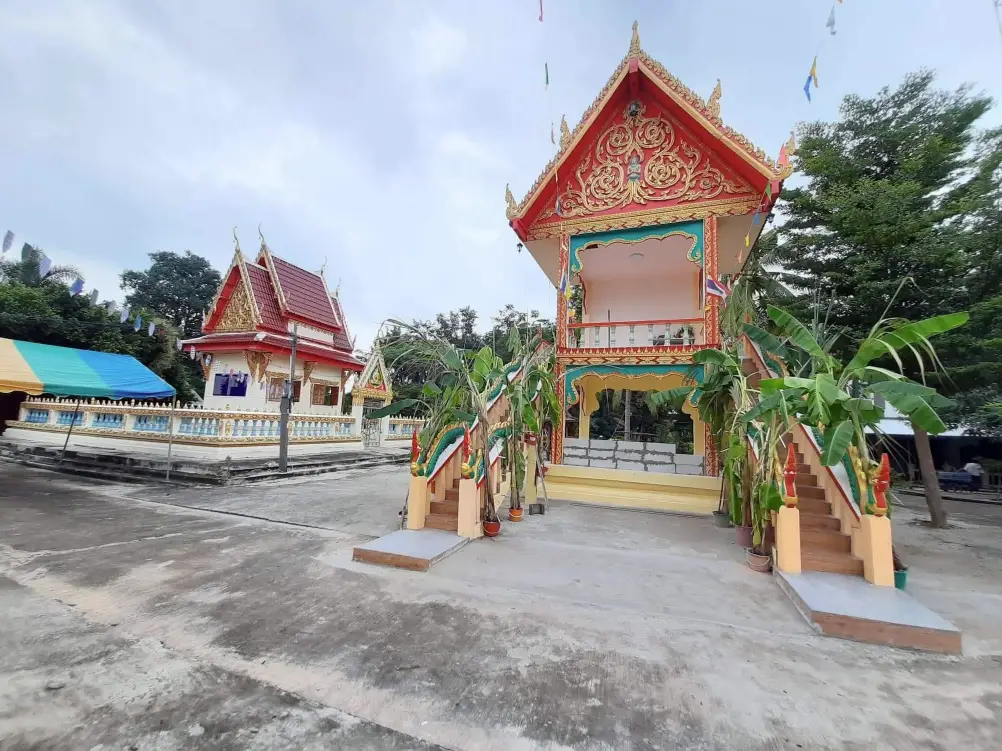
The temple grounds can be understood through several main areas. The most important is the Luang Pu Hin worship zone. Other areas include the ordination hall and ritual space, the temple courtyard, the pavilion and shaded resting areas, the entrance and parking zone, and the surrounding Ban Phue community. Visitors should begin at the main worship area and then walk calmly through the temple grounds to understand the atmosphere of a living rural temple.
Wat Luang Pu Hin is suitable for several types of visitors. Buddhist pilgrims can come to pay respect and make merit. Cultural travelers can learn about local belief, the old settlement of Non Ban Kao, and the return of the sacred image. Visitors interested in community traditions can come during Songkran to see the Luang Pu Hin festival. Families can use the visit to teach children about temple etiquette, local history, and respect for sacred community heritage.
Getting There is most convenient by private car, rental car, or hired local transport. From Maha Sarakham city, travel toward Chiang Yuen and Chuen Chom District, then continue to Nong Kung Subdistrict and Ban Phue. From Khon Kaen, visitors can use routes connecting to Chiang Yuen or Chuen Chom before continuing to Nong Kung. Because the temple is located in a rural community area, private transport is more practical than relying on infrequent public transport.
A half-day route can include worship at Wat Luang Pu Hin, a stop at Non Ban Kao, Nong Kung wooden bridge, Wat Muen Chai Si or its spring area, and Nong Daeng Reservoir. A full-day route can extend toward Chiang Yuen District, including Wat Pa Nong Chad, Wat Phuttha Pradit Ban Phon, or Ku Thong. This route combines faith, local history, rural landscape, and community travel in the northern part of Maha Sarakham.
The best time to visit is in the morning or late afternoon, when the weather is more comfortable and the temple atmosphere is calm. The Songkran period in April is the most meaningful time for those who want to experience the annual tradition of paying respect to Luang Pu Hin, but visitors should allow extra time because many people return to the community for the festival. On ordinary days, the temple is quieter and suitable for peaceful worship.
Visitors should dress respectfully. Shoulders and knees should be covered. Loud behavior, climbing on Buddha image bases, touching sacred objects unnecessarily, and inappropriate photography should be avoided. If monks or local worshippers are performing ceremonies, visitors should keep a respectful distance and follow local practice. A calm and respectful attitude is the best way to experience the temple properly.
For international travelers, Wat Luang Pu Hin is a meaningful example of a sacred community Buddha image in rural northeastern Thailand. Its importance does not come only from age or material. It comes from the relationship between the image and the people who remember, protect, worship, and celebrate it. The story of discovery, relocation, return, and annual ritual shows how a Buddha image can become the heart of a community’s identity.
The value of Wat Luang Pu Hin lies in the way it brings together several layers of meaning: a laterite Buddha image of unknown age, the settlement history of Ban Phue, the old site of Non Ban Kao, the memory of loss and return, the Songkran procession, and the continuing role of Wat Pho Si Ban Phue as a community temple. These elements make the temple more than a place for worship. It is a living archive of faith and local history.
In summary, Wat Luang Pu Hin, or Wat Pho Si Ban Phue, in Nong Kung Subdistrict, Chuen Chom District, Maha Sarakham Province, is one of the most meaningful sacred destinations in the district. Luang Pu Hin is a laterite Buddha image in the meditation posture, revered as the spiritual Buddha image of Chuen Chom. The temple is suitable for merit-making, cultural learning, Songkran festival visits, and quiet rural travel. Visitors who want to understand Maha Sarakham through faith, village memory, and Isan community culture should include Wat Luang Pu Hin in their itinerary.
| Name | Wat Luang Pu Hin |
| Related Names | Wat Pho Si Ban Phue, Wat Ban Phue, Luang Pu Hin, Chao Luang Pu Hin |
| Location | Ban Phue, Nong Kung Subdistrict, Chuen Chom District, Maha Sarakham Province |
| Address | Ban Phue, Nong Kung Subdistrict, Chuen Chom District, Maha Sarakham Province 44160, Thailand |
| Temple Type | Community Buddhist temple under the Mahanikaya order |
| Highlights | Luang Pu Hin, a sacred laterite Buddha image in the meditation posture, carved from natural stone and revered as the spiritual Buddha image of Chuen Chom District |
| Characteristics Of Luang Pu Hin | Meditation-posture Buddha image made entirely from laterite stone, about 100 centimeters across the lap and about 150 centimeters high. The exact period of creation is unknown |
| History / Context | Luang Pu Hin is connected with the history of Ban Phue and the old settlement of Non Ban Kao. Villagers discovered three Buddha images emerging from the ground, with Luang Pu Hin as the principal image. The image was later moved away and eventually brought back to be enshrined at Wat Pho Si Ban Phue |
| Temple History | Wat Pho Si Ban Phue was established in 1867 and received Wisungkham Sima on 15 May 1996 |
| Name Origin | The name Wat Luang Pu Hin comes from the sacred Buddha image carved from natural stone, while Wat Pho Si Ban Phue is the community temple name of Ban Phue where the image is enshrined |
| Important Features Inside The Temple | 1. Luang Pu Hin, laterite Buddha image in meditation posture 2. Ordination hall and worship area 3. Pavilion and temple courtyard 4. Area for the Luang Pu Hin annual tradition 5. Merit-making area of Ban Phue community 6. Route connected with Non Ban Kao and the discovery story |
| Traditions / Important Activities | Annual tradition of paying respect to Chao Luang Pu Hin during Songkran, ritual bathing of Luang Pu Hin, procession of a replica image, respect-paying to elders, Buddhist holy day merit-making, Kathin, robe-offering ceremonies, and community merit-making in Nong Kung Subdistrict |
| Travel Information | From Maha Sarakham city, travel toward Chiang Yuen and Chuen Chom District, then continue to Nong Kung Subdistrict and Ban Phue. From Khon Kaen, use routes connecting to Chiang Yuen or Chuen Chom before continuing to Nong Kung. Private car, rental car, or hired local transport is recommended |
| Current Status | Open as a community temple and worship site for Luang Pu Hin. Visitors can make merit and visit during opening hours |
| Open Days | Daily |
| Opening Hours | 08.00 – 17.00 |
| Facilities | Luang Pu Hin worship area, ordination hall, pavilion, temple courtyard, merit-making area, shaded resting area, and parking space around the temple or nearby community area |
| Main Areas / Zones | 1. Luang Pu Hin worship zone 2. Ordination hall and ritual zone 3. Pavilion and temple courtyard zone 4. Annual Luang Pu Hin tradition zone 5. Entrance and parking zone 6. Ban Phue community and Non Ban Kao story route zone |
| Abbot / Caretaker | Phra Athikan Jamrong Anuttara, Abbot of Wat Pho Si Ban Phue, together with the Wat Pho Si Ban Phue monastic community |
| Local Administrative Contact | Nong Kung Subdistrict Municipality, Tel. 043-731069 |
| Official Website / Official Page | Nong Kung Subdistrict Municipality website: nongkungcity.go.th and Nong Kung Subdistrict Municipality Facebook page |
| Nearby Tourist Attractions | 1. Non Ban Kao / Luang Pu Hin Discovery Story Area, about 2 km 2. Nong Kung Wooden Bridge, about 6 km 3. Wat Muen Chai Si / Spring Area on Chuen Chom Faith Route, about 8 km 4. Nong Daeng Reservoir, Chuen Chom District, about 9 km 5. Huai Khon Sak Stream, about 12 km 6. Wat Pa Nong Chad, Chiang Yuen District, about 28 km |
| Nearby Restaurants | 1. Srichuenchom Cafe, about 8 km, Tel. 095-483-4485 2. Pa Dam Larb Koi Chuen Chom, about 9 km, Tel. 086-015-7959 3. Khrua Bai Mon Chuen Chom, about 9 km, Tel. 081-139-5398 4. Khanom Jeen Ku Thong, Chiang Yuen District, about 30 km, Tel. 043-306-749, 082-981-3320 5. Moo Inter Chiang Yuen, about 31 km, Tel. 093-131-6969 |
| Nearby Accommodations | 1. Tawan Permpoon Resort Chuen Chom, about 9 km, Tel. 089-619-2122 2. Yayu Place Hotel, Chiang Yuen District, about 31 km, Tel. 081-422-7125 3. Keankhun Resort, Chiang Yuen District, about 33 km, Tel. 043-988-198, 082-850-7731 4. Chiang Yuen Daily-Monthly Rental House, about 31 km, Tel. 043-020-189, 092-449-6979 5. Debua White House Maha Sarakham, about 45 km, Tel. 043-020-255 |
Frequently Asked Questions (FAQ)
Q: Where is Wat Luang Pu Hin located?
A: Wat Luang Pu Hin, also known as Wat Pho Si Ban Phue, is located in Ban Phue, Nong Kung Subdistrict, Chuen Chom District, Maha Sarakham Province.
Q: What kind of Buddha image is Luang Pu Hin?
A: Luang Pu Hin is a meditation-posture Buddha image carved from natural laterite stone. It is about 100 centimeters across the lap and about 150 centimeters high. Its exact period of creation is unknown.
Q: What are the opening days and hours of Wat Luang Pu Hin?
A: Wat Luang Pu Hin is open daily from 08.00 to 17.00.
Q: What is the history of Wat Pho Si Ban Phue?
A: Wat Pho Si Ban Phue is a community Buddhist temple under the Mahanikaya order. It was established in 1867 and received Wisungkham Sima on 15 May 1996.
Q: When is the Luang Pu Hin annual tradition held?
A: The tradition of paying respect to Chao Luang Pu Hin is held during Songkran in April. It includes bathing the sacred image, a procession of a replica image, and community merit-making activities.
Q: How can travelers get to Wat Luang Pu Hin?
A: From Maha Sarakham city, travel toward Chiang Yuen and Chuen Chom District, then continue to Nong Kung Subdistrict and Ban Phue. Private car, rental car, or hired local transport is recommended.
Q: What nearby places can be visited with Wat Luang Pu Hin?
A: Nearby places include Non Ban Kao, Nong Kung Wooden Bridge, Wat Muen Chai Si, Nong Daeng Reservoir, Huai Khon Sak Stream, and Wat Pa Nong Chad in Chiang Yuen District.
Q: How should visitors behave when paying respect to Luang Pu Hin?
A: Visitors should dress modestly, behave calmly, avoid climbing on sacred bases, avoid touching the Buddha image unnecessarily, and take photographs respectfully without disturbing monks or worshippers.
 Category: ●Places of Worship
 Group: ●Temple
Last Update : 2 MonthAgo
 Last Update : 2 MonthAgo
 Click to Access the Navigation Map GPS
 Art, Culture and Heritage
 Historical Sites and Monuments(4)
 Art, Craft Centres, Tradition(5)
 Museums(3)
Temple(17)
Museums(3)
Temple(17)
 Other Sacred Sites(7)
 Research and Development
 Royal Project(2)
 Suburban Living
 Village, Community(5)
 Nature and Wildlife
 National Parks and Marine Reserves(3)
 Dam, Reservoir, Lake(10)
 River, Canal(2)
 Bays and Beaches(2)
 Other natural attractions(2)
 Entertainment and Agricultural
 Farms, Parks and Ecotourism(3)
 Travel Articles, Recipes
 Food Menu, Northeastern Recipes(1)


