
lovethailand home >Northeastern Travel Attractions >Maha Sarakham Travel Attractions >Wapi Pathum >Nong Saeng > Ku Ban Daeng
TL;DR: Ku Ban Daeng is located at Ban Daeng, Village No. 12, Nong Saeng Subdistrict, Wapi Pathum District, Maha Sarakham Province, open Daily, hours 08.00 – 17.00.
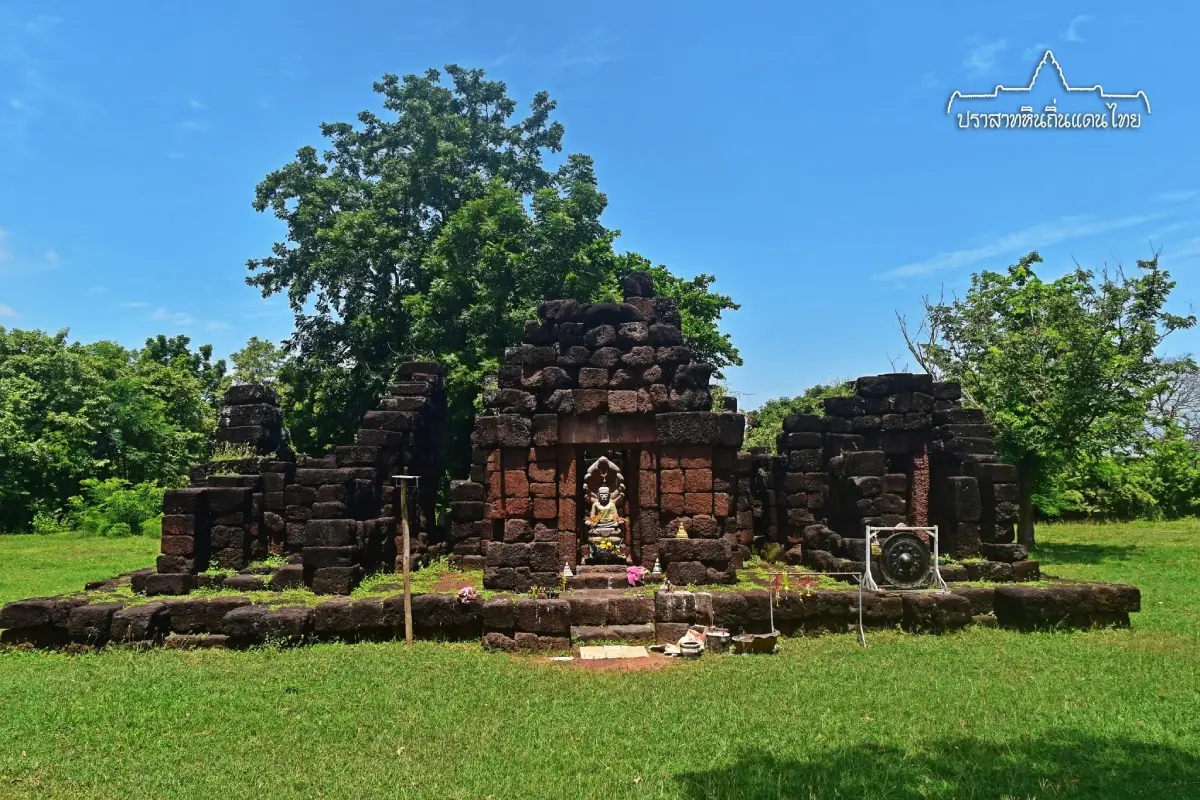
Ku Ban Daeng
Open Days: Daily
Opening Hours: 08.00 – 17.00
Ku Ban Daeng in Maha Sarakham Province is a small but highly meaningful laterite Khmer sanctuary located in Ban Daeng, Nong Saeng Subdistrict, Wapi Pathum District. The site consists of 3 small sanctuary towers arranged on the same base, built mainly of laterite and facing west. Although the monument is now largely ruined, it remains one of the most important cultural landmarks of the local community because of its Bayon-style artistic features and its strong connection with Mahayana Buddhist belief around the 18th Buddhist century.
Ku Ban Daeng is especially interesting for travelers who want to explore lesser-known Khmer heritage sites in northeastern Thailand. The monument is not large like Phimai or other famous Khmer complexes, but its historical value is deep. Its surviving laterite base, the arrangement of 3 sanctuaries, the unusual west-facing orientation, and the story of its important Mahayana Buddhist lintel make the site a rewarding stop for visitors interested in archaeology, Buddhist art, local traditions, and the cultural landscape of Maha Sarakham.
The site stands in Ban Daeng, Village No. 12, Nong Saeng Subdistrict, Wapi Pathum District. Ban Daeng is a rural community located along the route connecting Wapi Pathum with Na Dun. The name Ban Daeng is linked with local memory that the area once had many daeng trees, which gave the village its name. Because the ancient monument stands within this community, it became known as Ku Ban Daeng. The name therefore carries both archaeological meaning and local identity.
In northeastern Thailand, the word “ku” is commonly used for ancient sacred monuments, religious towers, shrines, or sanctuaries. Ku Ban Daeng is therefore not simply an abandoned ruin. For the local community, it is a sacred place, a cultural symbol, and a focus of annual ritual. The monument continues to be connected with community belief through the Song Ku Ban Daeng tradition, held on the full moon of the 5th lunar month. This living tradition helps preserve the meaning of the monument beyond its physical remains.
The architecture of Ku Ban Daeng consists of 3 small sanctuary towers standing on a shared base. This arrangement suggests that the structures were designed as a group rather than as separate buildings. The main construction material is laterite, a common and durable material used in many Khmer monuments in Isan. Laterite was especially suitable for bases, walls, and heavy structural components. Even after centuries of weathering, the surviving laterite remains allow visitors to understand the basic form and layout of the monument.
One notable feature of Ku Ban Daeng is that the sanctuaries face west. Many Khmer religious monuments emphasize the east, so the west-facing orientation of Ku Ban Daeng is an important point for observation. It may relate to the local landscape, former approach routes, or a specific ritual context. Visitors should take time to notice the direction of the sanctuary group, the position of the central tower, and the relationship between the monument and the surrounding community space.
The most important artwork associated with Ku Ban Daeng is a red sandstone lintel that once stood above the entrance frame of the central sanctuary. The lintel depicts a Mahayana Buddhist triad: a seated Buddha protected by a naga, Avalokitesvara Bodhisattva, and Prajnaparamita. This composition is known as the Mahayana Triad and is one of the key reasons Ku Ban Daeng is historically important. It clearly links the monument with Mahayana Buddhism and Bayon-style Khmer art.
The naga-protected Buddha at the center of the lintel represents spiritual protection and enlightenment. Avalokitesvara Bodhisattva, shown as a male figure with 4 arms, symbolizes compassion in Mahayana Buddhism. Prajnaparamita, shown as a female figure with 2 arms, symbolizes perfected wisdom. When these figures appear together, they reflect a religious worldview centered on the Buddha, compassion, and wisdom. For foreign travelers, this helps explain why Ku Ban Daeng is more than a small laterite ruin. It was once a meaningful sacred space connected with a sophisticated Buddhist belief system.
The lintel was once stolen from the site but was later recovered by police in Nakhon Ratchasima Province. Today, it is preserved and displayed at Phimai National Museum. Although visitors to Ku Ban Daeng will not see the original lintel in its former position, knowing its story gives depth to the visit. The empty architectural remains become easier to understand when travelers imagine the richly carved lintel once installed above the entrance of the central sanctuary.
Other important finds from Ku Ban Daeng include 3 sandstone hand fragments discovered during archaeological work in 1980. Two fragments are right hands, and one is a left hand. One right hand holds a lotus bud, while the other holds a manuscript-like object resembling palm-leaf scripture. The left hand also holds a manuscript. These attributes suggest that the fragments may have belonged to a Bodhisattva image in Mahayana Buddhism. The lotus and scripture are important symbols of compassion, wisdom, and spiritual teaching.
Another remarkable artifact is the lower part of a decorated doorframe pillar carved with a seated hermit. The hermit is shown sitting in a yogic posture, with hands joined at the chest while holding prayer beads. He has a long beard and a high topknot decorated with beads. This carving reflects Bayon-style artistic influence around the 18th Buddhist century. It also shows that Ku Ban Daeng once had more refined decorative elements than the surviving laterite ruins may suggest at first glance.
Ku Ban Daeng was officially registered as a national ancient monument in the Royal Gazette on 8 March 1935. The protected boundary was later announced on 15 March 1983, covering an area of about 4 rai and 2 ngan. This official status confirms that Ku Ban Daeng is not only a local landmark but also a heritage site of national importance. The registered boundary is important for conservation, site management, and the protection of archaeological evidence in the long term.
The present condition of Ku Ban Daeng is quite ruined. Much of the upper structure has collapsed, and many decorative elements are no longer in place. However, the remaining laterite structures are still meaningful. They allow visitors to read the basic layout, the shared base of the 3 sanctuaries, and the former position of the central entrance. The ruined state does not reduce the value of the site. Instead, it reminds visitors of the importance of conservation and the fragility of cultural heritage.
Ku Ban Daeng is closely associated with the broader historical context of King Jayavarman VII, Bayon-style Khmer art, and Mahayana Buddhism. During this period, Mahayana Buddhist ideas spread widely across Khmer-influenced regions, including parts of present-day northeastern Thailand. The Mahayana Triad on the lintel, together with Bodhisattva-related hand fragments, strongly reflects this religious atmosphere. The site is therefore important for understanding how Mahayana Buddhist art reached and shaped local sacred landscapes in Isan.
When visiting Ku Ban Daeng, travelers should begin by observing the shared base of the 3 sanctuary towers. This base helps explain the original arrangement of the monument. Next, visitors should look at the central sanctuary, which once held the important lintel above its entrance. From there, it is useful to walk around the site and observe the west-facing orientation, the remaining laterite blocks, and the open community setting. Even though the monument is small, careful observation reveals many layers of meaning.
The surrounding atmosphere is strongly rural. Ban Daeng is a farming community with traditions connected to rice cultivation, local craft, livestock raising, and village life. The ancient monument stands within this living community rather than in an isolated archaeological park. This makes Ku Ban Daeng especially valuable for cultural travelers who want to see how ancient heritage continues to exist alongside everyday Isan life.
The annual Song Ku Ban Daeng tradition is one of the strongest expressions of the monument’s living importance. On the full moon of the 5th lunar month, people from Ban Daeng and nearby communities gather at the site for Buddhist chanting, merit-making, water-pouring, honoring elders, and local rituals. In some accounts, the tradition also includes a rocket procession around the sanctuary and symbolic rocket activities connected with rain, agricultural fertility, health, and community well-being.
This tradition connects several layers of belief. Pouring water over the ancient shrine expresses respect for the sacred monument. Honoring elders reflects gratitude and social harmony. Rocket-related rituals connect the community with the agricultural cycle and the wish for sufficient rain. When all these practices take place at Ku Ban Daeng, the monument becomes a living cultural center where ancient Khmer heritage, Mahayana Buddhist memory, Isan folk belief, and local community identity meet.
Ku Ban Daeng is also suitable as an outdoor classroom. Students and cultural visitors can learn about Khmer architecture, laterite construction, Bayon art, Mahayana Buddhist iconography, the meaning of Avalokitesvara and Prajnaparamita, heritage theft and recovery, national monument registration, and local ritual continuity. Few small archaeological sites contain so many layers of interpretation in such a compact space. This makes Ku Ban Daeng valuable beyond its physical size.
For photography, Ku Ban Daeng offers a quiet and atmospheric setting. The texture of old laterite, the low ruin profile, and the rural background create a strong sense of place. Morning and late afternoon are the best times for soft light. During the rainy season, nearby fields and vegetation can add a greener landscape context. Visitors should photograph the site respectfully and avoid climbing on the sanctuary base, standing on ancient stones, or moving any laterite blocks or offerings.
Visitors should treat Ku Ban Daeng with care because it is both an archaeological site and a sacred community space. Do not climb on the ruins, write on the stones, remove fragments, move offerings, or leave trash behind. The site may appear open and easy to access, but every remaining block has historical value. Families traveling with children or elderly visitors should walk carefully because the ground and laterite remains may be uneven in some areas.
Getting There is most convenient by private car or motorcycle. From Wapi Pathum District town, take the Wapi Pathum–Na Dun route, also known as Highway 2040, toward Ban Daeng in Nong Saeng Subdistrict. The site is about 7 km from Wapi Pathum town. From Maha Sarakham city, travel toward Wapi Pathum and continue to Ban Daeng, with a total distance of about 45–50 km depending on the route. Travelers without private transport can take public transport to Wapi Pathum town and then hire a local vehicle to Ban Daeng.
A visit to Ku Ban Daeng can be combined with other cultural attractions along the Wapi Pathum–Na Dun route. Nearby points of interest include Phra That Huam Haeng, Ku Santarat, Phra That Na Dun, and the sandstone pagoda at Wat Pa Kung. Visitors can spend about 30 minutes to 1 hour at Ku Ban Daeng, then continue to other sites in the same region. Those who want to experience the strongest local atmosphere should consider visiting during the annual Song Ku Ban Daeng tradition.
Restaurants and accommodations are mostly located in Wapi Pathum town and nearby districts rather than directly beside the monument. Travelers can have meals in Wapi Pathum before or after visiting the site. Local options include Thai food, Isan food, som tam shops, shabu restaurants, and small cafés. Accommodation options include small resorts and hotels in Wapi Pathum, Borabue, or Maha Sarakham city, depending on whether the trip is planned as a short cultural stop or part of a longer provincial route.
What makes Ku Ban Daeng stand out is the depth of its artistic evidence. The Mahayana Triad lintel, the Bodhisattva hand fragments, and the hermit doorframe carving show that this small sanctuary once had a rich religious and artistic program. Although the original decorated pieces are no longer at the site, their stories remain essential to understanding the monument. A thoughtful visit should therefore combine the physical ruin with knowledge of the artworks that once belonged to it.
Ku Ban Daeng can be understood through 3 layers of meaning. The first layer is ancient Khmer history, Bayon-style art, and Mahayana Buddhism. The second layer is the local history of Ban Daeng and its rural community identity. The third layer is the living Song Ku tradition that continues to connect the monument with present-day belief. These 3 layers make Ku Ban Daeng one of the most meaningful small historical sites in Maha Sarakham Province.
For foreign travelers seeking a quieter and more authentic historical experience in northeastern Thailand, Ku Ban Daeng is worth visiting with patience and respect. It may not be a large or fully restored monument, but it carries strong evidence of ancient belief, Khmer artistry, community memory, and living Isan tradition. Its value lies not in monumental scale, but in the stories preserved in laterite, lost and recovered sculpture, annual ritual, and the continuing relationship between the people of Ban Daeng and their sacred heritage.
| Name | Ku Ban Daeng |
| Other Names | Prang Ku Ban Daeng, Prang Khu Ban Daeng That |
| Location | Ban Daeng, Village No. 12, Nong Saeng Subdistrict, Wapi Pathum District, Maha Sarakham Province |
| Address | Village No. 12, Ban Daeng, Nong Saeng Subdistrict, Wapi Pathum District, Maha Sarakham 44120, Thailand |
| Coordinates | 15.80369597 N, 103.3522725 E |
| Highlights | A small laterite Khmer sanctuary with 3 towers on a shared base, facing west and associated with Bayon-style Mahayana Buddhist art |
| History | Around the 18th Buddhist century, linked with Bayon-style Khmer art, Mahayana Buddhism, and the historical context of King Jayavarman VII |
| Name Origin | “Ku” is a local Isan term for an ancient sacred monument, while Ban Daeng refers to the local village, whose name is linked with daeng trees once abundant in the area |
| Distinctive Features | Three ruined laterite sanctuary towers standing on the same base, with a visible layout and west-facing orientation |
| Key Evidence | Red sandstone lintel depicting the naga-protected Buddha, Avalokitesvara, and Prajnaparamita; sandstone hand fragments; hermit doorframe pillar; and laterite architectural remains |
| Artifact Displayed Elsewhere | The Mahayana Triad lintel from Ku Ban Daeng is preserved and displayed at Phimai National Museum in Nakhon Ratchasima Province |
| Main Areas / Zones | 1. Shared Base Of The Three Sanctuaries 2. Central Sanctuary 3. Northern And Southern Side Sanctuaries 4. Former Laterite Enclosure Area 5. Worship Area And Song Ku Ban Daeng Ceremony Ground 6. Surrounding Ban Daeng Community |
| Local Tradition | Song Ku Ban Daeng tradition, held annually on the full moon of the 5th lunar month, with water-pouring, chanting, elder-honoring rituals, and rocket-related community activities |
| Travel Information | From Wapi Pathum District town, follow Highway 2040 on the Wapi Pathum–Na Dun route to Ban Daeng, about 7 km. From Maha Sarakham city, the distance is about 45–50 km depending on the route. |
| Current Status | Open to visitors as a registered national ancient monument and cultural attraction of Nong Saeng Subdistrict |
| Open Days | Daily |
| Opening Hours | 08.00 – 17.00 |
| Facilities | Walking area around the ancient monument, worship area, annual ceremony ground, and local community road access |
| Caretaker | Nong Saeng Subdistrict Administrative Organization in cooperation with the Fine Arts Department |
| Main Contact Number | Nong Saeng Subdistrict Administrative Organization, Tel. 0-4379-9525 ext. 11 |
| Nearby Tourist Attractions | 1. Wat Inthararam, Ban Daeng, about 1 km 2. Phra That Huam Haeng Or Phra That Wapi Pathum, about 8 km 3. Ku Santarat, about 18 km 4. Phra That Na Dun, about 22 km 5. Sandstone Pagoda At Wat Pa Kung, about 30 km |
| Nearby Restaurants | 1. Ban Wapi Restaurant, about 7 km, Tel. 081-6961800, 043-799398 2. Shabu Tee Noi Wapi Pathum Branch, about 7 km, Tel. 091-7076528 3. Somtam Rinlada, about 7 km 4. Madam Zapp Wapi Pathum, about 7 km, Tel. 095-3074545 5. Chomchan Lanna Wapi Pathum, about 15 km |
| Nearby Accommodations | 1. Baan Ai Aun Resort Wapi Pathum, about 7 km, Tel. 081-1933142 2. Saen Rak Resort Wapi Pathum, about 8 km 3. Wapi Pathum Earthen House Resort, about 8 km 4. Phuri Place, Borabue District, about 35 km, Tel. 043-750777, 082-3056842 5. Phiman Inn Grand, Borabue District, about 36 km, Tel. 098-1043989, 065-3096695 |
Frequently Asked Questions (FAQ)
Q: Where is Ku Ban Daeng located?
A: Ku Ban Daeng is located in Ban Daeng, Village No. 12, Nong Saeng Subdistrict, Wapi Pathum District, Maha Sarakham Province, about 7 km from Wapi Pathum town.
Q: Why is Ku Ban Daeng important?
A: It is a small laterite Khmer sanctuary with 3 towers on a shared base, associated with Bayon-style Mahayana Buddhist art around the 18th Buddhist century.
Q: What are the opening days and hours of Ku Ban Daeng?
A: The site is open daily from 08.00 to 17.00.
Q: What should visitors see at Ku Ban Daeng?
A: Visitors should see the shared laterite base of the 3 sanctuary towers, the central sanctuary, the west-facing layout, and learn about the Mahayana Triad lintel now displayed at Phimai National Museum.
Q: Where is the important lintel from Ku Ban Daeng now?
A: The red sandstone lintel depicting the naga-protected Buddha, Avalokitesvara, and Prajnaparamita is preserved and displayed at Phimai National Museum in Nakhon Ratchasima Province.
Q: When is the Song Ku Ban Daeng tradition held?
A: The tradition is held annually on the full moon of the 5th lunar month. It includes water-pouring, chanting, honoring elders, and local rocket-related rituals.
Q: How can travelers get to Ku Ban Daeng from Wapi Pathum?
A: Follow Highway 2040 on the Wapi Pathum–Na Dun route to Ban Daeng in Nong Saeng Subdistrict. The distance is about 7 km, and private transport or a local hired vehicle is recommended.
Q: What nearby attractions can be included in the same trip?
A: Travelers can combine Ku Ban Daeng with Phra That Huam Haeng, Ku Santarat, Phra That Na Dun, and the sandstone pagoda at Wat Pa Kung.
 Category: ●Art, Culture and Heritage
 Group: ●Historical Sites and Monuments
Last Update : 2 MonthAgo
 Last Update : 2 MonthAgo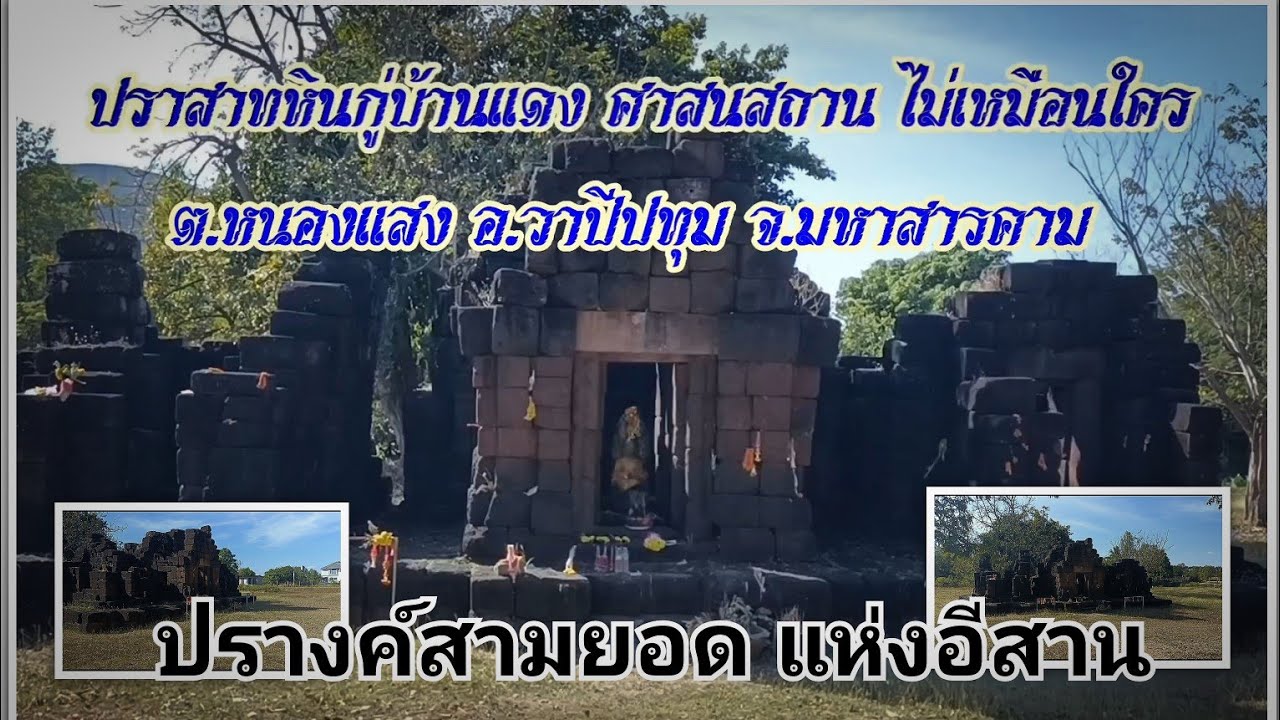
 Click to Access the Navigation Map GPS
 Historical Sites and Monuments(4)
 Art, Craft Centres, Tradition(5)
 Museums(3)
 Places of Worship
 Temple(17)
 Other Sacred Sites(7)
 Research and Development
 Royal Project(2)
 Suburban Living
 Village, Community(5)
 Nature and Wildlife
 National Parks and Marine Reserves(3)
 Dam, Reservoir, Lake(10)
 River, Canal(2)
 Bays and Beaches(2)
 Other natural attractions(2)
 Entertainment and Agricultural
 Farms, Parks and Ecotourism(3)
 Travel Articles, Recipes
 Food Menu, Northeastern Recipes(1)


