
lovethailand home >Northeastern Travel Attractions >Maha Sarakham Travel Attractions >Phayakha Phum Phisai >Mek Dam > Nong Ta Lok
TL;DR: Nong Ta Lok is located at Mek Dam Subdistrict, Phayakkhaphum Phisai District, Maha Sarakham Province, open Daily, hours 08.00 - 17.00.

Nong Ta Lok
Open Days: Daily
Opening Hours: 08.00 - 17.00
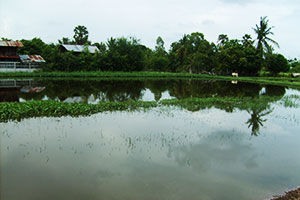
Nong Ta Lok in Maha Sarakham Province is a small irrigation water body in Mek Dam Subdistrict, Phayakkhaphum Phisai District. It is a quiet local water landscape with a road running along the side of the irrigation area. Although it is not a large commercial tourist attraction, Nong Ta Lok is a meaningful place for visitors who want to see a simple rural water source, local roads, farmland scenery, and the everyday atmosphere of an Isan community. It is suitable for a short stop, photography, countryside observation, and slow travel around Mek Dam.
For foreign travelers, Nong Ta Lok is best understood as a small local irrigation site rather than a resort-style destination. Its value lies in the way it reflects real rural life. The water body, the side road, the surrounding fields, nearby villages, and community routes all show how small water sources are connected with local agriculture and daily movement. Visitors who appreciate quiet places and local landscapes will find Nong Ta Lok interesting because it offers a natural and unpolished view of Maha Sarakham outside the main tourist route.
Nong Ta Lok is located in Mek Dam Subdistrict, Phayakkhaphum Phisai District, Maha Sarakham Province. The area is connected with Ban Ta Lok and the wider Mek Dam community. This part of the province has a rural Isan character, with local roads, farming areas, temples, small communities, and water sources that support local life. A visit to Nong Ta Lok can therefore be combined with nearby cultural places such as Phra That In Plaeng, Wat Mek Dam, Wat Ban Kaen Thao, and the town center of Phayakkhaphum Phisai.
The most distinctive feature of Nong Ta Lok is its simple irrigation landscape. A road passes along the side of the water, allowing travelers to see the reservoir-like setting from the route. This makes the place convenient as a short scenic stop, especially for visitors traveling by private car or motorcycle. The site is not designed for large-scale tourism, so the best way to experience it is to slow down, stop safely, observe the water and surrounding scenery, and respect the fact that the area is part of a working local landscape.
Small irrigation areas like Nong Ta Lok are important in northeastern Thailand because they help support community water use, agriculture, drainage, and local environmental balance. In rural Isan, water sources are closely connected with rice fields, livestock, village life, and seasonal changes. Nong Ta Lok reflects this relationship clearly. Even if the site looks modest at first, it plays a role in the local environment and gives visitors insight into how water management appears at the community level.
The atmosphere at Nong Ta Lok is calm and simple. Visitors may see water, roadside vegetation, fields, local houses, and community movement along the route. The place is especially suitable for early morning and late afternoon visits. In the morning, the light is softer and the air is more comfortable. In the late afternoon, the water and sky can take on warmer colors, and the area feels more relaxed. Midday can be hot, so visitors should bring drinking water, a hat, and sun protection if stopping during the day.
Because there is a road along the side of the irrigation area, visitors should be careful when stopping for photos. Park only in safe places and do not block local traffic. The road may be used by villagers, motorcycles, agricultural vehicles, and people moving between nearby communities. Nong Ta Lok should be visited with the mindset of a responsible guest in a local area, not as a tourist site where visitors can use every space freely.
The main zones around Nong Ta Lok can be understood in several parts. The first is the irrigation water zone, which forms the core of the site. The second is the roadside viewpoint zone, where visitors can see the water from the side road. The third is the waterside vegetation zone, which adds natural character to the area. The fourth is the farmland and Ban Ta Lok community zone, which shows the rural context around the water source. The fifth is the short rest-stop zone, suitable for quick photography and observation without disturbing local use.
Nong Ta Lok is not a place that requires a long visit. A simple stop of 30 minutes to 1 hour is usually enough for viewing, photography, and enjoying the local atmosphere. However, the site becomes more meaningful when included in a half-day route around Mek Dam and Phayakkhaphum Phisai. Visitors can combine Nong Ta Lok with Phra That In Plaeng, Wat Mek Dam, Wat Ban Kaen Thao, local cafés, and restaurants in Phayakkhaphum Phisai town.
Phra That In Plaeng is one of the nearby cultural attractions that fits well with a visit to Nong Ta Lok. It is located in Mek Dam Subdistrict and is known as a local religious landmark. By visiting both the water source and the religious site, travelers can see two important elements of rural Thai communities: water and faith. This makes the route more complete than simply stopping at the irrigation area alone.
Wat Mek Dam, also known as the central temple of Mek Dam, is another nearby place that can be included in the same trip. Local temples in Isan communities are not only religious spaces but also centers of festivals, community gatherings, merit-making, and local identity. Visiting a temple after stopping at Nong Ta Lok helps visitors understand how water sources, villages, and temples are connected in daily life.
Wat Ban Kaen Thao or Wat Suan Tan Wararam is also part of the wider Mek Dam cultural landscape. Travelers interested in local history and community belief can include it in a short route. The combination of Nong Ta Lok, nearby temples, and small community roads gives a deeper picture of Mek Dam than visiting only one point. This style of travel is suitable for people who want to understand local life rather than rush through famous attractions.
For photography, Nong Ta Lok offers simple rural compositions. The best subjects include the road running beside the irrigation area, the water surface, roadside plants, sky reflections, fields, and the quiet community background. These are not dramatic postcard images, but they are honest and local. Early morning and late afternoon are the best times for softer light. Visitors should avoid photographing private homes or local residents closely without permission.
Families can use Nong Ta Lok as a short educational stop. Children can see a real community water source and learn that water in rural areas is used for more than scenery. Adults can explain the connection between water, farming, roads, and village life. However, children should be supervised closely near the water and the roadside. The area is not a fully equipped park, so families should keep visits simple and safe.
Visitors should prepare for a local rural stop rather than a full tourist facility. Bring drinking water, comfortable shoes, sun protection, and a bag for personal waste. Do not leave rubbish near the water or on the roadside. Do not enter unsafe areas, slopes, or water management structures. Do not swim in unsupervised places. The best way to visit Nong Ta Lok is lightly, respectfully, and briefly, while protecting the water source and the surrounding community.
Food and café options are available in nearby Mek Dam and Phayakkhaphum Phisai town. O.P Cafe in Ban Mek Dam is one nearby option, while larger selections can be found in the district town, including Aep Zaap Phayak, 105 CAFE Coffee Bakery & Beer, Kanchana Jaew Hon Lap Ped Phayak & Ko Bua Ja Cafe, and Lung Dee Restaurant. Travelers who want more choices should continue into Phayakkhaphum Phisai town after visiting Nong Ta Lok.
Accommodation is mainly found in Phayakkhaphum Phisai District rather than directly at Nong Ta Lok. Publicly listed options include PP Tel Hotel Phayakkhaphum Phisai, Lullaby Residence, and Peemai Home Resort. These are suitable for visitors who want to stay near the district area. Travelers who need more hotel choices, restaurants, and urban services may also stay in Maha Sarakham city, but this requires a longer journey to and from Mek Dam.
Getting There is easiest by private car or motorcycle. From Phayakkhaphum Phisai town, travel toward Mek Dam Subdistrict for about 10–12 km, then continue toward the Ban Ta Lok area and Nong Ta Lok irrigation site. Search for “Nong Ta Lok” together with “Mek Dam” in a navigation app, or set the destination to Mek Dam Subdistrict, Phayakkhaphum Phisai District. Self-driving is recommended because it allows visitors to combine Nong Ta Lok with nearby temples and food stops.
If traveling from Maha Sarakham city, plan the trip as a visit to Phayakkhaphum Phisai District rather than a quick stop from the city. The district is located in the southern part of Maha Sarakham Province and requires more travel time than attractions near the provincial center. A practical route is to visit Nong Ta Lok, Phra That In Plaeng, Wat Mek Dam, Wat Ban Kaen Thao, and Phayakkhaphum Phisai town in the same half-day or full-day route.
The rainy season and the period after the rains usually make local water sources and farmland look fresher. The cool season is comfortable for short scenic stops, especially in the morning and evening. The hot season is still possible, but visitors should avoid the strongest sun and bring enough water. Because the area is simple and local, weather and daylight have a strong effect on the quality of the visit.
For foreign visitors, Nong Ta Lok shows a type of place that is often overlooked in mainstream travel: a small community irrigation site. It is not famous or highly developed, but it helps explain rural Thailand in a direct way. Roads, water, farming, temples, and villages exist together in a small area. This makes Nong Ta Lok useful for slow travelers who want to understand how everyday landscapes function in Isan.
The charm of Nong Ta Lok is its lack of artificial decoration. It is a small water source with a road beside it, surrounded by a real rural community. Visitors who approach it with patience will see the quiet beauty of the place: water under the sky, simple roadside scenery, community movement, and the agricultural rhythm of Mek Dam. It is a modest destination, but it gives a clear view of local Maha Sarakham life.
In summary, Nong Ta Lok in Maha Sarakham Province is a small irrigation water body in Mek Dam Subdistrict, Phayakkhaphum Phisai District. It has a road running along the side of the irrigation area and is suitable for short stops, photography, rural observation, and slow travel. It can be combined with Phra That In Plaeng, Wat Mek Dam, Wat Ban Kaen Thao, local restaurants, cafés, and accommodation in Phayakkhaphum Phisai town. For travelers seeking a quiet and authentic local landscape, Nong Ta Lok is a small but meaningful place to include in the route.
| Name | Nong Ta Lok |
| Location | Mek Dam Subdistrict, Phayakkhaphum Phisai District, Maha Sarakham Province |
| Address | Ban Ta Lok Area, Mek Dam Subdistrict, Phayakkhaphum Phisai District, Maha Sarakham 44110, Thailand |
| Highlights | Small irrigation water body with a road running along the side, suitable for a short scenic stop, rural photography, and observing the local landscape of Mek Dam |
| History | A local water source in Mek Dam Subdistrict connected with small-scale irrigation and the agricultural community around Ban Ta Lok and nearby villages |
| Distinctive Features | A modest water landscape beside a local road, with views of water, roadside vegetation, farmland, and the rural community atmosphere of Mek Dam |
| Travel Information | From Phayakkhaphum Phisai town, travel toward Mek Dam Subdistrict for about 10–12 km, then continue toward Ban Ta Lok and the irrigation area. Private car or motorcycle is the most convenient option. |
| Current Status | Open as a small local irrigation water source and community nature stop. Visitors can stop by during the listed opening hours. |
| Open Days | Daily |
| Opening Hours | 08.00 - 17.00 |
| Facilities | Road along the irrigation area, small roadside stopping points, water-view area, local community routes, and restaurants/cafés in Mek Dam and Phayakkhaphum Phisai town |
| Main Areas / Zones | Irrigation water zone, roadside viewpoint zone, waterside vegetation zone, farmland and Ban Ta Lok community zone, short rest-stop zone |
| Caretaker / Related Agencies | Mek Dam Subdistrict Administrative Organization and local agencies related to Mek Dam Subdistrict, Phayakkhaphum Phisai District |
| Main Contact Number | Mek Dam Subdistrict Administrative Organization, Tel. 043-029588 |
| Nearby Tourist Attractions | 1. Phra That In Plaeng, Mek Dam Subdistrict, about 6 km 2. Wat Mek Dam / Wat Klang Mek Dam, about 5 km 3. Wat Ban Kaen Thao / Wat Suan Tan Wararam, about 6 km 4. Phayakkhaphum Phisai Town Center / Local Market, about 12 km 5. Wat Phayakkhaphum Wararam, about 14 km 6. Wat Nong Khaen Charoen Tham / Luang Pho To Kotama Hall, about 15 km 7. Ku Santarat, Na Dun District, about 35 km |
| Nearby Restaurants | 1. O.P Cafe Ban Mek Dam, about 4 km, Tel. 064-8598392 2. Aep Zaap Phayak, about 13 km, Tel. 095-1895624 3. 105 CAFE Coffee Bakery & Beer, about 13 km, Tel. 082-5461880 4. Kanchana Jaew Hon Lap Ped Phayak & Ko Bua Ja Cafe, about 13 km, Tel. 086-8579646 / 089-8924533 5. Lung Dee Restaurant Phayakkhaphum Phisai, about 14 km, Tel. 098-4547115 / 065-3309356 6. Phayak Buri Coffee, about 16 km |
| Nearby Accommodations | 1. PP Tel Hotel Phayakkhaphum Phisai, about 13 km, Tel. 098-3242994 2. Lullaby Residence Phayakkhaphum Phisai, about 13 km 3. Peemai Home Resort Phayakkhaphum Phisai, about 14 km, Tel. 095-6525186 4. Accommodations In Phayakkhaphum Phisai Town, about 12–15 km 5. Accommodations In Na Dun District, about 35 km 6. Hotels In Maha Sarakham City, about 80 km |
Frequently Asked Questions (FAQ)
Q: Where is Nong Ta Lok located?
A: Nong Ta Lok is located in Mek Dam Subdistrict, Phayakkhaphum Phisai District, Maha Sarakham Province. It is a small irrigation water body with a road running along the side.
Q: What are the opening hours of Nong Ta Lok?
A: Nong Ta Lok is open daily from 08.00 to 17.00. Morning and late afternoon are the most suitable times for a short stop, photography, and local scenery.
Q: What is special about Nong Ta Lok?
A: Its main feature is a small irrigation water landscape beside a local road, with views of water, farmland, roadside vegetation, and the quiet rural atmosphere of Mek Dam.
Q: How do travelers get to Nong Ta Lok?
A: From Phayakkhaphum Phisai town, travel toward Mek Dam Subdistrict for about 10–12 km, then continue toward Ban Ta Lok and the irrigation area. Private car or motorcycle is the most convenient option.
Q: What kind of travelers will enjoy Nong Ta Lok?
A: It is suitable for slow travelers, rural photographers, visitors passing through Mek Dam, and travelers interested in small local water sources and everyday Isan community landscapes.
Q: How much time should visitors spend at Nong Ta Lok?
A: A short visit of 30 minutes to 1 hour is usually enough. A half-day route is better if combined with Phra That In Plaeng, Wat Mek Dam, Wat Ban Kaen Thao, and Phayakkhaphum Phisai town.
Q: Are there restaurants or accommodations near Nong Ta Lok?
A: Nearby food options are available in Mek Dam and Phayakkhaphum Phisai town, including O.P Cafe, Aep Zaap, 105 Cafe, and Kanchana Jaew Hon. Accommodation options include PP Tel Hotel and Lullaby Residence in Phayakkhaphum Phisai.
Q: What should visitors be careful about at Nong Ta Lok?
A: Visitors should be careful near the water and roadside, avoid blocking local traffic, avoid swimming in unsupervised areas, keep the area clean, and respect the local community.
 Category: ●Nature and Wildlife
 Group: ●Dam, Reservoir, Lake
Last Update : 2 MonthAgo
 Last Update : 2 MonthAgo
 Art, Culture and Heritage
 Historical Sites and Monuments(4)
 Art, Craft Centres, Tradition(5)
 Museums(3)
 Places of Worship
 Temple(17)
 Other Sacred Sites(7)
 Research and Development
 Royal Project(2)
 Suburban Living
 Village, Community(5)
 National Parks and Marine Reserves(3)
Dam, Reservoir, Lake(10)
National Parks and Marine Reserves(3)
Dam, Reservoir, Lake(10)
 River, Canal(2)
 Bays and Beaches(2)
 Other natural attractions(2)
 Entertainment and Agricultural
 Farms, Parks and Ecotourism(3)
 Travel Articles, Recipes
 Food Menu, Northeastern Recipes(1)


