
lovethailand home >Northeastern Travel Attractions >Maha Sarakham Travel Attractions >Phayakha Phum Phisai >Kam Pu > Wat Ban Don Tio
TL;DR: Wat Ban Don Tio is located at Ban Don Tio, Kam Pu Subdistrict, Phayakkhaphum Phisai District, Maha Sarakham Province, open Daily, hours 08.00 – 17.00.
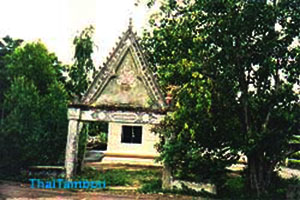
Wat Ban Don Tio
Open Days: Daily
Opening Hours: 08.00 – 17.00
Wat Ban Don Tio in Maha Sarakham Province is an important community temple in Ban Don Tio, Kam Pu Subdistrict, Phayakkhaphum Phisai District. The temple is known for its large modern-style pavilion, spacious grounds, shady trees, and peaceful location beside Nong Nam Ban Don Tio, the village pond. Its landscape gives the temple a calm and open atmosphere, making it suitable for merit-making, worship, community gatherings, and quiet rural travel. The temple is also associated with the registered temple name Wat Rat Burana, while local people commonly call it Wat Ban Don Tio.
The value of Wat Ban Don Tio lies in its role as a living rural temple. It is not a grand tourist temple built for large crowds, but a real community temple used by local people for Buddhist ceremonies, merit-making, festivals, funerals, and village activities. The large pavilion reflects the temple’s current role as a public religious and community space. The pond, trees, and wide temple grounds create a peaceful setting that makes the temple especially suitable for visitors who want to experience the quieter side of Maha Sarakham.
Historically, the temple was established in 1926. According to temple records, it was founded by Phra Kham, and local villagers later helped restore and develop it. This community effort led to the name Wat Rat Burana, a name that reflects the contribution of ordinary people in building and maintaining the temple. The temple received its Wisungkham Sima on 5 September 1979, with a sacred boundary measuring 20 meters wide and 40 meters long. These details show that Wat Ban Don Tio has been part of the spiritual life of the community for nearly a century.
The name Wat Rat Burana carries a meaningful local character. “Rat” refers to the people, while “Burana” means restoration or renewal. Together, the name suggests a temple sustained by the participation and faith of the community. The everyday name Wat Ban Don Tio connects the temple directly with the village. These two names together show the identity of the temple: it is both an officially recognized Buddhist temple and a deeply local place of worship for Ban Don Tio.
Ban Don Tio is a village in Kam Pu Subdistrict, Phayakkhaphum Phisai District, Maha Sarakham Province. Both Moo 8 and Moo 13 are associated with the Ban Don Tio name. The village is about 5 km from Phayakkhaphum Phisai town, making the temple accessible for local residents and visitors traveling through the district. Because the temple is located near the village pond, it reflects the traditional relationship between temple, water, settlement, and community life in rural northeastern Thailand.
Nong Nam Ban Don Tio is one of the most important landscape elements of the temple. The pond gives the temple a soft and peaceful atmosphere. In the morning and late afternoon, the light around the water and trees creates a pleasant setting for worship, walking, and quiet photography. The pond should not be seen only as scenery. It is part of the village environment and local memory, helping explain why the temple feels closely connected with the everyday life of the community.
The large modern-style pavilion is one of the temple’s most visible features. It serves many functions: religious ceremonies, merit-making activities, community meetings, festival gatherings, and funeral rites. Its modern form differs from older temple architecture, but its function remains deeply traditional. In a rural Thai temple, a pavilion is not only a building. It is a shared space where people meet, help one another, and maintain religious and social ties.
The temple’s ordination hall is also important. Temple records mention an ordination hall measuring 5 meters wide and 17 meters long, built in 1982. The temple also has a sermon hall, monk residences, a multipurpose hall, and a funeral hall. These structures show that Wat Ban Don Tio has the necessary religious and community facilities to support regular Buddhist life. It can host ceremonies, communal merit-making, ordination-related activities, funerals, and annual festivals.
Important sacred objects within the temple include several Buddha images, including a Phra Phuttha Ratcha-style Buddha image inside the ordination hall, a Buddha image in the sermon hall, and a standing Buddha image in the Abhaya posture. These sacred images are used for worship by local people. The temple may not be known for a major ancient monument, but its real value lies in the continuing faith of the people who come to worship and make merit here.
Wat Ban Don Tio has also played a role in Buddhist education. Temple records mention that a Dhamma section of Buddhist scripture study was opened in 1960. This reflects the wider role of rural Thai temples as educational places. In the past, temples often helped preserve religious learning and moral training for monks, novices, and local youth. Wat Ban Don Tio therefore belongs to a long tradition in which temples serve both spiritual and educational purposes.
The current abbot associated with Wat Rat Burana / Wat Ban Don Tio is Phra Athikan Wanit Charudhammo. In a village temple, temple management is closely connected with the local community. Monks, village leaders, local residents, the Kam Pu Subdistrict Administrative Organization, and Buddhist supporters all contribute in different ways. This shared care helps the temple remain active and meaningful for the people of Ban Don Tio.
Wat Ban Don Tio is connected with several community traditions. These include Songkran activities, village processions, merit-making events, Buddhist Lent and end-of-Lent ceremonies, Tak Bat Thewo, Kathin, robe-offering ceremonies, and ordinary Buddhist holy day activities. During festival periods, the temple becomes a lively community center where local families return, elders make merit, children participate in cultural events, and villagers strengthen their relationship with the temple.
Songkran in Ban Don Tio is especially meaningful because it brings people back to the temple and the village. Activities may include bathing Buddha images, making merit, offering respect to elders, village gatherings, and procession-style events. The large pavilion helps support these activities by providing a central space for people to gather. This shows how architecture, tradition, and community life work together in a rural temple.
The end of Buddhist Lent and Tak Bat Thewo activities also reflect the temple’s continuing religious role. The wide temple grounds and pond-side atmosphere are suitable for morning merit-making and community gathering. Such ceremonies help renew the relationship between monks and laypeople. They also allow villagers of different generations to meet and take part in a shared Buddhist tradition.
As a travel destination, Wat Ban Don Tio is best suited for visitors who appreciate authentic local places. Its attraction is not luxury, scale, or fame. Its appeal comes from its peaceful environment, spacious grounds, large pavilion, shady trees, and pond-side landscape. Visitors passing through Phayakkhaphum Phisai can stop here for worship, rest, and a quiet view of rural temple life in Maha Sarakham.
The temple is also appropriate for families. Children can learn how to behave in a Buddhist temple, how to pay respect to Buddha images, why temples matter to Thai communities, and how local festivals are connected with religion. The open grounds and shaded areas make the visit more comfortable than visiting a crowded temple. Parents can use the visit as a simple cultural lesson about village life and Buddhist etiquette.
For photographers, Wat Ban Don Tio offers quiet rural scenes rather than ornate monument photography. Interesting subjects include the large pavilion, the pond, trees, temple courtyard, Buddha images, and community atmosphere. Morning and late afternoon are the best times for photography because the light is softer and the temple is calmer. Photography should always be done respectfully, without disturbing monks, worshippers, or ceremonies.
Getting There is straightforward from Phayakkhaphum Phisai town. Travel toward Kam Pu Subdistrict and Ban Don Tio. The village is about 5 km from the district town. From Maha Sarakham city, travel first to Phayakkhaphum Phisai District, then continue to Kam Pu Subdistrict. Travelers using online maps can search for “Wat Ban Don Tio Kam Pu” or “Wat Rat Burana Kam Pu.” The village area coordinates 15.563107605215135, 103.21525856852531 can also be used for navigation.
A private car, rental car, or hired local vehicle is the most convenient option. Travelers using public transportation should first reach Phayakkhaphum Phisai town, then arrange local transport to Ban Don Tio. Those planning a wider itinerary can combine the temple with Phayakkhaphum Phisai City Pillar Shrine, Wat Phayakkhaphum Wararam, Wat Nong Khaen Charoen Tham, local restaurants, and small hotels in the district.
Visitors should dress respectfully when entering the temple. Shoulders and knees should be covered. Loud behavior, alcohol consumption, littering near the pond, and inappropriate photography should be avoided. If entering the ordination hall or a worship area, remove shoes and behave calmly. During the rainy season, visitors should be careful around the pond and wet ground, especially when traveling with children.
Wat Ban Don Tio can be visited as part of a half-day route in Phayakkhaphum Phisai. A simple route may begin with worship at Wat Ban Don Tio, followed by a visit to Phayakkhaphum Phisai City Pillar Shrine, Wat Phayakkhaphum Wararam, and a local restaurant. This route is not rushed and gives visitors a balanced view of a village temple and the district town.
For a full-day route, travelers can continue to other attractions in and around Phayakkhaphum Phisai, such as Wat Nong Khaen Charoen Tham, Sri Ayutthaya Lion Park, Wat Ban Kaen Thao, Ku Santarat in Na Dun District, or Phra That Na Dun. This wider route is suitable for those who want to explore southern Maha Sarakham through temples, local history, family-friendly attractions, and community landscapes.
Restaurants and accommodations are available mainly around Phayakkhaphum Phisai town. Visitors can find Isan restaurants, hot pot and jaew hon shops, cafés, and small hotels. Because accommodation choices are more limited than in Maha Sarakham city, travelers should plan ahead during weekends, festivals, or long holidays. Another option is to stay in Maha Sarakham city and visit Wat Ban Don Tio as a day trip.
For international travelers, Wat Ban Don Tio is a useful example of a rural Thai community temple. It does not present the monumental scale of major tourist temples, but it shows how temples function in everyday local life. The large pavilion, temple courtyard, pond, trees, and festival activities all help explain how Buddhism, community organization, and rural landscape are connected in Thailand.
The beauty of Wat Ban Don Tio is quiet and sincere. It is the beauty of a temple that people actually use. It is found in the shade of trees, the open temple grounds, the pond-side view, the Buddha images, and the large pavilion that welcomes community activities. Visitors should not see the temple only as a photo location. It is a living religious space that continues to support the social and spiritual life of Ban Don Tio.
In summary, Wat Ban Don Tio, or Wat Rat Burana, in Kam Pu Subdistrict, Phayakkhaphum Phisai District, Maha Sarakham Province, is a meaningful rural community temple with a long history dating back to 1926. Its highlights include the large modern-style pavilion, spacious temple grounds, shady trees, pond-side setting, ordination hall, sacred Buddha images, and active community traditions. Travelers who want to experience a calm and authentic side of Maha Sarakham should include Wat Ban Don Tio in a Phayakkhaphum Phisai itinerary.
| Name | Wat Ban Don Tio |
| Registered / Related Names | Wat Rat Burana, Wat Ban Don Tio |
| Location | Ban Don Tio, Kam Pu Subdistrict, Phayakkhaphum Phisai District, Maha Sarakham Province |
| Address | Ban Don Tio, Kam Pu Subdistrict, Phayakkhaphum Phisai District, Maha Sarakham Province 44110, Thailand |
| Ban Don Tio Area Coordinates | 15.563107605215135, 103.21525856852531 |
| Temple Type | Community Buddhist temple under the Mahanikaya order |
| Temple Area | About 12 rai |
| Highlights | Large modern-style pavilion, spacious temple grounds, shady trees, and a scenic pond-side setting beside Nong Nam Ban Don Tio |
| History / Context | The temple was established in 1926 by Phra Kham with support from local villagers. It received its Wisungkham Sima on 5 September 1979, with a sacred boundary measuring 20 meters wide and 40 meters long |
| Name Origin | Wat Ban Don Tio is the local name connected with the village, while Wat Rat Burana reflects the restoration and development carried out through the faith and cooperation of local people |
| Distinctive Features | A pond-side community temple with a large multipurpose pavilion, open temple grounds, religious buildings, and a peaceful rural atmosphere suitable for worship, community events, and quiet visits |
| Important Features Inside The Temple | 1. Large modern-style pavilion 2. Ordination hall 3. Sermon hall 4. Funeral hall 5. Buddha images 6. Nong Nam Ban Don Tio pond-side area |
| Traditions / Community Activities | Ban Don Tio Songkran activities, Buddha image procession, end-of-Buddhist-Lent activities, Tak Bat Thewo, Kathin, robe-offering ceremonies, and Buddhist holy day merit-making |
| Travel Information | From Phayakkhaphum Phisai town, travel to Kam Pu Subdistrict and Ban Don Tio. The village area is about 5 km from the district town. From Maha Sarakham city, travel first toward Phayakkhaphum Phisai District, then continue to Kam Pu Subdistrict. Private car, rental car, or hired local transport is recommended |
| Current Status | Open as a community temple and merit-making site for Ban Don Tio. Visitors can worship and visit during opening hours |
| Open Days | Daily |
| Opening Hours | 08.00 – 17.00 |
| Facilities | Large pavilion, temple courtyard, merit-making area, ceremony area, shaded resting area, pond-side area, and parking space around the temple or nearby community area |
| Main Areas / Zones | 1. Large pavilion zone 2. Ordination hall and worship zone 3. Sermon hall and merit-making zone 4. Temple courtyard and community activity zone 5. Nong Nam Ban Don Tio pond-side zone 6. Entrance and parking zone |
| Abbot / Caretaker | Phra Athikan Wanit Charudhammo, Abbot of Wat Rat Burana / Wat Ban Don Tio |
| Local Administrative Contact | Kam Pu Subdistrict Administrative Organization, Tel. 043-790529 |
| Official Website / Official Page | Kam Pu Subdistrict Administrative Organization website: kampoo.go.th and Ban Don Tio community Facebook page |
| Nearby Tourist Attractions | 1. Nong Nam Ban Don Tio, about 1 km 2. Kam Pu Subdistrict Administrative Organization, about 1 km 3. Phayakkhaphum Phisai City Pillar Shrine, about 7 km 4. Wat Phayakkhaphum Wararam, about 8 km 5. Wat Nong Khaen Charoen Tham / Wihan Luang Pho To Kotama, about 9 km 6. Sri Ayutthaya Lion Park, about 12 km |
| Nearby Restaurants | 1. Tom Pla Aep Zaap Cafe / Pho Sang Lui, about 7 km, Tel. 095-189-5624, 097-261-5872 2. Lung Dee Restaurant Phayakkhaphum Phisai, about 7 km, Tel. 098-454-7115, 065-330-9356 3. Kanchana Jaew Hon Larb Ped Phayak & Ko Bua Ja Cafe, about 8 km, Tel. 086-857-9646, 089-892-4533 4. Suan Phai Restaurant Phayakkhaphum Phisai, about 8 km, Tel. 094-462-3647 5. Na Pan Suk Phayakkhaphum Phisai, about 10 km, Tel. 088-297-7791 |
| Nearby Accommodations | 1. PP Tel Hotel Phayakkhaphum Phisai, about 8 km, Tel. 098-324-2994 2. Lullaby Residence Phayakkhaphum Phisai, about 8 km, Tel. 086-020-0042, 080-777-8780 3. Happy Resort Phayakkhaphum Phisai, about 8 km, Tel. 090-651-4542 4. Sap Wilai Hotel Phayakkhaphum Phisai, about 10 km, Tel. 097-341-4438 5. Banna Homestay Phayakkhaphum Phisai, about 12 km, Tel. 095-937-2449 |
Frequently Asked Questions (FAQ)
Q: Where is Wat Ban Don Tio located?
A: Wat Ban Don Tio is located in Ban Don Tio, Kam Pu Subdistrict, Phayakkhaphum Phisai District, Maha Sarakham Province, beside Nong Nam Ban Don Tio.
Q: What is the registered name of Wat Ban Don Tio?
A: The temple is associated with the registered name Wat Rat Burana, while local people commonly call it Wat Ban Don Tio.
Q: What makes Wat Ban Don Tio interesting?
A: The temple is known for its large modern-style pavilion, spacious grounds, shady trees, and scenic pond-side atmosphere beside Nong Nam Ban Don Tio.
Q: What are the opening days and hours of Wat Ban Don Tio?
A: Wat Ban Don Tio is open daily from 08.00 to 17.00.
Q: When was Wat Ban Don Tio established?
A: Wat Ban Don Tio, or Wat Rat Burana, was established in 1926 and received its Wisungkham Sima on 5 September 1979.
Q: How can travelers get to Wat Ban Don Tio?
A: From Phayakkhaphum Phisai town, travel to Kam Pu Subdistrict and Ban Don Tio. The village area is about 5 km from the district town. From Maha Sarakham city, travel first to Phayakkhaphum Phisai District, then continue to Kam Pu Subdistrict.
Q: What nearby places can be visited with Wat Ban Don Tio?
A: Nearby places include Nong Nam Ban Don Tio, Phayakkhaphum Phisai City Pillar Shrine, Wat Phayakkhaphum Wararam, Wat Nong Khaen Charoen Tham, and Sri Ayutthaya Lion Park.
Q: How should visitors behave at Wat Ban Don Tio?
A: Visitors should dress modestly, behave calmly, avoid littering near the pond, respect monks and worshippers, and take photographs respectfully.
 Category: ●Places of Worship
 Group: ●Temple
Last Update : 2 MonthAgo
 Last Update : 2 MonthAgo
 Art, Culture and Heritage
 Historical Sites and Monuments(4)
 Art, Craft Centres, Tradition(5)
 Museums(3)
Temple(17)
Museums(3)
Temple(17)
 Other Sacred Sites(7)
 Research and Development
 Royal Project(2)
 Suburban Living
 Village, Community(5)
 Nature and Wildlife
 National Parks and Marine Reserves(3)
 Dam, Reservoir, Lake(10)
 River, Canal(2)
 Bays and Beaches(2)
 Other natural attractions(2)
 Entertainment and Agricultural
 Farms, Parks and Ecotourism(3)
 Travel Articles, Recipes
 Food Menu, Northeastern Recipes(1)


