
lovethailand home >Northeastern Travel Attractions >Maha Sarakham Travel Attractions >Borabu >Bua Mat > Ku Bua Mat Archaeological Site
TL;DR: Ku Bua Mat Archaeological Site is located at Ban Kok Kok, Bua Mat Subdistrict, Borabue District, Maha Sarakham Province, open Daily, hours 08.00 – 17.00.
Ku Bua Mat Archaeological Site
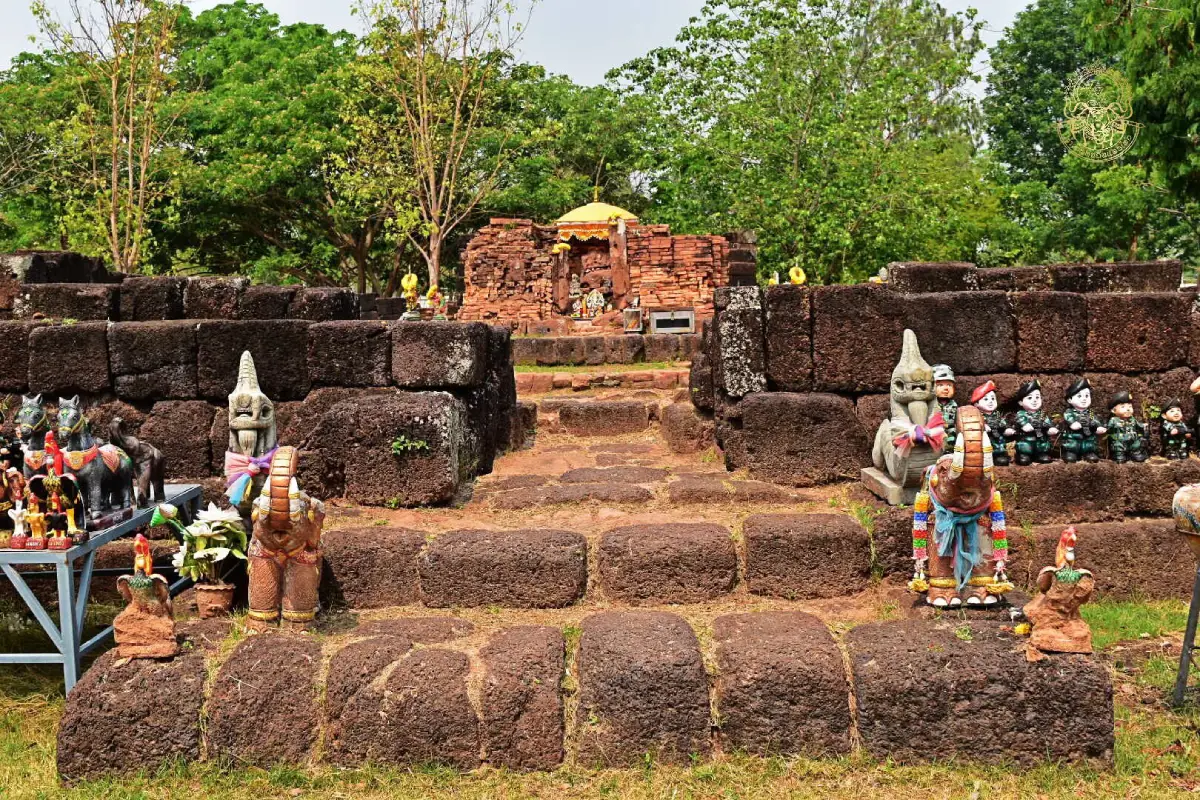
Open Days: Daily
Opening Hours: 08.00 – 17.00
Ku Bua Mat Archaeological Site in Maha Sarakham Province is an important Khmer-style historical site located in Ban Kok Kok, Bua Mat Subdistrict, Borabue District. Set within a rural lowland landscape of rice fields and local communities, the site preserves the remains of an ancient religious complex with a central sanctuary, an eastern gopura, a library building, a western rectangular structure, a laterite enclosure wall, and a U-shaped moat. For foreign travelers interested in lesser-known archaeological sites in northeastern Thailand, Ku Bua Mat offers a meaningful look into Khmer influence, Hindu belief, local ritual, and living community heritage in Maha Sarakham.
The site was originally known as a large earthen mound standing in the middle of a flat agricultural area. It was surrounded by rice fields, weeds, and large trees that grew densely over the ancient remains. The original mound had a rectangular appearance, measuring approximately 30 meters wide and 40 meters long. After archaeological excavation and study, the buried architectural layout became clearer. Visitors can now understand that Ku Bua Mat was not an isolated mound, but the remains of an organized religious monument with several architectural components arranged according to a sacred plan.
Ku Bua Mat is located in Bua Mat Subdistrict, one of the rural communities of Borabue District. The surrounding landscape is important for understanding the site. The subdistrict is characterized by shallow undulating terrain alternating with lowland fields, with agriculture forming the main local way of life. This setting makes the ancient monument part of a broader cultural landscape rather than a detached ruin. The relationship between the monument, water, rice fields, settlement, and local belief is central to the identity of Ku Bua Mat.
In historical terms, Ku Bua Mat is associated with an ancient Khmer religious site dating to around the 16th–17th Buddhist centuries. This was a period when Khmer cultural and artistic influence extended into many areas of present-day northeastern Thailand. The architectural remains, construction materials, and sacred objects found at the site show a clear connection with Khmer religious traditions, especially Hindu worship related to Vishnu, known in Thai as Phra Narai. The discovery of a sandstone Vishnu sculpture makes Ku Bua Mat especially significant because it provides strong evidence of the religious meaning of the monument.
The central sanctuary is the heart of the archaeological site. It stands at the middle of the compound and was built as a brick sanctuary on a laterite base. The base measures approximately 6.50 x 6.50 meters. The lower part was built with several layers of laterite arranged into a molded base, while the upper structure was made of brick. Although the brick superstructure has largely collapsed, traces of the original form remain visible. The sanctuary has its main entrance on the eastern side, while the other three sides were built as false doors. This arrangement follows an important principle found in many Khmer religious monuments, where the east is treated as the main direction of ritual approach.
The use of laterite, brick, red sandstone, and sandstone at Ku Bua Mat reveals a sophisticated understanding of construction materials. Laterite was used for structural elements such as the base, walls, and enclosure because of its strength and availability. Brick was used for the sanctuary tower. Sandstone and red sandstone were used for sculptural and architectural elements that required more refined carving or shaping. This combination of materials allows visitors to see how ancient builders adapted local resources to create a sacred monument with both structural stability and ritual significance.
The library building, or bannalai, stands to the southeast of the main sanctuary. It has a rectangular plan measuring approximately 4 x 6 meters and faces west toward the central sanctuary. The structure was built mainly of laterite with some red sandstone elements. Although the upper part and roof no longer survive, the ground plan remains meaningful. In Khmer religious architecture, a bannalai is usually interpreted as a supporting ritual structure, possibly associated with sacred objects, texts, or ceremonial functions. At Ku Bua Mat, its position shows that the site was planned as a complete religious compound.
The eastern gopura, or entrance pavilion, is another key feature of Ku Bua Mat. It forms the main entrance into the sacred precinct and has a cruciform plan measuring approximately 7 x 8 meters. The central hall of the gopura also follows a cross-shaped layout. Today, about 4–5 layers of laterite blocks remain, rising to approximately 1.50 meters. The floor inside the entrance was paved with laterite, and the enclosure wall extended outward from the gopura on the northern and southern sides. This entrance was more than a doorway; it marked the transition between the outside world and the sacred interior.
The laterite enclosure wall defines the inner sacred space of Ku Bua Mat. Its overall plan is rectangular, measuring approximately 20 x 26 meters. Most of the wall was built of laterite, with red sandstone added in some places, especially on the southern side. Although parts of the enclosure have collapsed or tilted over time, enough remains to show the original boundary of the sacred precinct. This enclosure helps visitors understand that the monument was once a carefully organized religious space with a clear separation between the ritual area and the outer landscape.
On the western side behind the main sanctuary, there is a rectangular laterite building measuring approximately 4 x 7 meters. It is especially interesting because the outer wall is solid while the inner side contains an entrance into a chamber paved with brick. A stone channel for sacred water extends from the interior floor and allows liquid to flow out toward the west. This detail suggests that ritual water played an important role at the site. It also shows that Ku Bua Mat was not only a place for housing sacred images, but also a place where ritual actions were performed in a structured way.
The U-shaped moat surrounding Ku Bua Mat is an important part of the archaeological landscape. It encloses the monument on most sides except the east, where the main entrance is located. In ancient religious sites, water was both practical and symbolic. It could support daily use, shape the landscape, and mark sacred boundaries. It also carried meanings of purification and separation from ordinary space. At Ku Bua Mat, the moat reinforces the sense that the site was designed as a sacred place integrated with the lowland environment of Bua Mat Subdistrict.
The most important artifact found at Ku Bua Mat is a sandstone sculpture of Vishnu, or Phra Narai, standing with four arms. The sculpture is approximately 80 centimeters high and was discovered in fragments near the northern side of the main sanctuary before being reassembled. The figure wears a short lower garment, has layered cloth detail at the front, and wears a crown or head ornament with a pointed central form. Some hands are broken, while surviving attributes include a mace and other symbolic elements. The artistic style relates to the Baphuon-Angkor Wat period, dating to around the 16th–17th Buddhist centuries.
The Vishnu sculpture is crucial to understanding the identity of Ku Bua Mat. Vishnu is one of the major deities in Hindu tradition and was widely worshipped in ancient Khmer culture. His presence at the site indicates that Ku Bua Mat was a Hindu religious monument with strong ritual significance. For travelers, this means the site should not be viewed only as an old ruin. It is a place where sacred images, ritual architecture, and local belief once came together to form a meaningful religious landscape.
Other artifacts recorded from the site include sandstone sculpture bases, a fragment of a crown or head ornament, bronze or brass objects, a medicine container, a lime container for betel chewing, a betel nut cutter, a brass plate, a bowl, a ring or seal, bells, copper currency-like objects, stoneware jars, small glazed containers, earthenware sherds, stoneware fragments, and a white-glazed terracotta conch. These finds show that the site had layers of use and meaning. They provide clues about ritual activity, daily objects, ceremonial items, and the material culture of the people connected with the site.
One of the strongest features of Ku Bua Mat today is its continuing connection with the local community. The people of Bua Mat do not treat the site merely as an archaeological ruin. It remains a sacred place and a focus of local identity. Every year, on the full moon of the 5th lunar month, the community organizes the Song Ku Bua Mat tradition. This ceremony includes paying respect, pouring water over the ancient shrine, worshipping Phra Narai, and gathering the community around the monument. The event shows how an ancient site can continue to live through ritual and collective memory.
The Song Ku Bua Mat tradition is more than a festival. It is a cultural practice that connects the ancient monument with present-day belief. Local residents and visitors come to pay respect and seek blessings for good fortune, family well-being, and community harmony. Ritual offerings, water-pouring, worship, and dance performances make the site active again each year. For foreign travelers, this tradition is an important reminder that heritage in Thailand is often not separated from living faith. Archaeological sites may still function as sacred community spaces.
Ku Bua Mat is cared for through cooperation between the Bua Mat Subdistrict Administrative Organization and the Fine Arts Department. The Fine Arts Department has worked with local leaders to organize the placement of offerings and sacred objects so that religious practice can continue while the archaeological site remains orderly and protected. This balance is important. It allows local devotion to remain visible while also helping preserve the physical remains of the monument for future generations.
For visitors, the best way to explore Ku Bua Mat is to begin by observing the overall mound and surrounding landscape. From there, enter from the eastern side, where the gopura marks the main approach into the sacred precinct. After passing the entrance, visitors can view the main sanctuary, then move toward the southeastern library building, the western rectangular structure, the enclosure wall, and the moat. This walking sequence helps reveal the logic of the site. Each component has a role, and together they create a complete sacred plan.
The site is especially rewarding for travelers who enjoy quiet historical places. Unlike larger and more commercialized heritage attractions, Ku Bua Mat has a calm rural atmosphere. The monument stands close to local fields and village life, allowing visitors to experience an archaeological site in a living community setting. It is suitable for historians, students, cultural travelers, photographers, and anyone interested in Khmer heritage beyond the well-known major temple complexes.
The best time to visit is in the morning or late afternoon when the light is softer and the weather is more comfortable for walking. Morning light is useful for observing brick and laterite textures, while late afternoon gives the site a warmer atmosphere. During the rainy season, the surrounding rice fields and vegetation become greener, giving the site a more vivid rural character. During the annual Song Ku Bua Mat tradition, visitors can experience the strongest expression of local faith, although the area will be busier than usual.
Ku Bua Mat is also a valuable outdoor classroom. Within a single compact site, visitors can learn about ancient Khmer architecture, sacred orientation, the use of laterite and brick, Hindu worship, Vishnu iconography, ritual water channels, community traditions, and heritage conservation. This combination makes the site educational even though it is not large. It is a place where travelers can see how archaeology, local religion, and everyday community life overlap in northeastern Thailand.
The name “Ku Bua Mat” carries local meaning. In northeastern Thailand, the word “ku” is commonly used for ancient sanctuaries, sacred structures, or old religious monuments. “Bua Mat” refers to the local subdistrict and community where the site is located. The name therefore combines the idea of an ancient sacred monument with the identity of the local community. Over time, the monument has become one of the most important cultural symbols of Bua Mat Subdistrict.
Visitors should treat the site with respect. Do not climb on the laterite base, brickwork, enclosure wall, or any remaining structure. Do not move stones, artifacts, offerings, or ritual objects. Do not write on the ancient surfaces, and keep the area clean. Photography is welcome when done respectfully. Because the ground may be uneven in some areas, families with children and elderly travelers should walk carefully around the monument, especially near collapsed masonry and raised laterite blocks.
Getting There to Ku Bua Mat is most convenient by private car, motorcycle, or local hired vehicle. From Borabue District town, travel southeast toward Bua Mat Subdistrict for about 26 km. Bua Mat is about 50 km from Maha Sarakham city. One practical route uses Highway 2063 on the Borabue–Wapi Pathum route before connecting to local rural roads into Bua Mat. Another route branches from Highway 2063 near Ban Khwa Noi intersection and continues through nearby subdistricts toward Bua Mat. The local road network connects the villages within the subdistrict, making private transport the easiest option for visitors.
Travelers coming from Maha Sarakham city can plan Ku Bua Mat as a half-day or full-day cultural trip. It is best to leave in the morning, visit the archaeological site, and then continue to nearby attractions such as Chiang Kham Wooden Bridge, Nong Bo Reservoir, Wat Borabue Sararam, Wat Pa Thamma Utthayan, or Wat Pa Wang Nam Yen. Food and accommodation options are more convenient in Borabue town or Maha Sarakham city than in the immediate rural area around Bua Mat.
Ku Bua Mat may appear modest at first glance, but its historical value is deep. The site preserves evidence of ancient architecture, Hindu worship, ritual planning, water symbolism, sacred sculpture, and community tradition. It shows that Maha Sarakham is not only a modern educational province but also a province with deep historical roots connected to ancient regional networks. For travelers willing to look closely, Ku Bua Mat is one of the most meaningful cultural places in Borabue District.
The value of Ku Bua Mat lies not in monumental scale, but in the richness of its layers. The site brings together an ancient sanctuary, Khmer construction techniques, a Vishnu sculpture, a ritual water feature, a community festival, and ongoing conservation work. A visit here allows foreign travelers to understand how heritage in northeastern Thailand can remain alive in both archaeology and local devotion. For those seeking a quieter and more authentic cultural experience in Maha Sarakham, Ku Bua Mat is a destination worth visiting with patience, curiosity, and respect.
| Name | Ku Bua Mat Archaeological Site |
| Other Names | Prang Ku Bua Mat, Ku Bua Mat |
| Location | Ban Kok Kok, Bua Mat Subdistrict, Borabue District, Maha Sarakham Province |
| Address | Moo 5, Ban Kok Kok, Bua Mat Subdistrict, Borabue District, Maha Sarakham 44130, Thailand |
| Coordinates | 15.890000 N, 103.210000 E |
| Highlights | Ancient Khmer religious site with a central sanctuary, eastern gopura, library building, western structure, laterite enclosure wall, and U-shaped moat |
| History | Ancient Khmer religious monument dating to around the 16th–17th Buddhist centuries, associated with Vishnu worship and Baphuon-Angkor Wat artistic influence |
| Original Landscape | Originally a large earthen mound in a lowland rice-field area, with an overall rectangular form of about 30 meters wide and 40 meters long |
| Distinctive Features | Brick main sanctuary on a laterite base measuring about 6.50 x 6.50 meters, with an eastern entrance and false doors on the other three sides |
| Key Evidence | Four-armed sandstone Vishnu sculpture, sculpture bases, crown fragment, bronze or brass objects, pottery, terracotta conch, and laterite architectural remains |
| Name Origin | “Ku” is a local Isan term for an ancient sacred monument, while “Bua Mat” refers to the local subdistrict and community where the site is located |
| Main Areas / Zones | 1. Main Sanctuary 2. Eastern Gopura 3. Southeastern Library Building 4. Western Rectangular Structure 5. Laterite Enclosure Wall 6. U-Shaped Moat 7. Worship Area And Song Ku Bua Mat Ceremony Ground |
| Local Tradition | Song Ku Bua Mat tradition, held annually on the full moon of the 5th lunar month to pay respect and pour water over the ancient shrine in worship of Phra Narai |
| Travel Information | About 26 km southeast of Borabue District town and about 50 km from Maha Sarakham city. Private car, motorcycle, or local hired vehicle is recommended. |
| Current Status | Open to visitors as an important cultural attraction and archaeological site of Bua Mat Subdistrict |
| Open Days | Daily |
| Opening Hours | 08.00 – 17.00 |
| Facilities | Walking area around the archaeological site, worship area, annual ceremony ground, and local community road access |
| Caretaker | Bua Mat Subdistrict Administrative Organization in cooperation with the Fine Arts Department |
| Main Contact Number | Bua Mat Subdistrict Administrative Organization, Tel. 043-750519 |
| Nearby Tourist Attractions | 1. Chiang Kham Wooden Bridge, about 20 km 2. Nong Bo Reservoir, about 24 km 3. Wat Borabue Sararam, about 26 km 4. Wat Pa Thamma Utthayan, about 27 km 5. Wat Pa Wang Nam Yen, about 50 km |
| Nearby Restaurants | 1. Rabue Phochana, about 26 km, Tel. 098-2292987 2. Song Phi Nong Lab Koi, about 26 km, Tel. 093-0733451 3. Ban Roi Sin Restaurant, about 27 km, Tel. 043-770811 4. SHARE KAFEINE, about 27 km, Tel. 086-4518612 5. Tang Tua CUP, about 30 km |
| Nearby Accommodations | 1. Phiman Inn Grand, about 22 km, Tel. 098-1043989, 065-3096695 2. Phuri Place, about 30 km, Tel. 043-750777 3. Ratcharos Thara Hotel, about 30 km, Tel. 082-8124117 4. Somsanuk Resort, about 31 km, Tel. 087-2600784 5. Kiang Tawan Resort, about 40 km, Tel. 086-2233566 |
Frequently Asked Questions (FAQ)
Q: Where is Ku Bua Mat Archaeological Site located?
A: Ku Bua Mat is located in Ban Kok Kok, Bua Mat Subdistrict, Borabue District, Maha Sarakham Province.
Q: Why is Ku Bua Mat important?
A: It is an ancient Khmer religious site dating to around the 16th–17th Buddhist centuries, with architectural remains and a sandstone Vishnu sculpture that reflect Hindu worship and Khmer artistic influence.
Q: What are the opening days and hours of Ku Bua Mat?
A: The site is open daily from 08.00 to 17.00.
Q: What should visitors see at Ku Bua Mat?
A: Key features include the main brick sanctuary on a laterite base, eastern gopura, library building, western rectangular structure, laterite enclosure wall, U-shaped moat, and worship area.
Q: When is the Song Ku Bua Mat tradition held?
A: The Song Ku Bua Mat tradition is held annually on the full moon of the 5th lunar month. It includes worship, water-pouring, and community rituals dedicated to Phra Narai.
Q: How can travelers get to Ku Bua Mat from Borabue District town?
A: Travel southeast from Borabue District town toward Bua Mat Subdistrict for about 26 km. Private cars, motorcycles, and local hired vehicles are the most convenient options.
Q: Who takes care of Ku Bua Mat Archaeological Site?
A: The site is cared for by the Bua Mat Subdistrict Administrative Organization in cooperation with the Fine Arts Department, with support from the local community.
Q: What nearby attractions can be included in the same trip?
A: Travelers can combine the visit with Chiang Kham Wooden Bridge, Nong Bo Reservoir, Wat Borabue Sararam, Wat Pa Thamma Utthayan, and Wat Pa Wang Nam Yen.
 Category: ●Art, Culture and Heritage
 Group: ●Historical Sites and Monuments
Last Update : 2 MonthAgo
 Last Update : 2 MonthAgo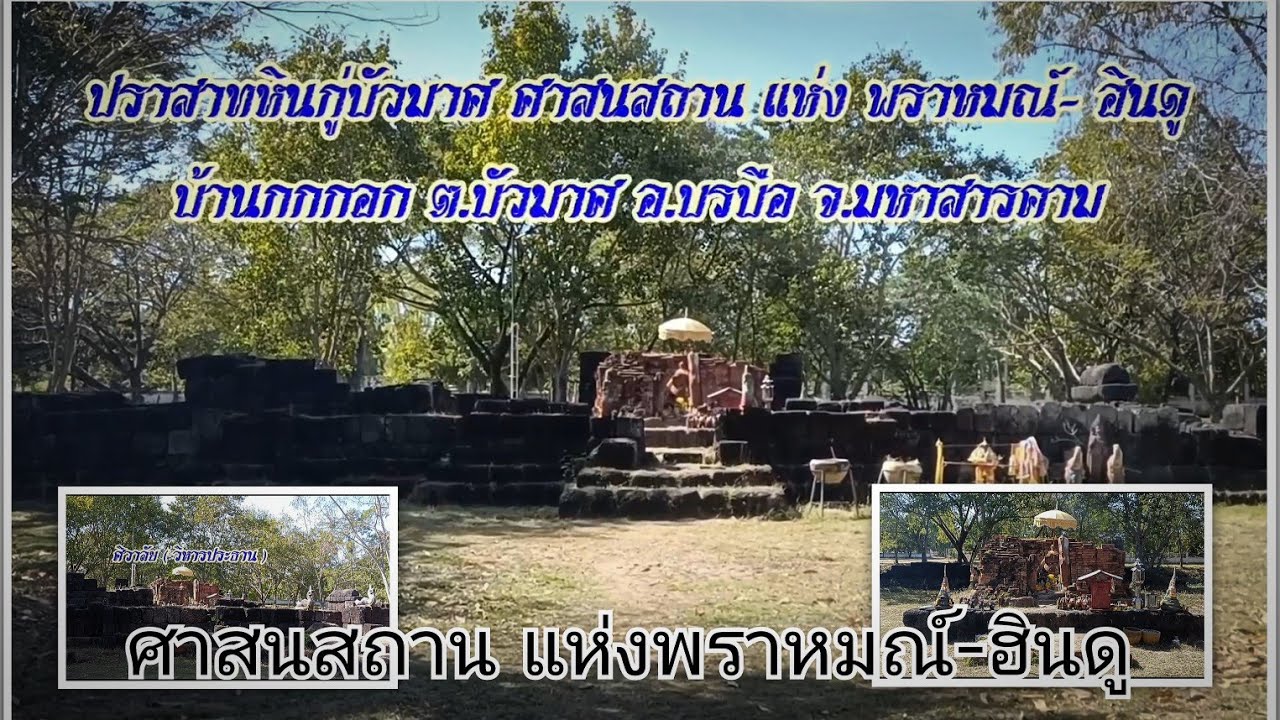
 Click to Access the Navigation Map GPS
Ku Bua Mat Archaeological Site Map
 Historical Sites and Monuments(4)
 Art, Craft Centres, Tradition(5)
 Museums(3)
 Places of Worship
 Temple(17)
 Other Sacred Sites(7)
 Research and Development
 Royal Project(2)
 Suburban Living
 Village, Community(5)
 Nature and Wildlife
 National Parks and Marine Reserves(3)
 Dam, Reservoir, Lake(10)
 River, Canal(2)
 Bays and Beaches(2)
 Other natural attractions(2)
 Entertainment and Agricultural
 Farms, Parks and Ecotourism(3)
 Travel Articles, Recipes
 Food Menu, Northeastern Recipes(1)


