
lovethailand home >Northeastern Travel Attractions >Maha Sarakham Travel Attractions >Kosum Phisai >Don Klang > Wat Pa Hin Rong
TL;DR: Wat Pa Hin Rong is located at Don Klang Subdistrict, Kosum Phisai District, Maha Sarakham Province, open Daily, hours 08.00 – 17.00.
Wat Pa Hin Rong
Open Days: Daily
Opening Hours: 08.00 – 17.00
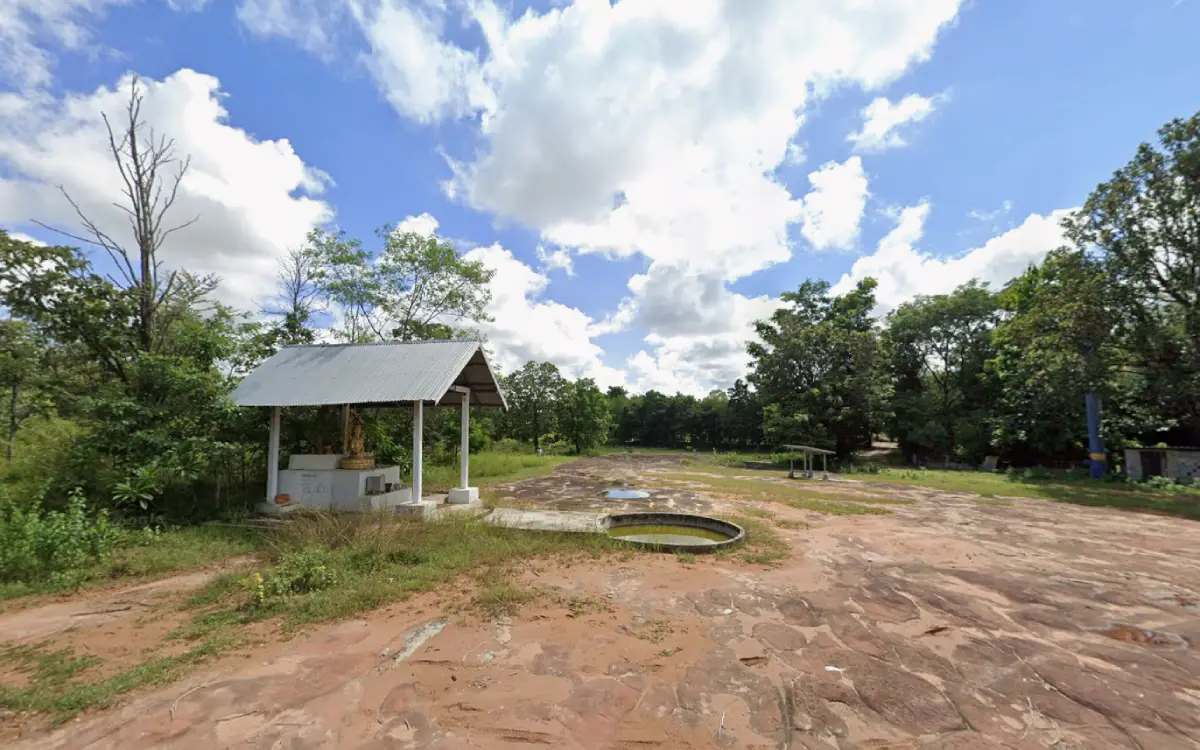
Wat Pa Hin Rong in Maha Sarakham Province, sometimes referred to by local pronunciation as Wat Pa Hin Long, is a forest temple and natural landmark in Don Klang Subdistrict, Kosum Phisai District. The site covers an area of about 100 rai and is best known for its unusual natural rock terrace. Across the stone surface are many small and large potholes that look like natural wells. Some of them hold water, creating a striking landscape where stone, water, forest, and Buddhist faith exist together in one peaceful setting.
Wat Pa Hin Rong should be understood through several connected layers. It is a forest temple where visitors can pay respect to Buddha images and experience a quiet monastic atmosphere. It is also a natural site with distinctive sandstone formations created by long-term water erosion. In addition, it is a geological learning area where visitors can observe potholes, grooves, and rock surfaces shaped by nature. Local stories about ancient human footprints also add cultural depth to the place, making it more than a simple scenic stop.
The most memorable feature of the site is the rock terrace. The surface of the stone contains many depressions of different sizes. Some are shallow, some are deep, some are round and smooth, and some contain water depending on the season. When viewed from above or while walking slowly across the area, the landscape appears like a field of natural stone wells. This unusual appearance gives Wat Pa Hin Rong a strong identity and makes it one of the most distinctive natural-cultural sites in Kosum Phisai District.
The rock potholes were formed by the long action of water, sediment, gravel, and time. When water flows across a stone surface and carries hard particles that rotate repeatedly in the same place, the stone gradually becomes worn down. Over time, this natural process forms rounded holes and grooves. These features are not man-made. They are evidence of slow geological change and show how powerful natural erosion can be even when it works quietly over a long period.
The beauty of Wat Pa Hin Rong lies in the details of the stone surface. Some areas are wide and flat, while others are marked by grooves and deep rounded holes. Water trapped inside the potholes can reflect the sky and trees, creating small pools across the rock. During soft morning or late afternoon light, the colors of the sandstone, water, and surrounding forest become especially attractive for photography. Travelers who enjoy natural textures, unusual landscapes, and documentary-style images will find many meaningful details here.
Another feature often mentioned by visitors is the presence of marks associated with ancient human footprints. These traces add a layer of local memory and imagination to the site. Whether approached as local heritage, a cultural story, or a landscape feature, the footprint area should be treated carefully. Visitors should not step on the marks, scratch the stone, pour liquids onto the surface, or try to make the marks more visible by altering the rock. The value of the place depends on careful preservation.
A Buddha image in the blessing posture stands on the rock terrace, giving the natural site a clear spiritual focus. The presence of the Buddha image transforms the stone landscape into a sacred space. Visitors can pay respect, calm the mind, and then walk through the rock area with awareness. This combination of Buddhist faith and natural scenery is one of the most important reasons why Wat Pa Hin Rong feels different from ordinary geological sites. It is both a place of learning and a place of inner quiet.
The surrounding area is forested and relatively quiet, which supports the atmosphere of a forest temple. Forest temples in Thailand are often associated with simplicity, meditation, and closeness to nature. At Wat Pa Hin Rong, the forest, rock terrace, water-filled holes, and monastic environment all work together to create a calm setting. Visitors should respect this quietness by walking gently, speaking softly, and avoiding disruptive behavior.
The name “Hin Rong” reflects the physical character of the place. “Hin” means stone or rock, while “rong” refers to grooves, channels, or eroded lines. The name is therefore closely connected with the visible landscape. Once visitors see the rock grooves and potholes, the meaning of the name becomes clear. The identity of the site is written directly into the stone surface.
The wider temple and forest area of about 100 rai gives the site a spacious character. It is not only a single rock slab but a broader natural and religious environment that includes forest, walking areas, worship space, monastic areas, and community activity zones. Visitors should allow enough time to experience the site slowly. The beauty of a forest temple is not always immediate. It appears through silence, light, stone textures, water, trees, and the feeling of being away from busy urban life.
Wat Pa Hin Rong is also important as a conservation site. Natural stone terraces and potholes take a very long time to form and cannot be replaced once damaged. Visitors should not drive onto the rock terrace, carve names into the stone, throw objects into the potholes, litter, or remove stones from the area. Responsible behavior helps protect both the natural landscape and the spiritual atmosphere of the temple.
The site is suitable for several types of travelers. Nature lovers can study the rock formations and forest environment. Cultural travelers can observe how a Buddhist forest temple coexists with a natural geological feature. Photographers can capture stone textures, reflections, and the Buddha image on the rock terrace. Families and students can use the site as an outdoor classroom to learn about erosion, conservation, and local belief. Meditative travelers can enjoy the calmness of the forest temple environment.
For students and young visitors, Wat Pa Hin Rong is an excellent outdoor learning site. The rock holes show that stones are not completely static objects. They record the movement of water, time, and environmental change. Seeing these features in person can help young people understand geography and environmental science more clearly than reading about them in a classroom. The site also teaches an important conservation lesson: natural heritage must be protected through careful behavior.
The best time to visit is in the morning or late afternoon. During these periods, the weather is cooler and the light is better for viewing the rock surface. Morning visits are suitable for paying respect to the Buddha image and photographing soft light on the sandstone. Late afternoon visits offer warmer light and a quieter atmosphere. During the rainy season, the site may look greener and more water may collect in the potholes, but the rock surface can become slippery. During the hot season, visitors should bring drinking water, a hat, and suitable footwear.
Getting There is most convenient by private car, rental car, or arranged local transport. From Maha Sarakham city, travel toward Kosum Phisai District, then continue to Don Klang Subdistrict. Travelers can search for Wat Pa Hin Rong or Wat Pa Maruekkhathayawan (Wat Pa Hin Rong), Don Klang Subdistrict, Kosum Phisai District, Maha Sarakham Province. Checking the route before departure is recommended, especially during the rainy season or when traveling through rural roads near forest areas.
From Kosum Phisai town, Wat Pa Hin Rong can be included in a broader nature and culture route. A practical itinerary may begin at Wat Pa Hin Rong in the morning, then continue to Kosamphi Forest Park, Kaeng Tat, Hat Wang Ko, Bueng Kui, or the Navel of Isan area in the afternoon. This route gives travelers a wider view of Kosum Phisai, combining forest temple atmosphere, natural stone formations, riverside landscapes, and local identity.
Travelers without a private vehicle can first reach Maha Sarakham city or Kosum Phisai town, then arrange local transport to Don Klang Subdistrict. Because public transport in rural communities may not operate frequently throughout the day, it is best to arrange both the outbound and return journey in advance. Traveling as a group or hiring a local vehicle makes it easier to visit nearby attractions on the same day.
Visitors should dress appropriately for both a temple and a natural rock site. Clothing should be modest, covering shoulders and knees. Footwear should be suitable for walking on stone, preferably with good grip. The rock surface can be hot in strong sunlight and slippery when wet. Visitors should avoid walking too close to deep holes, climbing carelessly, or stepping on fragile rock features.
Temple etiquette is also important. Visitors should speak quietly, avoid loud music, refrain from drinking alcohol, keep the area clean, and respect monks or people who may be practicing meditation. If taking photos of monks, worshippers, or monastic areas, permission should be requested first. A good visit to a forest temple should leave the place as peaceful as it was before arrival.
Wat Pa Hin Rong is also connected with local merit-making traditions. The area has been used for community events such as the annual Bun Bang Fai, or rocket festival, in Don Klang Subdistrict. This festival is closely related to Isan agricultural belief, rain, fertility, and community cooperation. When such a tradition takes place at a forest temple, it reflects how Buddhism, local belief, agriculture, and social unity remain connected in rural northeastern Thailand.
For photographers, the site is best approached through natural and documentary photography. Interesting subjects include the water-filled potholes, eroded grooves, the Buddha image on the rock terrace, sandstone colors, and the surrounding forest. Photography should be done carefully. Do not damage the rock, place heavy equipment on fragile edges, or step into potholes for a better angle. The best images should come from observation, not from disturbing the site.
Wat Pa Hin Rong also illustrates the relationship between Buddhism and nature in Thailand. Many forest temples are located in forests, hills, caves, or unusual natural landscapes because these environments support simplicity and meditation. At Wat Pa Hin Rong, the rock terrace itself becomes a teaching landscape. The holes and grooves in the stone remind visitors of time, impermanence, and the quiet power of natural change.
For geology-minded travelers, Hin Rong is an accessible example of erosion on sandstone. The rock terrace and its potholes allow visitors to see geomorphological processes directly. Each depression can be understood as a record of water movement and sediment abrasion. Even if strong water flow is no longer visible in the same way today, the remaining shapes show that the landscape was gradually carved by natural forces.
For cultural travelers, the site reveals how local communities give meaning to natural landscapes. The stone terrace is not only a geological formation. It is also a place of worship, a forest temple, a community gathering point, and a source of local stories. The Buddha image, the monastic retreat, the footprint narratives, and the annual festival all show how nature and culture are woven together in Isan life.
Visitors with about 1 hour can pay respect to the Buddha image, walk around the main rock terrace, observe the potholes, and take careful photographs. With a half day, visitors can spend more time studying different sections of the rock and continue to nearby attractions. With a full day, Wat Pa Hin Rong can be combined with Kosamphi Forest Park, Bueng Kui, the Navel of Isan, Kaeng Tat, and Hat Wang Ko to create a balanced route of nature, culture, and local travel in Kosum Phisai District.
Conservation is essential at Wat Pa Hin Rong. The rock terrace cannot be repaired easily if damaged by carving, littering, chemicals, or careless use. Monks, local residents, authorities, and visitors all share responsibility for protecting the place. The simplest way to help is to leave no waste, avoid making marks on the stone, stay away from risky edges, and treat both the temple and natural site with respect.
For international travelers, Wat Pa Hin Rong is a good example of how Thai forest temples can be deeply connected with nature. The sacred feeling of the place does not come from grand architecture alone. It comes from the forest, the stone, the Buddha image, the quietness, and the meaning that local people have given to the landscape. This makes the site especially valuable for visitors who want to understand rural Thai Buddhism beyond major tourist temples.
Although Wat Pa Hin Rong is not as widely known as some famous attractions in Maha Sarakham, its value lies in authenticity, peacefulness, and rare natural features. The field of stone potholes creates a strong visual identity, while the ancient footprint stories add cultural depth. Travelers who enjoy quiet destinations, conservation sites, forest temples, and unusual landscapes should include Wat Pa Hin Rong in a Kosum Phisai itinerary.
In summary, Wat Pa Hin Rong in Don Klang Subdistrict, Kosum Phisai District, Maha Sarakham Province is both a forest temple and an important natural site. Its area of about 100 rai includes a remarkable rock terrace with many small and large potholes, water-filled natural basins, a Buddha image on the stone surface, and local stories about ancient human footprints. It is suitable for merit-making, meditation, nature study, photography, and responsible cultural travel in northeastern Thailand.
| Name | Wat Pa Hin Rong / Wat Pa Maruekkhathayawan (Wat Pa Hin Rong) |
| Common Local Name | Wat Pa Hin Long, Hin Rong, Hin Rong Rock Terrace |
| Location | Don Klang Subdistrict, Kosum Phisai District, Maha Sarakham Province |
| Address | Wat Pa Hin Rong / Wat Pa Maruekkhathayawan area, Don Klang Subdistrict, Kosum Phisai District, Maha Sarakham Province 44140, Thailand |
| Site Type | Forest temple, meditation site, and natural rock terrace / geomorphological site |
| Approximate Area | About 100 rai |
| Highlights | Natural rock terrace with many small and large potholes, water-filled stone basins, a Buddha image on the rock terrace, and local stories about ancient human footprints |
| Natural Features | A sandstone terrace shaped by water erosion, creating numerous potholes, grooves, and natural basins |
| Environmental Importance | A conservation-worthy natural site and a learning area for geomorphology, water erosion, and the relationship between nature and a forest temple |
| Religious Importance | A quiet forest temple and meditation area suitable for merit-making, mindfulness, and peaceful reflection in nature |
| Main Areas / Zones | 1. Hin Rong rock terrace and natural potholes 2. Buddha image area on the rock terrace 3. Ancient footprint and rock mark area 4. Forest and nature walking area 5. Monastic and meditation area 6. Community merit-making and festival area |
| Tradition / Community Activity | Annual Bun Bang Fai rocket festival at Wat Pa Hin Rong, Don Klang Subdistrict, Kosum Phisai District, Maha Sarakham Province |
| Travel Information | From Maha Sarakham city, travel toward Kosum Phisai District, then continue to Don Klang Subdistrict. Private car, rental car, or arranged local transport is recommended |
| Current Status | Open as a forest temple, meditation site, and natural attraction during visiting hours |
| Open Days | Daily |
| Opening Hours | 08.00 – 17.00 |
| Facilities | Worship area, natural rock terrace, nature walking area, meditation area, and parking space around the temple or nearby community area |
| Visitor Cautions | The rock surface may be slippery when wet. Wear shoes with good grip, avoid deep pothole edges, do not carve on the stone, and do not litter in the natural area |
| Caretaker / Local Authority | Wat Pa Maruekkhathayawan (Wat Pa Hin Rong) monastic community, Don Klang community, and Don Klang Subdistrict Administrative Organization |
| Local Administrative Contact | Don Klang Subdistrict Administrative Organization, Tel. 043-997521 |
| Official Local Website / Page | Don Klang Subdistrict Administrative Organization website: donklang.go.th |
| Nearby Tourist Attractions | 1. Hin Rong Rock Terrace / Hin Rong Natural Site, about 0 km 2. Kosamphi Forest Park, about 24 km 3. Kaeng Tat, about 24 km 4. Hat Wang Ko, about 25 km 5. Bueng Kui / Navel of Isan, about 28 km |
| Nearby Restaurants | 1. Hugchee Grand Coffee & Resort, about 24 km, Tel. 094-262-9939 2. NANA FARM, about 24 km, Tel. 061-025-3555 3. KFC Lotus Kosum Phisai, about 24 km, Tel. 065-510-4714 4. Morocco Blue Cafe by Chilong River Farm Resort, about 30 km, Tel. 083-251-2123, 084-190-4560 5. Marak Na Cafe, about 30 km, Tel. 094-551-9092 |
| Nearby Accommodations | 1. Hugchee Grand Coffee & Resort, about 24 km, Tel. 094-262-9939 2. Morocco Blue Cafe by Chilong River Farm Resort, about 30 km, Tel. 083-251-2123, 084-190-4560 3. Faikham Resort, about 24 km, Tel. 088-069-3891 4. K.C. Garden View Guest House, about 24 km 5. Khan Suk Resort, about 28 km |
Frequently Asked Questions (FAQ)
Q: Where is Wat Pa Hin Rong located?
A: Wat Pa Hin Rong is located in Don Klang Subdistrict, Kosum Phisai District, Maha Sarakham Province, Thailand.
Q: Are Wat Pa Hin Rong and Wat Pa Hin Long the same place?
A: They refer to the same local area. Official and local records commonly use the name Wat Pa Hin Rong or Wat Pa Maruekkhathayawan (Wat Pa Hin Rong).
Q: What is Wat Pa Hin Rong known for?
A: The temple is known for its natural rock terrace, many small and large potholes, water-filled stone basins, a Buddha image on the rock surface, and local stories about ancient human footprints.
Q: What are the opening days and hours of Wat Pa Hin Rong?
A: Wat Pa Hin Rong is open daily from 08.00 to 17.00.
Q: How can travelers get to Wat Pa Hin Rong?
A: From Maha Sarakham city, travel toward Kosum Phisai District, then continue to Don Klang Subdistrict. A private car, rental car, or arranged local transport is recommended.
Q: What should visitors prepare before going to Wat Pa Hin Rong?
A: Visitors should dress respectfully, wear shoes with good grip, bring drinking water and sun protection, and walk carefully on the rock terrace, especially when the surface is wet.
Q: Who should visit Wat Pa Hin Rong?
A: The site is suitable for travelers interested in forest temples, natural rock formations, geology, photography, meditation, conservation travel, and quiet cultural experiences in Kosum Phisai.
Q: What nearby attractions can be included in the same trip?
A: Travelers can combine the visit with Kosamphi Forest Park, Kaeng Tat, Hat Wang Ko, Bueng Kui, and the Navel of Isan area.
 Category: ●Places of Worship
 Group: ●Temple
Last Update : 2 MonthAgo
 Last Update : 2 MonthAgo
 Click to Access the Navigation Map GPS
 Art, Culture and Heritage
 Historical Sites and Monuments(4)
 Art, Craft Centres, Tradition(5)
 Museums(3)
Temple(17)
Museums(3)
Temple(17)
 Other Sacred Sites(7)
 Research and Development
 Royal Project(2)
 Suburban Living
 Village, Community(5)
 Nature and Wildlife
 National Parks and Marine Reserves(3)
 Dam, Reservoir, Lake(10)
 River, Canal(2)
 Bays and Beaches(2)
 Other natural attractions(2)
 Entertainment and Agricultural
 Farms, Parks and Ecotourism(3)
 Travel Articles, Recipes
 Food Menu, Northeastern Recipes(1)


