
lovethailand home >Northeastern Travel Attractions >Maha Sarakham Travel Attractions >Kosum Phisai >Lao > Don Phra Thaen
TL;DR: Don Phra Thaen is located at Ban Thaen Community Forest, Ban Thaen, Lao Subdistrict, Kosum Phisai District, Maha Sarakham Province, open Daily, hours 08.00 – 17.00.
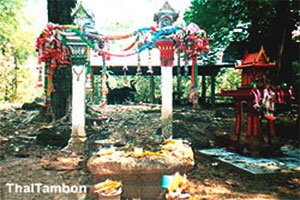
Don Phra Thaen
Open Days: Daily
Opening Hours: 08.00 – 17.00
Don Phra Thaen in Maha Sarakham Province is a small but culturally significant sacred archaeological site located in the Ban Thaen community forest, Ban Thaen, Lao Subdistrict, Kosum Phisai District. The site is known for a rectangular laterite stone block with a hole in the center, locally revered as “Phra Thaen” or the sacred stone platform. Although it is not a large tourist attraction, Don Phra Thaen is deeply meaningful because it combines ancient remains, local legends, community faith, forest landscape, and living Isan traditions in one place.
For travelers who want to understand Maha Sarakham beyond its city center and educational reputation, Don Phra Thaen offers a more intimate and local experience. The site is associated with a legend that it was created by Khmer people who traveled from Lopburi and stopped here before continuing their journey to pay homage to Phra That Phanom. This story gives the place a sense of sacred movement, connecting central Thailand, the Isan plateau, and the Mekong spiritual world through a route of faith and pilgrimage.
Don Phra Thaen is located in a community forest rather than in a heavily developed tourist zone. This makes the experience quiet, simple, and authentic. Visitors should not expect a large temple complex, commercial facilities, or crowded sightseeing areas. Instead, the value of the site lies in its peaceful atmosphere, the sacred laterite platform, and the way local people continue to respect and care for the place as part of their community heritage.
From an archaeological perspective, Don Phra Thaen is important because it is a laterite-built ancient site within the archaeological landscape of Lao Subdistrict, Kosum Phisai District. The Fine Arts Department identifies the site as Don Phra Thaen Ancient Monument, Moo 1, Ban Thaen, Lao Subdistrict, Kosum Phisai District, Maha Sarakham Province, with UTM coordinates 48Q 0292192 E / 1789855 N. A sandstone pedestal or image base was found in the area, and the site is considered to belong to the historical period, approximately the 16th to 18th Buddhist centuries. This information supports the interpretation of Don Phra Thaen as a place connected with ancient religious or ritual activity.
Laterite is a material frequently found in ancient monuments across northeastern Thailand and in areas influenced by Khmer culture. It is strong, durable, and commonly used for bases, foundations, platforms, and religious structures. The rectangular laterite form of Phra Thaen, especially with its central opening, makes the site visually distinctive. While the exact ritual function of the central hole is not definitively explained, the object itself clearly stands apart from ordinary stone blocks and has become the spiritual focus of the community.
The name “Don Phra Thaen” reflects both landscape and belief. In Thai and Isan usage, “don” refers to a slightly raised area or mound, while “Phra Thaen” suggests a sacred platform, revered pedestal, or holy base. Together, the name refers to a raised area where a sacred platform is located. This name shows how local people have long understood the place as special, sacred, and distinct from ordinary forest land.
The local legend about Khmer travelers from Lopburi stopping here on their way to Phra That Phanom gives Don Phra Thaen a wider cultural meaning. Phra That Phanom has long been one of the most important sacred destinations in the Mekong region and northeastern Thailand. The idea that travelers once passed through this area on a pilgrimage route reflects the community’s memory of movement, devotion, and cultural connection across regions. Even as a legend, it helps explain why the stone platform is treated as a sacred place rather than merely an old object.
Visitors should approach Don Phra Thaen with intention and respect. The site is best suited for travelers who enjoy quiet cultural places, local history, small archaeological sites, and sacred community spaces. It is not a place for hurried sightseeing. A meaningful visit involves walking slowly, observing the laterite block, noticing its form and texture, and understanding its relationship to the surrounding community forest.
Don Phra Thaen is also strongly connected with living local tradition. The community of Ban Thaen, especially residents of Moo 1, Moo 7, and Moo 11 in Lao Subdistrict, organizes the Bun Song Nam Don Phra Thaen and Bun Bang Fai tradition around May. This annual event combines the ritual washing of the sacred platform with the Isan rocket festival tradition. It reflects the community’s faith, seasonal agricultural beliefs, and collective identity.
The ritual of washing or sprinkling water on the sacred platform is an act of respect and blessing. It expresses reverence for the sacred object and asks for peace, prosperity, and protection. Bun Bang Fai, or the rocket festival, is one of the most important traditional events in northeastern Thailand. It is connected with the beginning of the rainy season, agricultural fertility, and the community’s wish for sufficient rainfall. When these two traditions meet at Don Phra Thaen, the site becomes a living ceremonial space where ancient belief, local devotion, and seasonal Isan culture come together.
Activities during the annual tradition usually include merit-making, almsgiving, the ritual washing of the sacred platform, wearing Thai or local woven clothing, rocket processions, and folk performances. The event is not merely entertainment. It is a way for elders, children, youth, and community members to share cultural knowledge and continue local identity. For visitors, attending during the festival period offers a rare opportunity to see how a small sacred site remains important in the social life of a village.
Outside the festival period, Don Phra Thaen remains a peaceful place for worship and quiet study. Visitors should dress modestly, avoid climbing on the stone platform, avoid touching or moving any ancient object, and keep the forest clean. The site carries both archaeological and spiritual value. Respectful behavior is essential because it is not only a heritage location but also a sacred place for local people.
The community forest setting adds another layer of meaning. A community forest is not simply a natural area; it is part of local life, conservation, and shared responsibility. The presence of Phra Thaen inside the forest gives the place a quiet sacred atmosphere. Trees, shade, soil, and the natural setting help create a contemplative experience different from visiting a city temple or a formal shrine.
Don Phra Thaen also expands the image of Maha Sarakham as a travel destination. The province is often known as a calm educational center in the heart of Isan, but it also contains archaeological sites, temples, shrines, sacred community spaces, and local traditions. Don Phra Thaen helps reveal this deeper cultural layer by linking ancient laterite remains with Khmer-related legends and living Isan rituals.
Compared with large Khmer temples or major archaeological parks, Don Phra Thaen is modest in scale. There is no grand stone sanctuary or extensive ruin field. Yet its value lies precisely in its simplicity. A single laterite platform can tell many stories: the local landscape, ancient material culture, possible ritual use, pilgrimage legends, forest-based faith, and modern community festivals. The site reminds visitors that cultural heritage does not always appear in monumental form.
For travelers interested in Khmer cultural influence in northeastern Thailand, Don Phra Thaen offers a small but useful point of study. Khmer influence in Isan is not visible only through large stone temples. It can also appear in laterite bases, sacred platforms, sandstone pedestals, local legends, and ritual spaces preserved by communities. Understanding a place like Don Phra Thaen requires attention to both archaeology and local memory.
Cultural travelers should visit with sensitivity to the local community. Parking should be done in appropriate areas without blocking local access. If villagers or local caretakers are present, visitors should ask politely before entering ceremonial areas. During festival preparation or religious events, it is best to keep a respectful distance and follow local guidance. These practices help protect both the site and the dignity of the community.
Don Phra Thaen can be included in a broader cultural route through Kosum Phisai District. A visit may begin at Don Phra Thaen and the Ban Thaen community forest, continue to nearby village temples or local sacred sites, and then move toward Kosum Phisai town for cafés or restaurants. Travelers can also extend the route to Kosamphi Forest Park, Sadue Isan, or other natural and cultural landmarks in the district. This kind of route gives visitors a balanced experience of archaeology, nature, local food, and community life.
The site is also suitable as an outdoor learning space. Students and young visitors can learn about laterite, ancient monuments, the 16th to 18th Buddhist centuries, community forests, and the importance of protecting local traditions. When interpreted carefully, Don Phra Thaen can become a living classroom where local history is experienced directly rather than read only from textbooks.
Worship at Don Phra Thaen does not require an elaborate ritual. Visitors may quietly pay respect, make a wish, and express gratitude according to their personal belief. If bringing flowers, incense, candles, or offerings, they should use proper areas and clean up afterward. Since this is a community sacred site rather than a large managed attraction, each visitor has a responsibility to help preserve the place.
For foreign travelers, Don Phra Thaen is an excellent example of how sacredness in Thailand can exist outside major temples. A sacred object may be located in a village forest, connected to a local legend, and honored through annual ceremonies. The site can be understood as a sacred ancient laterite platform respected by the local community. Its annual tradition is connected with the Isan rocket festival, which reflects agricultural life, rainfall beliefs, and communal celebration.
Although the site is small, spending time here slowly reveals many details. Visitors can observe the texture of the laterite, the rectangular form, the central opening, the placement of the stone within the forest, and the quiet atmosphere around it. This silence is part of the experience. It allows travelers to sense the age, reverence, and local memory attached to the sacred platform.
The best time to visit is in the morning or late afternoon, when the weather is more comfortable for walking in the community forest. Midday visits are possible but can be hot, especially during the dry season. Travelers should bring drinking water, a hat, and comfortable shoes. Around May, the annual Bun Song Nam Don Phra Thaen and Bun Bang Fai tradition offers a more colorful experience, but visitors should check the schedule with local authorities or the Ban Thaen community before traveling.
Travelers with a private car will find the visit easiest. From Mueang Maha Sarakham, drive toward Kosum Phisai District and continue to Lao Subdistrict and Ban Thaen. From Kosum Phisai town, continue along local roads toward Ban Thaen. Online maps can be used, but because the site is located in a community forest, asking local residents for directions can be helpful. Road conditions should be approached with care, especially during or after the rainy season.
Getting There from Maha Sarakham city is best done by private car. Drive toward Kosum Phisai District, then continue to Lao Subdistrict and Ban Thaen. From Khon Kaen, travelers can also enter through the Kosum Phisai route and continue to the village. Having a car is the most convenient option because it allows visitors to combine Don Phra Thaen with nearby attractions, cafés, restaurants, and accommodations in Kosum Phisai District.
A half-day trip can begin with Don Phra Thaen in the morning, allowing 30 to 60 minutes for worship and quiet exploration. After that, travelers can continue to a café or restaurant in Kosum Phisai town and then visit Kosamphi Forest Park or nearby natural attractions. A full-day itinerary can extend to Maha Sarakham city and include the City Pillar Shrine, Wat Mahachai, Wat Phutthawanaram, and Kaeng Loeng Chan, creating a route that combines local faith, archaeology, nature, and urban heritage.
Items worth bringing include comfortable shoes, drinking water, a hat, a camera or mobile phone, and a respectful attitude toward the sacred site. Visitors should avoid loud music, disruptive behavior, climbing on the stone platform, or treating the site as a casual photo prop. Group visitors should coordinate with local leaders or Lao Subdistrict Administrative Organization if planning a larger visit, especially during community events.
For photography, Don Phra Thaen offers a quiet and understated beauty. Suitable images include the sacred laterite platform within the community forest, the texture of the stone, the surrounding natural atmosphere, and the wider setting of the site. Visitors should not sit, stand, place objects on, or climb the sacred platform for photographs. Respect is more important than staging a picture.
Responsible tourism is especially important here because Don Phra Thaen is simultaneously an ancient site, a sacred community space, and part of a community forest. Good travel behavior should support the local area rather than create problems. Visitors can help by following local rules, using nearby restaurants or cafés, staying in Kosum Phisai accommodations when needed, and sharing accurate information about the site.
Don Phra Thaen teaches an important lesson about cultural heritage: a meaningful attraction does not need to be large. One laterite platform in a quiet village forest can carry stories of ancient culture, local belief, pilgrimage, seasonal ceremonies, and community identity. For travelers who arrive with patience and respect, the site offers a deeply local and memorable view of Maha Sarakham.
Overall, Don Phra Thaen should be included in the travel plans of those who want to explore Maha Sarakham in depth. It contains ancient laterite evidence, a Khmer-related local legend, a connection to the pilgrimage route toward Phra That Phanom, the Ban Thaen community forest, and the living tradition of Bun Song Nam Don Phra Thaen and Bun Bang Fai. It is a site of learning, worship, and cultural continuity that reflects the identity of central Isan with quiet strength.
| Name | Don Phra Thaen |
| Location | Ban Thaen Community Forest, Ban Thaen, Lao Subdistrict, Kosum Phisai District, Maha Sarakham Province |
| Address | Moo 1, Ban Thaen, Lao Subdistrict, Kosum Phisai District, Maha Sarakham 44140, Thailand |
| Coordinates | UTM 48Q 0292192 E / 1789855 N; approximately latitude 16.180238, longitude 103.056281 |
| Highlights | Rectangular sacred laterite stone platform with a central opening, located in the Ban Thaen community forest |
| History | Associated with ancient laterite remains and a sandstone image pedestal, considered to belong to the historical period around the 16th to 18th Buddhist centuries |
| Name Origin | “Don” means a raised area or mound, while “Phra Thaen” refers to a sacred platform revered by the local community. |
| Distinctive Features | Rectangular laterite platform with a central hole, set within a quiet community forest landscape |
| Legend / Local Belief | Local tradition suggests that the platform was created by Khmer travelers from Lopburi who stopped here before continuing to worship at Phra That Phanom. |
| Related Tradition | Bun Song Nam Don Phra Thaen and Bun Bang Fai tradition, organized by Ban Thaen communities of Moo 1, Moo 7, and Moo 11 in Lao Subdistrict around May |
| Travel Information | From Maha Sarakham city, drive toward Kosum Phisai District, then continue to Lao Subdistrict and Ban Thaen. A private car is the most convenient option, and asking local residents for directions is helpful. |
| Current Status | Open for visitors and worshippers as a sacred community site and ancient laterite monument |
| Open Days | Daily |
| Opening Hours | 08.00 – 17.00 |
| Facilities | Worship area, community forest walking area, and community festival space |
| Main Areas / Zones | Sacred laterite platform, worship court, Ban Thaen community forest, and ceremonial area for Bun Song Nam Don Phra Thaen and Bun Bang Fai |
| Caretaker / Related Authority | Lao Subdistrict Administrative Organization and Ban Thaen communities of Moo 1, Moo 7, and Moo 11, Lao Subdistrict, Kosum Phisai District, Maha Sarakham Province |
| Local Authority Contact | Lao Subdistrict Administrative Organization, Tel. 043-750400 |
| Official Website / Official Page | Lao Subdistrict Administrative Organization, Kosum Phisai District, Maha Sarakham Province |
| Nearby Tourist Attractions | 1. Wat Ban Thaen, about 1 km 2. Don Ban Suan Kluai Archaeological Site, about 4 km 3. Kosamphi Forest Park, about 18 km 4. Sadue Isan, about 18 km 5. Kaeng Loeng Chan, about 28 km 6. Maha Sarakham City Pillar Shrine, about 30 km 7. Wat Mahachai, about 31 km 8. Wat Phutthawanaram (Wat Pa Wang Nam Yen), about 32 km |
| Nearby Restaurants | 1. Try Cafe Kosum Phisai, about 15 km, Tel. 087-855-0397 2. Jungle Cafe Kosum Phisai, Hua Khwang Branch, about 16 km, Tel. 086-755-9085 3. Sawan Ban Na Restaurant & Homestay, Tha Phra-Kosum Phisai, about 17 km, Tel. 084-006-0399 4. NANA FARM, about 18 km, Tel. 061-025-3555 5. Panna, about 19 km, Tel. 091-064-9363 6. Ban Na Khok Khao Kho, about 24 km, Tel. 061-929-4623 |
| Nearby Accommodations | 1. Ban Na Khok Khao Kho Homestay, about 24 km, Tel. 061-929-4623 2. Morocco Blue Cafe by Chilong River Farm Resort, about 18 km, Tel. 083-251-2123, 084-190-4560 3. K.C. Garden View Guest House, about 18 km 4. Faikham Resort, about 18 km 5. KC Garden Resort, about 18 km 6. Khansuk Resort, about 22 km 7. Thinpaka Resort, about 24 km |
Frequently Asked Questions (FAQ)
Q: Where is Don Phra Thaen located?
A: Don Phra Thaen is located in the Ban Thaen community forest, Ban Thaen, Lao Subdistrict, Kosum Phisai District, Maha Sarakham Province.
Q: Why is Don Phra Thaen important?
A: It is a sacred laterite archaeological site respected by the Ban Thaen community and connected with local belief, Khmer-related legend, and the annual Bun Song Nam Don Phra Thaen and Bun Bang Fai tradition.
Q: What are the opening hours of Don Phra Thaen?
A: Don Phra Thaen is open daily from 08.00 to 17.00.
Q: Is there an admission fee at Don Phra Thaen?
A: Don Phra Thaen is a sacred community site where visitors can pay respect during the stated visiting hours.
Q: How is Don Phra Thaen connected with Khmer culture?
A: Local legend suggests that Khmer travelers from Lopburi created or used the sacred platform while stopping here before continuing to worship at Phra That Phanom. Archaeological evidence also indicates ancient activity in the historical period around the 16th to 18th Buddhist centuries.
Q: When is the Bun Song Nam Don Phra Thaen tradition held?
A: The Bun Song Nam Don Phra Thaen and Bun Bang Fai tradition is held around May by the Ban Thaen communities of Moo 1, Moo 7, and Moo 11 in Lao Subdistrict, Kosum Phisai District.
Q: What should visitors prepare before going to Don Phra Thaen?
A: Visitors should dress modestly, wear comfortable shoes, bring drinking water, and treat the sacred platform and community forest with respect. Do not climb, write on, or damage the stone platform.
Q: Is Don Phra Thaen suitable for foreign travelers?
A: Yes. It is suitable for foreign travelers interested in Thai local culture, sacred community sites, laterite archaeology, Isan traditions, and the Bun Bang Fai rocket festival.
 Category: ●Places of Worship
 Group: ●Other Sacred Sites
Last Update : 2 MonthAgo
 Last Update : 2 MonthAgo
 Click to Access the Navigation Map GPS
 Art, Culture and Heritage
 Historical Sites and Monuments(4)
 Art, Craft Centres, Tradition(5)
 Museums(3)
 Temple(17)
Other Sacred Sites(7)
Temple(17)
Other Sacred Sites(7)
 Research and Development
 Royal Project(2)
 Suburban Living
 Village, Community(5)
 Nature and Wildlife
 National Parks and Marine Reserves(3)
 Dam, Reservoir, Lake(10)
 River, Canal(2)
 Bays and Beaches(2)
 Other natural attractions(2)
 Entertainment and Agricultural
 Farms, Parks and Ecotourism(3)
 Travel Articles, Recipes
 Food Menu, Northeastern Recipes(1)


