
lovethailand home >Northeastern Travel Attractions >Maha Sarakham Travel Attractions >Na Dun >Dong Bang > Wat Photharam
TL;DR: Wat Photharam is located at Ban Dong Bang, Moo 5, Dong Bang Subdistrict, Na Dun District, Maha Sarakham Province, open Daily, hours 08.00 – 17.00.
Wat Photharam
Open Days: Daily
Opening Hours: 08.00 – 17.00
Wat Photharam in Maha Sarakham Province is an important historic temple in Ban Dong Bang, Dong Bang Subdistrict, Na Dun District. The temple is deeply connected with the history of Lao communities who migrated from Vientiane during the reign of King Rama III. Ban Dong Bang was established on a raised mound once surrounded by dense forest, which gave the village its name, “Dong Bang,” meaning a settlement hidden or screened by forest. Today, Wat Photharam is one of the most meaningful cultural sites in southern Maha Sarakham because it preserves an old Isan sim, traditional hoop taem murals, carved wooden Buddhist art, and the memory of a community shaped by migration, faith, and local craftsmanship.
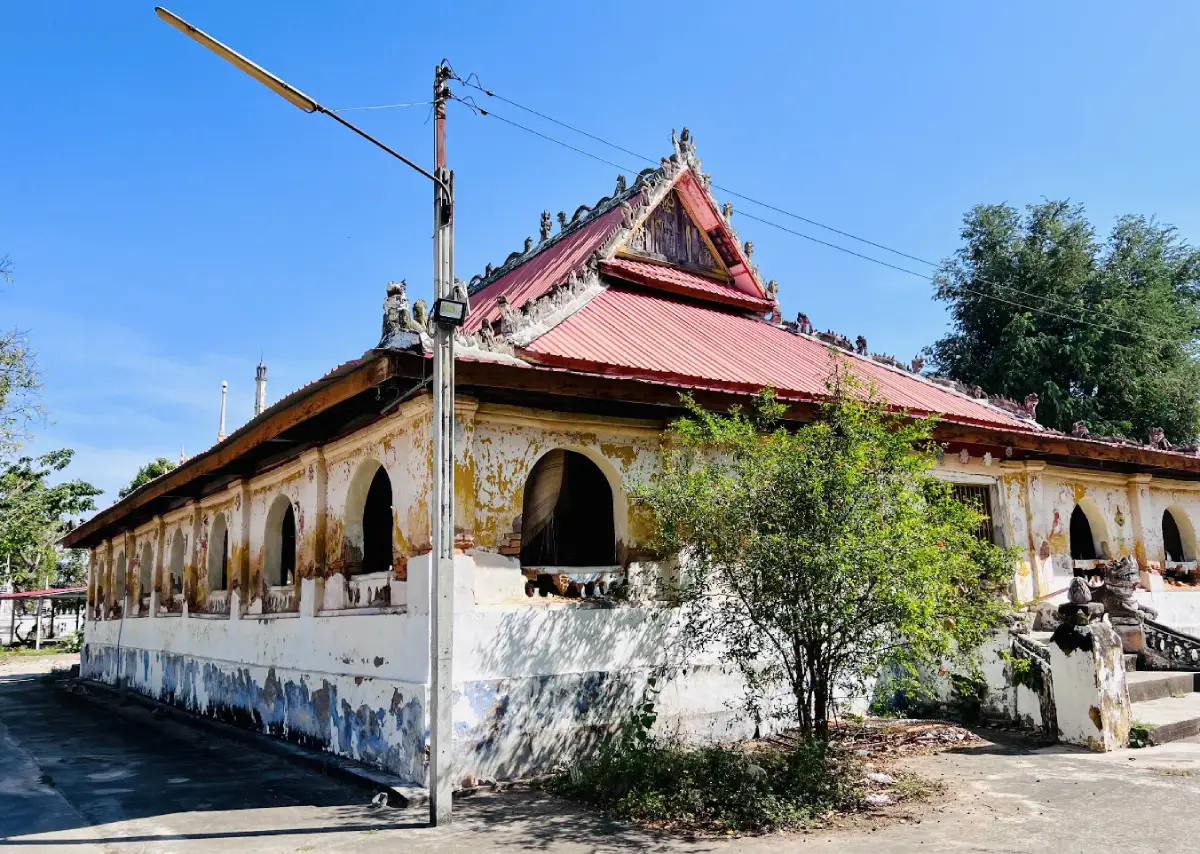
The most important feature of Wat Photharam is its old Isan sim, or ordination hall, together with the murals painted both inside and outside the building. The sim stands on a high base with a surrounding circumambulatory platform. Wooden posts support the extended eaves around the structure, while the solid brick-and-plaster walls are pierced by two small window openings on each side to allow light into the interior. The principal Buddha image is a carved wooden Buddha made by local craftsmen. The entire building reflects the character of vernacular Isan Buddhist architecture: modest in scale, deeply sacred in function, and rich in local meaning.
The history of Wat Photharam is closely tied to the history of Ban Dong Bang. The area is believed to have been an old settlement or ancient town site, as traces such as surrounding moats, laterite blocks, ancient objects, elephant-shaped jars, and human skeletons were found in the area. This suggests that the village landscape contains several historical layers. The temple therefore stands not only as a Buddhist place of worship, but also as a cultural marker in a landscape where archaeology, migration history, and village memory overlap.
Before the present land-based sim was built, Wat Photharam once had a scripture hall and an old ordination hall built in water. This water-based ordination hall was known locally as a sim nam and functioned as an udakukkhepa sima, using water as the sacred boundary for monastic rites. It was located to the north of the current ordination hall. After it became damaged, a new land-based sim was built. Phra Khru Chandi, the fourth abbot of the temple, designed the new sim. The temple was originally called Wat Pho Thong and was renamed Wat Photharam in 1942.
The sim of Wat Photharam is a striking example of vernacular Isan architecture. Its elevated base gives the building a dignified appearance. The base supporting the surrounding posts includes decorative mouldings, creating the impression of a second architectural layer. This two-tiered base makes the sim more visually prominent than many other small rural sims in the region. The 11-step staircase further emphasizes the transition from ordinary ground level to sacred ritual space.
The roof was originally constructed with timber and covered with wooden shingles. The decorative roof elements include lamyong, hang hong in the form of naga heads, ho-ng ornaments, and carved wooden chofa along the ridge. These elements show the refined skill of local Isan craftsmen. The roof ornaments are not merely decorative. They connect the sacred building with naga symbolism, protection, water, fertility, and Buddhist cosmology in northeastern Thai culture.
At the entrance of the sim, two stucco nagas guard the staircase. They are among the most valuable sculptural features of the building. The front porch was likely added later to protect these naga sculptures from rain damage. The naga figures mark the entrance into sacred space and reflect one of the most important symbols in Isan Buddhist art. In local belief, the naga is associated with protection, water, power, and devotion to Buddhism.
The solid walls of the sim create a calm and enclosed interior. The small window openings allow light to enter without making the space too open. This suits the ritual function of the sim as a place for monastic ceremonies and worship. The carved wooden principal Buddha image gives the interior a distinct local character. Wood has a warmth and intimacy that differs from stone or metal, and the image preserves the hand, devotion, and aesthetic sense of local craftsmen.
The hoop taem murals at Wat Photharam were painted by Acharn Salai and Nai Sing, both local residents of Ban Dong Bang. They used powdered pigments mixed with glue, without applying a separate base layer. The natural surface of the sim wall was used as the ground color of the mural. The main colors include blue, green, red, black, and white. The overall tone is soft rather than bright or aggressive. Important areas are emphasized with contrasting colors, such as indigo outlined with brown, orange, and black.
The subjects of the murals are wide-ranging and deeply connected with Isan Buddhist culture. They include the Vessantara Jataka, the life of the Buddha, Phra Palelai, Ramasun and Mekhala, and Sang Sinchai. These stories were familiar to Isan communities through sermons, merit-making festivals, folk literature, and oral storytelling. The murals therefore served as visual teaching tools for people who learned religious and moral ideas through images as much as through written texts.
The Vessantara Jataka is especially important in Isan culture because it is closely connected with Bun Phawet, or the Mahachat merit-making tradition. The story teaches generosity, sacrifice, and the perfection of giving. When painted on the sim walls, the Vessantara story becomes part of the community’s shared religious memory. Villagers who gathered for sermons and festivals could connect the painted images with what they heard during temple ceremonies.
The life of the Buddha provides the core Buddhist narrative of the murals. These scenes allow viewers to follow important events in the Buddha’s life through visual storytelling. The Phra Palelai scene, in which the Buddha stays in the forest and is served by an elephant and a monkey, carries meanings of solitude, compassion, and harmony with nature. The Ramasun-Mekhala story reflects local explanations of thunder and lightning, showing how Buddhist art in Isan also absorbed folk cosmology and natural belief.
The story of Sang Sinchai, also known as Sinxay, is a major work of Lao and Isan literature. Its presence in the murals makes Wat Photharam a valuable site for understanding local literary culture. Sang Sinchai includes themes of courage, gratitude, travel, struggle, and moral virtue. By placing this story alongside Buddhist narratives, the painters show that religion, literature, and local ethical education were not separate worlds in the minds of the community.
The murals also show scenes of everyday Isan life. They depict clothing styles, hairstyles, social relations, merit-making, child care, trade, hunting, singing, dancing, and daily occupations. These details make the murals valuable not only as religious art, but also as social history. They allow visitors to see past village life through the eyes of local painters rather than through official records. The sim walls therefore function as a visual archive of the community.
The charm of Isan hoop taem lies in its local visual language. The paintings do not follow Western rules of realism, perspective, or anatomical proportion. Characters may be simplified, multiple events may appear within one scene, and important figures may be emphasized through scale or color. These features should not be seen as artistic limitations. They are part of a narrative system designed to communicate meaning clearly, memorably, and emotionally to local viewers.
Wat Photharam is therefore an exceptional learning site. Visitors interested in art history can study the sim structure, timber ornaments, naga sculptures, and mural composition. Those interested in local culture can read village life from the walls. Those interested in Buddhism can learn through Jataka stories, the Buddha’s life, and moral narratives. Travelers interested in cultural heritage can experience the relationship between the temple and Ban Dong Bang community directly.
A meaningful visit should not be rushed. Visitors should spend at least one hour observing the building and murals. Begin by looking at the whole sim, including the high base, surrounding posts, extended eaves, and staircase. Then walk around the exterior walls slowly, reading the mural scenes one side at a time. Finally, enter the interior respectfully to view the wooden Buddha image and the large interior murals. A slow visit reveals details that are easily missed during a quick stop.
Proper behavior is essential when visiting Wat Photharam. The murals and the old sim are fragile cultural heritage. Visitors should dress modestly, avoid touching the walls, avoid leaning on the paintings, avoid scratching surfaces, avoid using strong flash at close range, and avoid climbing on the staircase or naga sculptures. Photography should be done respectfully and without disturbing monks, local worshippers, or temple activities.
Ban Dong Bang itself is part of the experience. The village is recognized as a cultural tourism community with old hoop taem murals and a strong local identity. The Thai-New Zealand Road, or Highway 2040, connects the area with nearby routes. Visitors should take time to observe the village atmosphere, trees, local houses, and the relationship between the temple and its surroundings. These elements help explain how such a rich mural tradition emerged in this rural community.
Getting There is most convenient by private car, rental car, or hired local transport. From Maha Sarakham city, travel toward Na Dun District, then continue to Dong Bang Subdistrict and Ban Dong Bang, Moo 5. Travelers can use the coordinates 15.65858126, 103.2484804 for navigation. From Phra That Na Dun or the Champa Si Historical Study Center, visitors can continue to Wat Photharam within a short drive.
A half-day cultural route can begin at Wat Photharam to study the old sim and murals, then continue to Phra That Na Dun and the Champa Si Historical Study Center. A full-day route can include Ku Santarat, Wat Palelai, and other sites in Na Dun District. This route allows travelers to see vernacular Buddhist art, Khmer-style laterite heritage, sacred relic worship, and old village culture within one area of southern Maha Sarakham.
Phra That Na Dun is the most important nearby sacred site and should be visited together with Wat Photharam. The Champa Si Historical Study Center adds historical context to the ancient city landscape, while Ku Santarat offers an example of a Khmer-style laterite monument associated with an ancient arogyasala, or hospital shrine. Together, these sites help visitors understand the cultural depth of Na Dun District.
The best time to visit Wat Photharam is in the morning or late afternoon. Natural light is important for viewing murals, especially on the exterior walls. Morning offers a quiet temple atmosphere, while late afternoon gives softer light for photography. Visitors who want to study the interior murals should choose a time with sufficient light and avoid using harsh artificial light near the old paintings.
Wat Photharam is suitable for many types of travelers. Cultural travelers can study Isan murals and architecture. Students can learn from a real heritage site. Buddhist visitors can reflect on Jataka stories and the life of the Buddha. International travelers can understand a form of Thai Buddhist art that differs from the grand temples of Bangkok, Chiang Mai, or Ayutthaya. The temple is smaller, quieter, and more community-based, but its cultural depth is remarkable.
For international visitors, Wat Photharam is an excellent example of Isan sim architecture and hoop taem mural painting. A sim is not just a small ordination hall. It is a sacred ritual space and a visual memory of the village. Hoop taem murals are not royal court paintings; they are community murals that teach religion, narrate literature, show folk belief, and preserve everyday life. Visiting this temple helps foreign travelers understand the regional diversity of Thai Buddhist art.
Food, cafés, and accommodation are available around Na Dun District and nearby routes. Travelers can stop at restaurants such as Thung Dok Chan Cafe & Homestay, Cafe Phak Lang Ban, Khrua Na Dun, Zaep Nua Khrua Je Bim, and 4 Naka-Cafe 2465. Nearby accommodations include Luk Kaew Resort Na Dun, Piang Fah Resort, Inaka Resort, INAKA Pool Villa, and Thung Dok Chan Homestay. Planning ahead is recommended during festivals or major merit-making periods in Na Dun.
The preservation of Wat Photharam depends on the shared responsibility of the temple, local community, cultural agencies, local administration, and visitors. The murals cannot be fully replaced if damaged. Every visitor can help by viewing respectfully, keeping the site clean, avoiding physical contact with the paintings, and communicating the value of the temple accurately. Responsible cultural travel helps protect the temple for future generations.
In summary, Wat Photharam in Ban Dong Bang, Na Dun District, Maha Sarakham Province is one of the most important destinations for understanding Isan sim architecture, hoop taem murals, Lao-Isan community history, and rural Buddhist art. Its highlights include the high-based brick-and-plaster sim, carved wooden Buddha image, naga staircase guardians, traditional roof ornaments, murals by local painters, stories of the Vessantara Jataka, the Buddha’s life, Phra Palelai, Ramasun-Mekhala, Sang Sinchai, and detailed scenes of everyday Isan life. Visitors who want to experience Maha Sarakham through art, faith, and community memory should spend meaningful time at Wat Photharam.
| Name | Wat Photharam |
| Former / Related Names | Wat Pho Thong, Wat Photharam Ban Dong Bang, Sim Wat Photharam, Hoop Taem Wat Photharam |
| Location | Ban Dong Bang, Moo 5, Dong Bang Subdistrict, Na Dun District, Maha Sarakham Province |
| Address | Ban Dong Bang, Dong Bang Subdistrict, Na Dun District, Maha Sarakham Province 44180, Thailand |
| Coordinates | 15.65858126, 103.2484804 |
| Site Type | Historic temple, Isan sim, vernacular mural site, and cultural tourism destination in Na Dun District |
| Highlights | High-based Isan sim, interior and exterior hoop taem murals, carved wooden Buddha image, naga staircase guardians, and the cultural history of Ban Dong Bang |
| History | The temple was built during the reign of King Rama III by Lao migrants from Vientiane. It was formerly called Wat Pho Thong and was renamed Wat Photharam in 1942 by Phra Khru Chandi, the fourth abbot |
| Name Origin | The name Dong Bang comes from a raised settlement once surrounded and screened by dense forest. Wat Photharam preserves the Buddhist meaning of the Bodhi tree, symbolizing awakening and sacred learning |
| Ancient Settlement Context | The Ban Dong Bang area is believed to have been an old settlement with surrounding moats, laterite blocks, ancient objects, elephant-shaped jars, and human skeletons found in the area |
| Distinctive Features Of The Sim | Brick-and-plaster sim on a high base with a surrounding circumambulatory platform, wooden posts supporting extended eaves, solid walls, two small window openings on each side, an originally wooden-shingle roof, lamyong, hang hong shaped as naga heads, ho-ng, and carved wooden chofa |
| Principal Buddha Image | A carved wooden Buddha image made by local craftsmen, reflecting the character of Isan vernacular Buddhist art |
| Important Sculptural Elements | Two stucco naga guardians at the staircase, protected by a later front porch to reduce rain damage |
| Mural Painters | Acharn Salai and Nai Sing, both local painters from Ban Dong Bang, using powdered pigments mixed with glue without a separate base layer |
| Mural Subjects | Vessantara Jataka, the life of the Buddha, Phra Palelai, Ramasun-Mekhala, Sang Sinchai, and scenes of Isan life such as clothing, hairstyles, merit-making, child care, trade, hunting, singing, and dancing |
| Colors And Technique | Blue, green, red, black, and white pigments with an overall soft tone. Important scenes are emphasized through contrasting colors such as indigo outlined with brown, orange, and black |
| Important Features Inside The Temple | 1. Old Isan sim 2. Exterior and interior hoop taem murals 3. Carved wooden Buddha image 4. Stucco naga staircase guardians 5. Temple grounds and Ban Dong Bang community 6. Ancient settlement landscape of Ban Dong Bang |
| Traditions / Community Activities | Bun Phawet, Kathin, robe-offering ceremonies, Buddhist holy days, candlelight processions, and merit-making activities of Ban Dong Bang community |
| Travel Information | From Maha Sarakham city, travel toward Na Dun District, then continue to Dong Bang Subdistrict and Ban Dong Bang, Moo 5. From Phra That Na Dun, continue toward Ban Dong Bang within a short drive. Private car, rental car, or hired local transport is recommended |
| Current Status | Open as a community temple and learning site for Isan sim architecture and hoop taem murals. Visitors can worship and view the murals during opening hours |
| Open Days | Daily |
| Opening Hours | 08.00 – 17.00 |
| Facilities | Temple courtyard, worship area, old sim and mural viewing area, shaded resting area, and parking space around the temple or nearby community area |
| Main Areas / Zones | 1. Old Isan sim zone 2. Exterior mural zone 3. Interior mural zone 4. Carved wooden Buddha image zone 5. Naga staircase and circumambulatory platform zone 6. Temple courtyard and Ban Dong Bang community zone |
| Abbot / Caretaker | Phra Khru Thawon Photharak (Sawat Thawaro), Abbot of Wat Photharam, together with the Wat Photharam monastic community |
| Local Administrative Contact | Dong Bang Subdistrict Municipality, Tel. 043-706-750, 043-706-6751 |
| Official Website / Official Page | Dong Bang Subdistrict Municipality website: dongbanglocal.go.th and Dong Bang Subdistrict Municipality Facebook page |
| Nearby Tourist Attractions | 1. Ban Dong Bang Community, about 1 km 2. Phra That Na Dun, about 9 km 3. Champa Si Historical Study Center / Nakhon Champa Si Museum, about 9 km 4. Ku Santarat, about 13 km 5. Wat Palelai, Na Dun District, about 14 km 6. Chang Thong Kham Elephant Conservation Center, Wapi Pathum District, about 25 km |
| Nearby Restaurants | 1. Thung Dok Chan Cafe & Homestay, about 4 km, Tel. 064-954-1598 2. Cafe Phak Lang Ban & Ja-O Beauty Hair Cafe & Restaurants, about 8 km, Tel. 092-105-1999 3. Khrua Na Dun, about 9 km, Tel. 093-474-7855, 093-475-7855 4. Zaep Nua Khrua Je Bim, Na Dun Branch, about 9 km, Tel. 098-420-4546 5. 4 Naka-Cafe 2465, about 18 km, Tel. 083-369-0694 |
| Nearby Accommodations | 1. Thung Dok Chan Cafe & Homestay, about 4 km, Tel. 064-954-1598 2. Luk Kaew Resort Na Dun Branch, about 8 km, Tel. 043-020-442 3. Piang Fah Resort, about 9 km, Tel. 081-617-1213, 043-797-051 4. Inaka Resort, about 12 km, Tel. 089-518-7526 5. INAKA Pool Villa, about 18 km, Tel. 083-369-0694, 082-935-4598 |
Frequently Asked Questions (FAQ)
Q: Where is Wat Photharam located?
A: Wat Photharam is located in Ban Dong Bang, Moo 5, Dong Bang Subdistrict, Na Dun District, Maha Sarakham Province. The coordinates are 15.65858126, 103.2484804.
Q: What is Wat Photharam famous for?
A: The temple is famous for its high-based Isan sim, interior and exterior hoop taem murals, carved wooden Buddha image, naga staircase guardians, and the cultural history of Ban Dong Bang.
Q: What stories are shown in the murals?
A: The murals show the Vessantara Jataka, the life of the Buddha, Phra Palelai, Ramasun-Mekhala, Sang Sinchai, and scenes of Isan daily life such as merit-making, trade, child care, hunting, singing, and dancing.
Q: What are the opening days and hours of Wat Photharam?
A: Wat Photharam is open daily from 08.00 to 17.00.
Q: What was the old water sim at Wat Photharam?
A: The old water sim was an ordination hall built in water as an udakukkhepa sima. It once stood north of the present ordination hall. After it became damaged, the present land-based sim was built.
Q: How can travelers get to Wat Photharam?
A: From Maha Sarakham city, travel toward Na Dun District, then continue to Dong Bang Subdistrict and Ban Dong Bang, Moo 5. From Phra That Na Dun, visitors can continue to Wat Photharam within a short drive.
Q: What nearby places can be visited with Wat Photharam?
A: Nearby places include Ban Dong Bang community, Phra That Na Dun, the Champa Si Historical Study Center, Ku Santarat, Wat Palelai, and Chang Thong Kham Elephant Conservation Center.
Q: How should visitors behave when viewing the murals?
A: Visitors should dress modestly, avoid touching or leaning on the walls, avoid close flash photography, avoid scratching or writing on surfaces, and take photographs respectfully.
 Category: ●Places of Worship
 Group: ●Temple
Last Update : 2 MonthAgo
 Last Update : 2 MonthAgo
 Click to Access the Navigation Map GPS
 Art, Culture and Heritage
 Historical Sites and Monuments(4)
 Art, Craft Centres, Tradition(5)
 Museums(3)
Temple(17)
Museums(3)
Temple(17)
 Other Sacred Sites(7)
 Research and Development
 Royal Project(2)
 Suburban Living
 Village, Community(5)
 Nature and Wildlife
 National Parks and Marine Reserves(3)
 Dam, Reservoir, Lake(10)
 River, Canal(2)
 Bays and Beaches(2)
 Other natural attractions(2)
 Entertainment and Agricultural
 Farms, Parks and Ecotourism(3)
 Travel Articles, Recipes
 Food Menu, Northeastern Recipes(1)


