
lovethailand home >Northeastern Travel Attractions >Maha Sarakham Travel Attractions >Kosum Phisai >Nong Lek > Wat Nong Lek
TL;DR: Wat Nong Lek is located at Ban Nong Lek, Nong Lek Subdistrict, Kosum Phisai District, Maha Sarakham Province, open Daily, hours 08.00 – 17.00.
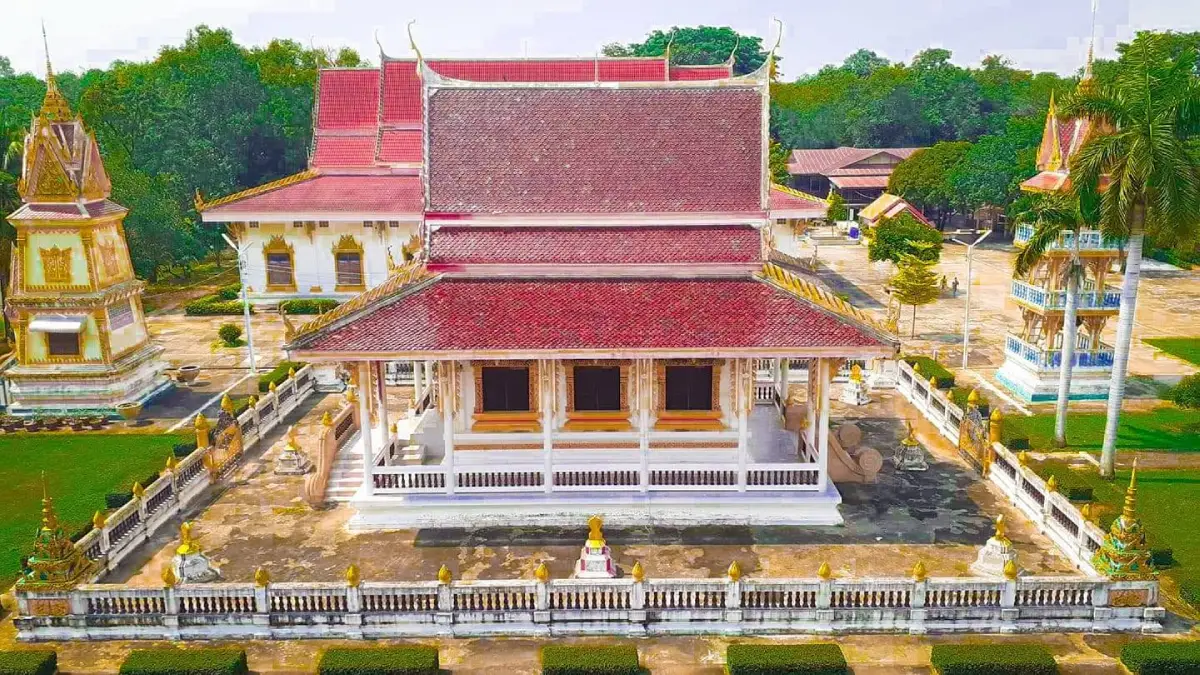
Wat Nong Lek
Open Days: Daily
Opening Hours: 08.00 – 17.00
Wat Nong Lek in Maha Sarakham Province is an important community temple in Ban Nong Lek, Nong Lek Subdistrict, Kosum Phisai District. Known for its graceful religious architecture and peaceful Isan village atmosphere, the temple is a meaningful destination for travelers who want to make merit, pay respect to Buddha images, explore local Buddhist architecture, and learn about the spiritual heritage of Kosum Phisai. It is also closely associated with Phra Sunthon Thammaphani, widely known as Luang Pu Son Suntharo, a respected former abbot of Wat Nong Lek and an important monk in Maha Sarakham’s religious history.
Wat Nong Lek is a local Buddhist temple under the Mahanikaya monastic order. It is located in Nong Lek Subdistrict, Kosum Phisai District, Maha Sarakham Province, within a rural Isan community where the temple still functions as a spiritual and social center. For travelers visiting Maha Sarakham, the temple offers a quieter and more local perspective on the province. It is not a commercialized tourist attraction; instead, it represents the living relationship between temple, village, faith, and community memory.
The most distinctive quality of Wat Nong Lek is its architectural beauty. The temple’s religious buildings reflect the character of an Isan community temple, where sacred space, local craftsmanship, and practical village use exist together. The beauty of the temple should be appreciated not only through decorative details but also through the overall atmosphere: the calm courtyard, the sacred buildings, the worship areas, and the quiet sense of devotion that continues to shape daily religious life in the community.
Visitors arriving at Wat Nong Lek will encounter the feeling of a genuine village temple. The temple grounds include areas for worship, merit-making, monastic activities, and community gatherings. There are also spaces connected with the memory of Luang Pu Son Suntharo, whose life and work remain important to local people. This kind of temple is best visited slowly. Its value is revealed through details: the shape of the buildings, the stillness of the grounds, the care given by the community, and the way the temple continues to serve local religious life.
The history of Wat Nong Lek helps explain its importance. The temple was established in 1903 and received its royal boundary for monastic ceremonies on 16 August 1994. The early establishment date shows that Ban Nong Lek had a long-standing need for a shared Buddhist space where local people could make merit, participate in rituals, and gather as a community. The granting of the monastic boundary confirms the temple’s role as an official religious site for important Buddhist ceremonies, especially those associated with the ordination hall.
The name “Nong Lek” reflects local geography and community identity. In northeastern Thai usage, “nong” often refers to a pond, wetland, or small water source, while “lek” means iron or may refer to a local feature, memory, or oral tradition. The temple’s name follows the name of the village and subdistrict, showing that Wat Nong Lek grew directly from the community. It is not separate from the village; it is part of the village’s identity, spiritual life, and shared history.
From an architectural perspective, Wat Nong Lek is best appreciated as a community temple with religious buildings that express devotion through form and function. Isan Buddhist architecture often combines practical use with sacred symbolism. Roof forms, gables, decorative details, Buddha image halls, stupas, and worship spaces all work together to create a religious landscape. At Wat Nong Lek, the architectural value lies in how these elements support both faith and community use.
Wat Nong Lek is also important because of its connection with Phra Sunthon Thammaphani, or Luang Pu Son Suntharo. Luang Pu Son was born in Ban Nong Lek in the area that is now Nong Lek Subdistrict, Kosum Phisai District, Maha Sarakham Province. He became widely respected for his humble way of life, kindness, devotion to Buddhist education, and contributions to the Sangha and local society. His life story gives the temple a deeper spiritual meaning beyond its physical buildings.
Luang Pu Son Suntharo had a strong connection with Wat Nong Lek. After his early religious education, he returned to the temple and played an important role in Buddhist learning, teaching, and community development. He later served as abbot of Wat Nong Lek and held several important monastic positions in Kosum Phisai District. Through his work, Wat Nong Lek became associated with religious education, public service, and the memory of a monk deeply respected by local people.
For visitors, this connection with Luang Pu Son adds a strong spiritual dimension to the temple. A trip to Wat Nong Lek is not only about viewing architecture; it is also an encounter with the memory of a respected teacher monk. Local people continue to remember his virtues through annual ceremonies and acts of devotion. This living memory gives the temple an emotional and cultural depth that cannot be understood through architecture alone.
One of the important activities associated with the temple is the annual homage ceremony for Luang Pu Son Suntharo, also honored as Phra Sunthon Thammaphani. Such ceremonies bring together local residents, disciples, and devotees who come to make merit, pay respect, and remember the contributions of the former abbot. These events help keep the story of Luang Pu Son alive and show how the temple remains a center of collective memory and faith.
For cultural travelers, Wat Nong Lek should be understood through 3 connected layers: temple architecture, community faith, and the legacy of Luang Pu Son. A meaningful visit can begin with paying respect to the Buddha images, followed by a slow walk around the temple grounds to observe the religious buildings and atmosphere. Learning about Luang Pu Son’s life then adds a deeper understanding of why this temple matters to the people of Nong Lek and Kosum Phisai.
Wat Nong Lek is suitable for travelers who prefer quiet, reflective cultural experiences. Kosum Phisai District is one of the older districts of Maha Sarakham and is connected with the Chi River, agricultural communities, local temples, and natural sites. The temple can therefore be included in a broader route that combines religious visits, local food, riverside landscapes, and small-town life in northeastern Thailand.
Visitors should observe proper temple etiquette. Dress modestly, covering shoulders and knees. Avoid loud behavior, climbing on religious structures, touching sacred objects without permission, or entering monastic areas without being invited. Photography should be respectful, especially when monks or local worshippers are present. Responsible behavior helps preserve the peaceful atmosphere of the temple and shows respect for the local community that uses the space every day.
The best time to visit Wat Nong Lek is in the morning or late afternoon, when the weather is more comfortable and the light is suitable for photography. Maha Sarakham can be hot during the day, especially in the dry season. Morning visits are good for seeing the temple’s architectural details clearly, while late afternoon provides a quieter and warmer atmosphere. Travelers interested in the homage ceremony for Luang Pu Son should check local schedules before planning their visit.
Getting There is most convenient by private car, rental car, or arranged local transport. From Maha Sarakham city, travel toward Kosum Phisai District, then continue to Nong Lek Subdistrict and Ban Nong Lek. Travelers can use the map destination “Wat Nong Lek, Nong Lek Subdistrict, Kosum Phisai District, Maha Sarakham Province” or the coordinates 16.14231, 102.98373. Checking the route before departure is recommended, especially during the rainy season or during local temple events.
From Kosum Phisai town, Wat Nong Lek can be included in a local day route. Visitors may start with the temple, then continue to natural and cultural attractions such as Kosamphi Forest Park, Kaeng Tat, Hat Wang Ko, or temples in the district center. This route works well for travelers who want to combine merit-making, architecture, nature, and local food in one trip.
Travelers without a private vehicle can first reach Maha Sarakham city or Kosum Phisai town, then arrange local transport to Nong Lek Subdistrict. Because public transport in rural communities may not run frequently throughout the day, it is best to arrange both the outbound and return journey in advance. Group travel or a hired local vehicle is often more convenient for visiting several places in the same day.
Those interested in Luang Pu Son Suntharo should spend extra time at the temple. His story is central to the cultural meaning of Wat Nong Lek. He was known for Buddhist learning, teaching, public service, and devotion to the Sangha. Understanding his connection with the temple helps visitors see Wat Nong Lek as more than a village temple. It becomes a place of religious memory, education, and local devotion.
For families and students, Wat Nong Lek can serve as an outdoor learning site. Young visitors can learn about the role of temples in Isan communities, the history of local monks, appropriate behavior in sacred spaces, and the importance of preserving religious architecture. A visit to the temple can help children understand that cultural heritage is not found only in museums or major monuments; it also lives in village temples that continue to serve their communities.
For photographers, Wat Nong Lek is suitable for documentary-style photography focusing on temple architecture, quiet atmosphere, religious details, and the relationship between the temple and the village. Photographers should avoid disturbing worshippers or monks and should not enter restricted areas without permission. When sharing images, the location should be clearly identified as Wat Nong Lek in Kosum Phisai District, Maha Sarakham Province, to avoid confusion with temples of similar names elsewhere.
Culturally, Wat Nong Lek represents the role of a village temple in northeastern Thailand. A temple is not only a place with buildings and Buddha images; it is where people gather for annual merit-making, ordination ceremonies, religious observances, memorial rites, and community activities. In this way, Wat Nong Lek functions as both a sacred space and a community center. This social role is one of the reasons small local temples remain deeply important in Isan culture.
The temple also encourages reflection on the conservation of community religious heritage. Many small temples have historical, architectural, and spiritual value but are less widely publicized than famous tourist temples. Visiting respectfully, recording information accurately, and sharing the temple’s value in the right way can help support awareness without disrupting local religious life. For a community temple like Wat Nong Lek, responsible travel is essential.
Overall, Wat Nong Lek is ideal for travelers seeking a deeper view of Maha Sarakham. It is especially suitable for those interested in local temples, Buddhist architecture, respected monks, and rural community life. It does not offer the atmosphere of a busy tourist site; instead, it offers calm, authenticity, and cultural depth. Visitors will see how a small community temple can carry long memories, shared faith, and meaningful local identity.
A half-day itinerary can begin at Wat Nong Lek in the morning, allowing 30 to 60 minutes for merit-making and walking around the temple. Afterward, travelers can continue to Kosum Phisai town for food or coffee, then visit nearby natural attractions. With a full day, the route can include Kosamphi Forest Park, Kaeng Tat, Hat Wang Ko, and other temples in Kosum Phisai District. This creates a balanced itinerary combining religion, nature, food, and local life.
For foreign travelers, Wat Nong Lek is a valuable example of a living Isan temple. It shows that Thai Buddhism is not limited to famous temples in major tourist cities. It is also present in rural village temples where people continue to make merit, gather for ceremonies, and preserve the memory of respected monks. The beauty of Wat Nong Lek is therefore quiet and rooted in daily life. It is best experienced with patience, respect, and an interest in local culture.
In summary, Wat Nong Lek in Ban Nong Lek, Nong Lek Subdistrict, Kosum Phisai District, Maha Sarakham Province is a temple of architectural beauty, spiritual significance, and local cultural value. Its highlights include graceful religious buildings, a peaceful community atmosphere, a long history, and its association with Luang Pu Son Suntharo, a respected former abbot. The temple is suitable for merit-making, cultural learning, quiet travel, and inclusion in a broader Kosum Phisai itinerary.
| Name | Wat Nong Lek |
| Location | Ban Nong Lek, Nong Lek Subdistrict, Kosum Phisai District, Maha Sarakham Province |
| Address | Moo 12, Nong Lek Subdistrict, Kosum Phisai District, Maha Sarakham Province 44140, Thailand |
| Coordinates | 16.14231, 102.98373 |
| Highlights | A community temple known for graceful religious architecture, merit-making, and its connection with Luang Pu Son Suntharo |
| History | A local temple under the Mahanikaya order, established in 1903 and granted its monastic boundary on 16 August 1994 |
| Name Origin | The temple name follows Ban Nong Lek and Nong Lek Subdistrict, reflecting the connection between the temple and the local community |
| Distinctive Features | Beautiful religious architecture, peaceful temple grounds, and the continuing role of a living community temple |
| Tradition / Ritual | Annual homage ceremony for Phra Sunthon Thammaphani, or Luang Pu Son Suntharo, a respected former abbot of Wat Nong Lek |
| Main Areas / Zones | 1. Main religious architecture and temple buildings 2. Worship and merit-making area 3. Stupa / devotional remembrance area 4. Temple courtyard and community activity space 5. Monastic and religious activity area |
| Travel Information | From Maha Sarakham city, travel toward Kosum Phisai District, then continue to Nong Lek Subdistrict and Ban Nong Lek. Private car, rental car, or arranged local transport is recommended |
| Current Status | Open as a community temple and cultural religious site where visitors can make merit and visit during opening hours |
| Open Days | Daily |
| Opening Hours | 08.00 – 17.00 |
| Facilities | Temple courtyard, worship area, religious activity space, and parking space around the temple or nearby community area |
| Important Former Abbot | Phra Sunthon Thammaphani, also known as Luang Pu Son Suntharo, former abbot of Wat Nong Lek and former ecclesiastical district chief of Kosum Phisai |
| Caretaker / Local Authority | Wat Nong Lek monastic community, Ban Nong Lek community, and Nong Lek Subdistrict Administrative Organization |
| Local Administrative Contact | Nong Lek Subdistrict Administrative Organization, Tel. 043-706878 |
| Official Local Website / Page | Nong Lek Subdistrict Administrative Organization website: nonglek.go.th |
| Nearby Tourist Attractions | 1. Kosamphi Forest Park, about 17 km 2. Kaeng Tat, about 16 km 3. Hat Wang Ko, about 16 km 4. Kosum Phisai District Stadium, about 13 km 5. Wat Tai Kosum / Important temples in Kosum Phisai town, about 15 km |
| Nearby Restaurants | 1. Hugchee Grand Coffee & Resort, about 14 km, Tel. 091-442-9444 2. NANA FARM, about 13 km, Tel. 061-025-3555 3. KFC Lotus Kosum Phisai, about 14 km, Tel. 065-510-4714 4. Morocco Blue Cafe by Chilong River Farm Resort, about 18 km, Tel. 083-251-2123, 084-190-4560 5. Kok Thai Ban Phaeng, about 12 km, Tel. 082-309-5137 |
| Nearby Accommodations | 1. Morocco Blue Cafe by Chilong River Farm Resort, about 18 km, Tel. 083-251-2123, 084-190-4560 2. Hugchee Grand Coffee & Resort, about 14 km, Tel. 091-442-9444 3. Faikham Resort, about 13 km, Tel. 088-069-3891 4. K.C. Garden View Guest House, about 13 km 5. Khan Suk Resort, about 18 km |
Frequently Asked Questions (FAQ)
Q: Where is Wat Nong Lek located?
A: Wat Nong Lek is located in Ban Nong Lek, Nong Lek Subdistrict, Kosum Phisai District, Maha Sarakham Province, Thailand.
Q: What is Wat Nong Lek known for?
A: Wat Nong Lek is known for its graceful religious architecture, peaceful community temple atmosphere, and connection with Luang Pu Son Suntharo, a respected former abbot.
Q: What are the opening days and hours of Wat Nong Lek?
A: Wat Nong Lek is open daily from 08.00 to 17.00.
Q: Who was Luang Pu Son Suntharo?
A: Luang Pu Son Suntharo, also known as Phra Sunthon Thammaphani, was a respected former abbot of Wat Nong Lek and former ecclesiastical district chief of Kosum Phisai.
Q: How can travelers get to Wat Nong Lek?
A: From Maha Sarakham city, travel toward Kosum Phisai District, then continue to Nong Lek Subdistrict and Ban Nong Lek. A private car, rental car, or arranged local transport is recommended.
Q: What should visitors wear when visiting Wat Nong Lek?
A: Visitors should dress modestly, cover shoulders and knees, behave calmly, and respect monastic and religious areas within the temple.
Q: Who should visit Wat Nong Lek?
A: The temple is suitable for travelers interested in local temples, Buddhist architecture, respected monks, merit-making, and quiet cultural travel in Kosum Phisai District.
Q: What nearby attractions can be included in the same trip?
A: Travelers can combine the visit with Kosamphi Forest Park, Kaeng Tat, Hat Wang Ko, important temples in Kosum Phisai town, and local restaurants or cafes in the district.
 Category: ●Places of Worship
 Group: ●Temple
Last Update : 2 MonthAgo
 Last Update : 2 MonthAgo
 Click to Access the Navigation Map GPS
 Art, Culture and Heritage
 Historical Sites and Monuments(4)
 Art, Craft Centres, Tradition(5)
 Museums(3)
Temple(17)
Museums(3)
Temple(17)
 Other Sacred Sites(7)
 Research and Development
 Royal Project(2)
 Suburban Living
 Village, Community(5)
 Nature and Wildlife
 National Parks and Marine Reserves(3)
 Dam, Reservoir, Lake(10)
 River, Canal(2)
 Bays and Beaches(2)
 Other natural attractions(2)
 Entertainment and Agricultural
 Farms, Parks and Ecotourism(3)
 Travel Articles, Recipes
 Food Menu, Northeastern Recipes(1)


