
lovethailand home >Northeastern Travel Attractions >Maha Sarakham Travel Attractions >Kae Dam >Wang Saeng > Wat Don Ku Non Phra
TL;DR: Wat Don Ku Non Phra is located at Ban Takhu, Moo 5, Wang Saeng Subdistrict, Kae Dam District, Maha Sarakham Province, open Daily, hours 08.00 – 17.00.
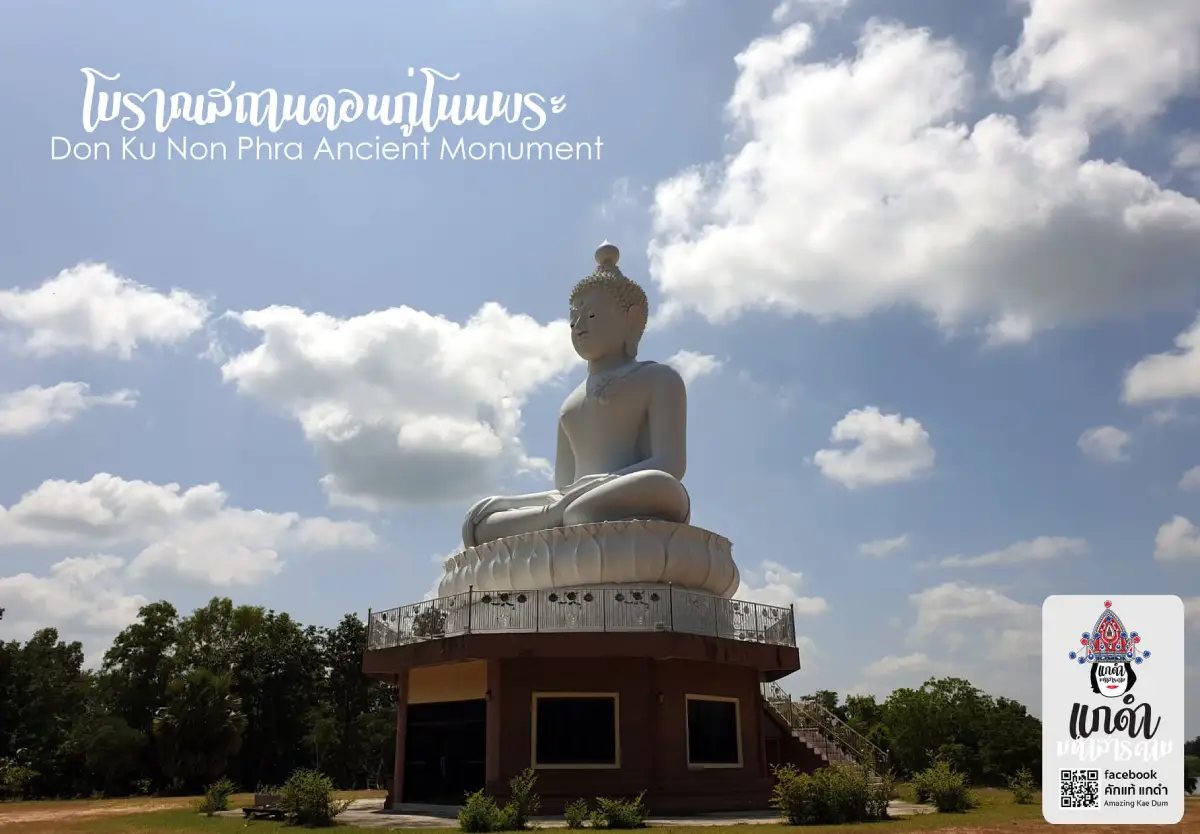
Wat Don Ku Non Phra
Open Days: Daily
Opening Hours: 08.00 – 17.00
Wat Don Ku Non Phra in Maha Sarakham Province, also known as Don Ku Non Phra Monastic Residence and Don Ku Non Phra Archaeological Site, is an important cultural and archaeological destination in Kae Dam District. Located at Ban Takhu, Moo 5, Wang Saeng Subdistrict, Kae Dam District, Maha Sarakham Province, the site is known for its ancient Khmer-style prang ku ruins set amid natural woodland, surrounded by water and connected by a bridge. This distinctive island-like landscape gives the place a quiet and sacred atmosphere, combining an archaeological site, a Buddhist monastic area, a natural setting, and local spiritual heritage in one compact destination.
Wat Don Ku Non Phra is suitable for travelers interested in local history, Khmer-influenced architecture in northeastern Thailand, Buddhist and folk beliefs, and peaceful cultural travel away from crowded tourist routes. The site is especially meaningful to Kae Dam District because it represents one of the area’s most distinctive ancient landmarks. It is also remembered in local identity through references to Ku Non Phra as part of the cultural pride of Kae Dam. For local people, this place is not simply a tourist attraction; it is part of community memory, sacred geography, and the cultural landscape of Maha Sarakham.
The first impression of Wat Don Ku Non Phra comes from its setting. The archaeological area is surrounded by natural woodland and water, creating a calm boundary between the sacred inner space and the surrounding community. A bridge leads visitors across the water into the main area, turning the approach into part of the experience. The act of crossing the bridge feels symbolic: visitors gradually leave the everyday village landscape and enter a space shaped by history, faith, nature, and long-standing local reverence.
The name “Don Ku Non Phra” reflects the character of the site. In Thai and Lao-Isan usage, “don” often refers to a raised piece of land or an elevated mound; “ku” is commonly used in northeastern Thailand for ancient shrines or small Khmer-style ruins; and “non phra” suggests a sacred mound associated with Buddha images or religious presence. Together, the name evokes a sacred raised place containing an ancient shrine and Buddhist memory. It is a name that explains the site’s geography, archaeology, and spirituality at the same time.
The archaeological remains at Don Ku Non Phra are Khmer-style religious structures. The original complex consisted of 3 buildings arranged along a north-south axis, all facing east. The central structure was larger than the 2 flanking buildings. Today, the visible remains are mainly the bases of the buildings and laterite fragments left after archaeological excavation and clearing. Although the structures are no longer complete towers, the layout and remaining materials are valuable evidence of a community-level sacred site linked to Khmer cultural influence in the Northeast.
Don Ku Non Phra is best understood as a local shrine rather than a large royal temple complex. Its form suggests a small community sanctuary or shrine associated with religious practice, probably connected to Brahmanical beliefs during the period of Khmer cultural influence. Such community sanctuaries could vary in size and layout, often incorporating features such as walls, moats, water bodies, or nearby ponds. This makes Don Ku Non Phra significant because it shows how Khmer religious and architectural traditions reached local communities in what is now Maha Sarakham Province.
Laterite is one of the key materials found at the site. This reddish-brown stone was widely used in ancient Khmer and related architectural traditions across northeastern Thailand. Its presence at Don Ku Non Phra supports the interpretation of the site as an ancient religious complex. The discovery of laterite blocks, a pedestal associated with a Shiva lingam, and ancient Buddha images also suggests that the site passed through layered religious meanings over time. It reflects both Brahmanical and Buddhist associations, showing how sacred places in the region could be reinterpreted and continuously respected across generations.
The site is generally associated with the later phase of Khmer cultural influence, around the 16th–17th Buddhist centuries. This period was marked by the spread of religious, artistic, and cultural networks across many areas of northeastern Thailand. Don Ku Non Phra may not be as visually complete as larger stone sanctuaries, but its value lies in its local scale. It helps reveal how ancient religious networks were not limited to major political centers but extended into rural communities where local shrines served as spiritual anchors for everyday life.
The modern archaeological history of Don Ku Non Phra became clearer in the early 2000s. The site was surveyed by the archaeological office based in Khon Kaen in 2001, and a plan for registration and conservation was prepared in 2002. In 2003, Wang Saeng Subdistrict Administrative Organization worked with the Fine Arts Office in Khon Kaen to carry out archaeological clearing and excavation. This work helped organize the site, study its remains, and reduce the risk of further damage to the surviving archaeological evidence.
Before systematic conservation work, the site had been disturbed by repeated illegal digging for antiquities. Such damage is common at small archaeological sites where local legends and the possibility of buried sacred objects attract attention. The archaeological project was therefore more than an academic exercise; it was also a protective measure. By identifying the site’s value and making it part of public cultural knowledge, the local community gained a stronger reason to preserve it as a shared heritage site.
Beyond archaeology, Don Ku Non Phra remains a deeply respected spiritual place. Local people in Kae Dam District have long regarded the area as sacred. One of the best-known local stories concerns a “golden Buddha image.” According to the oral tradition, a golden-looking seated Buddha image once existed within the area. Whether approached as legend, belief, or cultural memory, the story plays an important role in shaping local respect for the site. It reminds visitors that Don Ku Non Phra is not merely an ancient ruin; it is a living sacred landscape.
The story of the golden Buddha image also connects the site with forest, animals, and local spirituality. Local accounts tell of elephant handlers from Surin who once stopped near the ancient site. One of their elephants walked to a large tree, reached into a hollow with its trunk, and took out a Buddha image. The handlers later placed the image back where it had been found. This story gives sacred meaning to the tree, the forest, the ruins, and the Buddha image, turning the landscape into a moral space where people are expected to behave respectfully.
Other stories describe consequences for those who disrespected the sacred objects or hunted animals in the area. These accounts helped establish the site as a protected zone in local consciousness. People became reluctant to hunt, damage the place, or disturb the remains. In this sense, belief helped conservation. The sacred reputation of Don Ku Non Phra protected both the archaeological site and the natural environment around it, transforming the area into a de facto sanctuary where religious respect and ecological restraint support one another.
The most important annual tradition associated with Don Ku Non Phra is the Song Ku ceremony, held on the full moon day of the 6th lunar month, which coincides with Visakha Bucha Day. This ceremony reflects the blending of Buddhism, local belief, and reverence for the ancient shrine. Community members gather to make merit, honor the ku, and reaffirm their connection to the sacred site. The ceremony keeps the archaeological remains socially alive, ensuring that the ruins continue to matter to local people rather than becoming a silent relic of the past.
For travelers, the Song Ku tradition adds an important cultural dimension to the site. Visiting on an ordinary day allows one to appreciate the quiet forest, water, bridge, and archaeological remains. Visiting during the ceremony reveals the site’s active role in community life. It becomes clear that Don Ku Non Phra is both an archaeological place and a living ritual space. The annual ceremony helps connect younger generations with the history and sacred geography of their community.
Today, the remaining structures at Don Ku Non Phra consist mainly of large laterite blocks, bases of ancient buildings, and fragments associated with sacred images. A simple open concrete pavilion has been built over part of the archaeological alignment, while water still surrounds the area. A reinforced concrete bridge crosses the water on the western side, and a monastic area stands to the south. The result is a layered landscape where an ancient shrine, a modern Buddhist space, woodland, water, and community access coexist.
The appeal of Don Ku Non Phra lies not in monumental grandeur but in atmosphere and context. Visitors should not expect a fully restored tower. Instead, the experience is about reading traces: the arrangement of bases, the texture of laterite, the direction of the buildings, the surrounding water, and the quiet forest. These elements together help travelers imagine how a small sacred site once served the local community and how that sense of sacredness continues in a different form today.
The site has also been promoted as a local tourist attraction of Wang Saeng Subdistrict. The subdistrict cultural council has been involved, and the area has been recognized as a tourism resource by Wang Saeng Subdistrict Administrative Organization. Earlier information also records support from the Tourism Authority of Thailand for site improvement, together with cooperation from the Isan Cultural Center of Mahasarakham University for planning and layout design. These efforts show that Don Ku Non Phra is valued not only by villagers but also by cultural and tourism institutions in the province.
Visitors should treat Wat Don Ku Non Phra with respect because it is both a sacred place and an archaeological site. Appropriate clothing is recommended. Travelers should not climb on the ruins, move stones or fragments, scratch or write on laterite blocks, litter in the forest or water area, or make loud noise near the monastic space. Responsible behavior is essential because small archaeological remains are fragile, and the site’s peaceful character depends on careful visitor conduct.
The best time to visit is in the morning or late afternoon, when the heat is milder and the light is softer for photography. During the rainy season, the forest and water landscape can look especially lush, but paths may be slippery and visitors should walk carefully. Photographers may find the bridge, water, trees, and laterite remains visually interesting, especially when soft light creates reflections around the site. Travelers interested in local tradition should check the Visakha Bucha period, when the Song Ku ceremony is associated with the site.
Getting There is most convenient by private car or rental car. From Maha Sarakham city, travel toward Kae Dam District, then continue to Wang Saeng Subdistrict and Ban Takhu. The route passes through local roads and rural communities. Travelers should set the destination as Wat Don Ku Non Phra or Don Ku Non Phra Archaeological Site on a map application and check the route before departure, especially during the rainy season or periods of local roadwork. From Kae Dam town, the site can be combined with Kae Dam Wooden Bridge, Nong Kae Dam Reservoir, Luang Pu Choi Shrine, and local restaurants.
Travelers without a private vehicle can first reach Maha Sarakham city or Kae Dam District, then arrange local transport to Ban Takhu in Wang Saeng Subdistrict. It is advisable to arrange the return trip in advance because public transport in the immediate area is limited. Clear timing is important, especially for visitors who plan to continue to other attractions in Kae Dam or return to Maha Sarakham city in the evening.
Once at the site, visitors should take time to walk slowly. Begin by observing the water surrounding the area, the bridge leading inward, and the natural woodland. Then continue to the archaeological zone to view the laterite bases and remaining fragments. The site should be appreciated as historical evidence rather than as a fully standing monument. Its value is found in what remains, in how the ruins sit within the landscape, and in how local memory continues to give meaning to the place.
Those interested in architecture should pay attention to the 3-building layout and the east-facing orientation. The larger central structure suggests a hierarchy within the sanctuary. Even though only bases remain, the plan still helps visitors understand how the site may have functioned. These details make Don Ku Non Phra a useful place for learning about smaller Khmer-influenced community shrines in the Northeast.
Nature lovers will also appreciate the quiet environment. The surrounding woodland reduces outside noise, while the water gives the site a cooling and isolating effect. This calm setting makes Don Ku Non Phra suitable for slow cultural travel, documentary-style photography, and reflective visits. Its simplicity is part of its identity. Rather than offering commercialized attractions, it offers stillness, local history, and a sense of sacred continuity.
Culturally, Wat Don Ku Non Phra is a strong example of how ancient sites and living communities can coexist. A place that began as an ancient religious structure continues to be respected as sacred ground. A monastic presence remains nearby. The Song Ku ceremony continues to connect people with the site. Oral traditions still shape how local residents understand the ruins. This continuity turns Don Ku Non Phra from a static archaeological site into a living cultural landscape.
Conservation should remain central to any future development. Because the visible remains are mostly bases and fragments, they are vulnerable to damage. Improvements for visitors should not overwhelm the archaeological core or disturb the water, woodland, and quiet atmosphere. Travelers can contribute directly to conservation by walking carefully, avoiding contact with fragile remains, and keeping the site clean.
A half-day itinerary can begin at Wat Don Ku Non Phra in the morning, with 30–60 minutes for walking and observation. Afterward, visitors can continue to Kae Dam Wooden Bridge and Nong Kae Dam Reservoir, stop for a local meal in Kae Dam, and then visit Luang Pu Choi Shrine or other nearby community attractions. Those with more time can continue toward Maha Sarakham city to visit Ku Maha That, Prang Ku Ban Khwao, Wat Pa Wang Nam Yen, or other cultural sites in the province.
For families and students, Don Ku Non Phra is a useful outdoor learning site. It connects many subjects: local geography, water landscapes, forest ecology, Khmer cultural influence, religious history, oral tradition, community ceremony, and heritage conservation. The site helps demonstrate that archaeological value does not depend only on complete buildings. Even fragments, bases, and local stories can reveal deep connections between past communities and present-day life.
For foreign travelers, Don Ku Non Phra offers a quieter and more local perspective on northeastern Thailand. It is not a large, internationally famous ruin, but that is precisely its value. The site allows visitors to see how rural communities preserve sacred spaces, how ancient Khmer influence appears in small local shrines, and how Buddhist and local beliefs remain intertwined in everyday cultural life. It is a meaningful stop for travelers who want to go beyond mainstream sightseeing and understand Isan through its local heritage.
In summary, Wat Don Ku Non Phra in Maha Sarakham is a destination worth preserving and visiting with care. It combines Khmer-style archaeological remains, natural woodland, water, local belief, Buddhist practice, the Song Ku tradition, and an island-like sacred landscape. Travelers who enjoy quiet places with cultural depth will find that Don Ku Non Phra offers more than a quick photo stop. Every element of the site—the bridge, the water, the forest, the laterite stones, the oral legends, and the annual ceremony—forms part of a single cultural story rooted in Kae Dam community life.
| Name | Wat Don Ku Non Phra / Don Ku Non Phra Monastic Residence / Don Ku Non Phra Archaeological Site |
| Location | Ban Takhu, Moo 5, Wang Saeng Subdistrict, Kae Dam District, Maha Sarakham Province |
| Address | Ban Takhu, Moo 5, Wang Saeng Subdistrict, Kae Dam District, Maha Sarakham Province 44190, Thailand |
| Highlights | Ancient Khmer-style prang ku ruins set in natural woodland, surrounded by water and connected by a bridge, creating an island-like sacred landscape |
| History | A Khmer-style religious site associated with the 16th–17th Buddhist centuries; surveyed in 2001 and archaeologically cleared in 2003 |
| Name Origin | “Don” refers to raised land, “ku” refers to an ancient shrine or ruin, and “Non Phra” suggests a sacred mound associated with Buddha images or religious presence |
| Distinctive Features | A group of 3 ancient structures arranged north-south and facing east; the central building was larger than the 2 side buildings, with laterite bases and fragments remaining today |
| Tradition / Ritual | Song Ku ceremony, held on the full moon day of the 6th lunar month, coinciding with Visakha Bucha Day each year |
| Main Areas / Zones | 1. Ancient prang ku and laterite base area 2. Natural woodland around the archaeological site 3. Surrounding pond and water boundary 4. Bridge leading into the site 5. Monastic area to the south |
| Travel Information | From Maha Sarakham city, travel toward Kae Dam District, then continue to Wang Saeng Subdistrict and Ban Takhu. Private car, rental car, or arranged local transport is recommended |
| Current Status | Open as a local cultural attraction and religious site where visitors can view the archaeological remains and surrounding landscape during opening hours |
| Open Days | Daily |
| Opening Hours | 08.00 – 17.00 |
| Facilities | Bridge access to the archaeological area, pavilion, monastic area, and parking space around the nearby community area |
| Caretaker | The tourism area is within Wang Saeng Subdistrict Administrative Organization, and the religious area is associated with Don Ku Non Phra Monastic Residence |
| Main Contact Number | Wang Saeng Subdistrict Administrative Organization, Tel. 043-029534 |
| Official Website / Official Page | Wang Saeng Subdistrict Administrative Organization website: wungsang.go.th |
| Nearby Tourist Attractions | 1. Kae Dam Wooden Bridge / Nong Kae Dam Reservoir, about 11 km 2. Luang Pu Choi Shrine, about 13 km 3. Kae Dam Market, about 12 km 4. Ku Maha That / Prang Ku Ban Khwao, about 30 km 5. Wat Phutthawanaram / Wat Pa Wang Nam Yen, about 28 km |
| Nearby Restaurants | 1. Jim Jum Fai Daeng Kae Dam 2, about 11 km, Tel. 082-584-7990 2. Jungle Cafe Kae Dam Branch, Maha Sarakham, about 12 km, Tel. 061-143-2590 3. Phi Tor Restaurant, about 12 km, Tel. 096-684-3685, 086-283-7530 4. Ponlaom Cafe, about 18 km, Tel. 099-472-4666 5. Kuai Tiao Champ, about 12 km |
| Nearby Accommodations | 1. Jinnapha Garden & Resort, about 13 km, Tel. 086-047-6263 2. Ban Suan Damrong Sap, about 13 km, Tel. 095-568-2938 3. Siamtara Palace Hotel Maha Sarakham, about 33 km, Tel. 043-706-944, 084-470-1888 4. Ketsara Hotel, about 31 km, Tel. 095-236-2395 5. Top Inn Hotel Maha Sarakham, about 31 km, Tel. 062-545-5622 |
Frequently Asked Questions (FAQ)
Q: Where is Wat Don Ku Non Phra located?
A: Wat Don Ku Non Phra is located at Ban Takhu, Moo 5, Wang Saeng Subdistrict, Kae Dam District, Maha Sarakham Province, Thailand.
Q: What makes Wat Don Ku Non Phra interesting?
A: The site features Khmer-style prang ku ruins, laterite bases, natural woodland, surrounding water, and a bridge leading into an island-like sacred area.
Q: What are the opening days and hours of Wat Don Ku Non Phra?
A: The site is open daily from 08.00 to 17.00.
Q: How is Don Ku Non Phra related to Khmer culture?
A: It is a Khmer-style religious site with 3 structures facing east, laterite remains, and sacred image bases that reflect religious practices during the period of Khmer cultural influence.
Q: When is the Song Ku ceremony held at Don Ku Non Phra?
A: The Song Ku ceremony is held on the full moon day of the 6th lunar month, which coincides with Visakha Bucha Day each year.
Q: How can travelers get to Wat Don Ku Non Phra?
A: From Maha Sarakham city, travel toward Kae Dam District, then continue to Wang Saeng Subdistrict and Ban Takhu. A private car, rental car, or arranged local transport is recommended.
Q: What should visitors wear when visiting Wat Don Ku Non Phra?
A: Visitors should dress respectfully because the site is both a religious area and an archaeological site. Avoid climbing, touching, moving stones, littering, or making loud noise.
Q: What nearby attractions can be included in the same trip?
A: Travelers can combine the visit with Kae Dam Wooden Bridge, Nong Kae Dam Reservoir, Luang Pu Choi Shrine, Kae Dam Market, Ku Maha That, and Wat Pa Wang Nam Yen.
 Category: ●Places of Worship
 Group: ●Temple
Last Update : 2 MonthAgo
 Last Update : 2 MonthAgo
 Click to Access the Navigation Map GPS
 Art, Culture and Heritage
 Historical Sites and Monuments(4)
 Art, Craft Centres, Tradition(5)
 Museums(3)
Temple(17)
Museums(3)
Temple(17)
 Other Sacred Sites(7)
 Research and Development
 Royal Project(2)
 Suburban Living
 Village, Community(5)
 Nature and Wildlife
 National Parks and Marine Reserves(3)
 Dam, Reservoir, Lake(10)
 River, Canal(2)
 Bays and Beaches(2)
 Other natural attractions(2)
 Entertainment and Agricultural
 Farms, Parks and Ecotourism(3)
 Travel Articles, Recipes
 Food Menu, Northeastern Recipes(1)


