
lovethailand home >Northeastern Travel Attractions >Maha Sarakham Travel Attractions >Na Dun >Na Dun > Walai Rukhavej Botanical Research Institute
TL;DR: Walai Rukhavej Botanical Research Institute is located at Near Phra Borommathat Na Dun, Na Dun District, Maha Sarakham Province, open Daily, hours 08.00 – 17.00.
Walai Rukhavej Botanical Research Institute
Open Days: Daily
Opening Hours: 08.00 – 17.00
Walai Rukhavej Botanical Research Institute in Maha Sarakham Province is an important learning destination for botany, biodiversity, local wisdom, and Isan culture. Located near Phra Borommathat Na Dun in Na Dun District, the institute stands to the east of Phra That Na Dun and connects scientific research with the everyday life and cultural heritage of northeastern Thailand. The site includes plant research areas, conservation and propagation work, a bamboo park, an herbal garden, a natural museum, an Isan cart museum, and the Isan Village Museum, making it suitable for students, researchers, cultural travelers, nature lovers, and visitors who want to understand Isan beyond its temples and archaeological sites.
The appeal of Walai Rukhavej Botanical Research Institute lies in its multidimensional character. Visitors do not simply see plants or exhibition buildings. They encounter the relationships among plants, ecology, local knowledge, houses, farming tools, beliefs, traditional architecture, and rural life. This makes the institute different from an ordinary park. Every area carries an educational purpose, whether as a plant conservation space, a biodiversity learning area, a cultural exhibition, or a peaceful landscape for slow exploration.
The institute is part of Mahasarakham University and plays a major role in research related to biodiversity and local wisdom. Its work is especially connected with plant resources in the Isan region, where ecosystems include dry dipterocarp forest, community forest, wetlands, rice fields, sacred groves, and local medicinal plant landscapes. By maintaining a research and learning site in Maha Sarakham, the institute helps ensure that native plants and community knowledge are documented, studied, preserved, and passed on to the public.
The name Walai Rukhavej reflects the institute’s connection with plants and conservation. In Thai, the word “rukkha” relates to trees or plant life, while “vej” suggests knowledge, care, and treatment. In practice, the name matches the institute’s mission: to study, conserve, propagate, and improve plant varieties that are important to northeastern Thailand in ecological, scientific, cultural, and community contexts.
The Na Dun operating station of the institute is especially meaningful because it is located near Phra Borommathat Na Dun, one of the most important Buddhist relic stupas in Maha Sarakham and the symbolic Buddhist Center of Isan. The surrounding area is also connected with the ancient city of Nakhon Champa Si. This allows visitors to create a complete cultural route: worship at Phra That Na Dun, learn about ancient history at Champa Si Museum, and continue to Walai Rukhavej Botanical Research Institute for plant knowledge and Isan living culture.
One of the interesting areas within the institute is the bamboo park. Bamboo has deep importance in Isan communities because it has been used for houses, tools, baskets, musical instruments, cooking equipment, food, and everyday materials. A bamboo learning area helps visitors understand that bamboo is not merely a plant; it is a practical and cultural resource closely tied to the survival and creativity of local communities.
The herbal garden is another meaningful part of the institute. Isan communities have long used local medicinal plants for health, food, rituals, and household needs. By presenting medicinal plants in a learning environment, the institute helps visitors see their forms, names, uses, and cultural roles. This knowledge comes not only from textbooks, but also from village experience, observation of nature, and intergenerational transmission.
The natural museum helps explain environmental knowledge in an accessible way. Visitors can learn about plant life, ecosystems, local species, the relationship between living things, and the importance of conservation. For school groups and university students, this type of museum transforms biology and environmental studies into something more visible and memorable.
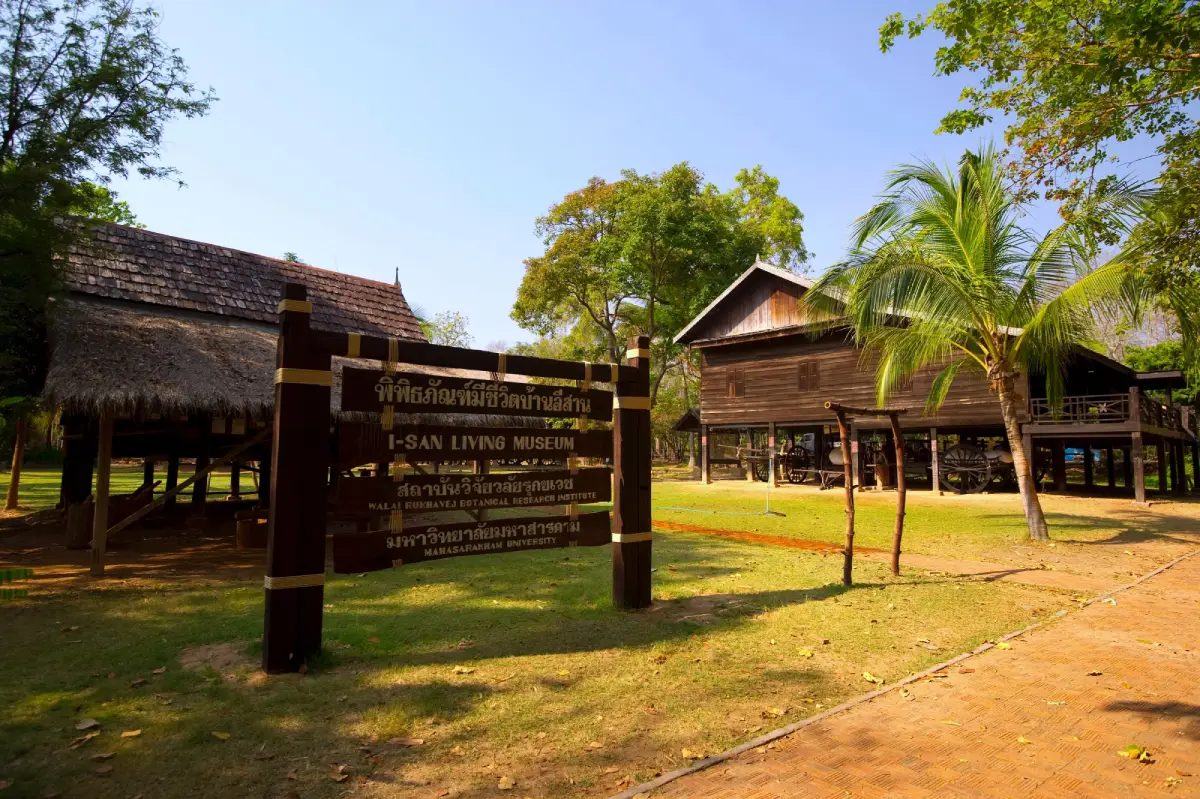
The Isan Village Museum is one of the most distinctive highlights of Walai Rukhavej Botanical Research Institute. It collects and presents the living conditions, social structure, and cultural landscape of Isan communities. The area includes an Isan village zone, cart house, field hut, rice field plot, haystack, outdoor performance space, and local-style accommodation areas within the village setting. Walking through this space gives visitors a much clearer understanding of rural Isan life than reading a short description from a guidebook.
The traditional Isan houses displayed in the museum are more than old wooden structures. Their forms reflect family systems, kinship, economy, belief, religion, climate adaptation, and village organization. Raised floors, shaded spaces under the house, natural materials, and the relationship between the house and the rice field all show how Isan people adapted to heat, seasonal rain, available resources, and community life.
Inside different houses and exhibition areas, visitors can learn about specific aspects of Isan life, such as Phu Thai houses, fishing culture, Isan music, animal-trap tools, woven textiles, and household objects. These zones show that Isan culture is diverse in ethnicity, occupation, craft knowledge, music, clothing, food, and belief. The museum therefore works as a living cultural classroom rather than a static display.
The Isan cart museum helps visitors understand transportation and rural economy in the past. Before paved roads and motor vehicles became common, carts were essential for moving rice, firewood, goods, and household items between villages and markets. Seeing carts in the museum helps visitors imagine an earlier period when travel required animal labor, dirt roads, patience, and cooperation within the community.
The field hut, rice field plot, and haystack areas show the close connection between houses and rice farming. In Isan culture, a rice field is not merely a place of production. It is a space of labor, family memory, seasonal hope, and ritual meaning. A field hut provides shade, rest, food, and shelter during farming work. A haystack recalls the harvest season. These displays help visitors understand agriculture as a foundation of Isan cultural identity.
The outdoor performance area adds an artistic dimension to the museum. Isan life includes music, dance, storytelling, folk performances, rituals, and seasonal celebrations. An open-air performance zone allows the institute to support cultural activities, learning events, student programs, and group visits in a way that connects knowledge with experience.
The value of Walai Rukhavej Botanical Research Institute lies in the balance between science and local wisdom. On one side, the institute conducts research and supports plant conservation. On the other side, it does not separate plants from human life. It presents how communities use bamboo, medicinal herbs, house-building materials, woven textiles, food plants, ritual plants, and local tools. This connection makes the place deeper than a typical botanical garden.
Visitors interested in the environment can gain a great deal from exploring the grounds. The institute helps explain the importance of native plants, plant genetic resources, and biodiversity conservation in Isan. Although the region is often described as dry, it actually contains many ecological micro-landscapes and plant species adapted to local conditions. Visiting the institute helps shift the image of Isan from dryness to diversity, resilience, and local ecological knowledge.
For students, the institute works well as an outdoor classroom. Subjects such as plants, herbs, ecosystems, local culture, rural society, and community history can be learned through real objects and landscapes. Teachers can use the Isan Village Museum as a base for comparing past and present ways of life, analyzing social change, and understanding the relationship between humans and nature.
For general travelers, Walai Rukhavej Botanical Research Institute is best experienced slowly. Visitors should allow at least 1 to 2 hours to walk through the bamboo park, herbal garden, natural museum, and Isan Village Museum. Each zone has its own story, from plant conservation to traditional houses, rice farming, and everyday tools of Isan communities.
The institute is also ideal for a learning route combined with Phra That Na Dun and Champa Si Museum. These three nearby places complement one another: Phra That Na Dun represents Buddhist faith, Champa Si Museum explains ancient history and archaeology, and Walai Rukhavej Botanical Research Institute presents nature and community culture. Together, they make Na Dun one of the most complete cultural learning areas in Maha Sarakham.
For international visitors, the institute can be described as a botanical research institute and Isan living museum near Phra That Na Dun. Its distinctive feature is that it is not limited to an indoor museum. It brings together Isan houses, traditional ecology, herbal plants, farming landscapes, village tools, and cultural practices in an open learning environment. Visitors interested in local culture, vernacular architecture, traditional ecological knowledge, and Thai biodiversity will find it especially valuable.
The Isan Village Museum makes the concept of local wisdom easier to understand. Local wisdom is not an abstract phrase; it appears in the way houses are built, the way bamboo is used, the way herbs are selected, the way tools are placed, the way rice is grown, and the way knowledge is passed through families. Walking through the museum allows visitors to see how local knowledge developed through long experience with nature.
Preserving Isan houses and traditional tools is increasingly important as rural communities change. Many old wooden houses have been replaced by concrete homes. Traditional farming tools have been replaced by machines. Lifestyles once closely tied to forest, field, and family labor have changed with the modern economy. The Isan Village Museum therefore preserves community memory for younger generations and future researchers.
For photography, the institute offers many distinctive angles: raised wooden Isan houses, bamboo groves, green areas, field huts, rice plots, haystacks, and traditional carts. Visitors should photograph respectfully, avoid climbing restricted structures, avoid touching displays unnecessarily, and not disturb staff, students, or other visitors who are learning in the area.
The best times to visit are in the morning or late afternoon, when the weather is more comfortable and the light is suitable for walking and photography. During the rainy season and after rainfall, the greenery becomes especially fresh. The cool season is also pleasant for exploring the open-air museum and herbal areas.
Visitors should prepare comfortable walking shoes, drinking water, a hat or umbrella, and a camera. Study groups should contact the institute or Na Dun operating station in advance to receive proper guidance on visiting, activities, and suitable timing. Advance contact is useful because it helps confirm the latest visitor information, available areas, and any special activities.
Getting There is easiest by private car. Visitors can use the same route as the journey to Phra That Na Dun. From Maha Sarakham city, travel through Kae Dam and Wapi Pathum toward Na Dun District. Near Phra Borommathat Na Dun, the institute is located along the entrance route before reaching the stupa area. Visitors unfamiliar with the route should use an online map together with local directions.
From Maha Sarakham city, the distance is similar to the route to Phra That Na Dun and normally takes about 1 to 1.5 hours depending on the starting point and traffic. A one-day itinerary can include Phra That Na Dun, Champa Si Museum, Walai Rukhavej Botanical Research Institute, Ku Santarat, and Ku Noi. This route combines Buddhism, archaeology, biodiversity, rural culture, and local history in one trip.
Restaurants, cafés, and accommodations around Na Dun have become more available. Visitors can dine near Phra That Na Dun or in Na Dun town and stay in local resorts or accommodations near the stupa. During long weekends or the annual Phra That Na Dun worship festival, advance accommodation booking is recommended because many visitors travel to the area.
Overall, Walai Rukhavej Botanical Research Institute in Maha Sarakham is a valuable destination for anyone who wants to understand Isan more deeply. It brings together plant research, biodiversity, medicinal herbs, natural history, Isan houses, agricultural life, traditional tools, and local cultural memory in one meaningful landscape. Visitors who come with patience and curiosity will see that Isan is not only a region of relic stupas and ancient ruins, but also a region of ecological wisdom and living community heritage.
| Name | Walai Rukhavej Botanical Research Institute / Na Dun Operating Station / Isan Village Museum |
| Location | Near Phra Borommathat Na Dun, Na Dun District, Maha Sarakham Province |
| Address | Na Dun Subdistrict, Na Dun District, Maha Sarakham 44180, Thailand |
| Coordinates | 15.7140470, 103.2267224 |
| Highlights | Learning destination for plant research, biodiversity, medicinal herbs, natural history, and Isan living culture near Phra That Na Dun |
| Distinctive Features | Research, conservation, propagation, and improvement of plant varieties in northeastern Thailand, combined with a living museum of Isan culture |
| Main Areas / Zones | Bamboo Park, Herbal Garden, Natural Museum, Isan Cart Museum, Isan Village Museum, Isan Village Zone, Field Hut, Rice Field Plot, Haystack, Outdoor Performance Area, and Native Plant Learning Areas |
| Academic Value | Important learning site for plant research, biodiversity, medicinal plants, and local wisdom of the Isan region |
| Cultural Value | Presents Isan houses, traditional tools, agricultural life, folk music, woven textiles, and the relationship between local people, plants, and nature |
| Travel Information | Private car is the most convenient option. Use the same route as Phra That Na Dun; the institute is located near the entrance route before reaching the stupa area. |
| Current Status | Open as a research area, outdoor museum, nature learning site, and cultural attraction of Na Dun District |
| Open Days | Daily |
| Opening Hours | 08.00 – 17.00 / Isan Village Museum 08.00 – 16.30 |
| Fees | Free Admission |
| Facilities | Walking areas, open-air museum zones, rest pavilions, learning grounds, activity areas, green spaces, and access route to Phra That Na Dun |
| Caretaker / Related Authority | Walai Rukhavej Botanical Research Institute, Mahasarakham University, Na Dun Operating Station, directed by Assistant Professor Dr. Sudarat Thanonkaew |
| Contact Number | Walai Rukhavej Botanical Research Institute, Tel. 043-719-816 Tourism Information, Tel. 043-797-048, 043-723-539 |
| Official Website / Official Page | Walai Rukhavej Botanical Research Institute, Mahasarakham University, and Na Dun Operating Station |
| Nearby Tourist Attractions | 1. Phra Borommathat Na Dun, about 1 km 2. Champa Si Museum, about 2 km 3. Phan Pi Champa Si Nakhon Community Market, about 2 km 4. Nakhon Champa Si Archaeological Area, about 3 km 5. Ku Santarat, about 7 km 6. Ku Noi, about 8 km 7. Wat Pa Kung or Wat Prachakhom Wanaram, about 35 km 8. Kae Dam Wooden Bridge, about 45 km |
| Nearby Restaurants | 1. Chang Thong Kham Elephant Dung Coffee, about 2 km, Tel. 093-686-9016, 080-604-2879 2. Krua Na Dun, about 3 km, Tel. 093-475-7855 3. Cafe Phak Lang Ban & Ja-O Beauty Hair, about 4 km, Tel. 092-105-1999 4. Lo Don Non Na Cafe, about 5 km, Tel. 092-489-3008 5. 4 NAKA CAFE 2465, about 5 km, Tel. 089-518-7526 6. Thung Dok Chan Cafe, about 10 km, Tel. 064-954-1598 |
| Nearby Accommodations | 1. Inaka Resort, about 5 km, Tel. 089-518-7526 2. INAKA Pool Villa, about 5 km, Tel. 082-935-4598, 083-369-0694 3. Lo Don Non Na Resort, about 5 km, Tel. 092-489-3008 4. Lookkaew Resort Na Dun Branch, about 7 km, Tel. 043-020-442 5. Piang Fah Resort Na Dun, about 8 km, Tel. 081-617-1213, 043-797-051 6. Top Inn Hotel Maha Sarakham, about 65 km, Tel. 043-711-979 |
Frequently Asked Questions (FAQ)
Q: Where is Walai Rukhavej Botanical Research Institute located?
A: The Na Dun operating station of Walai Rukhavej Botanical Research Institute is located near Phra Borommathat Na Dun in Na Dun District, Maha Sarakham Province.
Q: Why is Walai Rukhavej Botanical Research Institute important?
A: It is an important learning site for plant research, conservation, propagation, biodiversity, medicinal plants, and Isan cultural heritage through the Isan Village Museum.
Q: What are the opening hours?
A: The institute is generally open daily from 08.00 to 17.00, while the Isan Village Museum is open from 08.00 to 16.30.
Q: Is there an admission fee?
A: Admission is free, making it suitable for general visitors, students, study groups, and cultural travelers.
Q: What can visitors see inside the institute?
A: Visitors can see the Bamboo Park, Herbal Garden, Natural Museum, Isan Cart Museum, Isan Village Museum, traditional houses, field hut, rice field plot, haystack, and outdoor performance area.
Q: Is the institute suitable for foreign travelers?
A: Yes. It is suitable for foreign travelers interested in Isan culture, traditional houses, medicinal plants, biodiversity, and Thai rural life.
Q: How can travelers get there?
A: Private car is the most convenient option. Use the same route as Phra That Na Dun; the institute is located near the entrance route before reaching the stupa area.
Q: What nearby places can travelers visit after the institute?
A: Travelers can continue to Phra Borommathat Na Dun, Champa Si Museum, Phan Pi Champa Si Nakhon Community Market, Ku Santarat, Ku Noi, Wat Pa Kung, and Kae Dam Wooden Bridge.
Tel : 043797048
 Tel : 043797048
 Category: ●Research and Development
 Group: ●Royal Project
Last Update : 2 MonthAgo
 Last Update : 2 MonthAgo
 Click to Access the Navigation Map GPS
Walai Rukhavej Botanical Research Institute Map

 Art, Culture and Heritage
 Historical Sites and Monuments(4)
 Art, Craft Centres, Tradition(5)
 Museums(3)
 Places of Worship
 Temple(17)
 Other Sacred Sites(7)
Royal Project(2)
Other Sacred Sites(7)
Royal Project(2)
 Suburban Living
 Village, Community(5)
 Nature and Wildlife
 National Parks and Marine Reserves(3)
 Dam, Reservoir, Lake(10)
 River, Canal(2)
 Bays and Beaches(2)
 Other natural attractions(2)
 Entertainment and Agricultural
 Farms, Parks and Ecotourism(3)
 Travel Articles, Recipes
 Food Menu, Northeastern Recipes(1)


