
lovethailand home >Northeastern Travel Attractions >Maha Sarakham Travel Attractions >Muang Maha Sarakham >Khe Wa > Ku Mahathat (Prang Ku Ban Khwa)
TL;DR: Ku Mahathat (Prang Ku Ban Khwa) is located at Ban Khwa, Khwa Subdistrict, Mueang Maha Sarakham District, Maha Sarakham Province, open Daily, hours 08.00 – 17.00.
Ku Mahathat (Prang Ku Ban Khwa)
Open Days: Daily
Opening Hours: 08.00 – 17.00
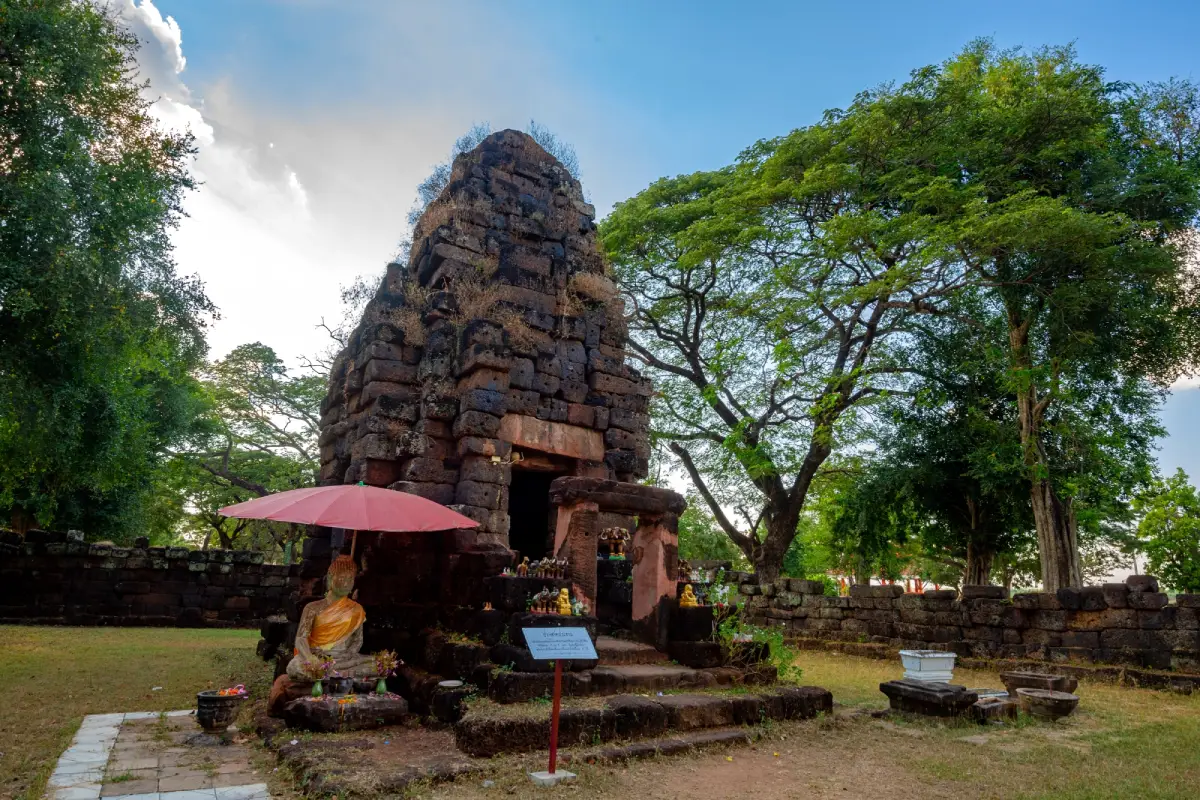
Ku Mahathat (Prang Ku Ban Khwa) in Maha Sarakham Province is one of the most important ancient Khmer-style archaeological sites in Ban Khwa, Khwa Subdistrict, Mueang Maha Sarakham District. Located about 13 km from Maha Sarakham city along Chaeng Sanit Road, also known as Highway 208 on the Maha Sarakham–Roi Et route, this laterite sanctuary preserves the layout of an ancient arokayasala, or hospital chapel, associated with the reign of King Jayavarman VII. The site is open daily and has no admission fee, making it a highly accessible cultural stop for travelers interested in Khmer architecture, Mahayana Buddhism, ancient healthcare beliefs, and the historical landscape of northeastern Thailand.
Ku Mahathat is not simply a small ruin in a rural community. It is a compact but meaningful heritage site that connects architecture, religion, medicine, local belief, and community memory. The sanctuary stands in Ban Khwa, a community area connected with natural water sources and agricultural settlement. Around the monument, the landscape remains calm and local in character, allowing visitors to experience the site at a slow and thoughtful pace. From the entrance, travelers can see the main laterite prang standing at the center of the sacred compound, surrounded by a laterite enclosure wall. The plan includes the main sanctuary, a gopura or entrance pavilion, a library building, a sacred pond, and surrounding open space that reflects the standard layout of a Khmer hospital chapel.
The historical importance of Ku Mahathat is closely linked to the arokayasala system created during the reign of King Jayavarman VII of the Khmer Empire. These hospital chapels were built as part of a network of healthcare and religious institutions across the empire. In this context, an arokayasala was not only a place for physical healing; it was also a sacred space where medical care, ritual practice, Buddhist belief, and royal authority came together. Each hospital site normally had a religious structure connected with Mahayana Buddhist ideas, especially the worship of Bhaisajyaguru, the Medicine Buddha. This makes Ku Mahathat an important place for understanding how ancient societies connected healing with faith.
The main prang at Ku Mahathat is constructed mainly from laterite and follows the Bayon style of Khmer art. It has a square, tapering form often described in Thai sources as a four-sided pavilion-like tower. The structure is approximately 4 wa high from ground level to the top and about 2 wa 2 sok wide. Its orientation is significant: the main entrance faces east, while the other three sides contain false doorways. This east-facing plan is typical of many Khmer religious monuments, where the direction of entry marks the symbolic movement from the outer world into a sacred interior. Sandstone was used for important architectural elements such as doorframes and lintels, while laterite formed the main body of the structure.
Inside and around the sanctuary, important sacred objects have been recorded, including two seated images with hands joined in reverence and holding a conch. These images relate to the healing symbolism of Bhaisajyaguru, the Medicine Buddha in Mahayana Buddhism. The connection is especially meaningful because Ku Mahathat belonged to the arokayasala tradition. The Medicine Buddha represents compassion, healing, and relief from suffering, and his presence in a hospital chapel reflects the way religious belief was integrated into ancient medical practice. For foreign travelers, this point is essential: Ku Mahathat should not be seen only as a Khmer ruin, but as a sacred site connected with the idea of healing the body and mind.
The laterite enclosure wall at Ku Mahathat defines the sacred precinct and separates the inner ritual space from the outside landscape. The entrance pavilion, or gopura, is placed on the eastern side and provides the only main access into the compound. Walking through this entrance gives visitors a clear view of the main prang rising at the center. Although parts of the gopura and wall have naturally weathered over time, the overall layout remains easy to understand. The structure helps visitors visualize how the sanctuary once functioned as a controlled sacred space where ritual, devotion, and healing practices were performed.
The library building, or bannalai, stands in the southeastern part of the enclosure. In Khmer religious architecture, this type of building is often interpreted as a ritual support structure or a place associated with sacred texts and objects. At Ku Mahathat, the library is made of laterite and has a rectangular plan. It faces west, toward the main sanctuary, and forms an important part of the overall sacred layout. Even though only parts of the structure remain, it helps complete the architectural reading of the site and shows that the monument followed a carefully organized design rather than being an isolated tower.
Another important element is the pond located outside the enclosure wall on the northeastern side. Water played a meaningful role in ancient sacred landscapes. It was practical for daily use, but it also carried ritual associations with purification, healing, and sacred order. For an arokayasala, the presence of water was especially relevant because the site was connected with health and care. When visitors look at Ku Mahathat together with the surrounding water landscape of Ban Khwa and Nong Krathum, the monument becomes part of a broader cultural landscape rather than a stand-alone archaeological ruin.
Ku Mahathat has been registered as a national ancient monument and has been excavated and restored by the Fine Arts Department. Archaeological work has revealed significant evidence, including Khmer inscriptions, Sanskrit inscriptions, silver-covered Buddha images, pottery, architectural fragments, and remains that indicate the site continued to hold religious meaning across different historical periods. The monument therefore represents more than one era. It reflects Khmer influence during the Bayon period, later religious memory in the local community, and continuing respect for sacred heritage in present-day Maha Sarakham.
The name of the site also carries local meaning. The word “ku” is commonly used in northeastern Thailand for ancient sanctuaries or stone religious structures associated with Khmer culture. The name Ban Khwa is linked with local community memory, which tells of khwa trees that once grew in abundance in the area. Over time, the sanctuary became known by several related names, including Ku Ban Khwa, Prang Ku Ban Khwa, Prang Ku Don Du, Prang Du Mahathat, and Ku Mahathat. These different names show how the place has been remembered by local people across generations.
The atmosphere of Ku Mahathat is quiet and modest, which makes it different from larger and more crowded Khmer temple sites. Visitors can walk slowly around the monument, observe the texture of the laterite blocks, study the enclosure wall, and see how the main sanctuary, gopura, library, and pond relate to one another. The site is not large, but it is intellectually rich. It is ideal for travelers who prefer meaningful cultural places over heavily commercialized attractions. For students, photographers, history enthusiasts, and visitors interested in lesser-known destinations in Isan, Ku Mahathat offers a concise but powerful introduction to ancient Khmer heritage in Maha Sarakham.
For travelers interested in Buddhism, Ku Mahathat is particularly valuable because it reflects the presence of Mahayana Buddhist belief in the region. The association with the Medicine Buddha and the arokayasala system shows how religious structures were once connected to healthcare, compassion, and the well-being of ordinary people. This connection gives the site a strong human dimension. It was not only a symbolic monument of royal power, but also part of a network intended to support healing and public welfare. Understanding this background makes a visit to Ku Mahathat far more meaningful than a simple stop to photograph ancient stones.
Ban Khwa community also plays an important role in keeping the meaning of the site alive. The community has long been associated with agriculture, water sources, local settlement, and cultural memory. Ku Mahathat stands as a cultural asset for the community, a sacred place for local respect, and a landmark that connects the present village with a much older historical landscape. The site is therefore not detached from everyday life. It continues to exist within a living community where heritage, memory, and local identity remain closely connected.
Each year, local authorities and the community organize the ceremony of paying respect to and pouring water over Prang Ku Ban Khwa. This annual tradition links the ancient monument with contemporary spiritual life. The ceremony expresses respect for the sacred site and reflects the belief that worship at this former arokayasala brings merit, good health, and protection from illness. For visitors, this tradition is an important reminder that Ku Mahathat is not only an archaeological site; it remains part of the living cultural rhythm of the local community.
A visit to Ku Mahathat can be completed in about 30 minutes to 1 hour, but travelers who enjoy history may want to spend more time reading the layout and observing details. The best approach is to first view the gopura from the east, then walk into the enclosure to see the main prang, move toward the southeastern library building, and then step back to observe the enclosure wall and surrounding landscape. This sequence helps visitors understand how the site was designed and why its layout matters. The monument is small enough to explore easily, yet complete enough to illustrate the basic pattern of an ancient Khmer hospital chapel.
Photography is enjoyable at Ku Mahathat because the laterite surfaces create strong visual texture. The entrance view through the gopura frames the main prang beautifully, while side angles reveal the relationship between the enclosure wall, the library building, and the central tower. Morning and late afternoon light are particularly suitable because the light is softer and brings out the warm tone of the laterite blocks. Visitors should avoid climbing on the monument, touching fragile stone elements, or moving any archaeological fragments. Respectful behavior helps protect the site for future generations.
Getting There from Maha Sarakham city is straightforward. Follow Chaeng Sanit Road or Highway 208 on the Maha Sarakham–Roi Et route toward Khwa Subdistrict. The distance is about 13 km, and the journey usually takes around 20 minutes by car depending on traffic. Private cars, rental cars, and local hired vehicles are the most convenient options. Travelers using local transport should tell the driver they are going to Ku Mahathat or Prang Ku Ban Khwa in Ban Khwa. Daytime visits are recommended because the architectural details are easier to see and the surrounding village area is more convenient to navigate.
Visitors should dress respectfully, keep the area clean, and treat the site as a sacred ancient monument. Do not climb on the laterite structures, write on the stones, remove fragments, or step on unstable surfaces. Although the site is open and easy to access, it remains a protected national heritage place. Families traveling with children or elderly visitors should take care around uneven ground, stone edges, and raised areas near the enclosure wall. A respectful visit ensures that the monument remains safe, meaningful, and accessible for future travelers.
For travelers staying overnight, Maha Sarakham city is the most practical base. The city has hotels, restaurants, convenience stores, and transport services, while Ku Mahathat is close enough for an easy half-day excursion. After visiting the monument, travelers can continue to nearby attractions such as Ku Noi Ban Khwa, Wat Nong Hu Ling, Wat Pa Wang Nam Yen, Ka Dam Wooden Bridge, and Kaeng Loeng Chan. This route works well for cultural travelers, families, photographers, and anyone who wants to combine ancient heritage with local sightseeing in Mueang Maha Sarakham District.
What makes Ku Mahathat special is the density of historical meaning within a small site. Within one compact compound, visitors can learn about Khmer architecture, Bayon-period art, the arokayasala healthcare network, the Medicine Buddha, laterite construction, local settlement, sacred water symbolism, heritage conservation, and living community traditions. This makes Ku Mahathat one of the most rewarding cultural attractions in Maha Sarakham for travelers who want to understand the province beyond its modern urban and educational identity. It shows that Maha Sarakham has deep historical roots connected to ancient regional networks.
Ku Mahathat deserves a place in any thoughtful Maha Sarakham itinerary. It is easy to reach, free to visit, and rich in cultural value. The sanctuary may not be large, but its meaning extends across history, religion, medicine, architecture, and community life. A walk around the laterite prang of Ban Khwa is a journey into the world of ancient healing, Mahayana devotion, Khmer artistic influence, and local Isan heritage. For foreign travelers seeking a quieter and more authentic historical destination in northeastern Thailand, Ku Mahathat is a site worth visiting with patience, curiosity, and respect.
| Name | Ku Mahathat (Prang Ku Ban Khwa) |
| Other Names | Ku Ban Khwa, Prang Ku Ban Khwa, Prang Ku Don Du, Prang Du Mahathat, Ku Mahathat Mueang Yang Thit Nak |
| Location | Ban Khwa, Khwa Subdistrict, Mueang Maha Sarakham District, Maha Sarakham Province |
| Address | Moo 17, Maha Sarakham–Roi Et Road, Khwa Subdistrict, Mueang Maha Sarakham District, Maha Sarakham 44000, Thailand |
| Coordinates | 16.158225 N, 103.417367 E |
| Highlights | Laterite Khmer sanctuary in Bayon style and one of the ancient arokayasala hospital chapels associated with King Jayavarman VII |
| History | Dating to around the 18th Buddhist century, related to Khmer Bayon-period culture and the Mahayana Buddhist hospital chapel system |
| Name Origin | “Ku” is a local Isan term often used for ancient Khmer-style sanctuaries, while Ban Khwa refers to the local community name connected with khwa trees once abundant in the area |
| Distinctive Features | Square laterite prang with an east-facing entrance, false doors on the other three sides, sandstone doorframes and lintels, laterite enclosure wall, gopura, library building, and sacred pond |
| Key Evidence | Seated sacred images with joined hands and conch, Khmer inscriptions, Sanskrit inscriptions, silver-covered Buddha images, pottery, architectural fragments, and Fine Arts Department restoration traces |
| Main Areas / Zones | 1. Main Prang 2. Eastern Gopura 3. Laterite Enclosure Wall 4. Southeastern Library Building 5. Northeastern Pond 6. Nong Krathum Rest Area |
| Local Tradition | Annual ceremony of paying respect to and pouring water over Prang Ku Ban Khwa, connected with local faith, good health, and the memory of the ancient hospital chapel |
| Travel Information | From Maha Sarakham city, follow Chaeng Sanit Road or Highway 208 on the Maha Sarakham–Roi Et route for about 13 km to Ban Khwa. Private car, rental car, or local hired transport is recommended. |
| Current Status | Open to visitors as a restored archaeological site and cultural attraction of Khwa Subdistrict |
| Open Days | Daily |
| Opening Hours | 08.00 – 17.00 |
| Fees | No admission fee |
| Facilities | Walking area around the ancient monument, rest area near Nong Krathum, and surrounding community space suitable for a short cultural visit |
| Caretaker | Khwa Subdistrict Administrative Organization and the Fine Arts Department |
| Main Contact Number | Khwa Subdistrict Administrative Organization, Tel. 043-029501 |
| Nearby Tourist Attractions | 1. Ku Noi Ban Khwa, about 1 km 2. Wat Nong Hu Ling, about 6 km 3. Wat Pa Wang Nam Yen, about 13 km 4. Ka Dam Wooden Bridge, about 15 km 5. Kaeng Loeng Chan, about 15 km |
| Nearby Restaurants | 1. Farmsook Cafe Maha Sarakham, about 8 km, Tel. 064-9966414 2. Jan Ngoen Restaurant, about 13 km, Tel. 043-722415 3. Tong Kai Yang Restaurant, about 14 km, Tel. 063-2264905 4. Tawan Ok Chiang Nuea Restaurant, about 15 km, Tel. 061-4232546 5. Rim Chon Kung Phao, about 18 km, Tel. 061-1541394 |
| Nearby Accommodations | 1. Debua Mahasarakham, about 14 km, Tel. 043-020191 2. Debua White House, about 15 km, Tel. 043-020255 3. Taksila Hotel, about 15 km, Tel. 043-719999 4. Topinn Hotel, about 14 km, Tel. 043-711979 5. Ketsara Hotel, about 15 km, Tel. 095-2362395 |
Frequently Asked Questions (FAQ)
Q: Where is Ku Mahathat (Prang Ku Ban Khwa) located?
A: It is located in Ban Khwa, Khwa Subdistrict, Mueang Maha Sarakham District, Maha Sarakham Province, about 13 km from Maha Sarakham city along Highway 208.
Q: Why is Ku Mahathat important?
A: Ku Mahathat is a Bayon-style Khmer laterite sanctuary and one of the ancient arokayasala hospital chapels associated with King Jayavarman VII, reflecting the link between Mahayana Buddhism, healing, and Khmer architecture.
Q: What are the opening days and hours of Ku Mahathat?
A: The site is open daily from 08.00 to 17.00.
Q: Is there an admission fee for Ku Mahathat?
A: No. Visitors can enter Ku Mahathat without an admission fee.
Q: What should visitors see inside Ku Mahathat?
A: Key features include the main laterite prang, eastern gopura, enclosure wall, southeastern library building, sacred pond, and the overall arokayasala layout.
Q: How can travelers get to Ku Mahathat from Maha Sarakham city?
A: Follow Chaeng Sanit Road or Highway 208 on the Maha Sarakham–Roi Et route for about 13 km to Ban Khwa. Private cars, rental cars, and local hired transport are the most convenient options.
Q: Is there an annual tradition connected with Ku Mahathat?
A: Yes. The local community holds an annual ceremony to pay respect to and pour water over Prang Ku Ban Khwa, reflecting local faith, good health, and respect for the ancient hospital chapel.
Q: What nearby attractions can be included in the same trip?
A: Travelers can combine the visit with Ku Noi Ban Khwa, Wat Nong Hu Ling, Wat Pa Wang Nam Yen, Ka Dam Wooden Bridge, and Kaeng Loeng Chan.
 Category: ●Art, Culture and Heritage
 Group: ●Historical Sites and Monuments
Last Update : 2 MonthAgo
 Last Update : 2 MonthAgo
 Click to Access the Navigation Map GPS
Ku Mahathat (Prang Ku Ban Khwa) Map
 Historical Sites and Monuments(4)
 Art, Craft Centres, Tradition(5)
 Museums(3)
 Places of Worship
 Temple(17)
 Other Sacred Sites(7)
 Research and Development
 Royal Project(2)
 Suburban Living
 Village, Community(5)
 Nature and Wildlife
 National Parks and Marine Reserves(3)
 Dam, Reservoir, Lake(10)
 River, Canal(2)
 Bays and Beaches(2)
 Other natural attractions(2)
 Entertainment and Agricultural
 Farms, Parks and Ecotourism(3)
 Travel Articles, Recipes
 Food Menu, Northeastern Recipes(1)


