
lovethailand home >Northeastern Travel Attractions >Loei Travel Attractions >Erawan >Sap Phai Wan > Wat Tham Khao San Hin
TL;DR: Wat Tham Khao San Hin is located at Mu 4, Ban Pha Sana, Sap Phai Wan Subdistrict, Erawan District, Loei Province, open Daily, hours 08.00 – 17.00.
Wat Tham Khao San Hin
Open Days: Daily
Opening Hours: 08.00 – 17.00
Wat Tham Khao San Hin in Loei Province is a mountain cave temple located in Mu 4, Ban Pha Sana, Sap Phai Wan Subdistrict, Erawan District. The temple is set among complex mountain ranges, steep cliffs, rubber plantations, forested slopes, and many natural cave chambers. Its most distinctive feature is a large cave about 300 meters long, containing several smaller cave sections, beautiful stalactites, rock formations, and countless small stone-like particles resembling grains of rice. These particles are locally known as “khao san hin”, or stone rice grains, giving the temple its name. For foreign travelers, the temple offers a meaningful combination of Buddhist worship, forest-temple atmosphere, cave exploration, natural scenery, and a quiet local setting in Erawan District.
Wat Tham Khao San Hin began as a monastic residence in 1998. It was officially permitted to be established as a temple in 2015 and became a recognized Buddhist temple in 2016. The temple belongs to the Dhammayut Nikaya Buddhist order and has long served as a spiritual center for Ban Pha Sana community. It is also a place for meditation, forest practice, and seclusion for monks who follow the Thai forest tradition. Visitors therefore encounter not only a cave attraction but also a living Buddhist site where faith, silence, and natural surroundings remain closely connected.
The temple covers more than 24 rai of land and is surrounded by rubber plantations and large mountains. The front area borders local rubber plantations, while the side of the temple connects with mountain terrain. Behind the temple are lodging areas for lay supporters and visitors who join religious activities. This landscape makes Wat Tham Khao San Hin very different from a city temple. It has the feeling of a forest temple, a cave temple, and a rural community temple at the same time.
The name Khao San Hin comes from the small stone-like grains found in the cave area. They look similar to grains of rice, and local people refer to them as stone rice grains. This unusual feature gives the temple a distinctive identity among cave temples in Loei Province. Visitors should view them respectfully and should not collect, move, or remove them from the cave. They are part of the natural and local heritage of the site.
The large cave at Wat Tham Khao San Hin is about 300 meters long. Inside, there are many smaller chambers and passages, creating the feeling of walking through several natural rooms within the mountain. Some areas are wider and more open, while others are narrower, darker, and more enclosed. Stalactites hang from the ceiling, stalagmites rise from the floor, and limestone surfaces form patterns shaped by water and minerals over a long period of time. This makes the cave a valuable natural feature as well as a place of religious significance.
The stalactites and other cave formations should be treated with great care. They form slowly as mineral-rich water passes through limestone and deposits minerals layer by layer. Touching them, writing on cave walls, breaking rock surfaces, or removing natural objects can damage formations that took centuries to develop. Responsible visitors should stay on suitable paths, use flashlights carefully, avoid touching the cave walls, and take all rubbish back out of the site.
The route up toward the cave begins from the temple area and monastic zone. This gives the visit the feeling of a gradual journey from the lower temple ground into a quiet mountain space. The cave is not only a place for sightseeing. It has been used by monks for forest practice, meditation, and seclusion. The cool air, dim light, and natural silence of the cave make it suitable for spiritual reflection. Visitors should therefore keep their voices low, avoid playing music, and respect areas used by monks for practice.
Within the temple compound are several religious facilities, including multi-purpose halls, kitchen and food-service areas, monks’ residences, lodging areas for lay supporters, and the Phra Phuttha Metta Maharaj building, associated with the large Buddha image. These facilities show that the temple functions as a real religious community, not merely a tourist stop. Local people and lay supporters come here for merit-making, meditation, ceremonies, and support of temple activities.
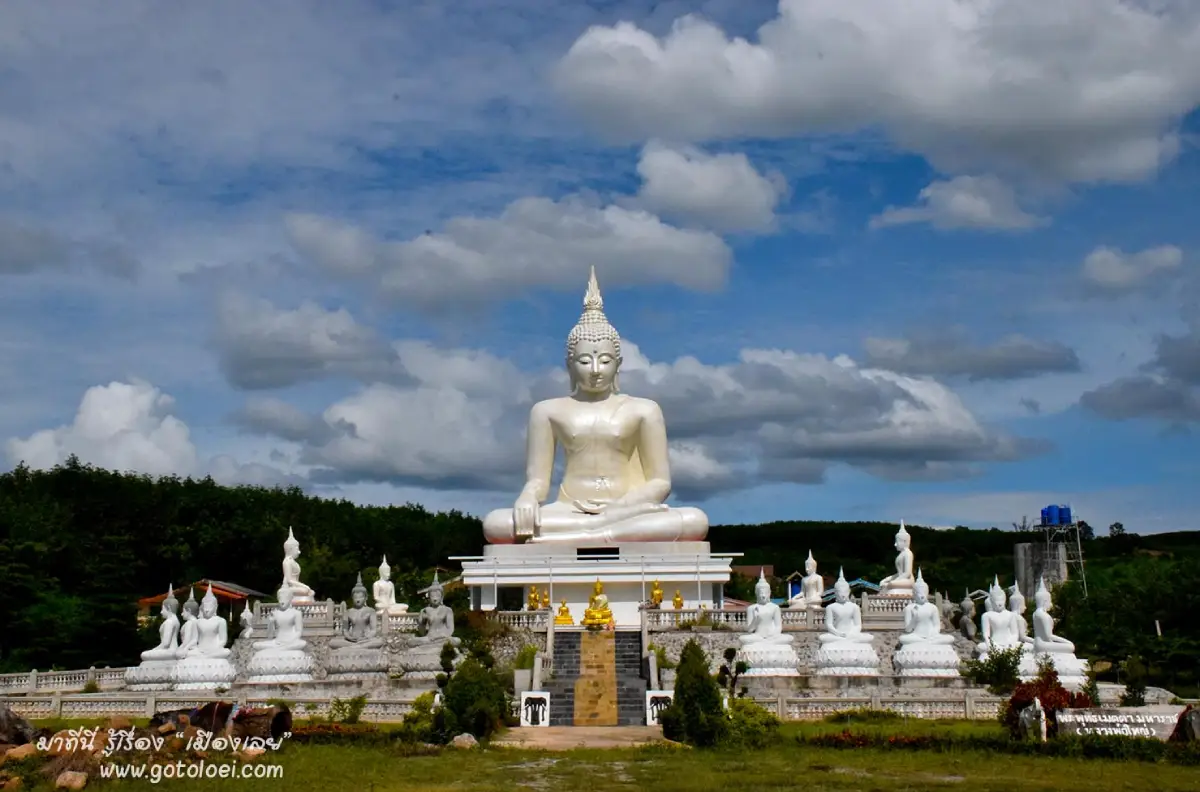
The large Buddha image known as Phra Phuttha Metta Maharaj is one of the visual highlights of the temple. Set against the natural mountain and plantation landscape, the image creates a strong sense of serenity and devotion. Visitors often pay respect here before or after exploring the cave. The combination of the large Buddha image, the forest atmosphere, and the cave setting gives the temple a balanced character of worship and nature.
The surrounding landscape is defined by high mountains, steep cliffs, rubber plantations, and rural roads. The temple is located away from the main road, and some access sections are winding. This remoteness is part of the temple’s appeal. As visitors approach the temple, the scenery gradually becomes quieter and greener, creating the feeling of leaving behind busy areas and entering a place of calm. Drivers should travel carefully, especially during rain or late afternoon.
Getting There is most convenient by private car or rental car. From Erawan District, travel toward Sap Phai Wan Subdistrict and Ban Pha Sana. The route can be accessed via Highway 2400, the Erawan – Nong Hin route, then Road 3334, and Road 4001 on the Nong Hin – Wang Saphung route before turning toward the temple. Online maps can also be used by searching for “Wat Tham Khao San Hin, Erawan, Loei” or using the location code 5XG8+H5M in Sap Phai Wan Subdistrict.
The temple is about 4 km from the Sap Phai Wan community learning center. The final approach passes through local roads and rural scenery. Visitors should allow enough travel time and avoid rushing, especially if they plan to explore the cave. After arriving, begin with the lower temple area, pay respect to the Buddha image, and then continue toward the cave area according to personal readiness and safety conditions.
Wat Tham Khao San Hin is also linked in local tourism narratives with the Khuha Wari cave system on the other side of the mountain. The large cave route is described as being able to pass through the mountain toward the Khao San Hin cave area. This connection makes the landscape between Erawan and Wang Saphung districts especially interesting for travelers who enjoy caves and community-based nature routes. However, any deep cave route or mountain-through passage should be explored only with local guidance and proper equipment.
Visitors who plan to enter the cave should prepare carefully. Non-slip shoes, drinking water, modest and comfortable clothing, a flashlight or headlamp, and a small bag for carrying rubbish back out are recommended. Some cave areas may be uneven, damp, dark, or narrow. Good preparation makes the visit safer and helps protect the cave environment. Travelers should not enter deeper sections alone or without someone familiar with the area.
The best time to visit is from morning to afternoon, when there is enough daylight for the temple grounds, mountain area, and cave entrance. Morning is suitable for worship and a calmer visit, while late afternoon is good for photography around the temple and mountain scenery. Visitors should avoid entering caves or climbing mountain areas close to dark. During the rainy season, the forest becomes greener, but paths may become slippery. The cool season is generally the most comfortable time for walking and cave viewing.
Temple and cave etiquette are both important at Wat Tham Khao San Hin. Visitors should dress modestly, speak quietly, avoid littering, avoid touching stalactites and cave walls, and never remove stone rice grains or other natural objects. Writing on cave walls, damaging rock formations, or entering monks’ practice areas without permission is inappropriate. A respectful visit protects both the sacred character of the temple and the fragile natural environment of the cave.
For photographers, the temple offers several strong visual subjects: the religious buildings among rubber plantations, the mountain backdrop, the large Buddha image, the cave entrance, the interior chambers, stalactites, and the detailed texture of the stone rice grains. Photographs should be taken without disturbing worshippers or monks. Inside the cave, flash and artificial lighting should be used with care, and no photograph should require touching, moving, or damaging natural formations.
From an educational perspective, Wat Tham Khao San Hin is suitable for travelers interested in nature, local geology, forest temples, cave heritage, and Thai Buddhist practice. The cave and mountain setting helps explain why quiet places away from settlements are often chosen for meditation and forest practice. Seeing the cave, rock formations, and stone rice grains in their natural context gives visitors a clearer understanding of the relationship between Buddhist sites and natural landscapes in rural Loei.
The temple can be combined with other attractions in Erawan District and nearby areas. Nearby places include Wat Tham Khao San, Wat Pa Sap Phaiwan Santitham or Wat Pha Chang Mong, Wat Pa Thep Nimit, Wat Pa Pha Sam Yot Pha Sukaram, Rai Phoem Phun Sap Agricultural Farm, Phanang Cafe, and Erawan Cave. With more time, travelers can continue toward Suan Hin Pha Ngam, known as the Kunming of Loei, or connect with community cave routes around Khuha Wari in Wang Saphung District.
A half-day itinerary can focus on Wat Tham Khao San Hin in the morning, including worship, the temple ground, the large Buddha image, and the cave area. After that, visitors can stop for local food in Sap Phai Wan or Erawan District. A full-day route may add Rai Phoem Phun Sap Agricultural Farm, Phanang Cafe, or Erawan Cave depending on travel time. Those who prefer cave and nature experiences can plan a broader route that includes Tham Khuha Wari and the 360-degree viewpoint in Wang Saphung.
Families with children and elderly visitors should begin with the easier parts of the temple, such as the lower grounds, worship areas, and the large Buddha image. Entering deeper cave areas should be considered carefully. Children should not run near rocks, cave passages, or cliff areas. Elderly visitors should avoid slippery or steep sections if the route feels unsafe. Safety should always be more important than trying to visit every point.
Spiritually, Wat Tham Khao San Hin offers a quiet atmosphere for people who want to rest the mind. The cave is cool and silent, while the lower temple area feels open and peaceful among plantations and mountains. Even visitors who do not enter the cave deeply can still experience the calm of the forest temple by paying respect, walking slowly, and sitting quietly under the shade. This makes the temple suitable for both nature travelers and Buddhist visitors.
The temple’s development from a monastic residence to an officially recognized Buddhist temple also gives it cultural importance. Its history reflects the cooperation of monks, local villagers, temple supporters, and the wider Buddhist community. The request to use the architectural model of Wat Phra Ram 9 Kanchanaphisek for the temple’s ordination hall also shows the community’s intention to develop the temple as a proper place for monastic ceremonies and Buddhist practice.
Wat Tham Khao San Hin is therefore a distinctive cave-temple destination in Loei Province. Its high mountains, steep cliffs, 300-meter cave, smaller chambers, stalactites, stone rice grains, forest-practice setting, monastic heritage, and quiet rural surroundings make it different from ordinary temples. Visitors who come with respect for the temple, the monks, the community, and the cave environment will find a meaningful experience of faith, nature, and local wonder in Erawan District.
| Name | Wat Tham Khao San Hin |
| Location | Mu 4, Ban Pha Sana, Sap Phai Wan Subdistrict, Erawan District, Loei Province |
| Address | Wat Tham Khao San Hin, Ban Pha Sana, Mu 4, Sap Phai Wan Subdistrict, Erawan District, Loei Province 42220, Thailand |
| Coordinates | 5XG8+H5M, Sap Phai Wan Subdistrict, Erawan District, Loei Province |
| Highlights | Mountain cave temple with many caves, a large cave about 300 meters long, smaller chambers, beautiful stalactites, and numerous small stone-like grains known locally as stone rice grains |
| Distinctive Features | Complex mountain landscape, steep cliffs, natural cave system, monastic cave-practice area, Phra Phuttha Metta Maharaj or large Buddha image, and peaceful forest-temple atmosphere |
| History | Originally established as a monastic residence in 1998, permitted to be built as a temple on 12 November 2015, and officially established as a Buddhist temple on 15 August 2016 |
| Buddhist Order | Dhammayut Nikaya |
| Name Origin | The name comes from small stone-like grains found in the cave, resembling rice grains and locally called “khao san hin” |
| Key Features Inside | Large cave, smaller cave chambers, stalactites, stalagmites, stone rice grains, Phra Phuttha Metta Maharaj, multi-purpose halls, kitchen and food-service areas, monks’ residences, and meditation spaces |
| Travel Information | Use Highway 2400 on the Erawan – Nong Hin route, continue to Road 3334, then Road 4001 on the Nong Hin – Wang Saphung route before turning into the temple access road at Ban Pha Sana |
| Current Status | Active forest cave temple and local attraction in Sap Phai Wan Subdistrict for worship, merit-making, meditation, cave viewing, and nature-based relaxation |
| Open Days | Daily |
| Opening Hours | 08.00 – 17.00 |
| Facilities | Temple courtyard, multi-purpose halls, kitchen and food-service areas, monks’ residences, Phra Phuttha Metta Maharaj building, lay supporter lodging area, parking area, and cave access route |
| Main Areas / Zones | Lower temple ground, central religious buildings, Phra Phuttha Metta Maharaj area, mountain path, cave entrance, main cave, smaller cave chambers, stalactite zone, stone rice grain zone, and monks’ meditation area |
| Abbot / Caretaker | Phra Boonthom Uthayano |
| Main Contact Number | 082-851-2111 |
| Local Administrative Office | Sap Phai Wan Subdistrict Administrative Organization, Tel. 042-810-944 |
| Official Website / Official Page | Facebook page: Wat Tham Khao San Hin |
| Nearby Tourist Attractions | 1. Wat Tham Khao San, Sap Phai Wan Subdistrict, about 1 km, Tel. 093-365-9071 2. Rai Phoem Phun Sap Agricultural Farm, Ban Na Ang Kham, about 6 km, Tel. 086-008-0874 3. Wat Pa Sap Phaiwan Santitham / Wat Pha Chang Mong, about 7 km 4. Wat Pa Thep Nimit, Sap Phai Wan Subdistrict, about 8 km 5. Wat Pa Pha Sam Yot Pha Sukaram / Nam Thip, about 10 km 6. Phanang Cafe and Pha In Plaeng route, about 18 km, Tel. 062-896-5524 7. Erawan Cave, about 28 km 8. Tham Khuha Wari and 360-Degree Viewpoint, Ban Sam Nok Chip, about 42 km, Tel. 098-674-3093 |
| Nearby Restaurants | 1. Local Made-to-Order Restaurant, Lap Khom, Tom Saep and Som Tam, Sap Phai Wan Subdistrict, about 5 km 2. Krua Khun Pat (Nu Tia Sirada), Ban Mai-Sam Bun Road, about 6 km 3. Rai Phoem Phun Sap Agricultural Farm, about 6 km, Tel. 086-008-0874 4. 3 Tor Tam Nua Som Tam & Spicy Salad, about 7 km, Tel. 082-447-4735 5. Kung Tam & Yum, Sap Phai Wan Subdistrict, about 7 km 6. Phanang Cafe’ & Water Park, about 18 km, Tel. 062-896-5524 |
| Nearby Accommodations | 1. Phanang Cafe & Camping, about 18 km, Tel. 095-870-6598, 082-324-5536 2. Erawan Resort Hotel, Erawan District, about 20 km, Tel. 086-876-4667 3. Suan Lamyai Resort, about 38 km, Tel. 081-837-5458 4. The Cozy Hotel, Wang Saphung, about 39 km, Tel. 042-870-565, 095-654-8965 5. Wang Saphung In View Hotel, about 40 km, Tel. 081-505-1569 6. Tonsak Loei Resort, about 42 km, Tel. 093-546-3633 |
Frequently Asked Questions (FAQ)
Q: Where is Wat Tham Khao San Hin located?
A: Wat Tham Khao San Hin is located in Mu 4, Ban Pha Sana, Sap Phai Wan Subdistrict, Erawan District, Loei Province. It is a mountain cave temple in a quiet natural setting.
Q: What are the opening hours of Wat Tham Khao San Hin?
A: The temple is open daily from 08.00 to 17.00. Morning to afternoon is the best time for worship, cave viewing, and walking in the mountain area.
Q: What is special about Wat Tham Khao San Hin?
A: The temple is known for its high mountains, steep cliffs, a large cave about 300 meters long, smaller cave chambers, stalactites, stone rice grains, the large Buddha image, and its forest meditation atmosphere.
Q: What are stone rice grains?
A: Stone rice grains are numerous small stone-like particles found in the cave area. They resemble grains of rice and are the distinctive natural feature that gives the temple its name.
Q: Who is the abbot of Wat Tham Khao San Hin?
A: The abbot of Wat Tham Khao San Hin is Phra Boonthom Uthayano.
Q: How can travelers get to Wat Tham Khao San Hin?
A: Travelers can use Highway 2400 on the Erawan – Nong Hin route, continue to Road 3334, then Road 4001 on the Nong Hin – Wang Saphung route before turning into the temple access road at Ban Pha Sana. A private car or rental car is recommended.
Q: What should visitors prepare before entering the cave?
A: Visitors should wear non-slip shoes, dress modestly, bring drinking water, carry a flashlight or headlamp, and avoid entering deeper cave sections without someone familiar with the route.
Q: What nearby attractions can be included in the same trip?
A: Nearby attractions include Wat Tham Khao San, Rai Phoem Phun Sap Agricultural Farm, Wat Pa Sap Phaiwan Santitham, Wat Pa Thep Nimit, Phanang Cafe, Erawan Cave, and Tham Khuha Wari.
 Category: ●Places of Worship
 Group: ●Temple
Last Update : 2 MonthAgo
 Last Update : 2 MonthAgo
 Click to Access the Navigation Map GPS
Wat Tham Khao San Hin Map
Recommend

 Art, Culture and Heritage
 Historical Sites and Monuments(2)
 Landmarks and Memorials(3)
 Art, Craft Centres, Tradition(2)
 Museums(4)
 Art Gallery(1)
 Educational Places
 Educational Gardens, Farm(2)
Temple(16)
Educational Gardens, Farm(2)
Temple(16)
 Other Sacred Sites(8)
 Research and Development
 Royal Project(3)
 Suburban Living
 Village, Community(3)
 Local Market(1)
 Nature and Wildlife
 National Parks and Marine Reserves(5)
 Mountain (Doi)(10)
 Dam, Reservoir, Lake(7)
 Waterfalls(21)
 Caves(3)
 River, Canal(5)
 Bays and Beaches(1)
 Other natural attractions(1)
 Entertainment and Agricultural
 Farms, Parks and Ecotourism(8)
 Waterpark(1)
 Outdoor and Adventure Activities(2)


