
lovethailand home >Northeastern Travel Attractions >Loei Travel Attractions >Pha Khao >Non Po Daeng > Phu Tham Phra
TL;DR: Phu Tham Phra is located at Non Po Daeng Subdistrict, Pha Khao District, Loei Province, Thailand, open Daily.
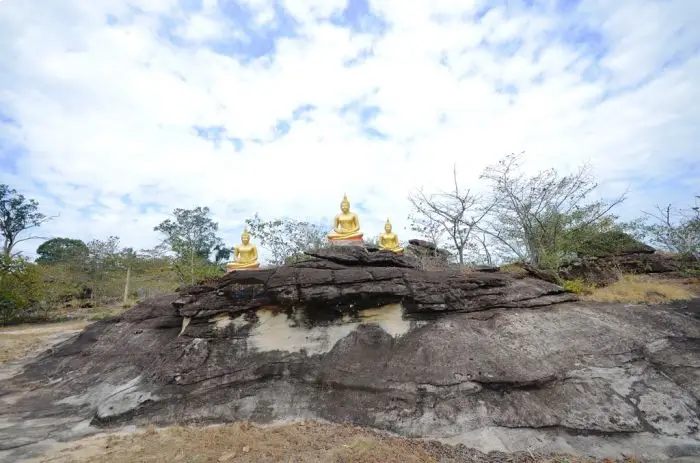
Phu Tham Phra
Open Days: Daily
Recommended Visiting Hours: 06.00 – 17.00
Phu Tham Phra in Loei Province, also associated with Wat Phu Tham Phra Si Tharat in Non Po Daeng Subdistrict, Pha Khao District, is a mountain-and-cave religious nature site. In the past, many wooden Buddha images were kept inside the cave. The mountain contains 3 caves and is home to a large bat population. It is a meaningful destination for travelers interested in Buddhist heritage, cave ecology, quiet forested landscapes, and lesser-known natural attractions in Loei.
Phu Tham Phra in Loei Province is a distinctive natural and religious attraction in Pha Khao District. The name can be understood directly: “phu” refers to a mountain, “tham” means cave, and “phra” refers to Buddha images or sacred Buddhist objects. This name reflects the essential character of the place: a mountain with caves that have long been associated with Buddhist faith, wooden Buddha images, local reverence, and quiet spiritual atmosphere.
The site is connected with Wat Phu Tham Phra Si Tharat in Non Po Daeng Subdistrict, Pha Khao District, Loei Province. This part of Pha Khao is known for a landscape of hills, caves, limestone formations, forests, local temples, and small rural communities. Phu Tham Phra is therefore not simply a temple or a cave. It is a layered place where geography, faith, ecology, and local memory meet inside one mountain.
One of the most important stories connected with Phu Tham Phra is that many wooden Buddha images were once kept inside the cave. Wooden Buddha images are meaningful in local Buddhist culture because they reflect devotion, craftsmanship, and the use of natural materials in acts of faith. In rural communities, such images were often created and placed in temples, forest monasteries, or caves as sacred offerings. This gives Phu Tham Phra strong cultural value beyond its natural scenery.
The mountain contains 3 caves. This makes the site more complex than a single cave attraction. Each cave contributes a different feeling to the overall experience. One area is strongly connected with Buddhist worship and the memory of wooden Buddha images. Other parts reveal the natural character of the mountain, while the cave areas inhabited by bats show that the site is also a living ecosystem. Visitors therefore experience both sacred space and natural habitat in one visit.
The main cave area, often understood as the cave of Buddha images, carries the spiritual identity of Phu Tham Phra. When visitors enter the cave, the atmosphere changes immediately. The outside light softens, the air becomes cooler, and sounds echo against the rock walls. These natural qualities create a sense of stillness that suits Buddhist reflection and quiet observation. Visitors should walk calmly and treat the cave as a sacred and fragile place.
The historical presence of wooden Buddha images gives Phu Tham Phra a deep sense of local memory. Even though the number and condition of old wooden images may have changed over time, the story remains important because it shows how local people once connected faith with the cave landscape. Caves in Thailand have often served as places of meditation, worship, and spiritual retreat. Phu Tham Phra continues this tradition through its association with Buddhist images and forest-temple culture.
Another defining feature of Phu Tham Phra is the large number of bats living inside the caves. Bats are an important part of cave ecosystems. They help control insect populations, contribute to ecological balance, and form part of the natural food chain. Their presence shows that the caves are not empty spaces created only for visitors. They are living habitats that require careful and respectful travel behavior.
A visit to Phu Tham Phra should therefore combine faith, nature appreciation, and conservation awareness. Visitors should avoid loud voices, unnecessary bright lights, touching bats, throwing objects, writing on cave walls, removing stones, or leaving trash behind. A cave is a delicate environment. Small disturbances can affect animals, humidity, cleanliness, and the spiritual atmosphere of the place. Responsible behavior keeps the site meaningful for both the community and future visitors.
Phu Tham Phra also has the quiet character of a forest temple. Cave temples and mountain monasteries are often chosen because they provide solitude, shade, and natural stillness. Such environments are suitable for meditation and religious practice. For this reason, travelers should dress modestly and behave respectfully, just as they would at any Buddhist temple in Thailand. The experience is not only sightseeing, but also entering a place of reverence.
The broader landscape of Pha Khao District helps explain why Phu Tham Phra is worth visiting. Pha Khao is an area where cliffs, mountains, springs, caves, reservoirs, waterfalls, temples, and rural communities are closely connected. The district motto refers to high cliffs, sweet tamarind farms, water sources, and beautiful nature. Phu Tham Phra fits this identity well because it brings together a mountain, caves, forest, faith, and local life.
The charm of Phu Tham Phra lies in its simplicity. It is not a highly commercialized tourist complex. Its value comes from the mountain itself, the cave atmosphere, the memory of wooden Buddha images, the presence of Buddha images, the bats, and the quiet rural surroundings of Non Po Daeng. Travelers who appreciate peaceful sites will find that Phu Tham Phra offers a slower and more reflective experience than crowded destinations.
The 3 caves inside the mountain make the destination especially interesting. The first cave is associated with Buddhist worship and sacred objects. The other cave areas reveal the natural structure of the mountain, including darker, cooler, and more enclosed spaces. The cave area with bats shows how wildlife continues to live within the mountain. This combination creates a site where religion, nature, and ecology overlap in a visible way.
For travelers interested in Buddhist art and local belief, the story of wooden Buddha images is important. In many local traditions, wooden Buddha images were made with devotion and placed in sacred areas as offerings. They were not merely decorative objects, but expressions of faith. The memory of many wooden Buddha images inside Phu Tham Phra gives the site cultural depth and helps distinguish it from ordinary cave attractions.
The presence of many bats requires particular care. Bats are sensitive to light, sound, and repeated disturbance. Strong flashlights, camera flashes, loud voices, or approaching bat colonies too closely can disrupt their natural behavior. Visitors should use light only when needed, keep a respectful distance, and avoid staying too long in areas where bats gather. Observing quietly is the best way to appreciate the cave without harming its ecosystem.
Walking inside the caves requires attention to safety. Cave floors may be damp, uneven, or slippery. Some passages may be narrow or dimly lit. Visitors should wear shoes with good grip, bring a small flashlight, walk with others, and stay within safe areas. Children and elderly visitors should be supervised closely, especially on uneven ground and near cave entrances. Anyone uncomfortable with darkness or enclosed spaces can still appreciate the exterior temple area and mountain atmosphere.
Traveling to Phu Tham Phra is most convenient by private car. The site is located in Non Po Daeng Subdistrict, Pha Khao District. From Loei town, travelers can drive toward Pha Khao District via Wang Saphung, then continue into Non Po Daeng. Because nearby attractions are spread across rural roads, a private vehicle allows visitors to combine Phu Tham Phra with other places in the same district more easily.
Getting There from Loei town is straightforward by road. Drive toward Pha Khao District through Wang Saphung, then continue to Non Po Daeng Subdistrict. Use the destination name “Wat Phu Tham Phra Si Tharat” or “Phu Tham Phra, Ban Niyom Thai, Non Po Daeng” for navigation. A private car is recommended because it also allows travelers to continue to Phu Pha Nam Tao Thong, Phu Pha Khao, Tat Thong Waterfall, Phu Pa Phai Reservoir, and Wat Tham Pha Sawan in the same route.
The best time to visit is during daylight, from morning to late afternoon. The caves should be visited in daytime because visibility is better and the route is safer. Early morning is suitable for a calm temple atmosphere, while late afternoon is good for observing the mountain and surrounding scenery before leaving. Entering cave areas at night is not recommended because of low visibility, uneven ground, and the presence of bats.
The most pleasant season is from the late rainy season through the cool season. Loei Province has cooler weather during this period, and the surrounding vegetation is often fresh and green. The rainy season can make the landscape beautiful, but visitors should be careful of slippery paths. During the hot season, midday heat can be strong, so it is better to visit early or later in the day.
Before visiting Phu Tham Phra, travelers should prepare for both a cave visit and a temple visit. Useful items include modest clothing, comfortable walking shoes, a small flashlight, drinking water, a mask for those sensitive to cave smells, and a small bag for carrying trash back out. Clothing should be appropriate for a Buddhist site, and footwear should be practical for walking on stone or damp ground.
Phu Tham Phra is suitable for several types of travelers, including nature lovers, cave enthusiasts, families, Buddhist pilgrims, and travelers looking for a quieter side of Loei Province. However, the cave sections require caution. Visitors with knee problems, difficulty walking in low light, respiratory sensitivity, or fear of enclosed spaces should choose the areas they can comfortably visit and avoid pushing beyond personal limits.
Phu Tham Phra can be used as the main stop in a Pha Khao nature-and-faith route. Visitors can begin with worship and cave exploration at Phu Tham Phra, then continue to Phu Pha Nam Tao Thong, a distinctive mountain with a cave; Phu Pha Khao Viewpoint; Wat Tham Pha Sawan; Phu Pa Phai Reservoir; or Tat Thong Waterfall. A route like this gives travelers a fuller view of Pha Khao’s mountains, caves, temples, water sources, and rural communities.
Travelers who want to stay overnight can find small resorts, homestays, and local accommodations in Pha Khao District. These places are generally simple and practical, suitable for travelers who want to stay close to natural attractions. It is advisable to call ahead, especially during holidays, because accommodation options in Pha Khao are more limited than in major tourist towns.
Restaurants near Phu Tham Phra are mostly local Thai eateries, noodle shops, cafés, and Isan-style restaurants in Non Po Daeng and Pha Khao District. Stopping at local restaurants helps make the trip more comfortable and supports the local economy. Some restaurants have confirmed contact numbers, while smaller local eateries may require checking opening times before visiting.
Phu Tham Phra is also a good place to learn about cave conservation. Cave environments are more fragile than they may appear. Humidity, temperature, airflow, darkness, and animal behavior are all part of the cave’s natural balance. Littering, touching formations, disturbing bats, or using strong lights repeatedly can have long-term effects. Visitors should treat the caves as places to observe and learn, not as playgrounds.
From a spiritual perspective, Phu Tham Phra should be approached with respect. The story of many wooden Buddha images once being kept inside the cave gives the site a sacred atmosphere in local memory. Visitors should avoid touching Buddha images, moving objects, climbing on sacred areas, or behaving in ways that disturb monks, worshippers, or the calm environment of the temple.
What makes Phu Tham Phra special is the way it combines several layers of meaning. It is a mountain, a cave system, a place of Buddhist memory, a habitat for bats, and a community religious site. Travelers who take time to understand these layers will see more than a cave. They will see a place where nature, faith, wildlife, and rural identity come together.
Phu Tham Phra also helps introduce travelers to a lesser-known side of Loei Province. Many visitors know Loei through Chiang Khan, Phu Kradueng, or Phu Ruea, but Pha Khao District offers a quieter local experience. The district has mountains, caves, waterfalls, reservoirs, temples, local roads, and small community businesses. Phu Tham Phra is one of the places that shows this quieter identity clearly.
A good visit to Phu Tham Phra should not be rushed. Begin by walking around the temple area, then enter the cave calmly and carefully. Observe the Buddha images, cave walls, natural forms, and bat habitat from a respectful distance. After leaving the cave, take time to appreciate the mountain surroundings before continuing to nearby attractions. This slower pace matches the nature of the place.
Phu Tham Phra is best for travelers who appreciate quiet natural and religious sites. Those expecting large tourist facilities may find the site simple, but those interested in caves, wooden Buddha image history, forest temple atmosphere, bats, and local faith will find it meaningful. It is one of Pha Khao District’s destinations where the value is not in scale, but in depth.
A respectful visit helps keep Phu Tham Phra clean, peaceful, and alive as both a religious place and a natural habitat. Do not leave waste behind, do not disturb bats, do not damage rocks or plants, and support local services when possible. With careful travel behavior, Phu Tham Phra can remain a meaningful cave, temple, and nature-learning site in Loei Province for future visitors.
| Name | Phu Tham Phra / Wat Phu Tham Phra Si Tharat |
| Location | Non Po Daeng Subdistrict, Pha Khao District, Loei Province, Thailand |
| Address | Non Po Daeng Subdistrict, Pha Khao District, Loei 42240 |
| Highlights | A mountain with 3 caves, historically associated with many wooden Buddha images, Buddha worship areas, natural cave chambers, and a large bat population |
| History / Name Origin | The name Phu Tham Phra reflects a mountain with caves connected to Buddha images and local Buddhist devotion |
| Distinctive Features | A mountain-and-cave religious nature site combining Buddhist heritage, cave ecology, bats, forest-temple atmosphere, and local faith |
| Travel Information | From Loei town, travel toward Pha Khao District via Wang Saphung, then continue to Non Po Daeng Subdistrict. Use Wat Phu Tham Phra Si Tharat or Phu Tham Phra, Ban Niyom Thai, as the navigation point. A private car is recommended. |
| Current Status | A temple and natural cave attraction in Pha Khao District, Loei Province |
| Open Days | Daily |
| Recommended Visiting Hours | 06.00 – 17.00; daylight visits are recommended for cave safety |
| Facilities | Temple area, nearby parking, walking access to cave areas, worship space, and local restaurants and accommodations in Non Po Daeng and Pha Khao District |
| Main Areas / Zones | 1. Temple And Worship Area 2. Main Buddha Cave Area 3. Second Natural Cave Area 4. Third Natural Cave Area 5. Bat Habitat Area 6. Nature Walking Area Around The Mountain 7. Mountain Rest And View Area |
| Monk / Related Person | Luang Por Ronnakrit Khantithammo |
| Main Contact Number | 084-835-0509 |
| Official Website / Official Page | Non Po Daeng Municipality / Local Pha Khao District Information |
| Visitor Guidelines | Dress modestly, walk carefully inside the caves, use lights only as needed, do not disturb bats, do not touch Buddha images or natural cave features, and take all trash back out |
| Nearby Tourist Attractions | 1. Phu Pha Nam Tao Thong, about 8 km 2. Wat Tham Pha Sawan, about 10 km 3. Phu Pa Phai Reservoir, about 10 km 4. Phu Pha Khao / Phu Pha Khao Viewpoint, about 12 km 5. Tat Thong Waterfall, about 14 km 6. Nam Phu Ban Dong Noi, about 15 km 7. Wat Pa Phu Khao Wong, about 16 km |
| Nearby Restaurants | 1. Krua Lung Nuat, Non Po Daeng Subdistrict, about 3 km 2. Kuai Tiao Kai Mara Ban Na Lom, about 4 km 3. Huen Him Than, Ban Sam Kok Kho, about 5 km 4. Hakna Cafe Pha Khao, about 8 km, Tel. 095-932-6635 5. Jaew Hon Yon Yuk Pha Khao, Loei, about 8 km, Tel. 093-451-3269 6. Alatar Cafe’, Pha Khao District, about 10 km |
| Nearby Accommodations | 1. Baan Suan Homestay, Ban Niyom Thai, about 4 km, Tel. 093-223-0756, 095-189-1491 2. Family Resort, Ban Non Po Daeng, about 5 km, Tel. 081-058-5819 3. Nattharika Resort, Pha Khao District, about 8 km, Tel. 081-964-9268 4. Asia Resort, Pha Khao District, about 12 km, Tel. 081-016-4688 5. Cafe Homestay, Pha Khao District, about 12 km |
Frequently Asked Questions (FAQ)
Q: Where is Phu Tham Phra in Loei located?
A: Phu Tham Phra, also known as Wat Phu Tham Phra Si Tharat, is located in Non Po Daeng Subdistrict, Pha Khao District, Loei Province.
Q: Why is Phu Tham Phra important?
A: It is important as both a Buddhist and natural site. In the past, many wooden Buddha images were kept inside the cave, and the mountain contains 3 caves with a large bat population.
Q: How many caves are inside Phu Tham Phra?
A: The mountain contains 3 caves, including areas connected with Buddhist worship, natural cave spaces, and bat habitats.
Q: What time should visitors go to Phu Tham Phra?
A: Visitors should go during daylight, especially between 06.00 and 17.00, because cave exploration is safer when there is enough natural light outside.
Q: What should visitors prepare before entering the caves?
A: Wear shoes with good grip, bring a small flashlight and drinking water, dress modestly, speak quietly, avoid disturbing bats, and do not touch Buddha images or natural cave features.
Q: Is Phu Tham Phra suitable for families?
A: Yes, it is suitable for families interested in nature and Buddhist sites. Children should be supervised closely, especially on uneven cave floors and near areas where bats live.
Q: What nearby attractions can be visited on the same trip?
A: Nearby attractions include Phu Pha Nam Tao Thong, Wat Tham Pha Sawan, Phu Pa Phai Reservoir, Phu Pha Khao Viewpoint, Tat Thong Waterfall, Nam Phu Ban Dong Noi, and Wat Pa Phu Khao Wong.
Q: What type of travel is Phu Tham Phra best for?
A: It is best for Buddhist travel, nature travel, cave exploration, conservation-minded visits, and travelers interested in wooden Buddha image history, forest temples, and cave-dwelling bats.
 Category: ●Nature and Wildlife
 Group: ●Mountain (Doi)
Last Update : 1 MonthAgo
 Last Update : 1 MonthAgo
Recommend

 Art, Culture and Heritage
 Historical Sites and Monuments(2)
 Landmarks and Memorials(3)
 Art, Craft Centres, Tradition(2)
 Museums(4)
 Art Gallery(1)
 Educational Places
 Educational Gardens, Farm(2)
 Places of Worship
 Temple(16)
 Other Sacred Sites(8)
 Research and Development
 Royal Project(3)
 Suburban Living
 Village, Community(3)
 Local Market(1)
 National Parks and Marine Reserves(5)
Mountain (Doi)(10)
National Parks and Marine Reserves(5)
Mountain (Doi)(10)
 Dam, Reservoir, Lake(7)
 Waterfalls(21)
 Caves(3)
 River, Canal(5)
 Bays and Beaches(1)
 Other natural attractions(1)
 Entertainment and Agricultural
 Farms, Parks and Ecotourism(8)
 Waterpark(1)
 Outdoor and Adventure Activities(2)


