
lovethailand home >Northeastern Travel Attractions >Loei Travel Attractions >Wang Saphung >Si Songkhram > Wat Tham Pha Mak Ho
TL;DR: Wat Tham Pha Mak Ho is located at Ban Huai Sai Kham and nearby Ban Thai Charoen community area, Si Songkhram Subdistrict, Wang Saphung District, Loei Province, open Daily, hours Daytime visits are recommended; visitors should descend from the mountain area.
Wat Tham Pha Mak Ho
Open Days: Daily
Opening Hours: Daytime visits are recommended; visitors should descend from the mountain area before dark
Wat Tham Pha Mak Ho is a mountain cave temple in Si Songkhram Subdistrict, Wang Saphung District, Loei Province. It is associated with the Ban Huai Sai Kham and Ban Thai Charoen community areas and is located about 8 km from Wang Saphung District town. Travelers from Loei town can reach the area via Highway 201, also known as Maliwan Road, before continuing into Si Songkhram Subdistrict. The temple is known for its hillside setting, cave environment, peaceful forest atmosphere, Buddhist worship areas, stairways, Buddha images, and the long-standing presence of macaques that have become one of the most recognizable features of the site.
Wat Tham Pha Mak Ho is not a flatland temple in a busy town center. It sits within a mountainous landscape where temple structures, stairways, trees, rocks, and cave areas are connected by the slope of the hill. This setting gives the temple a calm and secluded character. Visitors can come to pay respect to Buddha images, make merit, walk slowly through the temple grounds, enjoy the shade of the forest, and experience the quiet atmosphere of a local cave temple in Wang Saphung District.
The temple’s strongest identity comes from the combination of Buddhist faith and nature. The hillside and cave environment create a sense of retreat from everyday life. Cave temples in Thailand are often valued for their silence, cooler air, and suitability for meditation or quiet reflection. At Wat Tham Pha Mak Ho, visitors can feel this character through the mountain backdrop, the shaded temple grounds, the stairways rising toward the upper area, and the cave setting that gives the site a different atmosphere from ordinary village temples.
In religious terms, Wat Tham Pha Mak Ho belongs to the Dhammayut Nikaya Buddhist order and is one of the important temples in Si Songkhram Subdistrict. Buddhism in this area continues to be closely connected with local culture, village ceremonies, merit-making traditions, and community life. The temple is therefore not merely a tourist stop or a place known for monkeys. It is also a living Buddhist site where local people come together for religious activities and community merit-making.
The history of the temple is closely linked with forest, mountain, and wildlife. Older accounts describe the area as once being rich in forest resources and home to many wild animals, including macaques. Over time, the macaques became strongly associated with the temple and attracted visitors who came to see them. This wildlife element gives the temple a distinctive identity, but visitors should remember that macaques are wild animals. They should not be treated as pets, and travelers should behave carefully around them.
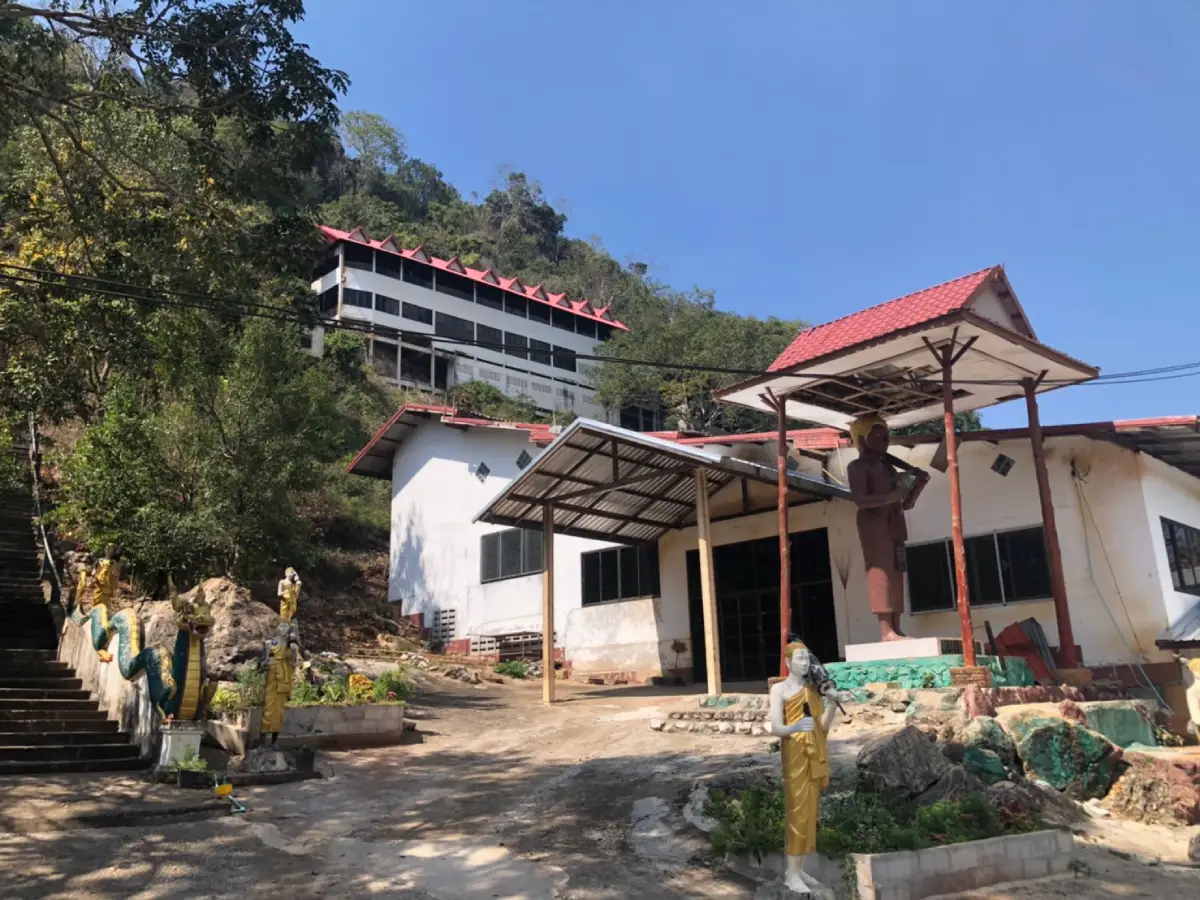
The overall atmosphere of Wat Tham Pha Mak Ho is quiet and local. Visitors entering the temple area will see the entrance gate, the road leading into the temple, religious buildings, Buddha images, hillside structures, stairways, and the forested mountain behind the temple. The place is not designed like a large commercial tourist attraction. Its charm lies in its simplicity, natural surroundings, and the feeling of a real community temple set against a mountain landscape.
The cave area is an important part of the temple’s identity. Caves in Buddhist and forest-temple traditions are often associated with solitude, meditation, and spiritual discipline. A cave reduces outside noise and creates a calmer inner space. Visitors should therefore respect the quiet atmosphere by speaking softly, avoiding loud music, keeping the area clean, and not writing on rock surfaces or damaging natural formations. The cave should be treated as both a natural site and a sacred temple space.
The hillside layout makes a visit to the temple feel like a gradual movement from the lower area toward a quieter upper space. The stairways and sloping paths encourage visitors to slow down, walk carefully, and notice the changing view around them. For many travelers, this is part of the experience. The climb is not only physical; it also gives time to settle the mind before reaching the more peaceful parts of the temple.
For nature-oriented travelers, Wat Tham Pha Mak Ho offers a pleasant setting of trees, rocky slopes, shaded temple areas, and mountain views. It is not a formally managed hiking destination, but the environment gives visitors a close sense of nature. Morning visits are especially comfortable because the light is soft and the air is cooler. Late afternoon can also be good for photography, especially around the gate, the stairways, the hillside buildings, and the forested background.
The temple is also suitable for merit-making and quiet relaxation. Visitors can begin by paying respect to Buddha images, making merit according to their faith, and then spending time walking around the temple grounds. The shaded areas and natural setting make the visit feel restful. Families should supervise children closely because the site includes slopes, stairways, monkeys, and areas where running or playing may not be safe. Elderly visitors should stay on easier paths and avoid climbing higher areas if the route feels too demanding.
One of the most memorable features of Wat Tham Pha Mak Ho is the macaque population. In the past, the temple was widely known for a large number of macaques living in the surrounding forest and temple area. Visitors should keep personal belongings secure, avoid carrying visible food, and never tease or approach monkeys too closely. Monkeys are fast and may snatch bags, bottles, or food. Extra care is needed around mother monkeys, young monkeys, and groups competing for food.
Feeding monkeys should be done only with caution and in accordance with temple or local guidance. Visitors should not feed them sweets, salty snacks, processed food, or food wrapped in plastic. Poor feeding practices can harm animals and create problems for the temple and nearby community. A responsible visit respects both the animals and the temple environment.
The local setting of the temple is tied to Ban Huai Sai Kham and Ban Thai Charoen in Si Songkhram Subdistrict. Ban Huai Sai Kham is associated with a small stream whose water was stronger in the rainy season and lighter in the dry season. The area has long been connected with agriculture and settlement near local waterways. Ban Thai Charoen later became another community name linked with the temple in local administrative references. This background shows that the temple is part of a wider rural landscape shaped by farming, water, forest, and Buddhist faith.
Si Songkhram Subdistrict also contains other learning and cultural sites, including the Queen Sirikit Sericulture Center in Loei and the Sirindhorn Art Center at Si Songkhram Witthaya School. Together with Wat Tham Pha Mak Ho, these places make the subdistrict more than a temple destination. It can be experienced as a cultural route combining a cave temple, forest atmosphere, local agriculture, sericulture, art education, and community heritage.
The Queen Sirikit Sericulture Center in Loei is located in Si Songkhram Subdistrict and is connected with mulberry and silk-related agricultural knowledge. The Sirindhorn Art Center is an art learning space that presents creative work and youth art development. Travelers who have enough time can combine these places with Wat Tham Pha Mak Ho to create a varied route that includes religion, nature, art, and local livelihoods.
Wat Tham Pha Mak Ho is best visited slowly. A good visit begins in the morning with worship and a walk through the temple grounds, followed by time to observe the mountain setting, cave area, and forest atmosphere. After that, travelers can continue to restaurants in Wang Saphung town or nearby Si Songkhram, then visit other attractions such as the Sirindhorn Art Center, the sericulture center, Wat Phatthasimaram, Phra Phutthabat Tham Pha Bing, or Wat Pa Sammanusorn.
The most suitable time to visit is from morning to late afternoon. Daytime travel is safer because the temple includes slopes, stairways, cave-related areas, and wildlife. Visitors should avoid walking up higher areas after dark. During the rainy season, paths and steps may become slippery, so non-slip shoes are important. During the cool season, Loei’s weather is especially pleasant for temple visits and slow exploration.
Getting There is most convenient by private car or rental car. From Loei town, take Highway 201, Maliwan Road, toward Wang Saphung District. From Wang Saphung, continue into Si Songkhram Subdistrict toward Ban Huai Sai Kham or Ban Thai Charoen. The temple is about 8 km from Wang Saphung District town. Travelers can search online maps for “Wat Tham Pha Mak Ho Wang Saphung Loei” or “Wat Tham Pha Mak Ho Si Songkhram”.
The route from Loei town to the Wang Saphung area is about 30 km before continuing to the temple area in Si Songkhram Subdistrict. This makes the temple suitable for a half-day or one-day itinerary. Travelers can visit the temple first and then continue to nearby attractions, restaurants, cafés, and accommodations in Wang Saphung and Si Songkhram.
A half-day visit can focus mainly on Wat Tham Pha Mak Ho. Visitors can pay respect, walk around the lower temple grounds, explore the hillside area carefully, take photographs, and rest under the shade before having a meal in Wang Saphung. A full-day route can add the Sirindhorn Art Center, the Queen Sirikit Sericulture Center, Wat Phatthasimaram, or Phra Phutthabat Tham Pha Bing, depending on time and interest.
For travelers interested in local culture, the temple should be understood within the broader context of Si Songkhram Subdistrict. The area includes Dhammayut temples, Buddhist merit-making traditions, art and youth learning spaces, agriculture, and sericulture. Wat Tham Pha Mak Ho is one part of this cultural landscape and should not be viewed only through its monkeys or cave setting.
Before visiting, travelers should prepare modest clothing, comfortable shoes, drinking water, a hat or umbrella, and a bag that can be closed securely. Food should be kept out of sight to avoid attracting monkeys. Visitors should not hold plastic bags, snacks, or drinks openly while walking near monkey areas. Respectful and careful behavior will make the visit safer and more pleasant.
Temple etiquette is important. Visitors should dress modestly, speak quietly, avoid littering, avoid climbing on religious structures, and treat Buddha images and sacred areas with respect. In the cave or hillside areas, visitors should walk carefully, avoid damaging rock surfaces, and not remove anything from the site. A cave temple is both a natural environment and a sacred space, so care and restraint are essential.
For photographers, useful angles include the temple entrance gate, the rural road leading into the temple, hillside buildings, the stairway, Buddha images, forested slopes, and scenes that show the coexistence of temple life and nature. Photography should be done without disturbing monks, worshippers, or animals. Avoid using food to attract monkeys for photos because it can create unsafe behavior and disrupt the temple environment.
During local religious events, Wat Tham Pha Mak Ho becomes a community gathering place for merit-making and Buddhist traditions. Visitors arriving during these times should park properly, follow local instructions, and respect the ceremony space. Such events show the temple’s continuing role in community life and make it clear that the site is more than a scenic viewpoint or wildlife stop.
The simplicity of Wat Tham Pha Mak Ho is part of its appeal. It is not a fully commercialized tourist complex. Instead, it is a real local cave temple with mountain scenery, forest shade, Buddhist faith, and a living relationship with the surrounding community. Visitors should come with realistic expectations and value the quiet, natural, and spiritual character of the place.
Within Wang Saphung District, Wat Tham Pha Mak Ho helps complete a route of temples, caves, forests, and cultural learning sites. Wang Saphung has cave temples, forest temples, a sema stone museum, art centers, sericulture learning sites, local restaurants, and small hotels. Travelers can stay in Wang Saphung or Si Songkhram and use the area as a base for a slower exploration of Loei Province.
What makes Wat Tham Pha Mak Ho distinct is its layered identity: a mountain cave temple, a quiet Buddhist site, a Dhammayut temple in Si Songkhram, a place connected with forest and macaques, and a local community landmark. These layers give the temple a memorable character and make it suitable for travelers seeking a deeper and less crowded side of Loei.
Wat Tham Pha Mak Ho in Loei Province is therefore a worthwhile destination for travelers who appreciate cave temples, mountains, nature, and quiet rural Buddhist sites. It is easy to reach from Wang Saphung District town, yet it offers a peaceful atmosphere that feels far from busy travel routes. With modest dress, careful behavior around monkeys, respect for the temple, and enough time to enjoy the setting, a visit to Wat Tham Pha Mak Ho can become a meaningful part of a cultural journey through Wang Saphung District.
| Name | Wat Tham Pha Mak Ho / Wat Tham Pha Mak Hor |
| Location | Ban Huai Sai Kham and nearby Ban Thai Charoen community area, Si Songkhram Subdistrict, Wang Saphung District, Loei Province |
| Address | Wat Tham Pha Mak Ho, Si Songkhram Subdistrict, Wang Saphung District, Loei Province 42130, Thailand |
| Highlights | Mountain cave temple with a peaceful forest atmosphere, cave areas, Buddha images, hillside stairways, merit-making areas, and macaques associated with the temple landscape |
| Distinctive Features | Temple located on a mountain with a cave, shaded natural surroundings, quiet atmosphere, Buddhist worship areas, and a rural hillside setting suitable for merit-making and relaxation |
| Buddhist Order | Dhammayut Nikaya |
| History / Local Context | A cave temple in Si Songkhram Subdistrict connected with Ban Huai Sai Kham and Ban Thai Charoen communities. The area was formerly rich in forest resources and became known for macaques living around the temple. |
| Travel Information | From Loei town, take Highway 201, Maliwan Road, toward Wang Saphung District, then continue into Si Songkhram Subdistrict. The temple is about 8 km from Wang Saphung District town. |
| Current Status | Active cave temple and local Buddhist site for worship, merit-making, relaxation, and nature viewing in the mountain area of Si Songkhram Subdistrict |
| Open Days | Daily |
| Opening Hours | Daytime visits are recommended; visitors should descend from the mountain area before dark |
| Facilities | Temple courtyard, entrance road, religious buildings, worship areas, hillside stairways, meditation-related areas, rest points, and parking space within the temple area |
| Main Areas / Zones | Temple entrance gate, access road, lower temple courtyard, hillside stairway, hillside buildings, cave area, Buddha image area, forested slope, and macaque area |
| Caretaker / Abbot | Wat Tham Pha Mak Ho |
| Local Administrative Office | Si Songkhram Subdistrict Municipality, Tel. 042-039206 |
| Nearby Tourist Attractions | 1. Queen Sirikit Sericulture Center, Loei, about 2 km, Tel. 042-039213 2. Sirindhorn Art Center, Si Songkhram Witthaya School, about 4 km, Tel. 089-862-5806 3. Wat Inthawanaram, Ban Bung Kok Tan, about 6 km 4. Wat Phatthasimaram / Ban Bung Phak Kam Sema Stone Museum, about 12 km 5. Phra Phutthabat Tham Pha Bing / Luang Pu Louis Chanthasaro Museum Chedi, about 18 km, Tel. 042-812-812 6. Wat Pa Sammanusorn, about 22 km 7. Phu Bo Bit, Mueang Loei District, about 30 km |
| Nearby Restaurants | 1. Cafe Amazon, Si Songkhram Subdistrict branch, about 4 km 2. Metro Cafe’ Artisan Croissant And Bread, about 5 km, Tel. 093-959-5595 3. A Little House Cafe Bakery Homemade, about 8 km, Tel. 065-192-5592 4. Na Wang Restaurant, about 9 km, Tel. 042-841-418 5. Krua Kan Eng, about 9 km, Tel. 062-782-5698 6. Pranee Me Bar For Enjoy, about 9 km, Tel. 084-404-2994 |
| Nearby Accommodations | 1. The Cozy Hotel, about 4 km, Tel. 095-654-8965 2. RARE LOEI HOTEL, about 5 km, Tel. 098-398-0157 3. Wang Saphung In View Hotel, about 10 km, Tel. 081-505-1569 4. Plus Hotel, about 9 km, Tel. 042-810-799 5. Tonsak Loei Resort, about 11 km, Tel. 093-546-3633 6. Sakul Plang Resort, about 12 km, Tel. 099-071-9937 |
Frequently Asked Questions (FAQ)
Q: Where is Wat Tham Pha Mak Ho located?
A: Wat Tham Pha Mak Ho is located in Si Songkhram Subdistrict, Wang Saphung District, Loei Province. It is associated with the Ban Huai Sai Kham and Ban Thai Charoen community areas and is about 8 km from Wang Saphung District town.
Q: What is Wat Tham Pha Mak Ho known for?
A: The temple is known for its mountain cave setting, peaceful forest atmosphere, Buddha images, hillside stairways, merit-making areas, and macaques that have long been associated with the temple.
Q: What are the opening hours of Wat Tham Pha Mak Ho?
A: The temple can be visited daily. Daytime visits are recommended, and visitors should descend from higher mountain areas before dark for safety.
Q: How can travelers get to Wat Tham Pha Mak Ho?
A: From Loei town, take Highway 201, Maliwan Road, toward Wang Saphung District, then continue into Si Songkhram Subdistrict. A private car or rental car is the most convenient option.
Q: Who should visit Wat Tham Pha Mak Ho?
A: The temple is suitable for Buddhist travelers, cave temple visitors, nature lovers, photographers, and travelers who want a quiet local temple experience in Wang Saphung District.
Q: What should visitors be careful about at Wat Tham Pha Mak Ho?
A: Visitors should be careful around macaques, keep food and valuables secured, avoid teasing or approaching monkeys, dress modestly, and avoid walking in hillside areas after dark.
Q: What nearby attractions can be included in the same trip?
A: Nearby attractions include the Queen Sirikit Sericulture Center in Loei, Sirindhorn Art Center, Wat Phatthasimaram, Phra Phutthabat Tham Pha Bing, Wat Pa Sammanusorn, and Phu Bo Bit.
Q: Is there an admission fee at Wat Tham Pha Mak Ho?
A: Wat Tham Pha Mak Ho is a local Buddhist temple where visitors can pay respect and make merit according to their faith. Visitors should follow temple rules and help keep the area clean.
 Category: ●Places of Worship
 Group: ●Temple
Last Update : 2 MonthAgo
 Last Update : 2 MonthAgo
 Click to Access the Navigation Map GPS
Wat Tham Pha Mak Ho Map
Recommend

 Art, Culture and Heritage
 Historical Sites and Monuments(2)
 Landmarks and Memorials(3)
 Art, Craft Centres, Tradition(2)
 Museums(4)
 Art Gallery(1)
 Educational Places
 Educational Gardens, Farm(2)
Temple(16)
Educational Gardens, Farm(2)
Temple(16)
 Other Sacred Sites(8)
 Research and Development
 Royal Project(3)
 Suburban Living
 Village, Community(3)
 Local Market(1)
 Nature and Wildlife
 National Parks and Marine Reserves(5)
 Mountain (Doi)(10)
 Dam, Reservoir, Lake(7)
 Waterfalls(21)
 Caves(3)
 River, Canal(5)
 Bays and Beaches(1)
 Other natural attractions(1)
 Entertainment and Agricultural
 Farms, Parks and Ecotourism(8)
 Waterpark(1)
 Outdoor and Adventure Activities(2)


