
lovethailand home >Northeastern Travel Attractions >Loei Travel Attractions >Wang Saphung >Khok Khamin > Wat Tham Kuhawari
TL;DR: Wat Tham Kuhawari is located at Mu 8, Ban Non Sawang or Ban Sam Nok Chip, Khok Khamin Subdistrict, Wang Saphung District, Loei Province, open Daily, hours 07.00 – 19.00.

Wat Tham Kuhawari
Open Days: Daily
Opening Hours: 07.00 – 19.00
Wat Tham Khuha Wari is located in Mu 8, Ban Non Sawang, also known locally as Ban Sam Nok Chip, Khok Khamin Subdistrict, Wang Saphung District, Loei Province. It is a cave temple and community-based natural attraction that is emerging as one of Loei’s new unseen destinations. The site combines sacred cave traditions, flowing spring water, limestone cave formations, 8 smaller cave zones, a 360-degree viewpoint called Pha Tabong Phet, and the rural lifestyle of Ban Non Sawang. It is about 5 km from Ban Lat Junction and about 16 km from Nikorn Suk Junction, making it suitable for travelers who want to experience a cave temple, local nature, mountain views, Buddhist faith, and community tourism in one trip.
Wat Tham Khuha Wari is set within Ban Non Sawang, Mu 8, Khok Khamin Subdistrict, Wang Saphung District. The village is also known as Ban Sam Nok Chip, a local name connected with the memory of the many small birds once found in the area. The community was officially established as Ban Non Sawang in 1979, but the older local name remains part of the village identity. Visiting Wat Tham Khuha Wari is therefore not only about seeing caves. It is also a way to understand a rural community, its agricultural way of life, its forest resources, and its close relationship with water, mountains, and Buddhist faith.
The name Khuha Wari reflects the nature of the site. In Thai, “khuha” refers to a cave or rock chamber, while “wari” means water. The name is strongly connected with the local legend of a spring that has continued to flow since the time associated with Luang Pu Louis Chanthasaro. This water has long supported the community and remains a symbol of abundance and sacredness. For local people, the cave is not merely a geological formation. It is a meaningful source of life, faith, and community memory.
The wider site includes 8 notable cave areas: Tham Nam, Tham Tam, Tham Si Racha, Tham Yai, Tham Chaeng or Tham Lom, Tham Ngoep, Tham Yoi Hai, and Tham Pak Om. Each cave has its own character. Tham Nam is known for water flowing throughout the year and is closely linked to the name Khuha Wari. Tham Tam is located near Tham Nam and can connect with it. Tham Si Racha lies higher and connects with Tham Tam. Tham Yai is wide and long, with a route that can pass through the mountain toward Tham Khao San Hin when community-guided access is arranged properly.
Tham Chaeng, also called Tham Lom, is known for its cool airflow and natural light. Rock forms inside are associated with a local image of an elderly couple sitting and talking. Tham Ngoep is small and quiet, making it suitable for peaceful reflection and meditation. Tham Yoi Hai includes a wooden stairway rising about 7 meters from the ground, giving visitors a different cave-level experience. Tham Pak Om has a small entrance, but its inner space opens up wider than expected, creating a sense of surprise for visitors who enter carefully with local guidance.
The beauty of Tham Khuha Wari lies in its limestone formations. Stalactites, stalagmites, rock curtains, textured walls, and mineral formations have been created slowly through natural processes over a long period of time. Some formations hang from the cave ceiling, while others rise from the cave floor. These formations are delicate and should not be touched. Oils from human hands and careless contact can damage the natural surface and disturb future growth. Visitors should also avoid writing on cave walls, leaving rubbish, or walking outside the recommended routes.
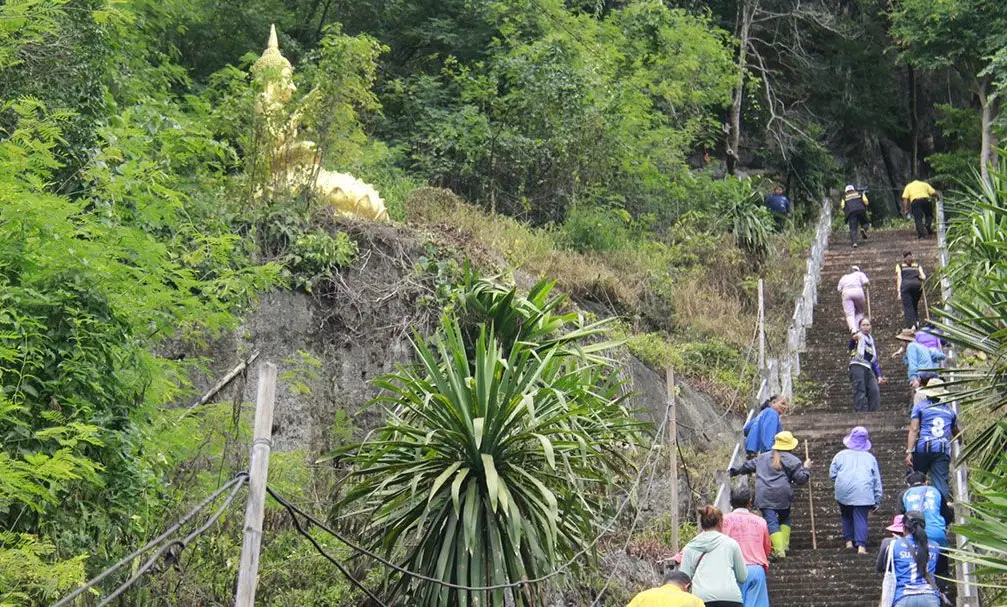
Another highlight of the area is the 360-degree viewpoint, also known as Pha Tabong Phet. Visitors walk up about 201 steps to reach this viewpoint, which sits at more than 480 meters above sea level. From the top, the view opens across mountains, forest, agricultural land, and the Ban Non Sawang community. The viewpoint is especially attractive in the morning, late afternoon, and around sunset. It is suitable for photography, landscape viewing, and appreciating the quiet mountain atmosphere of Wang Saphung District.
Although the walk to Pha Tabong Phet is not extremely long, visitors should still be careful. The stairway is part of a natural mountain setting, so proper footwear is important. Travelers should bring drinking water, walk at a steady pace, and avoid climbing during heavy rain or near dark. Those who want to watch sunset should plan the descent carefully. Because this is a community-managed nature area, following local advice is the best way to travel safely and respectfully.
Wat Tham Khuha Wari is memorable because it is driven by the Ban Sam Nok Chip community. The site is not being developed only as a cave attraction. The community connects the caves, viewpoint, forest, religious learning area, agricultural products, local shops, homestays, and guide services into one community-based tourism route. This gives visitors a more complete experience. They can see nature, learn about local beliefs, meet villagers, support local products, and understand how tourism can help preserve natural resources when managed responsibly.
The community forest around Ban Non Sawang is also important. It includes areas of wild plants, orchids, local edible plants, medicinal herbs, and old trees valued by the community. This forest context shows that the attraction is larger than the cave itself. The cave, spring, forest, plants, agricultural fields, and village life are all connected. Travelers who pay attention to this wider landscape will understand why the community treats the area as both a natural resource and a cultural inheritance.
For Buddhist travelers and those interested in meditation, Wat Tham Khuha Wari offers a quiet atmosphere that fits the tradition of cave and forest practice. Caves have long been used by monks and practitioners for seclusion because they reduce outside distractions. The cool air, softer light, and natural silence help create a reflective mood. Visitors should therefore keep their voices low, avoid playing music, and behave respectfully around worship areas, meditation zones, and sacred objects.
The spring legend is one of the strongest cultural elements of Tham Khuha Wari. Water is central to rural life, agriculture, food, and community well-being. The continuing flow of water inside the cave is meaningful not only as a natural phenomenon but also as a symbol of life and blessing. Understanding this relationship helps travelers appreciate the site more deeply. The water should be treated with respect, and visitors should avoid any action that could pollute or damage the cave environment.
Getting to Wat Tham Khuha Wari is straightforward by private car or rental car. From Maliwan Road, continue to Khok Khamin Junction and follow the local road through Ban Khok Khamin, Ban Lat, and Ban Non Sawang. The road is paved with asphalt and concrete. The distance from Khok Khamin Junction is about 15 km. From Ban Lat Junction, the site is about 5 km away, while the distance from Nikorn Suk Junction is about 16 km. These routes make the destination accessible while still retaining a rural, community-based atmosphere.
Getting There from Loei town can be done by driving toward Wang Saphung District and Khok Khamin Subdistrict, then continuing through the local village route to Ban Non Sawang. Travelers can search online maps for “Wat Tham Khuha Wari Ban Non Sawang Khok Khamin Wang Saphung Loei.” The final section passes through local community roads, so visitors should drive carefully, especially during rain or in the evening. Those who plan to enter several cave zones or climb to the viewpoint should contact the Ban Sam Nok Chip community tourism group in advance for route and safety advice.
The best time to visit is from morning to late afternoon. This gives enough daylight for cave exploration, walking to the viewpoint, and returning safely. If visitors want to see sunset from the viewpoint, they should plan the descent before darkness. The late rainy season and cool season are especially pleasant because the landscape is green and the weather is more comfortable. During the rainy season, the forest is beautiful, but cave and trail surfaces may be slippery, so extra care is needed.
Visitors should prepare for a nature-based trip. Useful items include non-slip shoes, modest and comfortable clothing, drinking water, a small flashlight, mosquito repellent, a hat, and a bag for carrying rubbish back out. When entering smaller caves or forest routes, local guides are recommended. Some cave passages may be narrow, low, damp, or uneven. Safety should come before speed, photography, or the desire to see every cave zone in one visit.
Temple and cave etiquette should be observed at all times. Dress modestly, speak quietly, avoid loud music, do not litter, do not write on rocks, do not touch stalactites or stalagmites, do not remove plants or stones, and do not enter closed or restricted areas. If you find Buddha images or worship points, approach them respectfully. Photography is fine when done appropriately, but visitors should not pose in ways that disrespect the religious or natural setting.
Wat Tham Khuha Wari can be combined with other attractions in Wang Saphung District and nearby areas. Cultural travelers may continue to Wat Phatthasimaram, home of the Ban Bung Phak Kam Sema Stone Museum and Dvaravati sandstone boundary stones. Buddhist travelers can visit Phra Phutthabat Tham Pha Bing and the Luang Pu Louis Chanthasaro Museum Chedi. Nature travelers may add Wat Pa Sammanusorn, Phu Bo Bit, or other scenic routes depending on time and travel conditions.
For travelers who want a complete community-based experience, it is worth spending more time in Ban Non Sawang. The community is developing local restaurants, shops, homestays, and guide services to support visitors. Buying local products, eating at community shops, using local guides, and staying overnight when available help return income to the village. This kind of travel supports conservation because local people gain value from protecting the cave, forest, water source, and cultural landscape.
For photographers, Wat Tham Khuha Wari offers many strong visual subjects: cave entrances, natural light inside the cave, flowing water, limestone formations, the stairway to Pha Tabong Phet, the 360-degree viewpoint, forest scenery, and the daily life of Ban Non Sawang. Photography should be done safely. Avoid standing too close to cliff edges, using flash in ways that disturb others, or touching natural formations to create a staged image. The best photographs are those that preserve the dignity and natural beauty of the place.
Families can visit Wat Tham Khuha Wari, but the route should be chosen carefully. Young children and elderly visitors should stay on easier sections and avoid deeper cave passages unless guided by local staff. People with knee, ankle, or mobility problems should consider their physical condition before climbing the viewpoint or entering difficult cave areas. A responsible visit is one that matches the route with the ability of the group.
Wat Tham Khuha Wari is suitable for several types of travelers: Buddhist visitors, nature lovers, photographers, community tourism travelers, and people looking for a new route in Loei Province. Beyond the cave and viewpoint, what makes the place special is the way Ban Sam Nok Chip community is actively managing tourism. Visitors can see how local people are turning their natural and cultural resources into a learning space while trying to protect the cave and forest for the future.
To experience Wat Tham Khuha Wari properly, travelers should allow at least half a day. Begin by contacting the community tourism group, then explore the main cave areas that are open and suitable for the day. Continue to Pha Tabong Phet for the 360-degree view, visit the community forest or local product area, and finish with local food or nearby accommodation. This slower approach helps visitors understand that Wat Tham Khuha Wari is not only a beautiful cave, but a complete landscape of faith, water, forest, and community life.
Wat Tham Khuha Wari, Ban Non Sawang, Loei Province, is therefore a promising destination for travelers who want to explore a deeper and less commercial side of Loei. It offers a sacred water legend, 8 cave zones, a 360-degree viewpoint, community forest, medicinal plants, agricultural products, local life, and a peaceful cave-temple atmosphere. With respectful travel, community guidance, and care for nature, this site can become one of the most meaningful community-based tourism routes in Wang Saphung District.
| Name | Wat Tham Khuha Wari / Tham Khuha Wari – 360-Degree Viewpoint, Ban Sam Nok Chip |
| Location | Mu 8, Ban Non Sawang or Ban Sam Nok Chip, Khok Khamin Subdistrict, Wang Saphung District, Loei Province |
| Address | Wat Tham Khuha Wari, Ban Non Sawang, Mu 8, Khok Khamin Subdistrict, Wang Saphung District, Loei Province 42130, Thailand |
| Highlights | Khuha Wari Cave, flowing spring legend, 8 cave zones, stalactites and stalagmites, Pha Tabong Phet 360-degree viewpoint, and Ban Sam Nok Chip community-based tourism |
| Distinctive Features | Natural cave temple and community attraction combining caves, spring water, community forest, mountain viewpoint, agriculture, and local lifestyle |
| Name Origin | “Khuha” means cave, while “Wari” means water, reflecting the cave spring that has long supported Ban Non Sawang community |
| Travel Information | From Maliwan Road, turn at Khok Khamin Junction and follow the route through Ban Khok Khamin, Ban Lat, and Ban Non Sawang / Wat Tham Khuha Wari. The distance is about 15 km from Khok Khamin Junction, about 5 km from Ban Lat Junction, and about 16 km from Nikorn Suk Junction. |
| Current Status | Open as a cave temple and community-managed natural attraction, with local shops, homestays, and guide services being developed by Ban Sam Nok Chip community |
| Open Days | Daily |
| Opening Hours | 07.00 – 19.00 |
| Facilities | Paved road access, community shops, restaurants, homestays, guide services, viewpoint, cave walking routes, and community learning areas |
| Main Areas / Zones | Tham Nam, Tham Tam, Tham Si Racha, Tham Yai, Tham Chaeng or Tham Lom, Tham Ngoep, Tham Yoi Hai, Tham Pak Om, Pha Tabong Phet / 360-degree viewpoint, community forest, Ban Non Sawang village area, and local shop area |
| Caretaker | Wat Tham Khuha Wari and Ban Sam Nok Chip Community Tourism Group |
| Main Contact Number | Mr. Sangkhom Suriyothai, Community Tourism Group Leader, Tel. 098-674-3093 Mr. Theerapon Thorat, Assistant Village Headman, Tel. 061-812-2022 Khok Khamin Subdistrict Administrative Organization, Tel. 063-181-8975 |
| Official Website / Official Page | Facebook page: Ban Sam Nok Chip Community Tourism |
| Nearby Tourist Attractions | 1. Pha Tabong Phet / 360-Degree Viewpoint, about 1 km 2. Pha Chan Dai 180-Degree Viewpoint, about 2 km 3. Ban Sam Nok Chip Community Forest and Ancient Trees, about 3 km 4. Wat Phatthasimaram / Ban Bung Phak Kam Sema Stone Museum, about 24 km 5. Phra Phutthabat Tham Pha Bing / Luang Pu Louis Chanthasaro Museum Chedi, about 30 km, Tel. 042-812-812 6. Wat Pa Sammanusorn, about 34 km 7. Phu Bo Bit, Mueang Loei District, about 39 km |
| Nearby Restaurants | 1. Ban Sam Nok Chip Community Shops, about 1 km 2. Rong Na Cafe The Cottage Coffee and Farm Wang Saphung, about 20 km, Tel. 061-265-6229 3. Pranee Me Bar For Enjoy, about 23 km, Tel. 083-666-6428 4. Na Wang Restaurant, about 24 km, Tel. 042-841-418 5. Krua Kan Eng, about 24 km 6. Kamwan HOME CAFE, about 24 km |
| Nearby Accommodations | 1. Ban Sam Nok Chip Community Homestay, about 1 km 2. The Cozy Hotel, about 25 km, Tel. 042-870-565, 095-654-8965 3. RARE LOEI HOTEL, about 26 km, Tel. 098-398-0157 4. Wang Saphung In View Hotel, about 26 km, Tel. 081-505-1569 5. Tonsak Loei Resort, about 27 km, Tel. 093-546-3633 6. Plus Hotel, about 26 km, Tel. 042-810-799 |
Frequently Asked Questions (FAQ)
Q: Where is Wat Tham Khuha Wari located?
A: Wat Tham Khuha Wari is located in Mu 8, Ban Non Sawang or Ban Sam Nok Chip, Khok Khamin Subdistrict, Wang Saphung District, Loei Province.
Q: What are the opening hours of Wat Tham Khuha Wari?
A: The site is open daily from 07.00 to 19.00. Visitors should allow enough time for cave exploration and descend from the viewpoint before dark.
Q: What can visitors see at Tham Khuha Wari?
A: Visitors can see 8 cave zones, flowing spring water, stalactites and stalagmites, cool cave chambers, meditation-friendly cave areas, and the 360-degree viewpoint at Pha Tabong Phet.
Q: How many steps are there to the 360-degree viewpoint?
A: The 360-degree viewpoint, also called Pha Tabong Phet, is reached by walking up about 201 steps to a height of more than 480 meters above sea level.
Q: How can travelers get to Wat Tham Khuha Wari?
A: From Maliwan Road, turn at Khok Khamin Junction and follow the route through Ban Khok Khamin, Ban Lat, and Ban Non Sawang. The site is about 15 km from Khok Khamin Junction, about 5 km from Ban Lat Junction, and about 16 km from Nikorn Suk Junction.
Q: Who should travelers contact before visiting Tham Khuha Wari?
A: Travelers can contact the Ban Sam Nok Chip Community Tourism Group at 098-674-3093 or 061-812-2022, or Khok Khamin Subdistrict Administrative Organization at 063-181-8975.
Q: What should visitors prepare before visiting Wat Tham Khuha Wari?
A: Visitors should wear non-slip shoes and modest clothing, bring drinking water, a small flashlight, mosquito repellent, and use local guides when entering smaller caves or natural routes.
Q: What nearby attractions can be included in the same trip?
A: Nearby attractions include Pha Tabong Phet, Pha Chan Dai, Ban Sam Nok Chip Community Forest, Wat Phatthasimaram, Phra Phutthabat Tham Pha Bing, Wat Pa Sammanusorn, and Phu Bo Bit.
 Category: ●Places of Worship
 Group: ●Temple
Last Update : 2 WeekAgo
 Last Update : 2 WeekAgo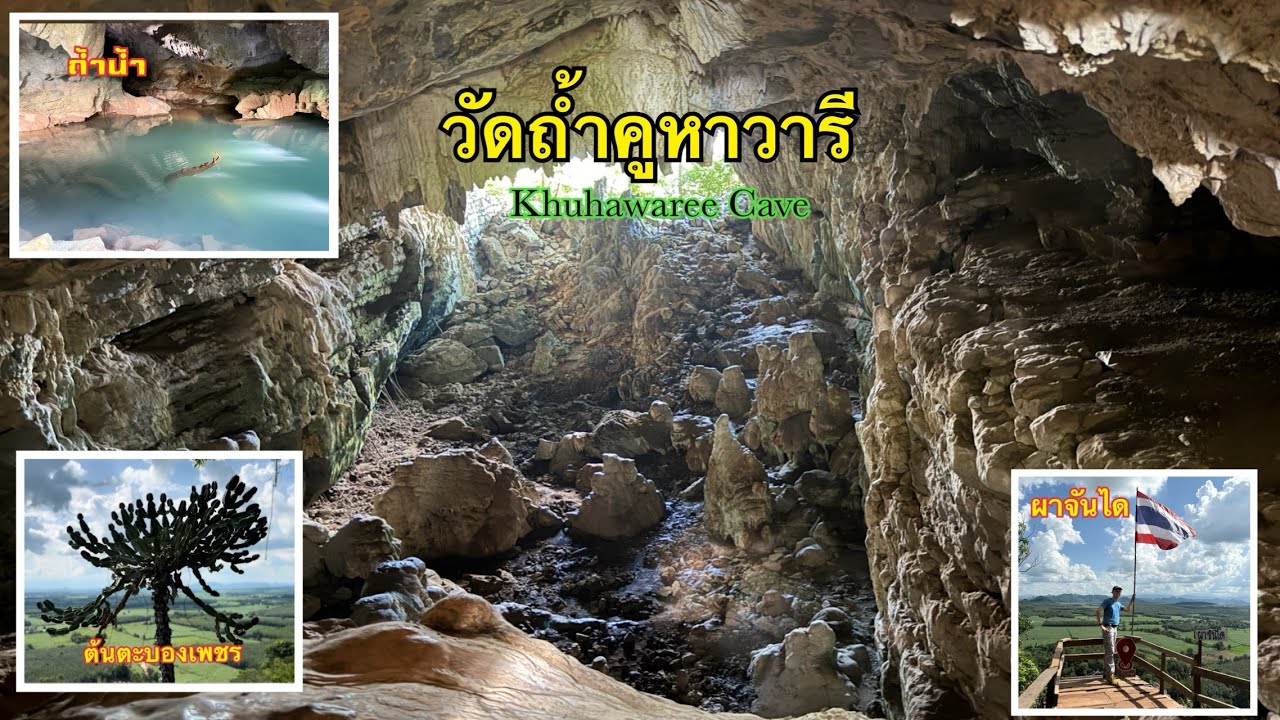
 Click to Access the Navigation Map GPS
Wat Tham Kuhawari Map
Recommend

 Art, Culture and Heritage
 Historical Sites and Monuments(2)
 Landmarks and Memorials(3)
 Art, Craft Centres, Tradition(2)
 Museums(4)
 Art Gallery(1)
 Educational Places
 Educational Gardens, Farm(2)
Temple(16)
Educational Gardens, Farm(2)
Temple(16)
 Other Sacred Sites(8)
 Research and Development
 Royal Project(3)
 Suburban Living
 Village, Community(3)
 Local Market(1)
 Nature and Wildlife
 National Parks and Marine Reserves(5)
 Mountain (Doi)(10)
 Dam, Reservoir, Lake(7)
 Waterfalls(21)
 Caves(3)
 River, Canal(5)
 Bays and Beaches(1)
 Other natural attractions(1)
 Entertainment and Agricultural
 Farms, Parks and Ecotourism(8)
 Waterpark(1)
 Outdoor and Adventure Activities(2)


