
lovethailand home >Northeastern Travel Attractions >Loei Travel Attractions >Tha Li >Tha Li > Wat Phra That Umong
TL;DR: Wat Phra That Umong is located at Mu 5, Ban Yang, Tha Li Subdistrict, Tha Li District, Loei Province, open Daily, hours 08.00 – 17.00.
Wat Phra That Umong
Open Days: Daily
Opening Hours: 08.00 – 17.00
Wat Phra That Umong is located in Mu 5, Ban Yang, Tha Li Subdistrict, Tha Li District, Loei Province. The temple stands about 10 km south of Tha Li District town and is one of the most meaningful Buddhist and cultural sites in the Ban Yang community. Its main highlight is Phra That Umong, a sacred old stupa revered by local Buddhists. The original structure once appeared only as a base and brick remains before a new stupa was built over the old sacred site. Inside the stupa are enshrined 225 relics of the Buddha, relics of enlightened disciples, and soil from the holy Buddhist sites in India. For foreign travelers, Wat Phra That Umong offers a quiet temple visit, a meaningful Buddhist experience, and an excellent starting point for exploring Ban Yang, Phu Pha Ngaem, Phra That Sajja, Kaeng Ton, and the natural landscapes of Tha Li District.
Wat Phra That Umong is a community temple that reflects the close relationship between Buddhism, local settlement, and the rural landscape of the Thai-Lao border region. Ban Yang is a village in Tha Li Subdistrict, surrounded by farmland, local waterways, hills, and cultural traditions. Visiting this temple is therefore not only about seeing a religious monument. It is also a way to understand the spiritual life of Ban Yang, the local memory of the community, and the broader cultural character of Tha Li District in Loei Province.
Phra That Umong has long served as a spiritual center for the people of Ban Yang. The importance of the stupa lies not only in its architecture but also in its role as a sacred local landmark. In the past, the site showed only the base and brick remains of an older stupa, suggesting that this area had been a place of religious significance before the present restoration. When the local community and Buddhist supporters later restored the site, Phra That Umong once again became a living place of worship and a meaningful cultural destination in Tha Li District.
The restoration of the stupa began in 1997, when a new structure was built over the original remains. This form of restoration preserved the memory of the old sacred site while making the area more suitable for worship and community use. As a result, the current Phra That Umong represents both the past and the present: the old base and brick remains symbolize the long history of local faith, while the new golden stupa shows the continuing devotion of the Buddhist community today.
Inside Phra That Umong are enshrined 225 relics of the Buddha, relics of the Buddha’s disciples, and soil from the sacred Buddhist sites in India. These sacred objects give the stupa deep spiritual significance. Many visitors come to pay respect, make merit, pray for prosperity, ask for protection during travel, and seek peace of mind. The temple is therefore best visited slowly and respectfully, with enough time to appreciate its religious atmosphere and the quiet setting of Ban Yang.
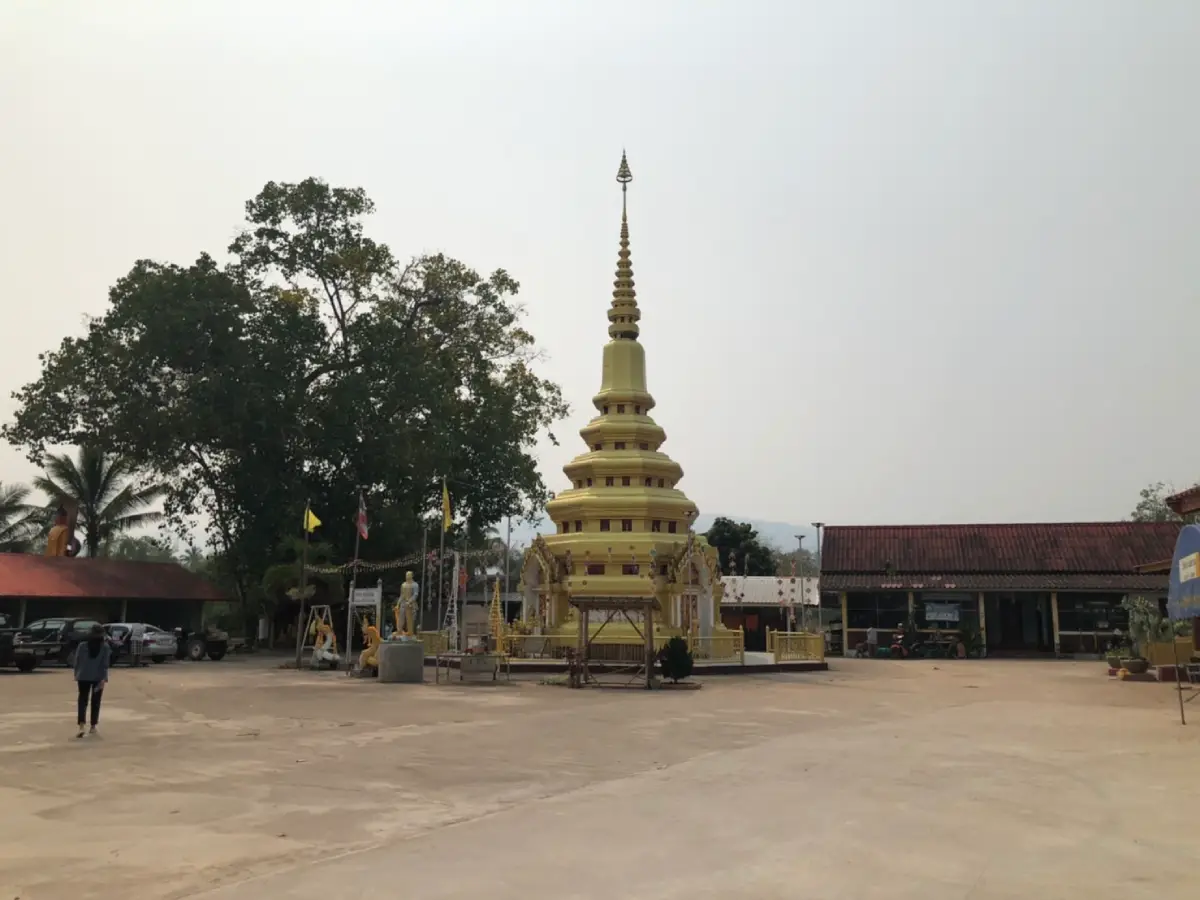
The present stupa is striking because of its golden color and tiered form. Standing on the temple grounds, it rises in stacked levels toward the top, creating a calm but dignified profile. The gold surface catches the sunlight beautifully, especially in the morning and late afternoon. This makes the stupa a strong visual center of the temple and one of the key photographic points for visitors interested in Buddhist architecture and local temples in Loei.
The name “Phra That Umong” is part of the local memory of Ban Yang. The word “Umong” gives a sense of an old, hidden, or sacred place, and the name continues to connect the present temple with the older religious site that once stood here. For the local community, the name is not merely a label. It represents a sacred memory, a historic landmark, and a spiritual inheritance passed down through generations.
Ban Yang itself has an interesting local history. The name of the village is associated with different local explanations, including memories of a group known as Yang people or Karen people who once settled in the area, as well as the nearby Huai Yang stream. Another local account refers to a group of 7 families from Vientiane who settled in the broader area of the Kham River basin. These stories reveal the layered history of Ban Yang, including migration, local settlement, agriculture, and cultural links across the Thai-Lao border region.
The landscape around Wat Phra That Umong is closely connected with the Kham River basin and the agricultural life of Ban Yang. Visitors can still feel the atmosphere of a rural village: farmland, local roads, hills, and simple community life. This quiet environment is one of the strongest reasons to visit the temple. Instead of a crowded tourist site, travelers find a peaceful religious place where local life continues naturally around the temple.
Wat Phra That Umong also plays an active role in the religious life of the community. Local people use the temple for Buddhist holy days, merit-making, Kathin ceremonies, and other Buddhist activities. This active function makes the temple a living community space rather than a site preserved only for tourism. Visitors should remember that the temple is still used for real religious purposes and should behave respectfully at all times.
The abbot of Wat Phra That Umong is Phra Sawat Attarakho. The temple is a local Buddhist temple that continues to serve the Ban Yang community. Because monks and caretakers are present, the temple grounds are maintained for worshippers and visitors. Travelers should dress modestly, keep their voices low, and avoid behavior that may disturb people who come to pray or take part in religious activities.
Upon entering the temple grounds, the first feature that catches the eye is the golden stupa standing in an open courtyard. Visitors can walk around the area, pay respect, and take photographs from several angles. The base of the stupa and the worship area should be treated with respect. Visitors should not climb on any part of the structure, place personal items on sacred areas, or touch religious elements unnecessarily.
The overall atmosphere of Wat Phra That Umong is simple, peaceful, and deeply local. It does not have the busy environment of major city temples. Instead, it offers the calmness of a rural village temple, the sound of the surrounding landscape, and a sense of continuity between the community and its sacred site. This makes it suitable for travelers who prefer slow travel, local culture, and quiet places of worship.
One important reason Wat Phra That Umong is especially interesting is its connection with Phu Pha Ngaem and the giant Makha tree. Phu Pha Ngaem is a natural attraction in Ban Yang, Mu 5, Tha Li Subdistrict. It is known for viewpoints, forest scenery, and a community-managed mountain route. For some Phu Pha Ngaem trips, visitors prepare at Wat Phra That Umong before continuing to the mountain route. This connection makes the temple both a spiritual site and a gateway to community-based nature tourism.
Phu Pha Ngaem is suitable for travelers who enjoy viewpoints, forests, and local adventure. The trip involves local transport and walking, so visitors should contact the community tourism group in advance, wear proper walking shoes, carry drinking water, and follow safety instructions. Combining Wat Phra That Umong with Phu Pha Ngaem creates a balanced itinerary that includes both Buddhist culture and natural scenery.
The temple also connects with the wider cultural life of Ban Yang. The community has local knowledge in agriculture, bamboo basketry, cotton weaving, and traditional rural skills. A visit to the temple can therefore become part of a broader cultural journey. Travelers who spend more time in the village can observe local life, small shops, farming landscapes, and traditional craftsmanship that continue to shape the identity of Ban Yang.
The best time to visit Wat Phra That Umong is in the morning or late afternoon. The temperature is more comfortable, the light is softer, and the golden stupa looks especially beautiful under natural light. If visitors plan to continue to Phu Pha Ngaem, they should begin early and check local arrangements before traveling. For a quiet temple visit, weekdays and non-festival periods are ideal.
During the rainy season, travelers should check road and weather conditions because Tha Li District includes hilly areas and some roads can become slippery. The cool season is one of the most pleasant times to visit Ban Yang, with comfortable temperatures, clearer skies, and scenic rural landscapes. The hot season can still be suitable for temple visits, especially if combined with nearby riverside or water attractions such as Kaeng Ton, but visitors should carry water and avoid excessive midday heat.
Getting There is easiest by private car or rental car. From Tha Li District town, travel south for about 10 km toward Ban Yang, Mu 5, Tha Li Subdistrict. The route passes through local roads and rural scenery. Travelers can search for “Wat Phra That Umong Ban Yang Tha Li Loei” on online maps. Having a private vehicle is recommended because it allows visitors to continue easily to nearby attractions such as Wat Umong Mangkhlaram, Phu Pha Ngaem, Phra That Sajja, Kaeng Ton, and the Thai-Lao border landscapes of Tha Li.
A half-day itinerary can begin with a morning visit to Wat Phra That Umong, followed by a short stop at nearby sites in Ban Yang and lunch in Tha Li town. A full-day itinerary can include Phra That Sajja, Kaeng Ton, or Phu Pha Ngaem, depending on the weather and physical readiness of the group. Travelers who wish to explore more deeply can stay overnight in Ban Yang or Tha Li District, allowing more time to experience local life, morning scenery, and nearby nature routes.
For travelers interested in local history, it is worth reading Wat Phra That Umong together with the story of Ban Yang. The stupa is not separate from the village. It is part of a cultural landscape that includes old religious traces, settlement memories, local waterways, and the continuing Buddhist faith of the community. Seeing the temple in this context makes the visit richer and more meaningful than a simple sightseeing stop.
For Buddhist travelers, paying respect at Phra That Umong should be done with calmness and sincerity. Visitors should dress modestly, remove hats in sacred areas, keep the site clean, and avoid loud conversations around the stupa. Photography is welcome when done respectfully, but visitors should not disturb people who are praying or taking part in religious ceremonies.
For photographers, the best angles include the front of the golden stupa, the open courtyard, side views showing the tiered structure, and the surrounding rural temple atmosphere. Morning light gives a calm feeling, while late afternoon light makes the gold surface of the stupa stand out strongly. In the cool season, the temple and village atmosphere can be especially photogenic.
Wat Phra That Umong is also a useful base for exploring Tha Li District. Nearby attractions include Phra That Sajja, another important sacred site; Kaeng Ton, a local water attraction; Phu Pha Ngaem, a community nature destination; and borderland routes along the Hueang River. Starting the journey at Wat Phra That Umong gives the trip a meaningful spiritual beginning before continuing to nature, food, and local accommodation in the district.
For visitors from outside Loei, this temple reveals a quieter side of the province. Loei is widely known for Chiang Khan, Phu Kradueng, and Phu Ruea, but Tha Li has its own cultural depth and rural charm. Wat Phra That Umong shows how a village-level sacred site can carry strong religious meaning and connect with community-based tourism in a way that large tourist destinations often cannot.
Before traveling, visitors should prepare modest clothing, comfortable shoes, drinking water, a camera, and an online map saved in advance. Those planning to visit Phu Pha Ngaem should prepare for a more active nature route and contact the local tourism group before departure. Families or elderly visitors may prefer the temple and nearby village sites, while more active travelers can combine the temple visit with mountain scenery.
Accommodation options are available in Ban Yang, Tha Li town, and nearby areas. Because Tha Li is not a major mass-tourism district, travelers should book in advance during long weekends or holiday periods. Staying in the area allows visitors to enjoy the morning village atmosphere, local food, and a more relaxed travel pace than a quick day trip.
Wat Phra That Umong, Ban Yang, is therefore an excellent destination for travelers seeking a peaceful temple, local Buddhist heritage, and a deeper experience of Loei Province. Its golden stupa, restored from the remains of an older sacred site, its enshrined relics, and its connection with Phu Pha Ngaem make it valuable for religious, cultural, and community-based tourism. For anyone exploring Tha Li District, this temple deserves a place on the itinerary.
| Name | Wat Phra That Umong |
| Location | Mu 5, Ban Yang, Tha Li Subdistrict, Tha Li District, Loei Province |
| Address | Wat Phra That Umong, Mu 5, Ban Yang, Tha Li Subdistrict, Tha Li District, Loei Province 42140, Thailand |
| Highlights | Sacred old stupa of Ban Yang, restored over the original base and brick remains, enshrining relics of the Buddha, relics of disciples, and soil from the holy Buddhist sites in India |
| History | The original stupa remained as a base and brick ruins before a new stupa was built over the old sacred structure in 1997 with support from Luang Pu Khamphan |
| Name Origin | The name Phra That Umong is connected with local memory of Ban Yang and the older sacred religious site in this area |
| Distinctive Features | Golden tiered stupa standing in a peaceful village temple, suitable for worship, merit-making, and religious photography |
| Sacred Objects | 225 relics of the Buddha, relics of Buddhist disciples, and soil from the holy Buddhist sites in India |
| Travel Information | From Tha Li District town, travel south for about 10 km to Ban Yang, Mu 5. Private car or rental car is recommended. |
| Current Status | Active local Buddhist temple and sacred community landmark for worship, merit-making, and cultural tourism |
| Open Days | Daily |
| Opening Hours | 08.00 – 17.00 |
| Facilities | Temple courtyard, worship area, religious activity space, local parking area, and community meeting point for Phu Pha Ngaem trips |
| Main Areas / Zones | Phra That Umong stupa, courtyard around the stupa, worship area, temple activity area, and surrounding Ban Yang community space |
| Abbot / Caretaker | Phra Sawat Attarakho |
| Main Contact Number | 080-015-9353 |
| Official Website / Official Page | Facebook page: Wat Phra That Umong |
| Nearby Tourist Attractions | 1. Wat Umong Mangkhlaram, Ban Yang, about 1 km 2. Phu Pha Ngaem and the giant Makha tree, about 3 km, Tel. 098-210-4626 3. Phra That Sajja, Tha Li District, about 13 km 4. Kaeng Ton, Tha Li District, about 18 km 5. Phu Mak Kheng Viewpoint, about 35 km 6. Hueang River and Thai-Lao border route, about 18 km |
| Nearby Restaurants | 1. Kuai Tiao Mu Nam Tok by Namphueng, about 11 km, Tel. 087-856-5855 2. Kuai Tiao Ruea Khun Pu, about 12 km, Tel. 042-033-862 3. Pang Nuea Restaurant, about 12 km 4. Kab Khao Mae Nong Om Restaurant, about 11 km 5. Hoi Tod Pad Thai Nai Nat, about 12 km 6. Café Amazon - DD1789 Neramit Petroleum Station, about 12 km |
| Nearby Accommodations | 1. Ban Chao O Homestay, about 1 km, Tel. 099-969-3139 2. Le Bar Tarry Hotel, about 12 km, Tel. 095-754-6268 3. Hero and Hug Loft Hotel, about 13 km, Tel. 061-934-8788, 094-628-5727 4. Ban Suan Rim Than Resort, Tha Li District, about 8 km 5. Tara Homestay, about 18 km, Tel. 081-871-8100 6. Hian Samapi Homestay, about 22 km, Tel. 064-402-5460 |
Frequently Asked Questions (FAQ)
Q: Where is Wat Phra That Umong located?
A: Wat Phra That Umong is located in Mu 5, Ban Yang, Tha Li Subdistrict, Tha Li District, Loei Province, about 10 km south of Tha Li District town.
Q: Why is Wat Phra That Umong important?
A: The temple enshrines Phra That Umong, a sacred old stupa of Ban Yang. Inside are relics of the Buddha, relics of Buddhist disciples, and soil from the holy Buddhist sites in India.
Q: What are the opening hours of Wat Phra That Umong?
A: The temple is open daily from 08.00 to 17.00, making it suitable for worship, merit-making, and cultural sightseeing.
Q: Who is the abbot of Wat Phra That Umong?
A: The abbot of Wat Phra That Umong is Phra Sawat Attarakho.
Q: How can travelers get to Wat Phra That Umong?
A: From Tha Li District town, travel south for about 10 km to Ban Yang, Mu 5. A private car or rental car is the most convenient option.
Q: What attractions can be visited near Wat Phra That Umong?
A: Nearby attractions include Wat Umong Mangkhlaram, Phu Pha Ngaem and the giant Makha tree, Phra That Sajja, Kaeng Ton, Phu Mak Kheng Viewpoint, and the Hueang River border route.
Q: Who should visit Wat Phra That Umong?
A: The temple is ideal for Buddhist travelers, cultural visitors, people interested in Ban Yang community history, and travelers who want to combine a peaceful temple visit with nearby nature attractions in Tha Li District.
Q: What should visitors wear when visiting Wat Phra That Umong?
A: Visitors should dress modestly, behave respectfully, avoid climbing or touching sacred structures, and keep the temple atmosphere peaceful for worshippers.
 Category: ●Places of Worship
 Group: ●Temple
Last Update : 2 MonthAgo
 Last Update : 2 MonthAgo
 Click to Access the Navigation Map GPS
Wat Phra That Umong Map
Recommend

 Art, Culture and Heritage
 Historical Sites and Monuments(2)
 Landmarks and Memorials(3)
 Art, Craft Centres, Tradition(2)
 Museums(4)
 Art Gallery(1)
 Educational Places
 Educational Gardens, Farm(2)
Temple(16)
Educational Gardens, Farm(2)
Temple(16)
 Other Sacred Sites(8)
 Research and Development
 Royal Project(3)
 Suburban Living
 Village, Community(3)
 Local Market(1)
 Nature and Wildlife
 National Parks and Marine Reserves(5)
 Mountain (Doi)(10)
 Dam, Reservoir, Lake(7)
 Waterfalls(21)
 Caves(3)
 River, Canal(5)
 Bays and Beaches(1)
 Other natural attractions(1)
 Entertainment and Agricultural
 Farms, Parks and Ecotourism(8)
 Waterpark(1)
 Outdoor and Adventure Activities(2)


