
lovethailand home >Northeastern Travel Attractions >Loei Travel Attractions >Na Haeo >Saeng Pha > Phra That Din Thaen
TL;DR: Phra That Din Thaen is located at Ban Saeng Pha / Ban Hua Na, Saeng Pha Subdistrict, Na Haeo District, Loei Province, open Daily, hours 08.00 – 17.00.

Phra That Din Thaen
Open Days: Daily
Opening Hours: 08.00 – 17.00
Phra That Din Thaen in Loei Province, also known locally as Phra That Din Thaem, is one of the most distinctive sacred sites in Na Haeo District. It is located west of Ban Saeng Pha in Saeng Pha Subdistrict, Na Haeo District, within the grounds of Wat Phra That on an area of about 50 rai. The site is about 800 meters from Ban Saeng Pha village and about 10–12 kilometers from Na Haeo town. Unlike most stupas in Thailand, Phra That Din Thaen was not built mainly with brick, plaster, or carved stone. It was formed from soil, stones, and sand brought by local people and devotees over generations, creating a large sacred earthen mound that represents Buddhist faith, community ethics, and the moral identity of Ban Saeng Pha.
The origin of Phra That Din Thaen is traditionally dated to 1621. According to local history, a forest monk traveled from Bangkok Noi to Ban Saeng Pha and found that the villagers still practiced spirit worship involving the killing of animals for vows and offerings. Seeing that this practice conflicted with Buddhist principles, he taught the villagers the proper way to take refuge in Buddhism through the Triple Gem: the Buddha, the Dhamma, and the Sangha. He also encouraged them to live according to the Five Precepts. The villagers then joined together to build the stupa using soil and stones. In this way, the creation of Phra That Din Thaen was not only the construction of a sacred monument but also a moral transformation of the community.
The most important principle associated with Phra That Din Thaen is the abstention from killing animals on Buddhist observance days and the preceding wan kon days. This includes the 7th or 8th lunar days and the 14th or 15th lunar days, both in the waxing and waning phases of the moon. Local people continue to connect this practice with the vow made before the stupa. This makes Phra That Din Thaen remarkable not only as a physical landmark but also as a living symbol of compassion, non-violence, and Buddhist discipline. The stupa stands as a reminder that true worship should not require the taking of life.
In the past, people in the area believed strongly in spirits and supernatural protection. When facing illness, misfortune, or uncertainty, they often made vows and offered animals according to older beliefs. The arrival of the forest monk became a turning point. Instead of rejecting local faith harshly, he redirected it toward Buddhist ethics. The villagers were taught that devotion could be expressed through wholesome actions, not sacrifice. Soil and stone became substitutes for animal offerings. This is why the name Din Thaen, meaning soil as a substitute, carries such deep meaning.
The act of bringing soil to the stupa is central to the site’s identity. Some people bring soil as an offering, some bring it as part of a vow, and others do it simply to participate in the inherited faith of the village. The offering is humble, but its meaning is powerful. It uses ordinary earth to replace violence and uses physical effort to express moral intention. This makes Phra That Din Thaen one of the most meaningful examples of how Buddhist ethics can become part of everyday community practice.
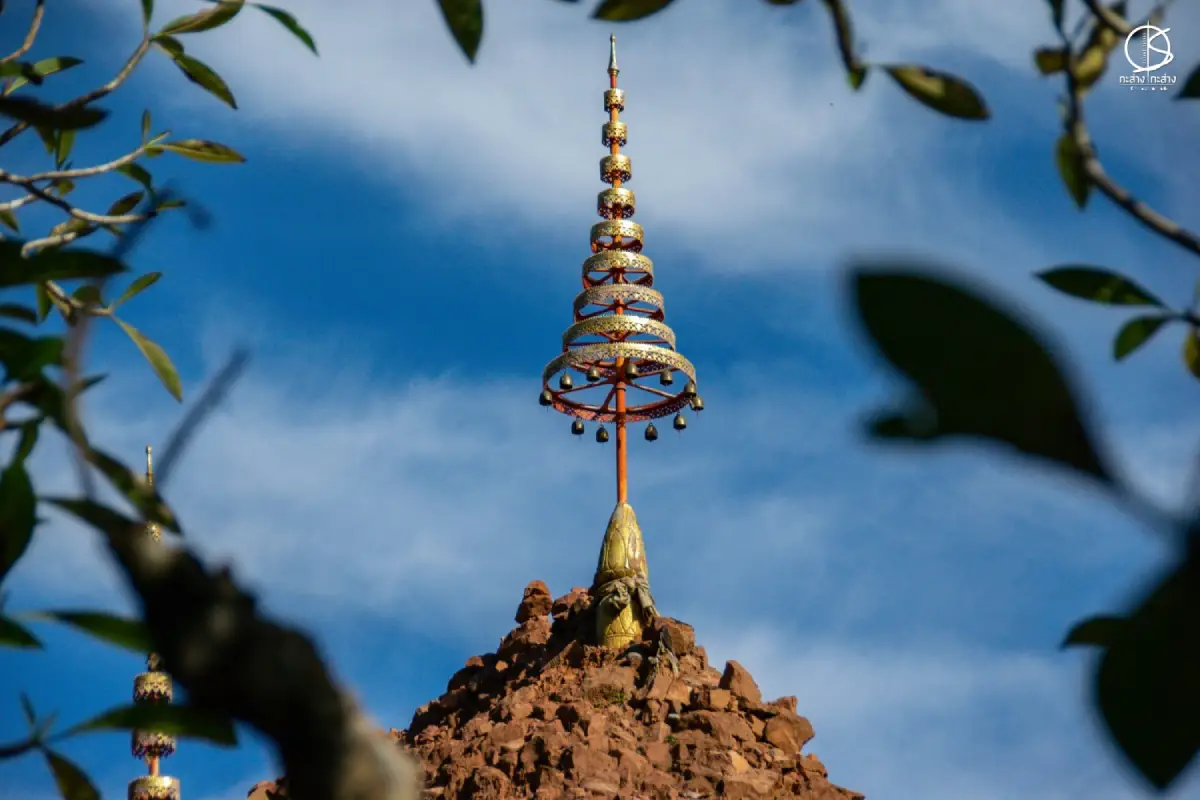
The appearance of the stupa is simple and powerful. It is a large earthen mound made from accumulated soil, stones, and sand. At the top are ceremonial umbrellas and auspicious elements, giving the mound the presence of a sacred hill rather than a conventional decorated stupa. Its beauty does not come from elaborate ornamentation. It comes from the visible layers of faith built up by villagers over time. Every handful of soil and every stone represents participation in a shared vow of non-harming.
Phra That Din Thaen is also closely connected with the landscape of Na Haeo, a mountainous district in Loei Province known for valleys, forests, cool air, borderland communities, and strong local traditions. Ban Saeng Pha is an old village with important cultural sites such as Wat Si Pho Chai and the famous Ton Dok Mai procession tradition. A visit to Phra That Din Thaen therefore should not be seen as an isolated stop. It is part of a wider cultural landscape of Saeng Pha, where temples, village rituals, mountain scenery, and Buddhist practice remain closely connected.
Ban Saeng Pha is a community with strong cultural continuity. Local people continue to value Buddhist observance days, merit-making, village ceremonies, and traditional practices. The rule against killing animals on observance days remains an important moral reminder. It teaches people to live with kindness toward animals, nature, and one another. For travelers, this gives the site a different feeling from ordinary tourist attractions. It is a place where local ethics are still visible in community life.
Behind the main stupa area, there is a route leading up to a Buddha footprint. The distance is not long, but the path is fairly steep in places. Visitors who want to continue to the footprint should wear comfortable shoes and walk carefully, especially during wet weather. This additional route enriches the visit because it connects the earthen stupa, created by community faith, with the symbolic act of following in the footsteps of the Buddha.
Worship at Phra That Din Thaen is usually simple. Visitors may pay respect, make merit, offer prayers, or bring soil and stones according to personal faith and local custom. The heart of worship here is not the value of offerings but the intention to reduce harm and live with moral discipline. Visitors should speak softly, dress modestly, avoid climbing on the stupa, avoid removing soil or stones from the site, and respect the quiet atmosphere of the temple grounds.
The site is also an excellent place for learning about local culture. It shows that a sacred monument can be important not because of grandeur but because of the idea it represents. Phra That Din Thaen tells the story of a community moving from animal sacrifice toward Buddhist refuge, merit-making, and ethical living. It is a clear example of how religion and village life can shape one another across generations.
The temple grounds are spacious and peaceful. Visitors will find a rural mountain atmosphere rather than the busy feeling of major city attractions. The sound of wind, birds, and village life gives the place a calm character. Morning is an especially good time to visit because the weather is cooler and the light is soft. Late afternoon is also pleasant for photography and for observing the surrounding hills and village landscape.
Getting There from Na Haeo town is most convenient by private car or local transport. Follow Highway 2113 and continue toward Ban Mueang Phrae and Ban Saeng Pha. From Ban Saeng Pha, a local road leads to Phra That Din Thaen, about 800 meters to 1 kilometer from the village. The final section is a local access road, so visitors should drive carefully, especially after rain. Travelers coming from Loei city should allow extra time because Na Haeo is a mountainous district with winding roads.
A visit can be combined easily with other places in Saeng Pha and Na Haeo. A half-day route may include Phra That Din Thaen, Wat Si Pho Chai, Ban Saeng Pha community, and nearby village scenery. A full-day route can add Phu Suan Sai National Park, Phu Hua Hom viewpoint, Tad Hueang Waterfall, Tad Mueang Waterfall, or Wat Pho Chai at Ban Na Phueng. Na Haeo is best explored slowly because its charm lies in mountains, borderland villages, old temples, and quiet natural landscapes.
The best time to visit is from morning to late afternoon. Morning offers cool air and a peaceful atmosphere for worship. During the cool season, Na Haeo has especially pleasant weather and, on some days, misty mountain views. The rainy season gives the area a lush green appearance, but roads and walking paths may become slippery. In the hot season, visitors should bring drinking water, a hat, and sun protection.
Etiquette at Phra That Din Thaen should reflect the moral meaning of the place. Visitors should avoid bringing activities that conflict with the site’s principle of non-harming, especially on Buddhist observance days. Do not litter, make loud noise, climb the stupa, write on surfaces, move soil or stones improperly, or disturb ritual areas. If visitors wish to bring soil as an offering or perform a specific vow, they should ask local caretakers or community members for guidance.
For photographers, Phra That Din Thaen offers a visual identity unlike most stupas in Thailand. The earthen mound, ceremonial umbrellas, offering parasols, natural soil textures, trees, and mountain surroundings create a simple but powerful image. The best photographs are those that show the humility and meaning of the site. Visitors should not climb onto the stupa for a better angle or use inappropriate poses in the sacred area.
Phra That Din Thaen is also meaningful for travelers interested in the relationship between Buddhism and folk belief. The site shows how an older practice of spirit offering was transformed into a Buddhist practice based on the Triple Gem and the Five Precepts. This was not simply a rejection of local belief but a redirection of faith toward compassion and ethical conduct. For international visitors, this makes the site a valuable example of living Buddhist culture in rural northeastern Thailand.
From an eco-cultural tourism perspective, the site connects naturally with Na Haeo’s broader identity. The district is known for forests, waterfalls, viewpoints, old temples, and communities that maintain strong traditions. Visiting Phra That Din Thaen can be the beginning of a deeper journey into Na Haeo’s landscape, including Phu Suan Sai National Park, Phu Hua Hom viewpoint, and the borderland villages near the Hueang River.
The lasting impression of Phra That Din Thaen comes from its meaning rather than its scale. Ordinary soil becomes sacred because it replaces killing. Ordinary stones become offerings because they are placed with faith. Ordinary observance days become community commitments because people continue to practice restraint and compassion. This simplicity gives the stupa a spiritual clarity that many larger monuments do not have.
Phra That Din Thaen is therefore a worthwhile destination for travelers visiting Na Haeo and Loei Province. It offers a sacred earthen stupa, a story of moral transformation, a living community vow against killing, a route to a Buddha footprint, and a peaceful mountain village atmosphere. Visitors who come with respect, patience, and awareness of the site’s ethical meaning will understand why this humble earthen stupa remains one of the most meaningful sacred places in Na Haeo.
| Name | Phra That Din Thaen / Phra That Din Thaem / Wat Phra That Din Thaen |
| Location | Ban Saeng Pha / Ban Hua Na, Saeng Pha Subdistrict, Na Haeo District, Loei Province |
| Address | Wat Phra That Din Thaen, Saeng Pha Subdistrict, Na Haeo District, Loei Province 42170, Thailand |
| Coordinates | FXWR+9JV, Saeng Pha Subdistrict, Na Haeo District, Loei Province |
| Highlights | A sacred earthen stupa formed from soil, stones, and sand offered by devotees, with an important community principle of abstaining from killing animals on Buddhist observance days |
| History / Period | Built in 1621 by a forest monk from Bangkok Noi who guided villagers from animal sacrifice and spirit worship toward taking refuge in the Triple Gem and observing Buddhist precepts |
| Stupa Features | A large sacred earthen mound made from accumulated soil, stones, and sand, topped with ceremonial umbrellas and auspicious symbols |
| Important Practice | Abstaining from killing animals on wan kon and Buddhist observance days, especially the 7th–8th and 14th–15th lunar days, both waxing and waning, while maintaining the Five Precepts and avoiding harmful ritual practices |
| Key Features Inside | Phra That Din Thaen, worship courtyard, soil and stone offering area, route to the Buddha footprint behind the stupa, temple grounds, and the cultural landscape of Ban Saeng Pha |
| Travel Information | From Na Haeo town, follow Highway 2113 toward Ban Mueang Phrae and Ban Saeng Pha. From Ban Saeng Pha, a local road leads to the stupa, about 800 meters to 1 kilometer from the village. |
| Approximate Distance | About 800 meters from Ban Saeng Pha and about 10–12 km from Na Haeo town |
| Current Status | Open as a sacred site and community cultural learning place in Saeng Pha Subdistrict for worship, merit-making, soil offerings, cultural learning, and travel routes around Na Haeo |
| Open Days | Daily |
| Opening Hours | 08.00 – 17.00 |
| Fees | No Admission Fee |
| Facilities | Parking area, worship courtyard, walking area around the stupa, route to the Buddha footprint, temple grounds, and local shops during visitor periods |
| Main Areas / Zones | Lower courtyard, Phra That Din Thaen stupa, soil and stone offering area, worship point, Buddha footprint route, shaded temple area, and connection to Ban Saeng Pha community |
| Abbot / Caretaker | Phra Khru Mongkhon Chediyakhun (Luang Pho Huean Panyapalo) / Wat Phra That Din Thaen And Ban Saeng Pha Community |
| Local Administrative Office | Saeng Pha Subdistrict Administrative Organization and Na Haeo local tourism authorities |
| Nearby Tourist Attractions | 1. Wat Si Pho Chai, Ban Saeng Pha, about 1 km 2. Ban Saeng Pha Community And Ton Dok Mai Procession Route, about 1 km 3. Phu Suan Sai National Park, about 8 km, Tel. 094-239-2498 4. Phu Hua Hom Viewpoint, about 12 km, Tel. 094-239-2498, 086-066-4147 5. Tad Mueang Waterfall, about 15 km 6. Tad Hueang Waterfall / Thai-Lao Friendship Waterfall, about 18 km 7. Wat Pho Chai, Ban Na Phueng, about 20 km 8. Ban Mueang Phrae Thai-Lao Border Checkpoint Area, about 12 km |
| Nearby Restaurants | 1. My Wife Coffee And Homestays, Saeng Pha Subdistrict, about 3 km 2. Local Pork Noodle Shop, Moo 5, Saeng Pha Subdistrict, about 5 km 3. MACLOEI Fineness Macadamia Product, Ban Bo Mueang Noi, about 8 km, Tel. 091-935-4926 4. Coffee View, Na Haeo District, about 10 km, Tel. 081-563-0996 5. Kodang Cafe Na Haeo, about 12 km, Tel. 087-306-4222 6. Reforest Coffee Nahaeo, about 12 km |
| Nearby Accommodations | 1. My Wife Coffee And Homestays, Saeng Pha Subdistrict, about 3 km 2. Na Haeo Resort, Ban Mueang Phrae, about 8 km, Tel. 081-826-7369 3. Phu Hua Hom Camping Area, Phu Suan Sai National Park, about 12 km, Tel. 094-239-2498, 086-066-4147 4. Camp Baan Khun Mae, Na Haeo District, about 12 km, Tel. 064-514-2289 5. Ban Saeng Pha Community Homestay, about 1–2 km 6. Accommodations In Na Haeo Town, about 10–12 km |
Frequently Asked Questions (FAQ)
Q: Where is Phra That Din Thaen located?
A: Phra That Din Thaen is located at Ban Saeng Pha / Ban Hua Na, Saeng Pha Subdistrict, Na Haeo District, Loei Province, about 800 meters from Ban Saeng Pha village and about 10–12 km from Na Haeo town.
Q: What are the opening hours of Phra That Din Thaen?
A: The site is open daily from 08.00 to 17.00. Morning to late afternoon is the best time for worship, walking around the stupa, and visiting the Buddha footprint route behind the site.
Q: When was Phra That Din Thaen built?
A: Phra That Din Thaen, also known as Phra That Din Thaem, was built in 1621 by a forest monk from Bangkok Noi together with villagers, using soil, stones, and sand.
Q: Why is Phra That Din Thaen important?
A: It is important because it represents a shift from animal sacrifice to Buddhist refuge, the Five Precepts, and merit-making through non-violent offerings such as soil, stones, and sand.
Q: What is the main practice associated with Phra That Din Thaen?
A: The main practice is abstaining from killing animals on wan kon and Buddhist observance days, especially the 7th–8th and 14th–15th lunar days, both waxing and waning, while maintaining the Five Precepts.
Q: What should visitors prepare before visiting?
A: Visitors should dress modestly, wear comfortable walking shoes, bring drinking water, and walk carefully if continuing to the Buddha footprint behind the stupa because the route is somewhat steep.
Q: Is there an admission fee?
A: There is no admission fee. Visitors may pay respect and make merit according to their faith while keeping the area clean and respecting local customs.
Q: What nearby attractions can be visited with Phra That Din Thaen?
A: Nearby attractions include Wat Si Pho Chai, Ban Saeng Pha community, Phu Suan Sai National Park, Phu Hua Hom viewpoint, Tad Hueang Waterfall, Tad Mueang Waterfall, Wat Pho Chai Ban Na Phueng, and Ban Mueang Phrae border area.
 Category: ●Places of Worship
 Group: ●Other Sacred Sites
Last Update : 1 MonthAgo
 Last Update : 1 MonthAgo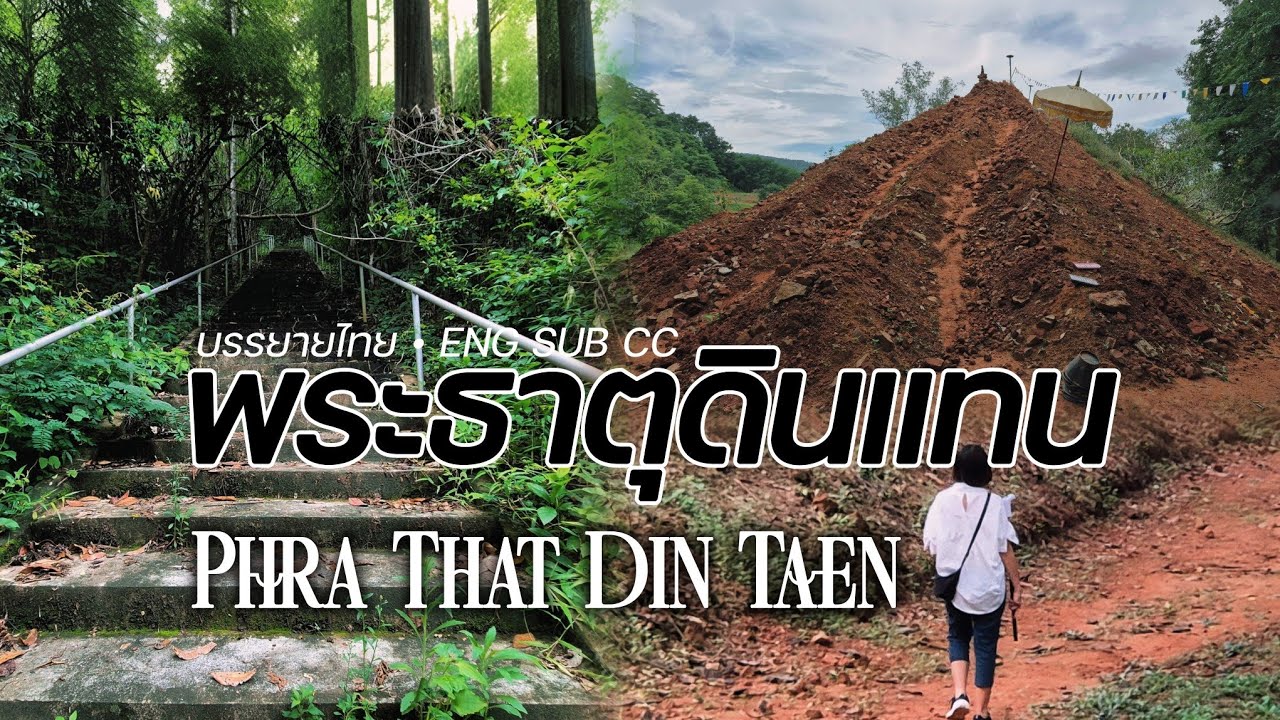
 Click to Access the Navigation Map GPS
Phra That Din Thaen Map
Recommend

 Art, Culture and Heritage
 Historical Sites and Monuments(2)
 Landmarks and Memorials(3)
 Art, Craft Centres, Tradition(2)
 Museums(4)
 Art Gallery(1)
 Educational Places
 Educational Gardens, Farm(2)
 Temple(16)
Other Sacred Sites(8)
Temple(16)
Other Sacred Sites(8)
 Research and Development
 Royal Project(3)
 Suburban Living
 Village, Community(3)
 Local Market(1)
 Nature and Wildlife
 National Parks and Marine Reserves(5)
 Mountain (Doi)(10)
 Dam, Reservoir, Lake(7)
 Waterfalls(21)
 Caves(3)
 River, Canal(5)
 Bays and Beaches(1)
 Other natural attractions(1)
 Entertainment and Agricultural
 Farms, Parks and Ecotourism(8)
 Waterpark(1)
 Outdoor and Adventure Activities(2)


