
lovethailand home >Northeastern Travel Attractions >Loei Travel Attractions >Na Haeo >Na Phueng > Wat Pho Chai Na Phueng
TL;DR: Wat Pho Chai Na Phueng is located at Ban Na Phueng, Na Phueng Subdistrict, Na Haeo District, Loei Province 42170, Thailand, open Daily, hours 07.00 – 18.00.

Wat Pho Chai Na Phueng
Open Days: Daily
Opening Hours: 07.00 – 18.00
Wat Pho Chai Na Phueng in Ban Na Phueng, Na Phueng Subdistrict, Na Haeo District, Loei Province, is one of the most culturally valuable historic temples in this quiet mountain district of northeastern Thailand. The temple is known for its old viharn, locally called an “aram,” its rare Isan-style mural paintings or hoop taem, and Phra Chao Ong Saen, an ancient Buddha image revered as a sacred guardian image of Ban Na Phueng and Na Haeo. For travelers who want more than a quick photo stop, this temple offers a deep encounter with local Buddhist art, community faith, old mural narratives, and the cultural memory of a historic village in Loei Province.
Wat Pho Chai Na Phueng is located in Ban Na Phueng, a rural community surrounded by mountains, streams, agricultural land, and forested landscapes. The name Na Phueng is connected with a local tree known as ton phueng and a stream called Lam Nam Phueng that flows through the community. As people settled in the area, the village became known as Ban Na Phueng. The temple grew alongside this community and became a spiritual, artistic, and social center for local residents over many generations.
The importance of Wat Pho Chai Na Phueng lies not only in its age, but also in the way it preserves a layered cultural identity. The temple reflects a blend of Lan Xang, Lanna, and upper northeastern Thai artistic traditions. Its old viharn, ordination hall, murals, Buddha images, local legends, and community setting reveal the historical connections between Na Haeo, Dan Sai, the Hueang River, Luang Prabang, and nearby Lao cultural zones. Visiting this temple helps travelers understand Loei beyond its famous mountains and cool climate.
The temple is believed to have origins around the late Ayutthaya period or the 22nd to 23rd Buddhist century. Other historical records indicate that the temple was formally established around 1832 and received its consecrated monastic boundary, known in Thai as wisungkhamsima, in 1837. These different layers of information suggest that the temple and the village have a long cultural history that predates later administrative records. Wat Pho Chai Na Phueng is therefore best understood as a living historic temple shaped by both oral tradition and documented heritage.
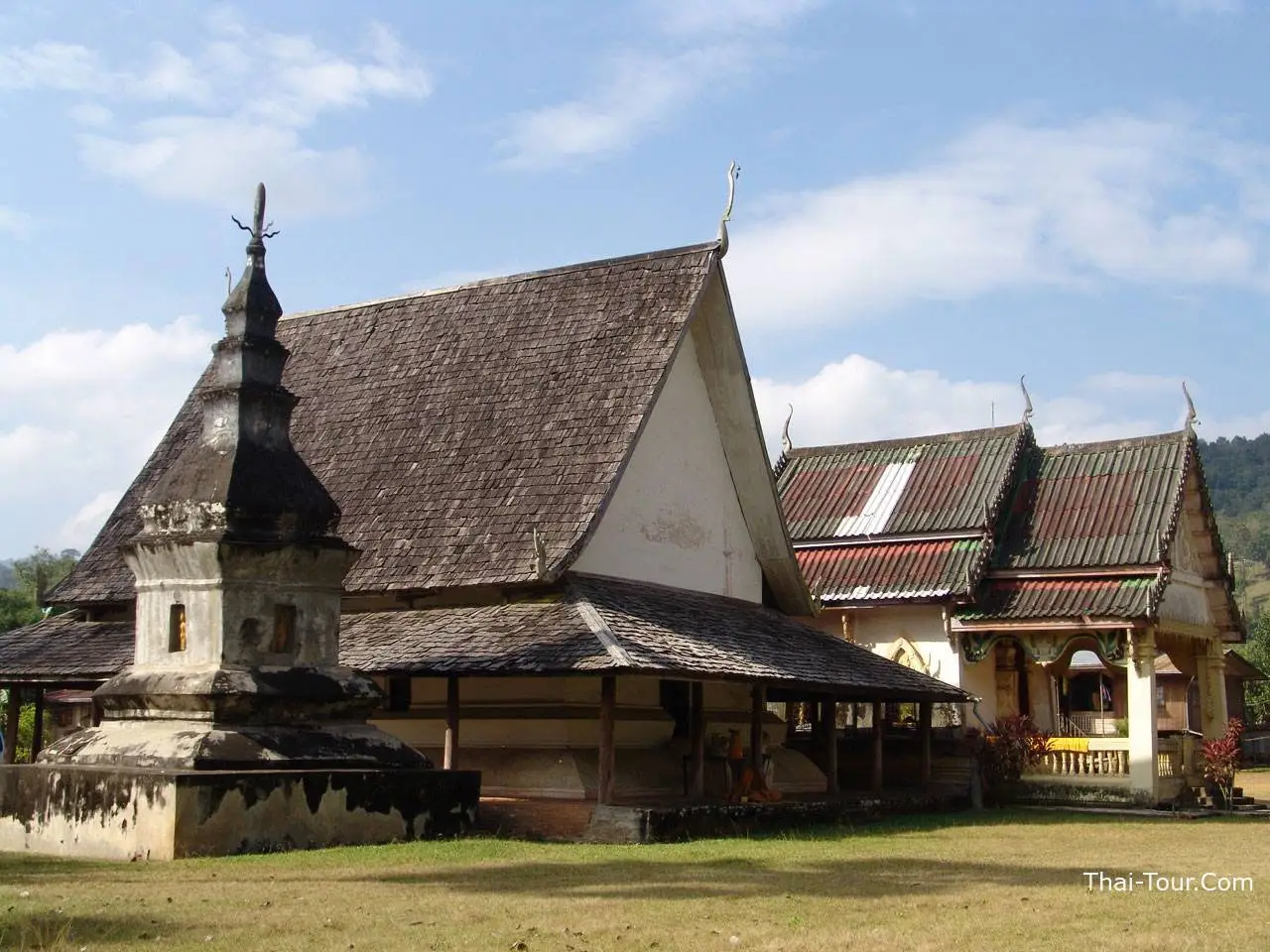
When entering the temple grounds, visitors can observe several important historic structures, including the old viharn, the ubosot or sim, stupas, a scripture hall, a drum tower, a small Buddha hall, the sao lak kham pillar, entrance gates, and the temple courtyard. The old viharn is the main highlight. It is a rectangular brick-and-plaster building facing north. It has three entrances: one to the north, one to the east, and one to the west, while the southern wall is solid. The roof is a gabled structure traditionally covered with wooden shingles and surrounded by low protective eaves supported by wooden posts. This low roofline is a distinctive feature of local temple architecture in Loei and also helps protect the murals from sunlight and rain.
At the entrances to the viharn are sculpted guardian creatures known locally as mom, which are mythical animals connected with Buddhist and local cosmological beliefs. These figures are not merely decorative. They mark the transition from the ordinary temple grounds into a sacred space. Their presence also shows how local artisans interpreted Buddhist architecture through village craftsmanship and regional imagination.
Inside the viharn is the main Buddha image, known as Phra Chao Yai, and mural paintings on all four interior walls. These murals are among the temple’s most significant treasures. They are painted in the local Isan tradition called hoop taem and show stories from the life of the Buddha, the Vessantara Jataka, the Nemi Jataka, and local folk narratives. The murals were painted using powdered pigments mixed with adhesive, with colors such as indigo, black, red, yellow, and white. The interior paintings retain a vivid and expressive quality that reflects the energy of local mural painting.
In the past, mural paintings in temples functioned as visual teaching tools. At a time when literacy was not widespread, these wall paintings allowed monks and elders to explain Buddhist teachings, moral lessons, stories of merit and karma, and local wisdom to younger generations. At Wat Pho Chai Na Phueng, the murals serve not only as works of art, but also as a visual scripture created for the community.
A key feature of the interior murals is an inscription on the northern wall. It states that the paintings were created in Chula Sakarat 1214, corresponding to 1852, during the reign of King Mongkut, Rama IV. This clear date gives the murals exceptional historical value because many old temple paintings do not have such precise inscriptions. For art historians and cultural travelers, this makes Wat Pho Chai Na Phueng an important reference site for studying local mural traditions in northeastern Thailand.
The exterior murals were painted later, in 1916. They include stories such as Phra Malai, Prince Nemi’s journey to hell, Sang Sin Chai, Karaket, and scenes of daily life and social change. Some images show modern elements of the period, including soldiers, clothing styles, bicycles, and trains. These details are fascinating because they show how local artists in a remote mountain district perceived and interpreted a changing world during the early 20th century.
The contrast between the interior and exterior murals is one of the most interesting aspects of the temple. The interior paintings focus more on Buddhist stories and Jataka narratives, while the exterior paintings include broader folk literature and scenes of social life. The use of color, line, composition, and storytelling also suggests different periods of painting, or possibly different groups of artists. This gives the temple a rare layered mural record that covers both sacred and everyday themes.
Another major sacred object at Wat Pho Chai Na Phueng is Phra Chao Ong Saen, also known as Phra Chao Fon Saen Ha. This ancient Buddha image is kept in the abbot’s residence. It is a bronze Buddha image seated in meditation posture, with an elongated oval face, a flame-like finial above the ushnisha, and a distinctive robe fold described locally as resembling a naga belly. The image is believed to be connected with Chiang Saen artistic traditions and has been revered by the people of Ban Na Phueng for many generations.
Local legends surrounding Phra Chao Ong Saen give the image even greater meaning. Villagers tell that wherever the Buddha image resides, rain will fall according to the season, water will be abundant, and drought will not afflict the land. This is why the image is also known as Phra Chao Fon Saen Ha, meaning a Buddha image associated with abundant rain. The belief connects the image with agriculture, fertility, seasonal balance, and the well-being of the community.
During the Songkran season, villagers traditionally bring Phra Chao Ong Saen out for ritual bathing and a change of ceremonial attire. This annual practice keeps the sacred image closely connected with community life. It is not treated merely as an ancient artifact, but as a living focus of faith. The ceremony allows villagers to make merit, pay respect, ask for blessings, and continue a tradition linked to water, renewal, and seasonal abundance.
Beyond the viharn and Phra Chao Ong Saen, the temple contains several other historic features. The ubosot or sim, the stupas, the scripture hall, the drum tower, the small Buddha hall, the entrance gate, and the sao lak kham pillar all help complete the sacred landscape of the temple. The sao lak kham pillar, with its lotus-bud capital and decorative motifs, was built as a memorial to former abbots. Such features show that Wat Pho Chai Na Phueng was not an isolated building, but a complete monastic site serving the religious needs of the community.
The wooden scripture hall is another valuable feature. A ho trai, or scripture hall, was traditionally used to store Buddhist texts and manuscripts. Its presence suggests that the temple once functioned as a place of learning and scriptural preservation. This aligns with local accounts of early abbots, especially Luang Pho Lak Kham Dhammacharn, who was remembered as a disciplined monk capable of reading ancient scripts and deeply versed in Buddhist teachings.
The Fine Arts Department registered Wat Pho Chai as a national historic site on 1 February 1987. This official recognition confirms the temple’s importance in terms of history, architecture, mural painting, and religious heritage. The old viharn, the murals, the sacred Buddha image, and the surrounding monastic structures together make the temple one of the most important cultural sites in Na Haeo District.
A visit to Wat Pho Chai Na Phueng should be slow and respectful. Travelers should begin by observing the temple courtyard and overall layout, then study the old viharn from the outside, paying attention to the low roof, wooden eaves, three entrances, and guardian mom figures. Inside the viharn, visitors should speak quietly and take time to observe the main Buddha image and mural paintings. After that, it is worth walking around the exterior walls to see the later murals, then continuing to the ubosot, stupas, scripture hall, and other structures.
Art lovers should spend extra time with the murals. The paintings contain many small details, including royal scenes, heavenly beings, villagers, soldiers, costumes, vehicles, moral episodes, and scenes from folk literature. The artists did not follow strict Western perspective. Instead, they used narrative arrangement, free line work, and bold color to communicate meaning. This gives the murals a direct and lively character that is deeply connected to local visual culture.
Travelers interested in community history should also learn about Ban Na Phueng itself. The village is known as an old Thai Loei community with abundant natural resources, local wisdom, and a distinctive weaving tradition called pha lai long. Visiting the temple can therefore be combined with learning about the community, including the story behind the village name, Lam Nam Phueng stream, the local environment, weaving, and the role of the temple in village life.
Getting There from Mueang Loei is straightforward but requires careful driving. Take the Loei–Dan Sai route for about 82 km, then turn right onto Highway 2113, the Dan Sai–Na Haeo route, and continue for about 23 km. When reaching Ban Na Phueng, follow the local road into the temple area. The route includes curves and mountain sections, so travelers should check the vehicle, drive during daylight, and allow enough travel time.
Travelers coming from Dan Sai can follow Highway 2113 toward Na Haeo. Wat Pho Chai Na Phueng is located before reaching Na Haeo town. This route is scenic, passing through mountain landscapes, agricultural areas, and rural communities. During the rainy season, caution is needed because roads may be slippery and visibility can drop. During the cool season, the area is especially pleasant and can be combined with nearby mist viewpoints.
The temple is open daily from 07.00 to 18.00 and has no admission fee. Visitors may prepare cash for voluntary merit-making donations. Because this is both an active temple and a registered historic site, visitors should dress modestly, avoid loud behavior, refrain from touching the murals, avoid using flash near old paintings, and not climb on or touch historic structures. Photography near sacred images or the abbot’s residence should be done respectfully.
Facilities listed for the temple include parking, toilets, shops, food, and basic facilities suitable for elderly visitors, guardians, and children. Even so, Wat Pho Chai Na Phueng remains a community temple rather than a large commercial tourist attraction. Travelers should prepare drinking water, personal medication, and extra time for rural mountain roads.
Nearby places that can be combined with a visit include Ban Na Phueng community and its weaving tradition, Wat Si Pho Chai in Ban Saeng Pha, Phu Kho–Phu Noi viewpoint, Pha Khoi Nang, Phu Suan Sai National Park, Phu Hua Hom, Tad Hueang Waterfall, and Ban Mueang Phrae community. A half-day trip can focus on the temple and Ban Na Phueng, while a full-day or overnight trip can add Na Haeo’s mountain viewpoints and natural attractions.
Restaurants and cafés in Na Haeo are mostly local eateries, coffee shops, Thai food restaurants, Isan food shops, and simple made-to-order places. Publicly listed options include Mac Loei, Reforest Coffee Na-Haeo, Rim Hueang, Stamp Restaurant, Krua Mae Si Fa, and Som Tam Tent & Toon. Travelers should check actual opening times before visiting, especially on weekdays or outside the main travel season.
Accommodation in Na Haeo includes resorts, homestays, farmstays, camping grounds, and viewpoint-area lodgings. Options found in public listings include Nahaeo Resort, Ban Phu Tawan Homestay, Ban Suan Sutthinan Homestay, Rai Lung Nueng, and homestays around Ban Bung and Phu Kho. Many of these places offer a quiet rural atmosphere, cool weather, and access to mountain views, making them suitable for travelers who want to visit the temple by day and enjoy misty scenery in the morning.
For a one-day trip from Mueang Loei, it is best to leave early, make Wat Pho Chai Na Phueng the main stop, and spend at least one to two hours exploring the viharn, murals, Buddha images, and temple grounds. Afterward, travelers can have lunch in Na Haeo and continue to Wat Si Pho Chai or a nearby viewpoint. For an overnight trip, staying in Na Haeo allows more time to visit Phu Kho or Phu Hua Hom at sunrise and return to the temple or village with a more relaxed schedule.
Wat Pho Chai Na Phueng is especially suitable for travelers who want cultural depth rather than a simple sightseeing stop. The temple brings together old architecture, dated mural paintings, sacred images, Songkran ritual traditions, Thai Loei community identity, local weaving, and a mountain-border landscape. It gives visitors a more complete understanding of Loei Province as a place of Buddhist heritage, living village culture, and regional artistic diversity.
The most memorable aspect of Wat Pho Chai Na Phueng is the completeness of its cultural story. Phra Chao Ong Saen represents living faith. The hoop taem murals represent visual knowledge and local imagination. The old viharn represents village craftsmanship. Ban Na Phueng represents the community that continues to preserve these memories. A visit here is therefore a journey into art, faith, and local life at the same time.
In summary, Wat Pho Chai Na Phueng is one of the most important old temples and national historic sites in Na Haeo District, Loei Province. Its old viharn, 1852 interior murals, 1916 exterior murals, Phra Chao Ong Saen ancient Buddha image, and official registration as a national historic site on 1 February 1987 make it an essential destination for travelers interested in Buddhist art, local history, cultural heritage, and meaningful temple travel in northeastern Thailand.
| Name | Wat Pho Chai Na Phueng, also known as Wat Pho Chai Ban Na Phueng |
| Location | Ban Na Phueng, Na Phueng Subdistrict, Na Haeo District, Loei Province 42170, Thailand |
| Address | No. 47, Ban Na Phueng, Dan Sai–Na Haeo Road, Moo 1, Na Phueng Subdistrict, Na Haeo District, Loei Province |
| Coordinates Of Ban Na Phueng Area | 17.409986914375217, 101.04773558682014 |
| Highlights | Old viharn, Isan-style hoop taem murals, Phra Chao Ong Saen ancient Buddha image, and the historic village atmosphere of Ban Na Phueng |
| History | Believed to date back to the late Ayutthaya period or the 22nd–23rd Buddhist century. Formal records indicate establishment around 1832 and consecrated boundary approval in 1837. |
| Name Origin | The village name is connected with a local tree called ton phueng and Lam Nam Phueng stream, which flows through the community. |
| Distinctive Features | A brick-and-plaster viharn facing north, with three entrances, a low wooden-shingle roof, protective eaves, and guardian mom sculptures at the entrances |
| Sacred Buddha Image | Phra Chao Ong Saen, also known as Phra Chao Fon Saen Ha, an ancient bronze Buddha image seated in meditation posture, with an elongated face, flame-like finial, and a robe fold associated with naga symbolism |
| Mural Paintings | Interior murals dated 1852 depict the Buddha’s life, the Vessantara Jataka, the Nemi Jataka, and folk stories. Exterior murals dated 1916 include Phra Malai, Sang Sin Chai, Karaket, and scenes of local life. |
| Heritage Status | Registered by the Fine Arts Department as a national historic site on 1 February 1987 |
| Travel Information | From Mueang Loei, take the Loei–Dan Sai route for about 82 km, then turn right onto Highway 2113 toward Dan Sai–Na Haeo for about 23 km. At Ban Na Phueng, follow the local road to the temple. |
| Current Status | An active temple and historic site open for worship, cultural visits, and local art study |
| Open Days | Daily |
| Opening Hours | 07.00 – 18.00 |
| Fees | No admission fee |
| Facilities | Parking, toilets, shops, food, and basic facilities for elderly visitors, guardians, and children |
| Main Areas / Zones | Old viharn or aram, ubosot or sim, abbot’s residence, Phra Chao Ong Saen, scripture hall, stupas, drum tower, Buddha hall, sao lak kham pillar, entrance gate, temple courtyard |
| Abbot / Caretaker | Phra Manoch Chanthako |
| Local Contact | Na Phueng Subdistrict Administrative Organization, Tel. +66 42 891 172, +66 42 891 246 |
| Nearby Tourist Attractions | 1. Ban Na Phueng Community And Lai Long Weaving Learning Area, about 1 km 2. Wat Si Pho Chai, Ban Saeng Pha, about 11 km 3. Phu Kho–Phu Noi Viewpoint, Ban Bung, about 14 km 4. Pha Khoi Nang, about 16 km 5. Phu Suan Sai National Park / Phu Hua Hom, about 22 km 6. Tad Hueang Waterfall, about 25 km |
| Nearby Restaurants | 1. Som Tam Tent & Toon, Na Phueng Subdistrict, about 2 km 2. Reforest Coffee Na-Haeo, about 13 km 3. Mac Loei / Macadamia Cafe, about 15 km, Tel. +66 91 935 4926 4. Rim Hueang Thai–Lao Border Restaurant, about 17 km 5. Stamp Restaurant, Ban Mueang Phrae Branch, about 17 km 6. Krua Mae Si Fa, about 14 km |
| Nearby Accommodations | 1. Nahaeo Resort, about 13 km, Tel. +66 81 826 7369 2. Ban Phu Tawan Homestay, Na Haeo, about 14 km, Tel. +66 64 508 3905 3. Ban Bung Homestay / Phu Kho Camping Area, about 14 km, Tel. +66 95 626 2547, +66 62 429 9716 4. Ban Suan Sutthinan Homestay, about 18 km, Tel. +66 89 576 4961, +66 89 394 1455 5. Rai Lung Nueng Na Haeo, about 18 km, Tel. +66 64 275 4888 |
Frequently Asked Questions (FAQ)
Q: Where is Wat Pho Chai Na Phueng located?
A: Wat Pho Chai Na Phueng is located in Ban Na Phueng, Na Phueng Subdistrict, Na Haeo District, Loei Province 42170, Thailand.
Q: Why is Wat Pho Chai Na Phueng important?
A: It is an important historic temple with an old viharn, dated mural paintings from 1852 and 1916, Phra Chao Ong Saen ancient Buddha image, and national historic site status.
Q: What is Phra Chao Ong Saen?
A: Phra Chao Ong Saen, also called Phra Chao Fon Saen Ha, is an ancient bronze Buddha image revered by the people of Ban Na Phueng as a sacred guardian image associated with rainfall and abundance.
Q: When were the murals at Wat Pho Chai Na Phueng painted?
A: The interior murals are dated 1852, during the reign of King Mongkut, Rama IV. The exterior murals were painted later in 1916.
Q: What are the opening hours of Wat Pho Chai Na Phueng?
A: The temple is open daily from 07.00 to 18.00. There is no admission fee.
Q: How can travelers get to Wat Pho Chai Na Phueng?
A: From Mueang Loei, take the Loei–Dan Sai route for about 82 km, then turn right onto Highway 2113 toward Dan Sai–Na Haeo for about 23 km. When reaching Ban Na Phueng, follow the local road to the temple.
Q: What nearby attractions can be combined with Wat Pho Chai Na Phueng?
A: Nearby places include Ban Na Phueng community, Wat Si Pho Chai in Ban Saeng Pha, Phu Kho–Phu Noi viewpoint, Pha Khoi Nang, Phu Suan Sai National Park, and Tad Hueang Waterfall.
Q: How should visitors behave when viewing the old murals?
A: Visitors should dress modestly, speak quietly, avoid touching the murals, avoid using flash near old paintings, and respect the temple as both an active religious site and a national historic site.
 Category: ●Places of Worship
 Group: ●Temple
Last Update : 2 MonthAgo
 Last Update : 2 MonthAgo
 Click to Access the Navigation Map GPS
Wat Pho Chai Na Phueng Map
Recommend

 Art, Culture and Heritage
 Historical Sites and Monuments(2)
 Landmarks and Memorials(3)
 Art, Craft Centres, Tradition(2)
 Museums(4)
 Art Gallery(1)
 Educational Places
 Educational Gardens, Farm(2)
Temple(16)
Educational Gardens, Farm(2)
Temple(16)
 Other Sacred Sites(8)
 Research and Development
 Royal Project(3)
 Suburban Living
 Village, Community(3)
 Local Market(1)
 Nature and Wildlife
 National Parks and Marine Reserves(5)
 Mountain (Doi)(10)
 Dam, Reservoir, Lake(7)
 Waterfalls(21)
 Caves(3)
 River, Canal(5)
 Bays and Beaches(1)
 Other natural attractions(1)
 Entertainment and Agricultural
 Farms, Parks and Ecotourism(8)
 Waterpark(1)
 Outdoor and Adventure Activities(2)


