
lovethailand home >Northeastern Travel Attractions >Loei Travel Attractions >Muang Loei >Na O > Wat Tham Pha Pu (Tham Phiang Din)
TL;DR: Wat Tham Pha Pu (Tham Phiang Din) is located at Moo 9, Ban Na O, Na O Subdistrict, Mueang Loei District, Loei Province 42000, Thailand, open Daily, hours 08.00 – 17.00 for the temple area and Luang Pu Khamdee Pabhaso Museum; visitors.

Wat Tham Pha Pu (Tham Phiang Din)
Open Days: Daily
Opening Hours: 08.00 – 17.00 for the temple area and Luang Pu Khamdee Pabhaso Museum; visitors must contact the temple before entering Tham Phra, the replica Buddha footprint, and the prehistoric rock-painting area
Wat Tham Pha Pu (Tham Phiang Din) in Loei Province is a peaceful forest temple located at Ban Na O, Na O Subdistrict, Mueang Loei District, Loei Province. It is one of the most meaningful religious, natural, and archaeological sites near Loei city. The temple is known for its limestone cave under the mountain, Buddha images inside the cave, stalactites and stalagmites, sacred water, a memorial stupa and museum dedicated to Luang Pu Khamdee Pabhaso, and the natural surroundings where spectacled langurs, gibbons, and monkeys may be seen. For travelers who want to understand a quieter and more contemplative side of Loei, this temple offers a rare combination of Buddhism, forest-monk heritage, cave landscape, wildlife, and prehistoric traces in one place.
The name Wat Tham Pha Pu is closely connected to the cave landscape. The cave is also referred to as Tham Phiang Din, reflecting its low and earth-level character beneath the limestone mountain. Entering the cave feels different from visiting a normal temple hall. The air becomes cooler, the light is softer, and the limestone formations create a natural sacred atmosphere. Inside the cave are Buddha images that visitors can pay respect to, while the surrounding rock formations remind visitors that this is both a religious site and a natural cave system. The experience is therefore not only visual but also meditative.
Wat Tham Pha Pu is suitable for travelers interested in Buddhist temples, Thai Forest Tradition, quiet natural places, cave temples, and local history. The temple is not far from Mueang Loei, making it a practical half-day visit from the city. It can also be combined with nearby places such as Luang Pu Khamdee Pabhaso Museum, Ban Kang Pla Tai Loei weaving group, Loei Walking Street, Kut Pong Public Park, and Phu Bo Bit Forest Park. The route is convenient for visitors who want to experience both spiritual and local cultural attractions without traveling far from the city center.
Historically, Wat Tham Pha Pu began as a small monastic residence around 1932. It later became closely associated with Luang Pu Khamdee Pabhaso, also known by his monastic title Phra Khru Yanathassi. He brought disciples from Khon Kaen and stayed at the temple, gradually developing the site by establishing religious structures such as halls, a bell tower, monks’ dwellings, and areas for meditation practice. Through his presence and work, Wat Tham Pha Pu became an important forest temple connected with the Dhammayuttika monastic tradition and the Thai Forest meditation lineage.
Luang Pu Khamdee Pabhaso was a highly respected meditation monk. He was born on 26 March 1902 in Khon Kaen Province and later became connected with the lineage of Luang Pu Mun Bhuridatto and Luang Pu Sing Khantayakamo. His life was known for simplicity, discipline, meditation, and compassion. When he stayed and developed Wat Tham Pha Pu, the temple became a spiritual refuge for local people and Buddhist devotees. Today, many visitors come not only to see the cave but also to pay respect to Luang Pu Khamdee and learn about the life of a Thai forest monk.
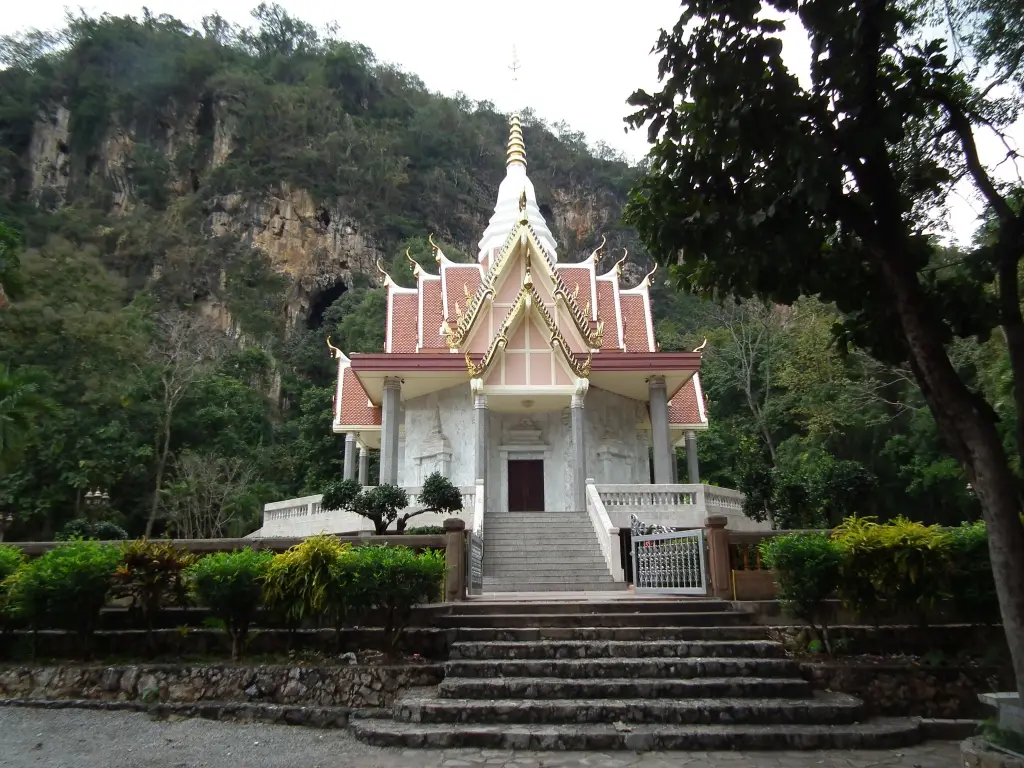
One of the most important sites inside the temple compound is the memorial stupa of Luang Pu Khamdee Pabhaso. It stands near the entrance area and was built as a memorial after his passing in 1984. The stupa was completed in 1994 and is made of marble. Inside are monastic requisites and images of important Thai forest-monk masters, including Luang Pu Sao Kantasilo, Luang Pu Mun Bhuridatto, Luang Pu Sing Khantayakamo, and Luang Pu Khamdee Pabhaso. This makes the stupa an important place for understanding the spiritual lineage behind the temple.
The temple also contains Luang Pu Khamdee Pabhaso Museum, an elegant mondop-style building that preserves his relics and personal monastic objects. The museum was built after his royal cremation ceremony through the devotion of his disciples and the public. Construction began on 5 August 1986 and was completed in October 1988. Inside the museum is a statue of Luang Pu Khamdee placed on a marble lotus pedestal, with his relics displayed in front of it. The museum also contains monastic requisites, robes, hair, relics, a ceremonial fan, biography, and personal objects used by him in daily life.
The objects displayed in the museum are powerful because of their simplicity. Visitors can see robes, walking requisites, a hot-water flask, bag, spoon, fork, needle, thread, pen, eyeglasses, flashlight, sandals, walking stick, and other everyday items. These objects are not luxurious, but they reveal the disciplined life of a forest monk. For international visitors, this museum helps explain Thai Forest Tradition in a direct and human way. It shows how spiritual authority in this tradition is connected to restraint, mindfulness, and a life lived with few possessions.
Tham Pha Pu, or Tham Phiang Din, is the natural heart of the temple. It is a large limestone cave beneath the mountain, with Buddha images inside and natural rock formations such as stalactites and stalagmites. The cave atmosphere is cool, quiet, and sacred. Visitors should walk carefully because some parts may be damp, uneven, or dimly lit. The cave is a place for respectful worship and contemplation, not a place for loud behavior or careless exploration.
A sacred water source inside Tham Pha Pu is another important feature. Local people have long regarded this water as auspicious. The presence of water within a limestone cave gives the site both geological and spiritual meaning. Visitors should treat the area with respect, avoid throwing anything into the water, and follow temple guidance. This place is part of the temple’s sacred landscape and should be preserved carefully.
Wat Tham Pha Pu is also important archaeologically because prehistoric red rock paintings were found at the shelter near the entrance of Tham Phra within the temple grounds. Archaeological surveys recorded several painted forms, including parallel lines, triangular forms, and geometric figures. Many of these images have faded greatly over time due to natural causes and human disturbance. Because of this, visitors who wish to see Tham Phra, the replica Buddha footprint, and the prehistoric rock-painting area must contact the temple in advance. These areas are not open for independent access.
This archaeological layer makes Wat Tham Pha Pu more than a cave temple. It is a multi-layered cultural landscape where prehistoric human traces, Buddhist devotion, forest-monk memory, limestone geology, wildlife, and local belief all meet. A visitor who walks through the temple with this understanding will see that the place is not only a scenic religious site. It is also a record of how people have related to caves, mountains, sacred spaces, and spiritual practice across different periods of time.
The natural surroundings are another reason many people remember Wat Tham Pha Pu. The area outside the cave is home to spectacled langurs, gibbons, monkeys, and other wildlife that may appear around the temple grounds. These animals add life to the temple landscape, but visitors must observe them responsibly. They should not chase, touch, tease, or feed the animals carelessly. Keeping a respectful distance protects both visitors and wildlife and helps maintain the natural balance of the temple environment.
The atmosphere of the temple is calm and shaded. It is not a commercial tourist site filled with entertainment facilities. Its value lies in quietness, simplicity, meditation, and natural surroundings. Visitors should allow at least 1 to 2 hours to pay respect at the stupa, visit Luang Pu Khamdee Museum, walk through the cave area, observe the natural surroundings, and experience the temple slowly. A slow visit is much more meaningful than a quick photo stop.
The first area to visit is the memorial stupa of Luang Pu Khamdee Pabhaso. This area helps visitors begin with respect and understand the teacher whose life shaped the temple. The stupa connects Wat Tham Pha Pu with the wider lineage of Thai forest monks and prepares visitors for the museum and cave. It is a good place to pause, pay respect, and reflect before continuing into other areas of the temple.
The second area is Luang Pu Khamdee Pabhaso Museum. This is the most important place for learning about the forest-monk history of the temple. The museum displays the statue, relics, robes, monastic requisites, and personal belongings of Luang Pu Khamdee. Visitors can see how a monk who lived simply became deeply respected by the community. The museum is open daily from 08.00 to 17.00 and does not charge an admission fee.
The third area is Tham Pha Pu, or Tham Phiang Din. This cave contains Buddha images and natural limestone formations. Visitors should walk with care and avoid touching stalactites or stalagmites. Rock formations in caves develop slowly over long periods, and damage can be permanent. The cave should be treated as both a natural site and a sacred Buddhist place.
The fourth area is Tham Phra, the replica Buddha footprint, and the prehistoric rock-painting zone. This part of the temple has high archaeological and conservation value and is not open for independent access. Visitors must contact the temple before visiting. This rule helps protect the remaining rock paintings and ensures that visitors enter the area safely and appropriately.
The fifth area is the natural zone around the temple, where spectacled langurs, gibbons, and monkeys may be seen. This area gives the temple a living forest atmosphere. Visitors should keep their voices low, avoid sudden movements near animals, and refrain from feeding them inappropriate food. The best way to enjoy wildlife here is to observe quietly and leave them undisturbed.
The sixth area is the meditation and religious space of the temple. Wat Tham Pha Pu is still a functioning temple, not only a tourist attraction. Monks, devotees, and meditation practitioners may use the area for religious practice. Visitors should respect restricted areas, avoid disturbing monks or practitioners, and behave in a way suitable for a sacred place.
Getting There from Mueang Loei is convenient by private car, rental car, or local transport. Travelers can take the Loei–Chiang Khan route or Highway 201 northward from Loei city, then turn left onto Highway 2115 toward Tha Li and Ban Na O. The temple is about 7 to 10 kilometers from Loei city depending on the route used. The final approach leads into the Na O area and toward the limestone hill where the temple is located.
Visitors driving to the temple should be careful near the entrance and parking area because monks, local people, other visitors, and wildlife may share the same space. On holidays or religious days, parking may be busier than usual. Elderly visitors may wish to focus first on the stupa, museum, and lower temple areas before deciding whether to walk into cave-related areas.
The temple and Luang Pu Khamdee Pabhaso Museum are open daily from 08.00 to 17.00. General access is free. However, visitors who want to see Tham Phra, the replica Buddha footprint, or the prehistoric rock paintings must contact the temple in advance because those areas are not open for free independent access. This helps protect important archaeological and natural features.
There is no admission fee for the temple and museum. Visitors may make merit according to their faith in designated areas. Even though access is free, visitors should remember that the temple is a sacred and working religious site. Cleanliness, quiet behavior, and respect for objects, animals, and restricted areas are essential.
Visitors should prepare comfortable shoes, modest clothing, drinking water, and enough time for a slow visit. Those entering cave areas should avoid slippery footwear and be careful on damp or uneven ground. During the rainy season, cave and stair areas may require extra caution. Good preparation helps make the visit safer and more meaningful.
For families, Wat Tham Pha Pu is a valuable outdoor learning place. Children can learn about Buddhism, forest monks, caves, wildlife, prehistoric paintings, and conservation. Parents can use the visit to teach respect for sacred places, responsible wildlife observation, and the importance of not writing on cave walls or damaging natural formations.
For Buddhist visitors and meditation practitioners, the temple provides a direct connection to the life of Luang Pu Khamdee Pabhaso. The museum, stupa, cave, and forest setting all encourage reflection on simplicity, restraint, mindfulness, and impermanence. A visit here can be a quiet spiritual experience rather than only a sightseeing trip.
For international travelers, Wat Tham Pha Pu helps explain the Thai Forest Tradition in a tangible way. The temple combines a natural cave, Buddha images, a forest-monk museum, a memorial stupa, wildlife, and peaceful monastic surroundings. It shows that Thai Buddhism is not only represented by grand city temples but also by forest temples where nature supports meditation and inner practice.
A good itinerary is to visit the temple in the morning, begin at the memorial stupa, continue to Luang Pu Khamdee Museum, walk to the cave area, observe the natural surroundings, and then return to Loei city or continue to nearby attractions. Visitors may combine the trip with Ban Kang Pla Tai Loei weaving group, Kut Pong Public Park, Loei Walking Street, or Phu Bo Bit Forest Park. This makes Wat Tham Pha Pu a convenient and meaningful stop in a cultural and spiritual route around Mueang Loei.
The most important rule for visiting Wat Tham Pha Pu is to respect both religion and nature. Visitors should dress politely, keep noise low, avoid touching sacred or fragile objects, never write on cave walls, avoid damaging stalactites and stalagmites, avoid feeding wildlife irresponsibly, and stay away from areas not open to visitors. These simple actions help preserve the temple, the cave, the archaeological evidence, and the natural environment for future generations.
In summary, Wat Tham Pha Pu (Tham Phiang Din) in Loei Province is one of the most worthwhile places to visit near Mueang Loei for travelers who appreciate Buddhist heritage, cave landscapes, forest-monk history, and quiet natural surroundings. The temple contains a limestone cave with Buddha images, stalactites and stalagmites, sacred water, prehistoric rock paintings, the memorial stupa and museum of Luang Pu Khamdee Pabhaso, and wildlife such as spectacled langurs, gibbons, and monkeys. It is a place where Dhamma, nature, archaeology, and local faith meet in a calm and memorable setting.
| Name | Wat Tham Pha Pu (Tham Phiang Din) |
| Location | Moo 9, Ban Na O, Na O Subdistrict, Mueang Loei District, Loei Province 42000, Thailand |
| Address | Loei–Tha Li Road, Ban Na O, Na O Subdistrict, Mueang Loei District, Loei Province 42000, Thailand |
| Coordinates | 17.57895 N, 101.71019 E |
| Highlights | A Thai forest temple with a limestone cave, Buddha images, stalactites and stalagmites, sacred water, Luang Pu Khamdee Pabhaso memorial stupa and museum, and natural surroundings where spectacled langurs, gibbons, and monkeys may be seen |
| History | The temple began as a small monastic residence in 1932. Luang Pu Khamdee Pabhaso later stayed and developed the temple as a Dhammayuttika forest-monk temple. The temple received its consecrated boundary in 1968 and contains prehistoric rock paintings near Tham Phra. |
| Distinctive Features | Located at the foot of Khao Nimit, the temple has limestone caves, sacred water, a replica Buddha footprint, a meditation atmosphere, and forest surroundings suitable for religious and natural learning |
| Key Things To See | Tham Pha Pu or Tham Phiang Din, Buddha images inside the cave, stalactites and stalagmites, sacred water, Luang Pu Khamdee Pabhaso stupa, Luang Pu Khamdee Pabhaso Museum, monastic requisites, prehistoric rock paintings, replica Buddha footprint, and wildlife around the temple |
| Main Areas / Zones | 1. Luang Pu Khamdee Pabhaso Memorial Stupa 2. Luang Pu Khamdee Pabhaso Museum And Monastic Requisites Area 3. Tham Pha Pu Or Tham Phiang Din Cave Area 4. Sacred Water Area Inside The Cave 5. Tham Phra, Replica Buddha Footprint, And Prehistoric Rock-Painting Area 6. Natural Area Around The Temple And Wildlife Habitat 7. Meditation And Religious Area Within The Temple |
| Abbot / Caretaker | Managed by Wat Tham Pha Pu; the abbot is Phra Athikan Bon Pasanno |
| Travel Information | From Mueang Loei, take the Loei–Chiang Khan route or Highway 201 northward, then turn left onto Highway 2115 toward Tha Li and Ban Na O. The temple is about 7 – 10 km from Loei city depending on the route. |
| Current Status | Open as a Thai forest temple, Buddhist learning site, natural cave attraction, and archaeological site in Loei Province |
| Open Days | Daily |
| Opening Hours | 08.00 – 17.00 for the temple area and Luang Pu Khamdee Pabhaso Museum; visitors must contact the temple before entering Tham Phra, the replica Buddha footprint, and the prehistoric rock-painting area |
| Fees | Free admission |
| Facilities | Worship area, museum, memorial stupa, cave area, some walkways inside the cave, temple courtyard, parking area, and quiet areas for Buddhist practice and respectful visits |
| Main Contact Number | 0 4283 4930, 042-801-188, 042-811-334 |
| Official Website / Official Page | Important Archaeological Sites Database in Thailand, Museum Database of Thailand, and Wat Tham Pha Pu Facebook page |
| Nearby Tourist Attractions | 1. Luang Pu Khamdee Pabhaso Museum, same compound, Tel. 0 4283 4930 2. Sacred Water Area Inside Tham Pha Pu, same compound, Tel. 042-801-188, 042-811-334 3. Tham Phra, Replica Buddha Footprint, And Prehistoric Rock Paintings, same compound, advance contact required, Tel. 042-801-188, 042-811-334 4. Ban Kang Pla Tai Loei Weaving Group, about 7 km 5. Kut Pong Public Park And Loei Walking Street, about 11 km 6. Phu Bo Bit Forest Park, about 13 km |
| Nearby Restaurants | 1. KOEN, Wat Tham Pha Pu Soi, about 1 km 2. Chom Bua Cafe & Restaurant, Na O, about 4 km, Tel. 082-945-5796 3. Noi Tam Sua, Mueang Loei, about 11 km, Tel. 081-471-5904 4. Phu Loei Restaurant, Ruamjai Road, about 11 km, Tel. 093-486-8585 5. Ban Tha Pae Restaurant, about 13 km, Tel. 095-604-5544 |
| Nearby Accommodations | 1. AU Place Hotel Loei, about 7 km, Tel. 065-237-7115, 042-813-441 2. Loei Palace Hotel, about 12 km, Tel. 042-815-668, 062-196-3896 3. Loei Village Hotel, about 13 km, Tel. 042-811-599, 084-785-2337 4. HOP INN Loei, about 13 km, Tel. 02-080-2222 5. Fortune D Hotel Loei, about 14 km, Tel. 042-036-630, 064-226-2726 |
Frequently Asked Questions (FAQ)
Q: Where is Wat Tham Pha Pu located?
A: Wat Tham Pha Pu is located at Moo 9, Ban Na O, Na O Subdistrict, Mueang Loei District, Loei Province 42000, about 7 – 10 km from Loei city depending on the route.
Q: What are the opening days and hours of Wat Tham Pha Pu?
A: The temple area and Luang Pu Khamdee Pabhaso Museum are open daily from 08.00 to 17.00. Visitors must contact the temple before entering Tham Phra, the replica Buddha footprint, and the prehistoric rock-painting area.
Q: Is there an admission fee for Wat Tham Pha Pu?
A: No. Admission to the temple and museum is free. Visitors may make merit according to their faith in designated areas.
Q: What can visitors see at Wat Tham Pha Pu?
A: Visitors can see Tham Pha Pu or Tham Phiang Din, Buddha images inside the cave, stalactites and stalagmites, sacred water, Luang Pu Khamdee Pabhaso stupa, Luang Pu Khamdee Pabhaso Museum, prehistoric rock paintings, a replica Buddha footprint, and wildlife around the temple.
Q: How is Luang Pu Khamdee Pabhaso connected to Wat Tham Pha Pu?
A: Luang Pu Khamdee Pabhaso, also known as Phra Khru Yanathassi, was a respected Thai forest monk who stayed at and developed Wat Tham Pha Pu into an important Dhammayuttika forest temple and spiritual center.
Q: Who is the current abbot of Wat Tham Pha Pu?
A: The abbot of Wat Tham Pha Pu is Phra Athikan Bon Pasanno.
Q: Which areas require advance contact before visiting?
A: Visitors who wish to see Tham Phra, the replica Buddha footprint, and the prehistoric rock-painting area must contact the temple in advance because those areas are not open for independent access.
Q: What nearby places can be visited after Wat Tham Pha Pu?
A: Nearby places include Luang Pu Khamdee Pabhaso Museum within the temple, Ban Kang Pla Tai Loei weaving group, Kut Pong Public Park, Loei Walking Street, and Phu Bo Bit Forest Park.
 Category: ●Places of Worship
 Group: ●Temple
Last Update : 2 MonthAgo
 Last Update : 2 MonthAgo
 Click to Access the Navigation Map GPS
Wat Tham Pha Pu (Tham Phiang Din) Map
Recommend

 Art, Culture and Heritage
 Historical Sites and Monuments(2)
 Landmarks and Memorials(3)
 Art, Craft Centres, Tradition(2)
 Museums(4)
 Art Gallery(1)
 Educational Places
 Educational Gardens, Farm(2)
Temple(16)
Educational Gardens, Farm(2)
Temple(16)
 Other Sacred Sites(8)
 Research and Development
 Royal Project(3)
 Suburban Living
 Village, Community(3)
 Local Market(1)
 Nature and Wildlife
 National Parks and Marine Reserves(5)
 Mountain (Doi)(10)
 Dam, Reservoir, Lake(7)
 Waterfalls(21)
 Caves(3)
 River, Canal(5)
 Bays and Beaches(1)
 Other natural attractions(1)
 Entertainment and Agricultural
 Farms, Parks and Ecotourism(8)
 Waterpark(1)
 Outdoor and Adventure Activities(2)


