
lovethailand home >Northeastern Travel Attractions >Chaiyaphum Travel Attractions >Phu Khieo >That Thong > Phu Jo Ko
TL;DR: Phu Jo Ko is located at Ban Tat Rin Thong Area, That Thong Subdistrict, Phu Khiao District, Chaiyaphum Province, open Daily, hours 24 Hours.
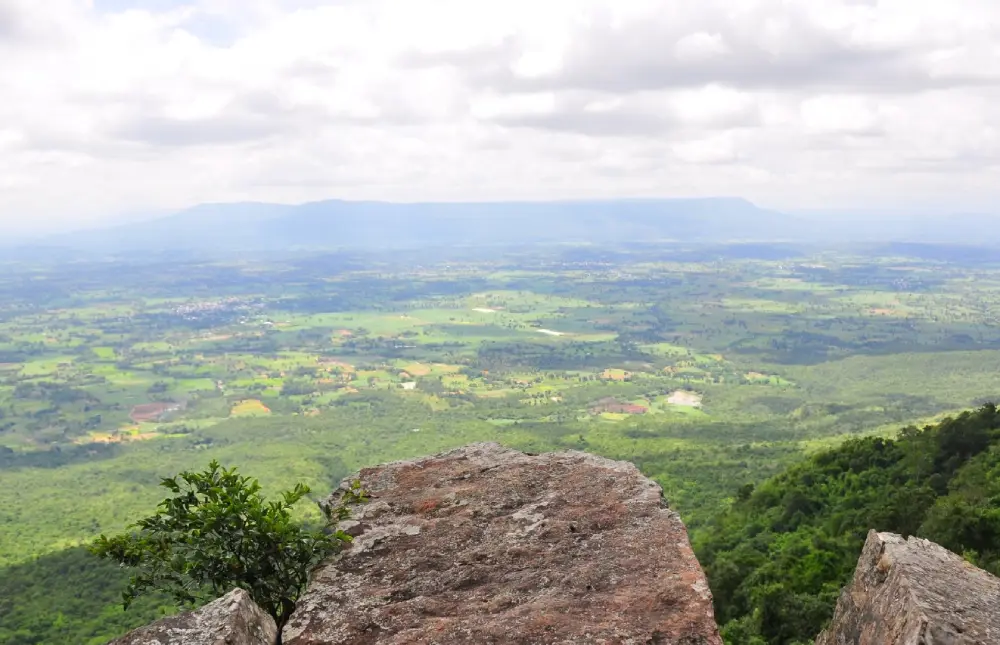
Phu Jo Ko
Open Days: Daily
Opening Hours: 24 Hours
Phu Jo Ko in Chaiyaphum Province is a striking mountain ridge located on the Phu Laen Kha range in That Thong Subdistrict, Phu Khiao District. The area is known for its elevated terrain, unusual mountain shape, and the scenic view down toward the upper Lam Pathao Reservoir. This reservoir is part of an important water system for Chaiyaphum, supplying water for hydropower, irrigation, agriculture, local communities, and the natural flow that helps sustain Tat Ton Waterfall, one of the province’s most famous natural attractions.
For travelers who want to understand Chaiyaphum beyond its better-known tourist sites, Phu Jo Ko offers a deeper look into the relationship between mountains, forests, water sources, reservoirs, and local life. It is not simply a viewpoint or a beautiful ridge. It is part of a living watershed landscape where upland forests collect moisture, mountain streams feed Lam Pathao, and water moves through reservoirs before supporting farms, communities, and waterfalls downstream. Visiting Phu Jo Ko therefore gives travelers a clearer view of how nature supports life in this part of northeastern Thailand.
Phu Jo Ko is closely associated with Ban Tat Rin Thong in That Thong Subdistrict. This community is located on the Phu Laen Kha mountain range, where high mountains alternate with upland plains and valleys. The local landscape is surrounded by several named mountains, including Phu Yuak, Phu Chik, Phu Klang, Phu Sam Chan, Phu Long, and Phu Jo Ko. These names are more than geographic labels; they are part of the way local people understand, navigate, and describe their homeland. Within this setting, Phu Jo Ko forms a distinctive eastern ridge and slope that descends toward the Lam Pathao basin.
The beauty of Phu Jo Ko comes from its elevation, its varied terrain, and its connection with water. From suitable viewpoints around the ridge, visitors can see the upper Lam Pathao Reservoir below, framed by forested slopes and upland scenery. In the morning, the light over the mountains is soft and quiet. After rainfall, moisture from the forest and streams often adds a misty atmosphere to the surrounding area. The result is a landscape that feels calmer and more intimate than many crowded viewpoints, yet more meaningful because it is part of an important watershed system.
The upper Lam Pathao Reservoir below Phu Jo Ko is central to the identity of the place. It is not only a scenic body of water but also a functional water resource. Lam Pathao water is used for electricity production, irrigation, agriculture, and local water needs. It is also connected with Tat Ton Waterfall downstream. When travelers look down from the mountain ridge toward the reservoir, they are not just seeing a beautiful view; they are seeing a working natural system that links upland forest, reservoir management, farming, and tourism together.
Geographically, Phu Jo Ko should be understood as part of the wider Phu Laen Kha landscape. The Phu Laen Kha range runs through Chaiyaphum and contains forests, streams, mountain villages, agricultural land, and natural viewpoints. Ban Tat Rin Thong is shaped by this mountain environment. The village area has the character of an upland basin surrounded by ridges, while Lam Pathao flows through the landscape and connects the upland area with lower zones. This geographic complexity gives Phu Jo Ko its value as both a scenic destination and a learning site.
The atmosphere around Phu Jo Ko is suitable for travelers who enjoy quiet nature rather than heavily commercialized attractions. The area does not have the feel of a large tourist complex. Instead, it offers a slower and more reflective experience. Travelers should spend time observing the ridge, the reservoir, the surrounding forest, and the village landscape. The best way to appreciate Phu Jo Ko is not to rush from one photo spot to another, but to understand the whole landscape as a connected system of mountain, water, forest, and community.
The best times to visit are early morning, late afternoon, and the period from the end of the rainy season into the cool season. In the morning, soft light makes the ridges and reservoir look gentle and clear. After rain, mist may appear along the mountain slopes and valleys. In the late afternoon, warm sunlight can fall across the water and forest, creating a peaceful atmosphere for photography. During the late rainy season and early cool season, the landscape is especially green, the air is fresher, and the reservoir scenery is at its most attractive.
Phu Jo Ko is also meaningful for visitors interested in water management and local environmental knowledge. The upper Lam Pathao watershed has long been important to communities in the area. Water from the mountains flows through small streams and upland valleys before entering the reservoir system. This connection between forest, slope, stream, reservoir, and downstream use makes the area an excellent example of how upland ecosystems support human life. For foreign travelers, it is a practical way to see how water security and landscape conservation are linked in rural Thailand.
As a travel route, Phu Jo Ko can be combined with the upper Lam Pathao Reservoir, Wat Pa Mahawan or Phu Long, Wat Pa Sukato, Tat Ton National Park, Lam Pathao Lower Reservoir, and Phu Laen Kha National Park. It can be planned as a one-day nature trip or as part of a two-day journey through northern and central Chaiyaphum. Traveling by private car or rental car is the most practical option because the area includes rural roads, mountain terrain, and several stops that are easier to reach with flexible transportation.
Phu Jo Ko is not a commercial attraction with full tourist facilities at every point. Visitors should prepare properly before traveling. Bring drinking water, light snacks, a hat, suitable walking shoes, personal medicine, and a fully charged phone. Check weather conditions before departure, especially during the rainy season. Roads and slopes can become slippery after rainfall. In the dry season, visitors should be careful about fire risk and avoid smoking, burning, or leaving anything that could damage the forest environment.
Respect for the local community is essential. The area around Phu Jo Ko includes villages, agricultural land, community forest, and watershed areas. Drive slowly through village roads, avoid loud noise, and do not enter private land without permission. All rubbish should be taken back out of the area. Even small pieces of litter can be washed into streams and eventually reach the reservoir. Responsible travel here directly supports both the beauty of the landscape and the quality of the water source.
For photography, Phu Jo Ko offers several types of scenery: mountain ridges, the upper Lam Pathao Reservoir, rural roads, misty morning slopes, forest texture, and evening light on water. The most representative photographs are those that include both the ridge and the reservoir, because these two elements explain the identity of the place. A mountain photograph alone may look similar to many other upland areas, but when the Lam Pathao water system appears below, the image becomes clearly connected to Chaiyaphum’s watershed landscape.
Phu Jo Ko also has strong potential as an educational nature destination. It can be used to discuss watershed ecology, forest conservation, irrigation, hydropower, local agriculture, and the relationship between rural communities and mountain resources. Students, nature groups, and environmentally minded travelers can learn from the site because it connects many subjects in one landscape: geography, water resources, forest ecology, community life, agriculture, and responsible tourism.
Looking at Phu Jo Ko through the role of Lam Pathao makes the destination more meaningful. Water from the upland area does not remain only in the forest. It moves through streams and reservoirs, then supports electricity generation, irrigation, farming, and natural attractions such as Tat Ton Waterfall. The beauty of a waterfall downstream is therefore connected with the health of the mountains upstream. This is one of the most important lessons travelers can take from Phu Jo Ko.
For nature travelers, Phu Jo Ko is best experienced quietly. Sitting near a viewpoint, observing the reservoir, listening to the wind, and watching the changing light on the slopes can be more rewarding than rushing through the area. This kind of slow travel allows visitors to feel the calmness of the mountain and understand why upland landscapes matter. It is a place for travelers who want to rest their eyes, breathe clean air, and appreciate the natural systems that support the province.
A good itinerary is to begin with the mountain ridge and viewpoints around Phu Jo Ko, then continue to the upper Lam Pathao Reservoir. This gives visitors both the high-angle view and the water-level experience. If time allows, the route can continue to Tat Ton Waterfall or other nearby natural attractions. This sequence helps travelers understand the area from upstream to downstream rather than seeing each destination as a separate stop.
The quietness of Phu Jo Ko is one of its strengths, but it also means travelers should plan carefully. Bring enough supplies, check the route, and avoid entering unfamiliar paths alone. Traveling in a small group is safer, especially early in the morning, late in the afternoon, or during changeable weather. A vehicle in good condition is recommended because some rural and mountain roads may have slopes, narrow sections, or surfaces that change with the season.
Drivers should use an appropriate speed and be cautious on winding roads. During heavy rain, it is better to delay or adjust the trip because mountain roads and soft soil can become difficult. When using digital navigation, set That Thong Subdistrict, Ban Tat Rin Thong, or the upper Lam Pathao Reservoir as reference points. These local names help guide travelers toward the correct mountain area connected with Phu Jo Ko.
Phu Jo Ko also helps diversify travel in Chaiyaphum. Many visitors know the province for Mo Hin Khao, Siam tulip fields, Tat Ton Waterfall, or Pha Koeng. Phu Jo Ko introduces another side of Chaiyaphum: a quieter mountain and watershed landscape in Phu Khiao District. Including this place in a travel plan helps visitors understand the province more broadly and encourages tourism to spread toward local communities beyond the main tourist routes.
Accommodation can be arranged in Phu Khiao, Kaeng Khro, or Mueang Chaiyaphum depending on the travel plan. Staying in Phu Khiao is convenient for access to That Thong and Ban Tat Rin Thong. Staying near Kaeng Khro or Lam Pathao is suitable for travelers who want to combine the reservoir with other mountain attractions. Staying in Mueang Chaiyaphum provides easier access to restaurants, fuel stations, and onward travel, but it is farther from Phu Jo Ko itself.
Restaurants near Phu Jo Ko are generally found around Lam Pathao Reservoir, Kaeng Khro, and Phu Khiao. Reservoir-side restaurants are good for travelers who want to relax after viewing the mountains, while restaurants in Phu Khiao are more convenient for those returning toward the district town. Local dining options often include Isan food, grilled fish, Thai dishes, coffee, and simple cafés. Calling ahead is recommended for groups because operating hours may vary by season and day.
Visitors should avoid trying to cover too many destinations in one day. Phu Jo Ko is most rewarding when there is time to pause, look at the landscape, and understand the role of the watershed. If the trip is too rushed, visitors may see only a mountain view and miss the deeper story of forest, water, reservoir, community, and downstream life. Spending 1–2 hours around the area and nearby viewpoints gives a better and more meaningful experience.
Families traveling with children or elderly visitors should choose accessible stopping points and avoid steep or slippery areas. Children should stay close to adults, especially near high ground or roadside viewpoints. Elderly visitors should use stable footwear and avoid walking on wet surfaces after rain. Phu Jo Ko can be an excellent family learning trip because it introduces children to mountains, water sources, reservoirs, and environmental responsibility through a real landscape.
In educational terms, Phu Jo Ko is a destination where tourism and resource use are closely connected. The water visible from the mountain is not just beautiful; it supports electricity, irrigation, agriculture, and the ecosystem that feeds Tat Ton Waterfall. Understanding this relationship encourages visitors to see the mountain and reservoir with greater respect. Every part of the landscape has a role in the larger environmental system of Chaiyaphum.
During the rainy season, Phu Jo Ko becomes especially green and humid, but travelers should be careful of slippery roads, thick mist, and fast water in low areas. During the cool season, the air is pleasant and there may be morning mist. During the hot season, early morning and late afternoon visits are better than midday travel. Each season offers a different atmosphere, but preparation and safety remain important throughout the year.
Traveling to Phu Jo Ko also encourages a better understanding of Ban Tat Rin Thong and That Thong Subdistrict. Local communities in upland areas depend closely on water and forest resources. Conservation of the watershed is therefore not only the work of government agencies but also part of everyday local life. Visitors should see the area as a shared community landscape, not as an empty tourist space. Respecting local rules, farms, forest areas, and water sources helps keep tourism sustainable.
In summary, Phu Jo Ko in Chaiyaphum is a mountain ridge with strong scenic, ecological, and educational value. Its main highlights are the unusual high ridge, the view over the upper Lam Pathao Reservoir, and its connection with a water system used for electricity production, irrigation, agriculture, and Tat Ton Waterfall. It is an ideal destination for travelers who want to see a quieter side of Chaiyaphum, appreciate mountain scenery, and understand how upland forests and reservoirs support life in northeastern Thailand.
Getting There is best planned by using That Thong Subdistrict, Phu Khiao District, or Ban Tat Rin Thong as the main reference point. A private car or rental car is the most convenient option because the route includes local roads and mountain terrain. Before departure, check weather conditions, prepare enough fuel and drinking water, and allow time for slow travel. Phu Jo Ko is best visited with patience, awareness, and respect for the watershed landscape that gives the area its true importance.
| Name | Phu Jo Ko |
| Location | Ban Tat Rin Thong Area, That Thong Subdistrict, Phu Khiao District, Chaiyaphum Province |
| Address | Phu Jo Ko Ridge, Phu Laen Kha Range, That Thong Subdistrict, Phu Khiao District, Chaiyaphum 36110, Thailand |
| Highlights | Distinctive high mountain ridge, view over the upper Lam Pathao Reservoir, and connection with Chaiyaphum’s important watershed system |
| History / Importance | A mountain ridge in the Ban Tat Rin Thong area on the Phu Laen Kha range, closely connected with the upper Lam Pathao watershed, forest resources, reservoir system, and upland community life |
| Distinctive Features | High mountains alternating with upland plains, slopes descending toward the Lam Pathao basin, suitable for scenic views, nature study, and watershed learning |
| Travel Information | Use That Thong Subdistrict, Phu Khiao District, or Ban Tat Rin Thong as the main reference point. Private car or rental car is the most convenient option. Check weather and road conditions before traveling. |
| Current Status | A natural mountain and watershed area that can be visited for scenic views, with respect for local communities, forests, and environmental rules |
| Open Days | Daily |
| Opening Hours | 24 Hours |
| Main Areas / Zones | Phu Jo Ko Ridge, upper Lam Pathao Reservoir viewpoint area, upper Lam Pathao watershed, Ban Tat Rin Thong community route, forest and mountain areas on the Phu Laen Kha range |
| Caretaker / Local Authority | That Thong Subdistrict Municipality, Phu Khiao District, Chaiyaphum Province, and Ban Tat Rin Thong community |
| Main Contact Number | That Thong Subdistrict Municipality, Tel. 0-4413-1566 |
| Nearby Tourist Attractions | 1. Upper Lam Pathao Reservoir / Upper Dam, about 5 km 2. Wat Pa Mahawan (Phu Long), Ban Tat Rin Thong, about 10 km 3. Wat Pa Sukato, about 24 km 4. Lower Lam Pathao Reservoir, about 32 km 5. Tat Ton National Park / Tat Ton Waterfall, about 50 km 6. Phu Laen Kha National Park / Mo Hin Khao, about 75 km |
| Nearby Restaurants | 1. Kuk Kik Pla Phao Restaurant, Lam Pathao Dam, about 8 km, Tel. 087-087-7956, 080-353-1175 2. Suan Ahan Rim Nam, Lam Pathao Dam, about 30 km, Tel. 095-662-7511, 062-496-1327 3. Krua Keerati, Lower Lam Pathao Raft Dining, about 36 km, Tel. 084-527-7120, 088-507-4013 4. Winter Farm Village, Phu Khiao, about 40 km, Tel. 081-876-6372 5. Saeng Arun Phochana (Ko Tee), Phu Khiao, about 40 km, Tel. 044-861-015 6. Rabiang Na Cafe, Phu Khiao, about 42 km, Tel. 084-227-2252 |
| Nearby Accommodations | 1. Bander Hotel, Phu Khiao, about 40 km, Tel. 044-862-332, 081-068-3563 2. Jamsai Resort, Phu Khiao, about 43 km, Tel. 081-499-5181 3. Muang Thong Resort Phu Khiao, about 45 km, Tel. 081-967-4810 4. On The Rock Chaiyaphum Bed & Breakfast, Kaeng Khro, about 48 km 5. The Peak Resort Chaiyaphum, about 70 km, Tel. 082-615-5587 |
Frequently Asked Questions (FAQ)
Q: Where is Phu Jo Ko located?
A: Phu Jo Ko is located around Ban Tat Rin Thong, That Thong Subdistrict, Phu Khiao District, Chaiyaphum Province, on the Phu Laen Kha mountain range.
Q: What makes Phu Jo Ko special?
A: It is known for its distinctive high mountain ridge, its view over the upper Lam Pathao Reservoir, and its connection with Chaiyaphum’s important watershed system.
Q: How is Lam Pathao Reservoir connected with Phu Jo Ko?
A: The upper Lam Pathao Reservoir lies below the Phu Jo Ko mountain area and receives water from the Phu Laen Kha uplands. The water supports electricity production, irrigation, and Tat Ton Waterfall downstream.
Q: When is the best time to visit Phu Jo Ko?
A: Morning, late afternoon, and the late rainy to early cool season are the best times because the weather is more comfortable, the scenery is clearer, and the landscape is greener.
Q: Is there an admission fee for Phu Jo Ko?
A: Phu Jo Ko is a natural mountain and community landscape, not a large ticketed attraction with a formal admission gate.
Q: What is the most convenient way to get to Phu Jo Ko?
A: A private car or rental car is the most convenient option. Use That Thong Subdistrict, Phu Khiao District, or Ban Tat Rin Thong as the main navigation reference.
Q: What should travelers prepare before visiting?
A: Bring drinking water, light snacks, a hat, suitable shoes, a fully charged phone, and check the weather before departure.
Q: What nearby places can be combined with Phu Jo Ko?
A: Travelers can combine the trip with the upper Lam Pathao Reservoir, Wat Pa Mahawan (Phu Long), Wat Pa Sukato, Lower Lam Pathao Reservoir, Tat Ton Waterfall, and Phu Laen Kha National Park.
 Category: ●Nature and Wildlife
 Group: ●Mountain (Doi)
Last Update : 4 MonthAgo
 Last Update : 4 MonthAgo
 Click to Access the Navigation Map GPS
 Art, Culture and Heritage
 Historical Sites and Monuments(1)
 Landmarks and Memorials(3)
 Royal Palace(1)
 Art, Craft Centres, Tradition(3)
 Educational Places
 Educational Gardens, Farm(1)
 University
 Rajabhat University(1)
 Places of Worship
 Temple(141)
 Other Sacred Sites(8)
 Suburban Living
 Village, Community(4)
 National Parks and Marine Reserves(7)
Mountain (Doi)(5)
National Parks and Marine Reserves(7)
Mountain (Doi)(5)
 Dam, Reservoir, Lake(10)
 Waterfalls(15)
 Caves(5)
 River, Canal(4)
 Other natural attractions(1)
 Entertainment and Agricultural
 Farms, Parks and Ecotourism(2)
 Waterpark(2)
 Travel Articles, Recipes
 Travel Review, Food Review(1)


