
lovethailand home >Northeastern Travel Attractions >Chaiyaphum Travel Attractions >Nong Bua Daeng >Tham Wua Daeng > Hin Sa Khao Ho
TL;DR: Hin Sa Khao Ho is located at Tham Wua Daeng Subdistrict, Nong Bua Daeng District, Chaiyaphum Province, open Outdoor Natural Area With No Specific Closing Days Announced, hours No Specific Opening Hours Announced; Daytime Visits Are Recommended.

Hin Sa Khao Ho
Open Days: Outdoor Natural Area With No Specific Closing Days Announced
Opening Hours: No Specific Opening Hours Announced; Daytime Visits Are Recommended
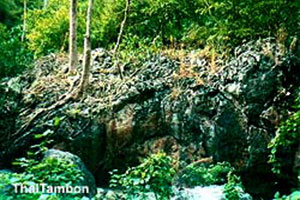
Hin Sa Khao Ho in Chaiyaphum Province is a distinctive natural rock landmark in Tham Wua Daeng Subdistrict, Nong Bua Daeng District. The site is known for a massive rock, approximately 15 meters in diameter, standing across Lam Nam Chiang, with water flowing underneath the rock. From this point, visitors can enjoy a dramatic natural view of the stream, the huge rock formation, and steep cliffs on both sides, making it especially suitable for travelers who enjoy rugged landscapes and challenging nature-based experiences.
Hin Sa Khao Ho is not a heavily developed tourist attraction with commercial facilities or decorative installations. Its value lies in the raw character of the landscape itself. The large rock sits across the watercourse like a natural symbol of the area, while Lam Nam Chiang continues to flow through and beneath it. When viewed together with the cliffs and the stream, the scene feels powerful, quiet, and untamed. It is the kind of place that rewards visitors who appreciate real terrain, natural textures, and the physical presence of rock, water, and forested slopes.
The first remarkable feature of Hin Sa Khao Ho is the relationship between the giant rock and the stream. The rock is not just a large natural object standing alone; it interacts directly with the flow of water. Seeing water passing beneath a stone mass of this size gives visitors a strong impression of both permanence and movement. The rock appears stable and heavy, while the stream continues to move around and under it. This contrast creates the identity of the site and makes it different from ordinary riverside rock formations.
The local name “Hin Sa Khao Ho” gives the place a memorable character. It is a local name attached to a striking rock formation in Tham Wua Daeng, and it helps turn the landscape into a recognizable destination. For travelers searching for hidden natural attractions in Chaiyaphum, the name functions as a local keyword that leads them beyond the province’s more famous destinations. The name also reflects how local communities remember and identify specific natural features in their surroundings.
Before approaching the rock area, visitors should first observe the overall condition of the site. Lam Nam Chiang is a natural stream, and its water level changes according to season and rainfall. During drier periods, the rock surface, streambed, and water channels may be easier to see. During the rainy season, the flow of water can become stronger and more impressive, but the area also becomes more dangerous. Wet rocks, slippery surfaces, changing currents, and steep edges require careful movement at all times.
The most memorable scene at Hin Sa Khao Ho is the water flowing underneath the giant rock. This natural passage gives the place a sense of a stone arch or water gate formed by nature. The large rock, the flowing stream, the cliff walls, and the surrounding vegetation combine into a compact but dramatic landscape. It is a strong location for nature photography, quiet observation, and outdoor learning, as visitors can see several major natural elements in one place: rock, water, cliffs, and a mountain-stream environment.
The steep cliffs on both sides of the area create a powerful backdrop. They frame Lam Nam Chiang and make the rock formation feel even more imposing. For photographers, the site offers several possible compositions: wide views of the stream and cliffs, close views of rock texture and moving water, and detail shots of natural patterns on stone surfaces. The cliffs also give the location a sense of depth and adventure, which is why the place is particularly appealing to travelers who prefer challenging natural landscapes.
Although Hin Sa Khao Ho is suitable for adventurous visitors, the challenge here should be approached with responsibility, not risk-taking. Travelers should wear shoes with good grip, move slowly on rock surfaces, avoid wet and mossy areas, and never enter risky zones for the sake of a photograph. The landscape is beautiful precisely because it is natural and not fully controlled. Visitors must therefore treat it as a real outdoor environment rather than a designed attraction.
Lam Nam Chiang gives life to the site. The stream is not merely a background element; it defines the sound, movement, and atmosphere of Hin Sa Khao Ho. The sound of water passing beneath the rock adds to the experience and makes the place feel alive. Visitors do not only see a rock formation; they hear the stream interacting with it. This sensory quality is one of the reasons the site feels more memorable than a static viewpoint.
Hin Sa Khao Ho is also useful as an outdoor learning site. It can help visitors understand the relationship between water flow, rock surfaces, cliffs, and stream landscapes. Children, students, and nature enthusiasts can observe how water moves around obstacles, how rock surfaces differ in texture, and how plants adapt to rocky and waterside environments. A single large rock may seem simple at first, but when viewed together with the stream and cliffs, the site becomes a living lesson in local geography.
The atmosphere of Hin Sa Khao Ho is best suited to travelers who enjoy places without crowds. It is not a mainstream tourist spot with extensive service infrastructure. Its appeal comes from quietness, rough terrain, and a sense of discovery. Visitors who enjoy silence, natural sounds, and slow observation will appreciate the site, while those who prefer convenience and full facilities should prepare accordingly before traveling.
Seasonal timing is important when visiting Hin Sa Khao Ho. Late rainy season to early cool season often brings greener scenery and more water, but visitors should always check weather conditions before traveling. The dry season may make walking and observing rock structures easier, although the water level may be lower. Heavy rain periods should be avoided because sudden stronger currents and slippery rock surfaces can create serious risk. A safe visit depends on choosing the right time and respecting natural conditions.
Visitors should treat Hin Sa Khao Ho as a protected natural place, even if it is not presented like a formal park. Do not climb onto risky parts of the rock. Do not enter water of unknown depth. Do not throw rubbish into the stream. Do not damage plants along the watercourse. Natural stream environments are sensitive, and even small amounts of waste can affect water quality and local life. Responsible travel is essential for keeping the site beautiful and usable for future visitors.
The viewing area around Hin Sa Khao Ho offers a memorable perspective of the large rock, Lam Nam Chiang, and the cliffs on both sides. Visitors should choose safe standing points and avoid cliff edges or slippery surfaces. Beautiful photographs can be taken from a safe distance, and there is no need to take unnecessary risks. The landscape is strong enough to be impressive without standing in dangerous positions.
For photography, morning and late afternoon are often the most rewarding times. Softer light brings out the surface texture of the rocks and reduces harsh shadows. Midday light can make the water and stone colors clearer, but it may also create strong contrast. Anyone photographing near the stream should be especially careful with tripods, camera bags, and footing. Wet rocks with algae can be extremely slippery even when they appear stable.
Hin Sa Khao Ho adds another dimension to Chaiyaphum travel. The province is already known for famous natural attractions such as Siam tulip fields, Mo Hin Khao, Phu Lan Kha National Park, and Bueng Lahan, but smaller natural sites like Hin Sa Khao Ho show the province’s deeper landscape diversity. This site is not famous because of facilities; it is memorable because of a unique natural formation where a large rock, a stream, and cliffs meet in a compact and dramatic way.
Tham Wua Daeng Subdistrict is strongly associated with mountain landscapes and watercourses. Visiting Hin Sa Khao Ho is therefore not simply a visit to one rock. It is a way to enter a landscape of streams, slopes, cliffs, and rural mountain terrain in Nong Bua Daeng District. Understanding this wider setting helps travelers appreciate the place as part of a living natural system, not just a single photo spot.
Hin Sa Khao Ho can be combined with other natural places in Nong Bua Daeng District. Lam Chiang Reservoir is closely connected with the wider Lam Nam Chiang area and gives visitors another perspective on water resources in Chaiyaphum. Waterfalls and rapids such as Namtok Kaeng Yai and Kaeng Dadat add more stream-based experiences to the route. These places together create a nature-focused itinerary for travelers who want to explore the less commercial side of Chaiyaphum.
Pha Koeng, also known through Wat Chaiyaphum Phithak, can add a cultural and scenic dimension to the trip. If Hin Sa Khao Ho represents raw and challenging nature, Pha Koeng offers a combination of temple atmosphere, mountain views, and local spirituality. Visiting both places helps travelers see how Nong Bua Daeng offers both sacred mountain viewpoints and rugged natural formations.
Travelers who want a longer route can continue toward Phu Lan Kha National Park and Mo Hin Khao. Although these places are farther away, they help expand the story of rock landscapes in Chaiyaphum. Hin Sa Khao Ho is a large rock formation beside a stream, while Mo Hin Khao is a famous group of stone pillars on a highland landscape. Seeing both can help visitors understand how diverse Chaiyaphum’s rock scenery can be.
For families with older children or teenagers, Hin Sa Khao Ho can be a meaningful outdoor classroom, but it is not a place where children should move around without supervision. The presence of rocks, running water, steep areas, and slippery surfaces means adults must stay alert. Parents can use the visit to teach children about natural safety, stream behavior, waste responsibility, and respect for outdoor places.
Adventure-oriented travelers should plan carefully. Since this is not a large commercial attraction, signage, services, and facilities may be limited. It is best to start early, check the route, monitor weather conditions, and avoid entering remote areas in the late evening or after heavy rain. Travelers should also inform someone about their route when visiting less crowded natural areas.
Recommended items include shoes suitable for rock surfaces, drinking water, sun protection, a lightweight raincoat, a small first-aid kit, waterproof protection for phones or cameras, and a bag for taking rubbish back. Visitors should carry only what they need because moving around rocky stream areas requires balance and mobility. Heavy or unnecessary luggage can make walking more difficult and less safe.
Good manners are important when visiting Hin Sa Khao Ho. Visitors should keep noise low, avoid blocking local roads, respect nearby communities, avoid entering private land, and never remove rocks, plants, or wildlife. Leaving the place unchanged is the best form of respect. A natural attraction like this remains valuable only when visitors help preserve its original condition.
Hin Sa Khao Ho is best experienced slowly. The details of the site become clearer when visitors take time to observe. Rock textures, cracks, shadows, water movement, cliff lines, and the sound of the stream all change with light and season. This is not a place to rush through. It is a place to stand still, listen, and allow the landscape to reveal its character gradually.
As a visual symbol, Hin Sa Khao Ho represents stability and movement existing together. The rock remains heavy and still, while the stream continues to move beneath it. This image reflects the nature of mountain landscapes, where stone and water continuously shape each other over time. Visitors who look beyond the surface will understand that the rock, stream, and cliffs are parts of the same natural story.
Travelers should plan food and accommodation before entering the area. The surroundings of Hin Sa Khao Ho are natural and not densely served by restaurants or hotels. The most practical approach is to eat in Nong Bua Daeng District or stop at cafés along the route before or after the visit. Accommodation is also best arranged in Nong Bua Daeng or, for more options, in Chaiyaphum town.
Getting There is most convenient by private car or rental car. From Nong Bua Daeng District, travelers continue toward Tham Wua Daeng Subdistrict using local roads. Because the site is a natural area, visitors should check maps before departure and allow enough time for rural road travel. During the rainy season or after heavy rain, road and streamside conditions may change, so local advice is helpful before entering the area.
From Chaiyaphum town, travelers can drive toward Nong Bua Daeng District, then continue to Tham Wua Daeng Subdistrict. The route is suitable for a full-day nature trip if starting early. Those who want a more relaxed trip can stay overnight in Nong Bua Daeng and combine Hin Sa Khao Ho with Lam Chiang Reservoir, Pha Koeng, waterfalls, or nearby cafés. Private transport gives visitors the best flexibility.
Special caution is required around the stream and cliffs. Rock surfaces near water are often slippery because of moisture and algae. Some dry-looking areas can still be slick. Visitors should not walk alone deep into the area, should not focus on photography to the point of ignoring their footing, and should avoid strong-flow water zones. The view is already impressive from safe positions.
Hin Sa Khao Ho is most suitable for travelers who value authenticity over convenience. There is no luxury here, but there is real nature: rock, water, cliff, silence, and a sense of place. Its simplicity is its strength. Visitors who understand this will find the experience more rewarding than those who expect a fully managed tourist site.
Conservation begins with visitor behavior. Do not litter, write on rocks, damage plants, play loud music, or alter the landscape for photographs. The best nature travel leaves no visible trace. If visitors help keep the place clean and quiet, Hin Sa Khao Ho can remain a natural landmark of Tham Wua Daeng and Nong Bua Daeng for years to come.
For travelers looking for a different side of Chaiyaphum, Hin Sa Khao Ho deserves attention. It is especially suitable for those who enjoy large rock formations, streams, cliffs, and mildly challenging natural routes. The place offers a direct encounter with the landscape: a massive rock across Lam Nam Chiang, water passing beneath it, and steep cliffs enclosing the scene on both sides.
Hin Sa Khao Ho is therefore more than a large rock beside a stream. It is a compact expression of Chaiyaphum’s natural character, combining stone, water, cliff, forest, and local terrain. For nature lovers, photographers, adventure travelers, and visitors interested in local geography, a well-prepared and respectful visit to Hin Sa Khao Ho can become one of the most memorable nature experiences in Chaiyaphum Province.
| Name | Hin Sa Khao Ho |
| Location | Tham Wua Daeng Subdistrict, Nong Bua Daeng District, Chaiyaphum Province |
| Address | Tham Wua Daeng Subdistrict, Nong Bua Daeng District, Chaiyaphum Province 36210, Thailand |
| Highlights | A large rock about 15 meters in diameter standing across Lam Nam Chiang, with water flowing beneath the rock and steep cliffs visible on both sides |
| Distinctive Features | Large rock formation, natural stream, water passage beneath the rock, steep cliffs, and a rugged landscape suitable for adventurous nature travelers |
| Local Importance | A distinctive natural point in Tham Wua Daeng and Nong Bua Daeng, reflecting the relationship between rock formations, Lam Nam Chiang, and cliff landscapes |
| Name Origin | A local name used for the large rock formation in Tham Wua Daeng, giving the site a clear and memorable identity |
| Travel Information | Best reached by private car or rental car from Nong Bua Daeng District toward Tham Wua Daeng Subdistrict; visitors should check maps and local route conditions before traveling |
| Current Status | A natural streamside rock area along Lam Nam Chiang in Tham Wua Daeng Subdistrict |
| Open Days | Outdoor natural area with no specific closing days announced |
| Opening Hours | No specific opening hours announced; daytime visits are recommended, especially morning and late afternoon |
| Facilities | Suitable for a self-prepared nature visit; bring drinking water, rock-grip shoes, sun protection, a rubbish bag, and essential personal items |
| Main Areas / Zones | 1. Large Rock Across Lam Nam Chiang 2. Water Passage Beneath The Rock 3. Lam Nam Chiang Stream Area 4. Cliff View Area On Both Sides 5. Safe Streamside Rock Observation Area |
| Caretaker / Local Contact Agency | Tham Wua Daeng Subdistrict Administrative Organization, Nong Bua Daeng District, Chaiyaphum Province |
| Main Contact Number | Tham Wua Daeng Subdistrict Administrative Organization, Tel. 044-100811 |
| Official Website / Official Page | Tham Wua Daeng Subdistrict Administrative Organization Website |
| Nearby Tourist Attractions | 1. Lam Chiang Reservoir, about 15 km 2. Namtok Kaeng Yai, Nong Bua Daeng District, about 45 km 3. Kaeng Dadat, Nong Bua Daeng District, about 50 km 4. Pha Koeng / Wat Chaiyaphum Phithak, Nong Bua Daeng District, about 55 km 5. Phu Lan Kha National Park, about 75 km |
| Nearby Restaurants | 1. Na Yai Cafe Restaurant, about 40 km, Tel. 096-087-4063 2. Mum Aroi Cafe, about 40 km, Tel. 082-206-3978 3. Party Nom Cafe, about 40 km, Tel. 065-842-7419 4. Rabbit Cake, about 40 km, Tel. 084-824-6650 5. ONE SHOT A DAY, about 42 km |
| Nearby Accommodations | 1. First Inn Resort, Nong Bua Daeng District, about 40 km, Tel. 098-584-7787 2. Apinya Resort, Nong Bua Daeng District, about 40 km, Tel. 081-076-6191 3. Lee Resort Farm Stay Nong Bua Daeng, about 40 km, Tel. 093-725-6720 4. Jae Hui Resort Nong Bua Daeng, about 42 km, Tel. 081-834-4193 5. RAKKHAO Resort Nong Bua Daeng, about 42 km, Tel. 095-668-6232 |
Frequently Asked Questions (FAQ)
Q: Where is Hin Sa Khao Ho located?
A: Hin Sa Khao Ho is located in Tham Wua Daeng Subdistrict, Nong Bua Daeng District, Chaiyaphum Province. It is a natural rock area along Lam Nam Chiang.
Q: What makes Hin Sa Khao Ho special?
A: Its highlight is a massive rock about 15 meters in diameter standing across Lam Nam Chiang, with water flowing underneath and steep cliffs visible on both sides.
Q: Who should visit Hin Sa Khao Ho?
A: It is suitable for nature lovers, photographers, adventure travelers, and visitors who enjoy rugged rock formations, streams, cliffs, and less commercial natural places.
Q: When is the best time to visit Hin Sa Khao Ho?
A: Daytime visits are recommended, especially in the morning or late afternoon. Visitors should avoid heavy rain periods and strong water conditions.
Q: What should visitors prepare before going to Hin Sa Khao Ho?
A: Visitors should bring shoes suitable for rock surfaces, drinking water, sun protection, seasonal rain gear, a rubbish bag, and check the route before traveling.
Q: Is Hin Sa Khao Ho suitable for families?
A: It can be suitable for families with careful supervision, especially for older children and teenagers. Adults should stay close to children because the area includes rocks, water, slopes, and slippery surfaces.
Q: What nearby places can be combined with Hin Sa Khao Ho?
A: Nearby places include Lam Chiang Reservoir, Namtok Kaeng Yai, Kaeng Dadat, Pha Koeng, and Phu Lan Kha National Park.
Q: What should visitors be careful about at Hin Sa Khao Ho?
A: Visitors should be careful of slippery rocks, stream currents, steep edges, and cliff areas. Avoid risky climbing, avoid entering strong-flow water, and take all rubbish back after the visit.
 Category: ●Nature and Wildlife
 Group: ●Other natural attractions
Last Update : 3 MonthAgo
 Last Update : 3 MonthAgo
Recommend

 Art, Culture and Heritage
 Historical Sites and Monuments(1)
 Landmarks and Memorials(3)
 Royal Palace(1)
 Art, Craft Centres, Tradition(3)
 Educational Places
 Educational Gardens, Farm(1)
 Places of Worship
 Temple(141)
 Other Sacred Sites(7)
 Suburban Living
 Village, Community(4)
 National Parks and Marine Reserves(7)
 Mountain (Doi)(5)
 Dam, Reservoir, Lake(10)
 Waterfalls(15)
 Caves(5)
 River, Canal(4)
Other natural attractions(1)
River, Canal(4)
Other natural attractions(1)
 Entertainment and Agricultural
 Farms, Parks and Ecotourism(2)


