
lovethailand home >Northeastern Travel Attractions >Chaiyaphum Travel Attractions >Nong Bua Daeng >Kut Chum Saeng > Wat Chaiyaphum Phithak (Pha Koeng)
TL;DR: Wat Chaiyaphum Phithak (Pha Koeng) is located at Ban Na Sombun, Moo 8, Kut Chum Saeng Subdistrict, Nong Bua Daeng District, Chaiyaphum Province, open Daily, hours 08.00 – 17.00.
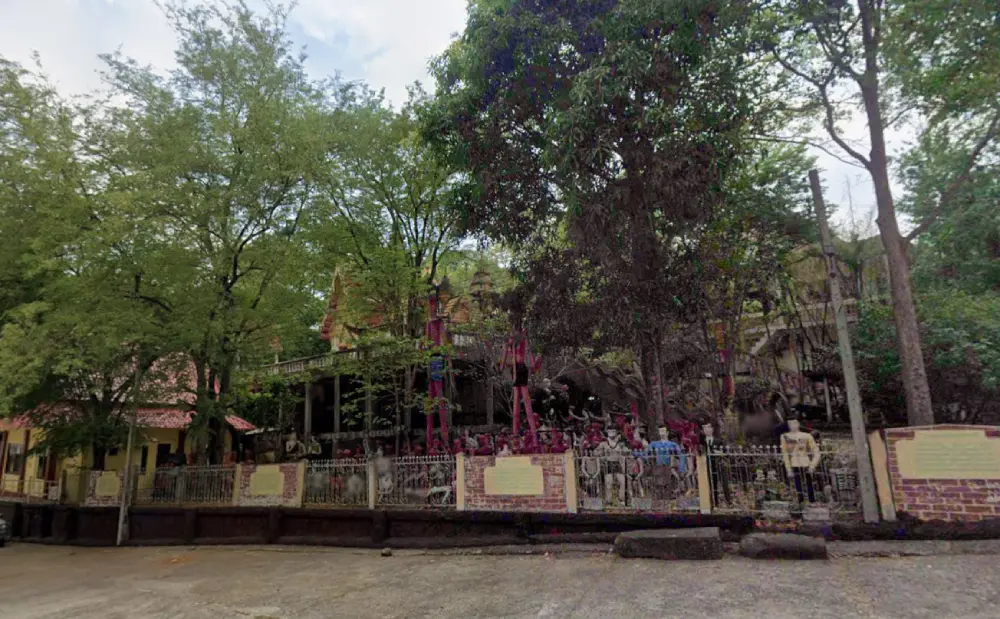
Wat Chaiyaphum Phithak (Pha Koeng)
Open Days: Daily
Opening Hours: 08.00 – 17.00
Wat Chaiyaphum Phithak (Pha Koeng) is a remarkable Buddhist temple located in Ban Na Sombun, Moo 8, Kut Chum Saeng Subdistrict, Nong Bua Daeng District, Chaiyaphum Province. Built on 15 October 1985 and granted its royal consecrated boundary on 16 October 1986, the temple belongs to the Mahanikaya monastic order and is widely known as one of Chaiyaphum’s most scenic faith-based destinations. Set on a mountainous landscape near the Phu Laen Kha range, the temple combines Buddhist devotion, meditation, cliff scenery, forest atmosphere, and panoramic views in one peaceful place.
Wat Chaiyaphum Phithak is also widely known as Wat Pha Koeng. Unlike many village temples on flat land, this temple is defined by its dramatic cliff, forested surroundings, mountain road, and elevated viewpoint. Visitors come here not only to make merit and pay respect to sacred Buddhist objects, but also to experience the calmness of nature. The temple is especially suitable for travelers who seek a quiet temple visit, meditation, mountain scenery, and a deeper sense of local Buddhist culture in northeastern Thailand.
The name “Pha Koeng” reflects the distinctive landscape of the area. In the local Isan language, the word “koeng” is associated with the moon. The cliff here projects outward in a curved shape that resembles a crescent moon, which is why local people came to call the area Pha Koeng. This name gives the temple a strong local identity, linking the Buddhist site with the natural form of the cliff and the language of the surrounding community.
The temple is located in Kut Chum Saeng Subdistrict, Nong Bua Daeng District, along the Chaiyaphum–Nong Bua Daeng route. The surrounding terrain forms part of the Phu Laen Kha mountain landscape. Travelers approaching the temple can see the high cliff and forested slopes from the road. This setting gives Wat Chaiyaphum Phithak a strong visual presence and makes it a meaningful place for both spiritual practice and scenic travel.
The history of the temple is closely connected with the development of Pha Koeng as a Buddhist and natural landmark. The area was originally valued for its peaceful forest atmosphere and dramatic cliff scenery. Later, the standing Buddha image known as Phra Phuttha Chaiyaphum Phithak was built as a symbol of protection and faith for Chaiyaphum Province. The image stands prominently near the cliff, allowing visitors to pay respect while also experiencing the open mountain view.
Phra Phuttha Chaiyaphum Phithak is the most important sacred image of the temple. It is a standing Buddha image in the blessing posture, built in the Rattanakosin style with reinforced concrete and covered with golden mosaic tiles. The image rises gracefully against the mountain backdrop and has become the visual heart of the temple. For many visitors, paying respect to this Buddha image is the central act of a visit to Wat Pha Koeng.
Another important sacred site within the temple is Phra Borommathat Pha Koeng. The presence of the standing Buddha image, the stupa, the cliff, and the forested landscape gives the temple a complete spiritual atmosphere. Visitors can worship, contemplate, walk quietly through the temple grounds, and appreciate the natural setting without feeling separated from Buddhist practice. The temple therefore offers both devotion and reflection.
The temple grounds cover 15 rai, with three additional plots of monastic land totaling 400 rai. The northern and eastern sides connect with the Nong Bua Daeng route, while the southern and western sides border protected forest areas. This location explains why the temple has such a strong relationship with both the road and the forest. Wat Chaiyaphum Phithak is not only a religious compound, but also a mountain temple where Buddhist practice and environmental setting support each other.
Important monastic buildings include the ordination hall, sermon hall, chanting hall, monks’ residences, vihara, and multipurpose hall. The ordination hall measures 10 meters wide and 10 meters long and is built in Thai style with reinforced concrete. The sermon hall measures 15 meters wide and 37 meters long and supports merit-making, Dhamma listening, ceremonies, and community gatherings. The chanting hall measures 18 meters wide and 22 meters long and is built as a semi-masonry, semi-wooden structure.
The temple also has a large number of monks’ residences. This reflects its role as a place of monastic practice, study, and meditation. The residences allow monks, novices, and practitioners to stay within the temple grounds, supporting daily chanting, meditation, Dhamma study, and religious activities. This structure makes Wat Chaiyaphum Phithak more than a viewpoint. It is a living Buddhist institution where monastic life continues in a natural setting.
Wat Chaiyaphum Phithak received its royal grant of Wisungkhamasima on 16 October 1986. The consecrated boundary measures 17.50 meters wide and 20 meters long. In Thai Buddhism, this boundary is essential for important Sangha ceremonies, especially ordination-related rituals. The royal consecrated boundary confirms the temple’s formal religious status and allows it to function properly as a complete Buddhist temple.
Phra Dhamma Phavana Wachirakhun, also known as Luang Pho Boonma Punnaphirato, is the important abbot associated with Wat Chaiyaphum Phithak. His role in Buddhist practice and temple development has helped shape the identity of the temple as a place of meditation, discipline, and spiritual cultivation. For many devotees, the temple is closely connected not only with its cliff and golden Buddha image, but also with the Dhamma practice associated with Luang Pho Boonma.
The temple is recognized as a model developed temple in Chaiyaphum because the grounds have been organized to support worship, meditation, public visits, and environmental appreciation. The development of the temple does not remove its natural character. Instead, it helps visitors access important areas more safely and meaningfully, including the Buddha image, the stupa, the viewpoint, the meditation areas, and the monastic zones.
The Pha Koeng viewpoint is one of the most memorable parts of the temple. From the cliff area, visitors can look out over the landscape below, especially when the sky is clear. Morning and late afternoon are particularly beautiful because the light gives depth to the mountains, fields, and distant landforms. Visitors should walk carefully, keep a safe distance from cliff edges, and respect the quiet atmosphere of the temple.
The temple is highly suitable for meditation and quiet reflection. Its mountain location, forest atmosphere, fresh air, and relative calm make it different from temples in busy towns. Visitors can chant, sit quietly, walk mindfully, or simply spend time observing the landscape. The temple shows how Buddhist practice can be supported by nature, and how natural surroundings can help people return to mindfulness.
Wat Chaiyaphum Phithak serves as a venue for religious activities of monks, local Buddhists, and the general public. These activities include Buddhist holy day observances, merit-making, Dhamma listening, chanting, meditation, Kathin robe offering, forest robe offering, ordination-related ceremonies, and annual temple events. The temple therefore plays an important role not only for local villagers, but also for Buddhist visitors from other areas.
On Buddhist holy days, the temple becomes a place where devotees come to make merit, listen to Dhamma, and pay respect to Phra Phuttha Chaiyaphum Phithak. Elderly villagers and Buddhist visitors may come to offer food, receive precepts, chant, and spend time in quiet reflection. The mountain setting gives these activities a calm and meaningful atmosphere that differs from urban temples.
During Buddhist Lent and the end of Lent, the temple becomes especially meaningful for the community. Devotees may offer candles, robes, food, and necessities to monks who remain at the temple for the rains retreat. Kathin and forest robe-offering ceremonies also gather monks, villagers, donors, and visitors in acts of shared merit. These ceremonies help maintain the temple and strengthen the relationship between Buddhism and the community.
Local Isan traditions are closely connected with Buddhist temples. Annual customs such as Bun Khao Chi, Bun Phawet, Songkran merit-making, Buddhist Lent, the end of Lent, Kathin, and forest robe offerings often use temples as the center of gathering. Wat Chaiyaphum Phithak may be known for its cliff and viewpoint, but its deeper role remains that of a Buddhist temple where merit-making, gratitude, and community culture continue.
For travelers, Wat Chaiyaphum Phithak can be visited as a half-day or full-day trip from Chaiyaphum city. A common route is to drive from Chaiyaphum toward Nong Bua Daeng along Highway 2159, stop at the temple to pay respect and enjoy the viewpoint, then continue to nearby natural or cultural destinations such as Phu Laen Kha National Park, Tat Ton National Park, Phra That Chaiyaphum, or the Chao Pho Phaya Lae Monument. This route combines faith, landscape, and local history.
Getting There is easiest by private car. From Chaiyaphum city, take the Chaiyaphum–Nong Bua Daeng route along Highway 2159 toward Kut Chum Saeng Subdistrict. Because the temple is located in a mountainous area, visitors should check a digital map before departure and drive carefully, especially on curves, slopes, and rainy days. A private car or rental car is the most practical option for travelers who want to visit several nearby attractions in one day.
Public transport may bring visitors to Chaiyaphum city or Nong Bua Daeng District first, but onward travel to the temple may require local transport or a hired vehicle. Since the temple is not located in a dense town center, public transport can be less convenient than driving. Travelers relying on public transport should plan additional time and arrange return travel in advance.
The best time to visit is in the morning or late afternoon. The weather is usually more comfortable, the light is pleasant for viewing the landscape, and the temple atmosphere is suitable for worship and quiet reflection. Visitors who prefer calm should choose ordinary weekdays, while those who want to experience local religious life may visit on Buddhist holy days or during major temple events.
There is no admission fee to enter the temple. Visitors may make donations according to personal faith. Because the temple is both a sacred place and a cliff viewpoint, visitors should dress modestly, speak quietly, wear comfortable walking shoes, keep children and elderly visitors safe, and avoid standing too close to cliff edges. Photography is appropriate in general areas, but visitors should avoid disturbing monks, ceremonies, or meditation practice.
In summary, Wat Chaiyaphum Phithak (Pha Koeng) is one of Chaiyaphum’s most distinctive Buddhist destinations. Built on 15 October 1985 and granted its royal consecrated boundary on 16 October 1986, the temple combines a golden standing Buddha image, a sacred stupa, a crescent-shaped cliff viewpoint, forested mountain scenery, and meditation areas. It is ideal for travelers who want to make merit, practice mindfulness, enjoy natural scenery, and experience a peaceful side of northeastern Thailand.
| Name | Wat Chaiyaphum Phithak (Pha Koeng) |
| Location | Ban Na Sombun, Moo 8, Kut Chum Saeng Subdistrict, Nong Bua Daeng District, Chaiyaphum Province |
| Address | Highway 2159, Kut Chum Saeng Subdistrict, Nong Bua Daeng District, Chaiyaphum Province 36210, Thailand |
| Highlights | A mountain temple on the Phu Laen Kha range with Phra Phuttha Chaiyaphum Phithak, Phra Borommathat Pha Koeng, a crescent-shaped cliff viewpoint, and peaceful meditation areas |
| History | Built on 15 October 1985, granted Wisungkhamasima on 16 October 1986, and affiliated with the Mahanikaya monastic order |
| Temple Area | 15 rai of temple land, with three additional plots of monastic land totaling 400 rai |
| Monastic Buildings | Ordination hall, sermon hall, chanting hall, monks’ residences, vihara, and multipurpose hall |
| Sacred Objects | Phra Phuttha Chaiyaphum Phithak, Phra Borommathat Pha Koeng, Hong Boat Pavilion, and a replica crystal cave |
| Consecrated Boundary | Granted Wisungkhamasima on 16 October 1986; the boundary measures 17.50 meters wide and 20 meters long |
| Abbot | Phra Dhamma Phavana Wachirakhun (Luang Pho Boonma Punnaphirato) |
| Admission Fee | Free Admission; Donations Are Voluntary |
| Facilities | Parking, Restrooms, Worship Area, Viewpoint, Meditation Areas, Rest Areas, And Basic Utilities |
| Main Areas / Zones | Phra Phuttha Chaiyaphum Phithak Area, Phra Borommathat Pha Koeng, Pha Koeng Viewpoint, Ordination Hall, Sermon Hall, Chanting Hall, Monks’ Residences, Vihara, Hong Boat Pavilion, Replica Crystal Cave, And Meditation Areas |
| Travel Information | Private car is the most convenient option. From Chaiyaphum city, take Highway 2159 toward Nong Bua Daeng and continue to Kut Chum Saeng Subdistrict. A digital map is recommended |
| Current Status | An active local Buddhist temple under the Mahanikaya order, serving as a meditation site and a faith-and-nature destination in Chaiyaphum Province |
| Open Days | Daily |
| Opening Hours | 08.00 – 17.00 |
| Nearby Tourist Attractions | 1. Pha Koeng Viewpoint, Inside The Temple, About 0 km 2. Phu Laen Kha National Park, About 1 km 3. Tat Ton National Park, About 28 km 4. Phra That Chaiyaphum, Kaeng Khro District, About 30 km 5. Chao Pho Phaya Lae Monument, Mueang Chaiyaphum District, About 36 km |
| Nearby Restaurants | 1. Warm House • Bakery, About 16 km, Tel. 081-757-9570, 092-516-5005 2. Tam Zaep Bua Daeng, Nong Bua Daeng District, About 17 km, Tel. 093-364-0326 3. Tam Zaep Restaurant, Nong Bua Daeng District, About 18 km, Tel. 099-038-7789 4. Mum Aroi Cafe, Nong Bua Daeng District, About 18 km, Tel. 082-206-3978 5. Torboon Coffee, Phra That Chaiyaphum, About 29 km, Tel. 081-933-8251 |
| Nearby Accommodations | 1. First Inn Resort, Nong Bua Daeng District, About 18 km, Tel. 098-584-7787 2. Lee Resort Farm Stay, Nong Bua Daeng District, About 20 km, Tel. 093-725-6720, 088-915-2592 3. Chaiyaphum Monster Fishing Park & Resort, About 29 km, Tel. 081-957-7312 4. Chaiyaphum Park Hotel, Mueang Chaiyaphum District, About 38 km, Tel. 044-816-567, 044-816-997 5. Lertnimit Hotel, Mueang Chaiyaphum District, About 39 km, Tel. 044-811-522, 080-165-9494 |
Frequently Asked Questions (FAQ)
Q: Where is Wat Chaiyaphum Phithak (Pha Koeng) located?
A: Wat Chaiyaphum Phithak (Pha Koeng) is located in Ban Na Sombun, Moo 8, Kut Chum Saeng Subdistrict, Nong Bua Daeng District, Chaiyaphum Province, Thailand.
Q: When was Wat Chaiyaphum Phithak (Pha Koeng) built?
A: The temple was built on 15 October 1985 and received its royal consecrated boundary on 16 October 1986.
Q: What are the highlights of Wat Chaiyaphum Phithak (Pha Koeng)?
A: Highlights include Phra Phuttha Chaiyaphum Phithak, Phra Borommathat Pha Koeng, the crescent-shaped cliff viewpoint, the Phu Laen Kha mountain atmosphere, and peaceful meditation areas.
Q: What type of travel is Wat Chaiyaphum Phithak (Pha Koeng) suitable for?
A: It is suitable for merit-making, temple visits, meditation, mountain viewpoints, nature photography, and faith-based travel in Chaiyaphum Province.
Q: Is there an admission fee at Wat Chaiyaphum Phithak (Pha Koeng)?
A: There is no admission fee. Visitors may make voluntary donations according to personal faith.
Q: How can travelers get to Wat Chaiyaphum Phithak (Pha Koeng)?
A: Traveling by private car is the most convenient option. From Chaiyaphum city, take Highway 2159 toward Nong Bua Daeng and continue to Kut Chum Saeng Subdistrict.
Q: Are there attractions near Wat Chaiyaphum Phithak (Pha Koeng)?
A: Nearby attractions include Pha Koeng Viewpoint, Phu Laen Kha National Park, Tat Ton National Park, Phra That Chaiyaphum, and the Chao Pho Phaya Lae Monument.
Q: What should visitors be careful about at the Pha Koeng viewpoint?
A: Visitors should walk carefully, avoid standing too close to cliff edges, supervise children and elderly travelers, wear comfortable shoes, and respect the temple’s meditation areas.
Mobile : 0926471008
 Mobile : 0926471008
 Category: ●Places of Worship
 Group: ●Temple
Last Update : 1 DayAgo
 Last Update : 1 DayAgo
 Click to Access the Navigation Map GPS
Wat Chaiyaphum Phithak (Pha Koeng) Map
Recommend

 Art, Culture and Heritage
 Historical Sites and Monuments(1)
 Landmarks and Memorials(3)
 Royal Palace(1)
 Art, Craft Centres, Tradition(3)
 Educational Places
 Educational Gardens, Farm(1)
Temple(141)
Educational Gardens, Farm(1)
Temple(141)
 Other Sacred Sites(7)
 Suburban Living
 Village, Community(4)
 Nature and Wildlife
 National Parks and Marine Reserves(7)
 Mountain (Doi)(5)
 Dam, Reservoir, Lake(10)
 Waterfalls(15)
 Caves(5)
 River, Canal(4)
 Other natural attractions(1)
 Entertainment and Agricultural
 Farms, Parks and Ecotourism(2)


