
lovethailand home >Northeastern Travel Attractions >Chaiyaphum Travel Attractions >Phu Khieo >Phak Pang > Wat Non That Ngam
TL;DR: Wat Non That Ngam is located at Ban Non Ngam, Pak Pang Subdistrict, Phu Khiao District, Chaiyaphum Province, open Daily, hours 08.00 – 17.00.
Wat Non That Ngam
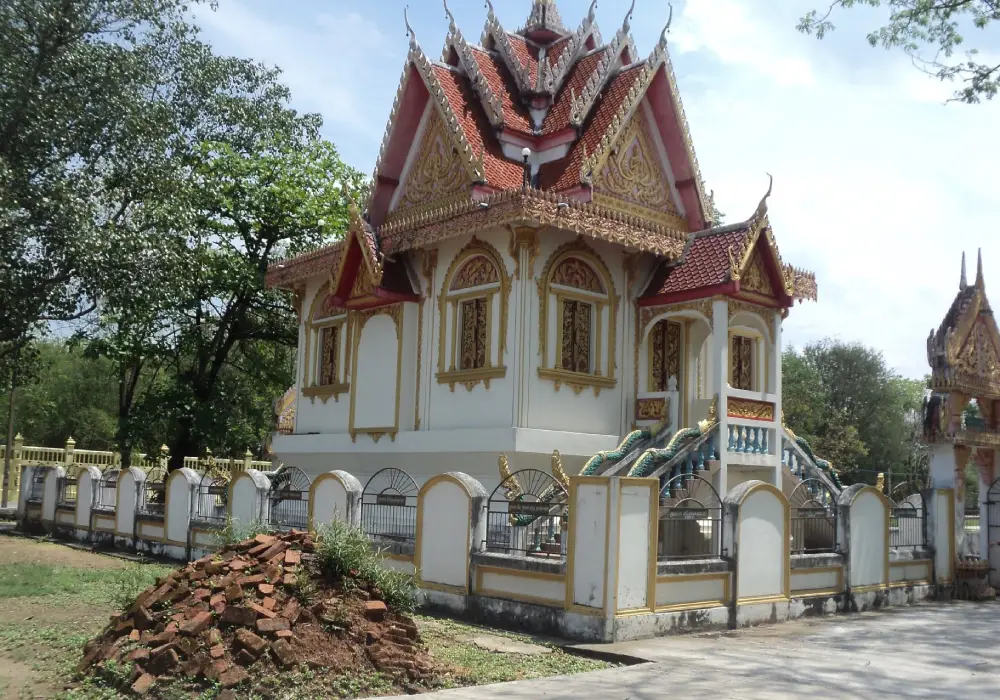
Open Days: Daily
Opening Hours: 08.00 – 17.00
Wat Non Thatu Ngam is located at Ban Non Ngam, Pak Pang Subdistrict, Phu Khiao District, Chaiyaphum Province. It is a community Buddhist temple under the Mahanikaya sect and is important both as a living religious site for local people and as a place of archaeological and cultural value. The temple has a peaceful, shaded atmosphere and contains important ancient remains within its grounds, especially two old stupas that reflect local northeastern Thai Buddhist art and the faith of the community in earlier times. Some ancient objects and structural remains have deteriorated over time and are now significant for survey, inspection, conservation, and appropriate restoration.
Wat Non Thatu Ngam is valuable not only as a place where villagers come to make merit, but also as a site where Buddhism, local history, archaeology, and community life are closely connected. Visitors will find a local temple that continues to serve religious functions, with resident monks, annual Buddhist activities, and a calm temple environment, while also preserving ancient remains that reveal the development of the local community in the past. This makes the temple suitable for visitors who wish to pay respect, make merit, practice mindfulness, and learn about the local history of Chaiyaphum Province.
Ban Non Ngam and Pak Pang Subdistrict are part of Phu Khiao District in Chaiyaphum Province. The area has the character of a rural community connected with agricultural land, local roads, and community temples. Wat Non Thatu Ngam stands within this cultural setting as both a spiritual center for villagers and a heritage site that helps explain the relationship between local people and Buddhism in the Phu Khiao area.
The main highlight of Wat Non Thatu Ngam is the group of two ancient stupas located within the temple grounds. The two structures stand approximately 25.5 meters apart and are valuable in terms of history, art, and conservation. The larger stupa has collapsed and only some parts remain, while the smaller stupa still preserves part of its artistic form, although much of the outer plaster has peeled away. These conditions make the temple an important learning site for visitors interested in local ancient monuments and northeastern Thai Buddhist art.
The artistic form of the stupas at Wat Non Thatu Ngam belongs to a local style often associated with Lao-style chedi architecture. The art historical character relates to the late Ayutthaya to early Rattanakosin period, reflecting the cultural connections between northeastern Thailand, Lao artistic traditions, and Buddhist faith along the Chi River basin and surrounding regions. Chaiyaphum is therefore not only a province of mountains, forests, and natural attractions, but also a place with cultural heritage preserved in community temples and ancient religious structures.
The first stupa is a square brick structure built with clay mortar and covered with plaster. Some decorative stucco traces remain, especially upturned lotus-petal motifs that still allow visitors to recognize part of the original artistic form. Although many sections have fallen away or deteriorated with time, the remaining base, brickwork, and traces of decoration show that the structure was once more complete. The base is partly buried, and bricks are visible at ground level, suggesting an additional foundation layer around the structure.
Around the stupa are traces of stone boundary markers, or sema stones, placed in groups on several sides. These are important archaeological elements because sema stones are often associated with sacred Buddhist boundaries and ritual areas. Their presence around the ancient stupa increases the archaeological significance of Wat Non Thatu Ngam and shows that the temple grounds contain more than ordinary village temple structures. They preserve evidence of a sacred space used by the community in the past.
The second stupa stands to the northwest of the first one. It is also a square brick structure built with clay mortar, but it is more heavily damaged and the original form can no longer be seen clearly. The remaining height is about 2.20 meters. Although this structure is less complete, it remains important as part of the same ancient monument group. Conservation should therefore consider both stupas together, rather than focusing only on the structure that still preserves more visible artistic form.
The ancient remains at Wat Non Thatu Ngam are important for understanding the local history of Pak Pang Subdistrict and Phu Khiao District. A site like this shows that the community used religious space for a long time before the temple developed into its present community form. The presence of ancient stupas and sema stones within the temple grounds makes Wat Non Thatu Ngam both a living religious site in the present and a place of local memory from the past.
The atmosphere of Wat Non Thatu Ngam is shaded, calm, and suitable for respectful visits. Visitors should treat the temple as both a sacred place and a conservation site. They should not touch, climb on, or move any ancient remains, because some objects and structures have deteriorated and require careful protection. Responsible visiting is part of helping preserve the cultural heritage of the local community for the future.
As a community temple, Wat Non Thatu Ngam continues to function as a place for Buddhist activities for monks and local devotees. Villagers come to the temple to make merit, offer food to monks, listen to Dhamma, join Buddhist holy day activities, and take part in traditional ceremonies. The temple is therefore not limited to archaeological interest; it remains a living Buddhist space where religion continues to be part of everyday life.
Recent Kathin-related temple information lists 5 resident monks at Wat Non Thatu Ngam and names Phra Athikan Narong Tikkhapanyo as the abbot. The presence of resident monks and continuing religious activities reflects the temple’s active role as a spiritual center of the community. Local people can come to make merit, listen to Buddhist teachings, and participate in ceremonies, while monks maintain the religious duties and peaceful atmosphere of the temple.
Important activities at Wat Non Thatu Ngam are connected with Buddhist holy days, Kathin ceremonies, robe-offering events, and merit-making occasions throughout the year. These activities allow villagers to work together, support the temple, prepare religious events, and strengthen community relationships. The temple therefore helps keep traditions and culture alive through real participation, not only through historical memory.
Wat Non Thatu Ngam also serves as a place for meditation and spiritual reflection. Practice at a village temple may take simple forms such as chanting, evening prayers, listening to Dhamma, observing precepts, sitting quietly, or spending time in the calm temple environment. This simplicity makes Buddhist practice accessible to ordinary people and allows the temple to be a place of mental rest for villagers and visitors throughout the year.
For visitors interested in local history, Wat Non Thatu Ngam is a place that should be explored slowly and respectfully. Details such as the ancient stupas, sema stones, brick bases, and traces of stucco decoration all help tell the story of the site. Observing these elements carefully allows visitors to understand that ancient religious sites were not merely buildings, but sacred places connected with ritual, belief, and the identity of the community.
When walking around the ancient remains, visitors should be especially careful. They should avoid stepping on ancient bricks or damaged foundations, avoid touching loose fragments, avoid placing objects on ancient structures, and never scratch, write, or carve anything on the surface of the remains. These practices reduce further damage and show respect for the heritage of the community.
Wat Non Thatu Ngam is suitable for several types of visitors. Buddhist devotees can come to make merit. Older visitors may appreciate the peaceful atmosphere. Families can bring children to learn temple manners and respect for heritage. Cultural travelers can study a local temple with ancient remains. Visitors interested in northeastern Thai art and archaeology can see a lesser-known historic site in Chaiyaphum that is still connected with community life.
Getting There is most convenient by private car. Travelers can drive toward Phu Khiao District in Chaiyaphum Province and continue on local roads to Pak Pang Subdistrict and Ban Non Ngam. From Chaiyaphum city, visitors can take the main route toward Phu Khiao and then continue to the temple via local roads. Travelers coming from Chum Phae District in Khon Kaen Province can also include Wat Non Thatu Ngam as part of a Phu Khiao route.
Visitors using public transportation should first travel to Phu Khiao town and then arrange local transport or a hired vehicle to Pak Pang Subdistrict. Village-level transport may not run frequently throughout the day, so a private car or hired local driver is more practical, especially for visitors who want to combine Wat Non Thatu Ngam with Wat Pa Phu Khiao, Wat Phra That Nong Sam Muen, and restaurants or accommodations in Phu Khiao District.
Upon arrival, visitors should park carefully without blocking temple access or community activities. They should enter the temple respectfully, dress modestly, avoid loud behavior, and take extra care around the ancient remains. Photography should be done from an appropriate distance and should not affect any ancient object or religious activity.
For a half-day trip, visitors can begin at Wat Non Thatu Ngam to pay respect and view the ancient stupas, then continue to a restaurant or cafe in Phu Khiao town. With a full day, the route can include Wat Phra That Nong Sam Muen, Wat Pa Phu Khiao, or Non Mueang Ancient Town in Chum Phae District. This creates a trip that combines temples, ancient sites, local food, and the atmosphere of a small northeastern town.
Socially, Wat Non Thatu Ngam helps maintain continuity within the community. Older generations pass on merit-making practices and temple care to younger people. Children and youth learn how to behave in sacred spaces. Adults take part in activities for the common good, and monks continue to teach Dhamma to the public. This continuity makes the temple an important institution for Ban Non Ngam and Pak Pang Subdistrict.
Culturally, Wat Non Thatu Ngam keeps traditions connected with real life. Kathin ceremonies, robe-offering events, Buddhist holy days, and annual merit-making activities are held within the temple grounds and supported by local people. Traditions therefore remain active through real community participation each year.
From a conservation perspective, Wat Non Thatu Ngam deserves careful attention because parts of the ancient remains have deteriorated. Survey, inspection, and restoration require cooperation among relevant authorities, the temple, the community, and visitors. Conservation is not only about preserving old objects; it is also about preserving the memory, identity, and cultural dignity of the Pak Pang community.
Overall, Wat Non Thatu Ngam is both a community temple and an important local heritage site in Pak Pang Subdistrict, Phu Khiao District, Chaiyaphum Province. With its shaded atmosphere, two ancient stupas, traces of sema stones, and archaeological remains that reflect local northeastern Buddhist art, the temple has clear religious, historical, and cultural value. Although some ancient objects have deteriorated and require careful conservation, the temple continues to serve as a place of faith, meditation, and local historical learning for Chaiyaphum.
| Name | Wat Non Thatu Ngam |
| Location | Ban Non Ngam, Pak Pang Subdistrict, Phu Khiao District, Chaiyaphum Province |
| Address | Pak Pang Subdistrict, Phu Khiao District, Chaiyaphum Province 36110, Thailand |
| Coordinates | 16.3622523955, 102.124579043 |
| Place Type | Community Buddhist temple under the Mahanikaya sect and local ancient monument site |
| Highlights | A shaded temple with two ancient stupas, traces of sema stones, and archaeological remains currently important for survey, inspection, conservation, and restoration |
| History / Period | Wat Non Thatu Ngam was established in 1940. The ancient stupas relate to local Lao-style chedi art associated with the late Ayutthaya to early Rattanakosin period |
| Key Evidence | Two ancient stupas located about 25.5 meters apart, with traces of stone sema markers and ancient brick foundations |
| Condition Of Ancient Remains | The larger stupa has collapsed and only some parts remain. The smaller stupa still preserves part of its artistic form, while much of the outer plaster has peeled away |
| Name Origin | The name relates to Ban Non Ngam and the ancient stupas within the temple, reflecting a sacred site with important community heritage |
| Distinctive Features | A peaceful and shaded temple suitable for merit-making, worship, meditation practice, and learning about local ancient monuments |
| Travel Information | Most convenient by private car; travel toward Phu Khiao District in Chaiyaphum Province, then continue on local roads to Pak Pang Subdistrict and Ban Non Ngam |
| Current Status | An active community Buddhist temple and an important ancient monument site requiring survey, inspection, conservation, and appropriate restoration |
| Open Days | Daily |
| Opening Hours | 08.00 – 17.00 |
| Facilities | Religious activity areas, temple grounds, worship area, community space, and ancient monument zone for respectful learning |
| Main Areas / Zones | Worship area, monks’ residence area, activity ground, meditation area, and ancient stupa zone with two historic structures |
| Abbot / Caretaker | Phra Athikan Narong Tikkhapanyo |
| Resident Monks | 5 Monks |
| Nearby Tourist Attractions | 1. Ancient Stupas Of Wat Non Thatu Ngam, within the temple grounds 2. Wat Pa Phu Khiao, Pak Pang Subdistrict, about 5 km 3. Wat Phra That Nong Sam Muen, Phu Khiao District, about 20 km 4. Non Mueang Ancient Town, Chum Phae District, Khon Kaen Province, about 28 km 5. Sok Nam Sai Health Park, Chum Phae District, Khon Kaen Province, about 30 km 6. Chum Phae Public Park, Khon Kaen Province, about 31 km |
| Nearby Restaurants | 1. Rabiang Na Cafe’ @ Phu Khiao, about 6 km, Tel. 084-227-2252 2. Jungle Cafe Phu Khiao Branch, about 7 km, Tel. 093-320-9302 3. Saeng Arun Phochana (Ko Tee), Phu Khiao, about 8 km, Tel. 044-861-015 4. Cha Chak Phu Khiao Chaiyaphum, about 8 km, Tel. 092-270-6040 5. Mam Yai Kham Chao Kao, Phu Khiao District, about 8 km, Tel. 091-862-2316, 089-423-5141, 094-284-8594 6. PunThai Coffee Phu Khiao Chalermprakiet Hospital, about 7 km, Tel. 061-393-7173 |
| Nearby Accommodations | 1. Bander Hotel Phu Khiao, about 7 km, Tel. 044-862-332, 081-068-3563 2. Phu Suai Nam Sai Resort, about 7 km, Tel. 044-844-212, 083-222-7744 3. P. Suwan Resort, about 8 km, Tel. 086-879-4509, 044-861-396 4. Sabai Jai Garden Home Resort, about 10 km, Tel. 086-874-3229, 087-446-2572 5. Ban Suan Amra Resort, about 10 km, Tel. 082-755-3908, 081-546-9909 6. Sanongchai Resort Phu Khiao, about 14 km, Tel. 081-471-9191, 088-375-1199 |
Frequently Asked Questions (FAQ)
Q: Where is Wat Non Thatu Ngam located?
A: Wat Non Thatu Ngam is located at Ban Non Ngam, Pak Pang Subdistrict, Phu Khiao District, Chaiyaphum Province.
Q: What is important at Wat Non Thatu Ngam?
A: The temple contains two ancient stupas, traces of sema stones, and archaeological remains that are valuable for local northeastern Thai history and art.
Q: What is the condition of the ancient remains at Wat Non Thatu Ngam?
A: Some ancient remains have deteriorated. The larger stupa has collapsed and only some parts remain, while the smaller stupa still preserves part of its artistic form. The site is important for survey, inspection, conservation, and restoration.
Q: Who is the abbot or caretaker of Wat Non Thatu Ngam?
A: Phra Athikan Narong Tikkhapanyo is listed as the abbot of Wat Non Thatu Ngam.
Q: What are the opening hours of Wat Non Thatu Ngam?
A: Wat Non Thatu Ngam is open daily from 08.00 to 17.00 for merit-making, worship, and respectful visits to the ancient monument area.
Q: How should visitors behave at Wat Non Thatu Ngam?
A: Visitors should dress modestly, keep quiet, avoid touching or climbing on ancient remains, avoid moving any fragments, and respect the monks’ and community areas.
Q: Is it convenient to visit Wat Non Thatu Ngam by private car?
A: Yes. A private car is the most convenient option. Travelers can drive toward Phu Khiao District, then continue on local roads to Pak Pang Subdistrict and Ban Non Ngam.
Q: What nearby places can be combined with a visit to Wat Non Thatu Ngam?
A: Visitors can combine the temple with Wat Pa Phu Khiao, Wat Phra That Nong Sam Muen, Non Mueang Ancient Town, Sok Nam Sai Health Park, and other attractions in Phu Khiao and Chum Phae.
 Category: ●Places of Worship
 Group: ●Temple
Last Update : 2 MonthAgo
 Last Update : 2 MonthAgo
 Click to Access the Navigation Map GPS
 Art, Culture and Heritage
 Historical Sites and Monuments(1)
 Landmarks and Memorials(3)
 Royal Palace(1)
 Art, Craft Centres, Tradition(3)
 Educational Places
 Educational Gardens, Farm(1)
Temple(141)
Educational Gardens, Farm(1)
Temple(141)
 Other Sacred Sites(7)
 Suburban Living
 Village, Community(4)
 Nature and Wildlife
 National Parks and Marine Reserves(7)
 Mountain (Doi)(5)
 Dam, Reservoir, Lake(10)
 Waterfalls(15)
 Caves(5)
 River, Canal(4)
 Other natural attractions(1)
 Entertainment and Agricultural
 Farms, Parks and Ecotourism(2)


