
lovethailand home >Northeastern Travel Attractions >Chaiyaphum Travel Attractions >Kaset Sombun >Ban Pao > Wat Phra That Ban Pao
TL;DR: Wat Phra That Ban Pao is located at Ban Pao Village, Moo 9, Ban Pao Subdistrict, Kaset Sombun District, Chaiyaphum Province, open Daily, hours 08.00 – 17.00.
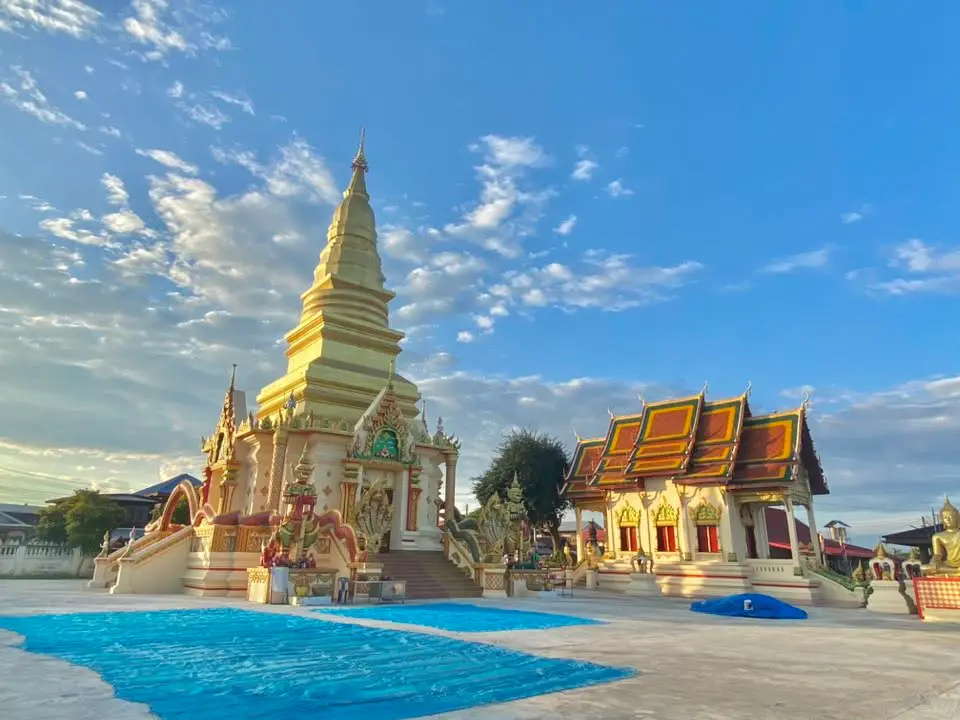
Wat Phra That Ban Pao
Open Days: Daily
Opening Hours: 08.00 – 17.00
Wat Phra That Ban Pao, also known locally as Wat That Ban Pao, is an important Buddhist temple and heritage site in Ban Pao Subdistrict, Kaset Sombun District, Chaiyaphum Province. The temple is best known for its 2 ancient brick stupas. The larger stupa is heavily damaged and now remains mainly as a base, while the smaller stupa is also badly deteriorated but still preserves visible traces of old brick construction. For travelers interested in ancient stupas, local Buddhist heritage, and the cultural history of northeastern Thailand, Wat Phra That Ban Pao is a meaningful place to visit.
This temple is not a large commercial tourist attraction. Its value lies in the quiet presence of old sacred structures that remain within a living village temple. Visitors come here to pay respect to the ancient stupas, worship sacred images inside the temple, and learn about the deep relationship between Buddhism and the Ban Pao community. Wat Phra That Ban Pao offers a different kind of travel experience: slow, respectful, historical, and rooted in local faith.
Ban Pao Subdistrict in Kaset Sombun District is a community with several temples, shrines, and sacred places. Wat That Ban Pao is one of the most important religious sites in the area because it connects Buddhist devotion with local history. The temple functions both as an active place of worship and as a community heritage site. This dual role makes it especially interesting for travelers who want to see how ancient remains continue to exist within the living religious life of a Thai village.
The 2 ancient stupas are the central features of Wat Phra That Ban Pao. The larger stupa has deteriorated until only its base remains, but that base is still important because it marks the original structure and sacred location. The smaller stupa is also badly damaged, yet it still shows the character of old brickwork. Local explanations often connect the bricks with Mon-style construction, and the site is commonly associated with older cultural influences such as Mon, Khmer, or Burmese artistic traditions. The historical interpretation of the site is also linked with the late Ayutthaya period and the early Rattanakosin period in local memory.
For cultural travelers, the damaged condition of the stupas should not be seen as a weakness. In fact, the remaining bases and old bricks are part of the site’s authenticity. They allow visitors to see how time, weather, community memory, and religious continuity shape a local heritage site. These traces are valuable because they preserve the physical evidence of past belief, craftsmanship, and settlement in the Kaset Sombun area.
Wat Phra That Ban Pao is often mentioned in connection with other ancient stupas in Chaiyaphum, especially Phra That Kut Chok in Kaset Sombun District and Phra That Ban Kaeng, also known as Phra That Nong Sam Muen, in Phu Khiao District. These sites show that Chaiyaphum has a wider landscape of ancient Buddhist monuments spread across local communities. Visiting them together helps travelers understand the cultural geography of old stupas in this part of northeastern Thailand.
The comparison with Phra That Kut Chok and Phra That Nong Sam Muen is useful because it shows that the Ban Pao stupas are not isolated objects. They belong to a broader network of sacred structures, local pilgrimage sites, and community memories. Each site has its own condition, scale, and historical role, but all of them reflect the importance of Buddhist relic monuments in the religious imagination of Chaiyaphum communities.
Another important feature at Wat Phra That Ban Pao is the tunnel-like sacred chamber with deity images located inside the sermon hall. This chamber is associated with Mon or Burmese artistic influence in local understanding and is used as a place of worship by Buddhists and local residents. Its presence adds another historical and spiritual layer to the temple. The sermon hall therefore functions not only as a space for religious gatherings, but also as a place where sacred images, local belief, and community devotion come together.
The temple also houses revered Buddhist images, including the sacred Phra Kaccayana, widely known in Thai culture as a symbol of abundance, kindness, prosperity, and auspicious blessings. Many devotees pay respect to Phra Kaccayana for good fortune, family happiness, and success. Together with the ancient stupas and the sacred chamber, this image makes Wat Phra That Ban Pao a temple with several layers of devotional meaning.
Wat Phra That Ban Pao remains active as a community temple. Its public temple page shares religious activities, temple events, and local traditions, showing that the site is still part of the living religious life of Ban Pao. This is important because the temple should not be understood only as an ancient ruin. It is also a functioning Buddhist temple where monks, laypeople, and villagers continue to gather for merit-making, ceremonies, and community events.
The current abbot of Wat That Ban Pao is Phra Athikan Kittirot Thanakaro. As the temple’s spiritual caretaker, he helps oversee Buddhist activities, temple events, and the ongoing connection between the temple and the local community. A temple with ancient heritage inside its grounds requires careful attention, because it must serve both present-day religious life and the preservation of fragile historical remains.
The people of Ban Pao have long been connected with Wat That Ban Pao through merit-making, Buddhist festivals, and local ceremonies. Events such as Visakha Bucha Day, Buddhist Lent, the end of Buddhist Lent, Tak Bat Thewo, Bun Mahachat, and other community merit-making activities help keep the temple active. These traditions bring together monks, elders, families, students, and local residents, turning the temple into a living cultural center rather than a silent monument.
Tak Bat Thewo, traditionally associated with the end of Buddhist Lent, is one example of how Buddhist belief becomes community practice. During this ceremony, people make offerings to monks and recall the story of the Buddha descending from Tavatimsa Heaven after teaching the Dhamma to his mother. When this tradition is held at a village temple such as Wat That Ban Pao, it strengthens both religious devotion and social bonds within the community.
Bun Mahachat, or the Great Birth Sermon festival, is another significant tradition often linked with Isan temples. It centers on the story of Prince Vessantara, a previous life of the Buddha, and emphasizes generosity, sacrifice, and moral virtue. At Wat That Ban Pao, community-based sermon events preserve the sound, rhythm, and meaning of local Buddhist teaching. For visitors, such traditions show that temples are not only architectural sites; they are also places where stories, values, and collective memory are performed.
Visitors to Wat Phra That Ban Pao should approach the site with respect. A recommended visit begins by paying respect at the temple, observing the 2 ancient stupas, and then worshipping the sacred chamber and Phra Kaccayana inside the temple area. Because the stupas are damaged and fragile, visitors should not climb on them, touch unstable parts, or treat them as photo props. They should be viewed as sacred remains and historical evidence that belong to the local community.
One of the most meaningful aspects of this temple is that the ancient stupas remain within an active religious environment. They have not been removed to a museum or separated from the community. Instead, they stand within a temple where people still make merit and hold ceremonies. This creates a living encounter between past and present. Travelers can see ancient brick remains and contemporary Buddhist practice in the same space.
Wat Phra That Ban Pao is well suited to a heritage route focusing on ancient stupas in Chaiyaphum. Travelers can combine it with Phra That Kut Chok in Kaset Sombun District and Phra That Nong Sam Muen in Phu Khiao District. This route allows visitors to compare different forms of ancient Buddhist monuments and understand how local communities preserve sacred places through worship, memory, and temple activities.
The Ban Pao community also has stories connected with respected monks and local spiritual figures. These memories are part of the temple’s cultural value. Elders, local scholars, temple caretakers, and community members have played important roles in keeping these stories alive. For this reason, Wat Phra That Ban Pao should be seen not only as a place of old bricks and damaged stupas, but also as a place shaped by people, faith, and collective memory.
The atmosphere of the temple is calm and local. Visitors should take time to look carefully at the stupas, observe the brickwork, notice the remaining structure, and understand the relationship between the temple and the village. This is not a place for a rushed visit. A slow visit helps travelers appreciate the site’s quiet historical depth and the sincerity of local devotion.
Proper temple etiquette is important. Visitors should dress modestly, speak softly, avoid disturbing monks or worshippers, and behave respectfully in the sermon hall and around the stupas. Since the ancient remains are already damaged, careful visitor behavior helps protect what is left. Respect for the site is also respect for the people of Ban Pao, who continue to maintain the temple as a sacred community space.
Getting There is most convenient by private car or rental car. Travelers can drive to Kaset Sombun District in Chaiyaphum Province and continue to Ban Pao Subdistrict. The temple is located at Ban Pao, Moo 9, on Ban Pao Road. Private transport is the best option because it allows visitors to combine the temple with nearby restaurants, cafes, accommodations, and other heritage sites such as Phra That Kut Chok and Phra That Nong Sam Muen.
From Chaiyaphum town, the temple can be visited as a day trip or as part of an overnight journey in Kaset Sombun. A good itinerary is to visit Wat Phra That Ban Pao in the morning, spend time paying respect and observing the ancient stupas, stop for lunch or coffee in Ban Pao or Kaset Sombun, and then continue to Phra That Kut Chok or Phra That Nong Sam Muen depending on available time. Travelers who prefer a slower route may stay overnight in the district.
There are several nearby restaurants and cafes that make the trip easier, including Saeb Ver Ban Pao, Jungle Cafe Ban Pao Branch, Tiwpha Cafe, Na Hao Cafe, and Noo Nu Cafe Kaset Sombun. These places are useful stops for food, coffee, or a short break before continuing the journey. Travelers should check each restaurant’s current opening status before visiting, especially if traveling early in the morning or late in the day.
Accommodation options around Ban Pao and Kaset Sombun include small local resorts and homestay-style stays, such as Ban Pao Garden Home Resort, Namfon Resort, KS Resort, Ban Khao Rao Suk Resort, and Homestay Yai Nan. Visitors who want more hotel choices may stay in Chaiyaphum town, but staying near Kaset Sombun is more convenient for travelers focusing on temple heritage, local communities, and ancient stupas in the area.
Wat Phra That Ban Pao is suitable for several types of travelers: those who want to make merit, visitors interested in ancient stupas, cultural travelers, local history enthusiasts, photographers, and writers researching Thai temple heritage. The temple’s appeal does not come from grandeur, but from historical depth, sacred atmosphere, and the lasting devotion of the Ban Pao community.
The most important way to understand Wat Phra That Ban Pao is to see it as local heritage. The damaged larger stupa and the fragile smaller stupa are not merely old structures; they are evidence of belief, craftsmanship, and community continuity. Presenting and visiting the temple responsibly helps protect the remains while supporting local awareness of their value.
Overall, Wat Phra That Ban Pao is one of the meaningful cultural and religious sites of Kaset Sombun District. Its main features include 2 ancient brick stupas, Mon-style brickwork associations, a sacred chamber with deity images in the sermon hall, the revered Phra Kaccayana image, continuing temple traditions, and the role of the temple as the spiritual center of Ban Pao. A visit here offers a rare chance to experience history, faith, and community life in one place.
Wat Phra That Ban Pao is best visited with intention and respect. Spend time observing the ancient remains, worshipping the sacred images, learning about the community context, and connecting the visit with other nearby stupas in Chaiyaphum. Even though the ancient structures are damaged, they still carry the power to connect visitors with the past, local faith, and the cultural roots of Ban Pao.
| Name | Wat Phra That Ban Pao / Wat That Ban Pao |
| Location | Ban Pao Village, Moo 9, Ban Pao Subdistrict, Kaset Sombun District, Chaiyaphum Province |
| Address | 111 Moo 9, Ban Pao Road, Ban Pao Subdistrict, Kaset Sombun District, Chaiyaphum Province 36120, Thailand |
| Place Type | Local Buddhist temple, community heritage site, and sacred center of Ban Pao |
| Highlights | 2 ancient stupas, the larger one remaining as a base and the smaller one badly deteriorated, together with a sacred chamber in the sermon hall and a revered Phra Kaccayana image |
| History | The ancient stupas are associated with old Mon, Khmer, or Burmese artistic influences and are often connected in local interpretation with the late Ayutthaya to early Rattanakosin period |
| Key Evidence | 2 brick stupas, Mon-style bricks, remaining stupa bases, sacred chamber with deity images, and locally revered sacred objects |
| Name Origin | The name refers to the ancient stupas within the temple and the Ban Pao community, giving rise to the common names Wat That Ban Pao and Wat Phra That Ban Pao |
| Distinctive Features | A living village temple with ancient stupas, local sacred images, historical artistic influences, and continuing Buddhist traditions |
| Main Areas / Zones | Ancient stupa area, sermon hall, sacred chamber with deity images, Phra Kaccayana worship area, temple courtyard, religious activity area, and local ceremony spaces |
| Abbot / Caretaker | Phra Athikan Kittirot Thanakaro |
| Current Status | Open as an active community temple and a place for worshipping Phra That Ban Pao, with ongoing Buddhist and local cultural activities |
| Open Days | Daily |
| Opening Hours | 08.00 – 17.00 |
| Travel Information | Best reached by private car or rental car via Kaset Sombun District, then onward to Ban Pao Subdistrict. The temple can be combined with Phra That Kut Chok, Phra That Nong Sam Muen, and other local attractions in Kaset Sombun. |
| Main Contact Number | 044-866-139 |
| Official Website / Official Page | Wat That Ban Pao Chaiyaphum Province / Watthat Banpao Chaiyaphumprovince |
| Nearby Tourist Attractions | 1. Wat Burapharam, Ban Pao Subdistrict, about 1 km 2. Wat Pa Ban Pao, Ban Pao Subdistrict, about 2 km 3. Phra That Kut Chok, Ban Yang Subdistrict, Kaset Sombun District, about 18 km 4. Wat Phra That Nong Sam Muen / Phra That Ban Kaeng, Phu Khiao District, about 30 km 5. Tiwpha Cafe and Ban Yang Route, Kaset Sombun District, about 14 km |
| Nearby Restaurants | 1. Saeb Ver Ban Pao, about 1 km, Tel. 098-412-1194 2. Jungle Cafe Ban Pao Branch, Chaiyaphum, about 1 km, Tel. 091-8658456 3. Tiwpha Cafe, about 14 km, Tel. 099-2929898 4. Na Hao Cafe, about 15 km, Tel. 096-4187365 5. Noo Nu Cafe Kaset Sombun, about 12 km, Tel. 086-5432422, 095-6651723 |
| Nearby Accommodations | 1. Ban Pao Garden Home Resort, about 1 km, Tel. 082-8826535 2. Namfon Resort, Kut Lo Subdistrict, about 8 km 3. KS Resort Kaset Sombun, about 9 km 4. Ban Khao Rao Suk Resort, about 12 km, Tel. 089-7791867 5. Homestay Yai Nan, Kaset Sombun, about 15 km |
Frequently Asked Questions (FAQ)
Q: Where is Wat Phra That Ban Pao located?
A: Wat Phra That Ban Pao, also known as Wat That Ban Pao, is located at 111 Moo 9, Ban Pao Road, Ban Pao Subdistrict, Kaset Sombun District, Chaiyaphum Province 36120, Thailand.
Q: What is the main highlight of Wat Phra That Ban Pao?
A: The main highlights are the 2 ancient stupas, the larger one remaining mainly as a base and the smaller one badly deteriorated, along with a sacred chamber in the sermon hall and the revered Phra Kaccayana image.
Q: How old are the ancient stupas at Wat Phra That Ban Pao?
A: The stupas are associated in local historical interpretation with Mon, Khmer, or Burmese artistic influences and are often linked with the late Ayutthaya to early Rattanakosin period.
Q: Who is the abbot of Wat Phra That Ban Pao?
A: The current abbot of Wat That Ban Pao is Phra Athikan Kittirot Thanakaro, who oversees the temple’s Buddhist activities and its connection with the Ban Pao community.
Q: What are the opening days and hours of Wat Phra That Ban Pao?
A: The temple is open daily from 08.00 to 17.00, making daytime visits the most convenient option.
Q: What local traditions are associated with Wat Phra That Ban Pao?
A: The temple is connected with Buddhist and local community traditions such as Visakha Bucha Day, Bun Mahachat, Tak Bat Thewo, Buddhist Lent, the end of Buddhist Lent, and local merit-making ceremonies.
Q: What nearby attractions can be visited with Wat Phra That Ban Pao?
A: Nearby places include Wat Burapharam, Wat Pa Ban Pao, Phra That Kut Chok, and Wat Phra That Nong Sam Muen or Phra That Ban Kaeng in Phu Khiao District.
Q: How should visitors behave around the ancient stupas?
A: Visitors should dress respectfully, behave calmly, avoid touching or climbing on the damaged stupas, respect the sacred area, and help preserve the site for the local community.
 Category: ●Places of Worship
 Group: ●Temple
Last Update : 3 DayAgo
 Last Update : 3 DayAgo
 Click to Access the Navigation Map GPS
Wat Phra That Ban Pao Map
Recommend

 Art, Culture and Heritage
 Historical Sites and Monuments(1)
 Landmarks and Memorials(3)
 Royal Palace(1)
 Art, Craft Centres, Tradition(3)
 Educational Places
 Educational Gardens, Farm(1)
Temple(141)
Educational Gardens, Farm(1)
Temple(141)
 Other Sacred Sites(7)
 Suburban Living
 Village, Community(4)
 Nature and Wildlife
 National Parks and Marine Reserves(7)
 Mountain (Doi)(5)
 Dam, Reservoir, Lake(10)
 Waterfalls(15)
 Caves(5)
 River, Canal(4)
 Other natural attractions(1)
 Entertainment and Agricultural
 Farms, Parks and Ecotourism(2)


