
lovethailand home >Northeastern Travel Attractions >Chaiyaphum Travel Attractions >Muang Chaiyaphum >Na Sieow > Tham Hia Waterfall
TL;DR: Tham Hia Waterfall is located at Ban Na Siao, Na Siao Subdistrict, Mueang Chaiyaphum District, Chaiyaphum Province, open Daily, hours 08.00 – 18.00.

Tham Hia Waterfall
Open Days: Daily
Opening Hours: 08.00 – 18.00
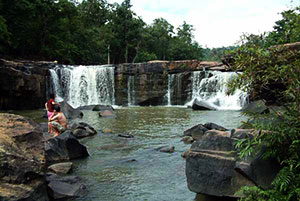
Tham Hia Waterfall in Chaiyaphum Province is a quiet natural waterfall located near Ban Na Siao in Na Siao Subdistrict, Mueang Chaiyaphum District. Unlike highly developed tourist attractions, this waterfall keeps a raw and peaceful character, with a broad rock terrace, a long sloping stone surface, natural pools, a cave-like lower section, and dense mixed deciduous forest surrounding the area. It is especially suitable for travelers who enjoy light trekking, local nature routes, forest scenery, and lesser-known waterfalls that still feel closely connected to the surrounding village landscape.
The waterfall lies about 4 km north of Ban Na Siao, followed by an additional walk of about 1 km to reach the main waterfall area. This short walk is part of the experience. Visitors gradually leave the village surroundings and enter a quieter natural setting where the sound of wind, leaves, insects, and flowing water becomes more noticeable. The approach to Tham Hia Waterfall is not designed as a quick photo stop; it is a slow nature visit that rewards those who are willing to walk, observe, and respect the landscape.
The most recognizable feature of Tham Hia Waterfall is its wide rock terrace. The stone surface is about 20 meters wide, with a sloping section extending for around 200 meters. During the rainy season and the early cool season, water flows across the rock surface, collects in natural basins, and continues downward toward the lower cave-like section. The result is a layered landscape of stone, water, forest, and shadow rather than a single vertical drop. This gives the waterfall a distinctive identity among the natural attractions of Chaiyaphum.
The upper rock terrace contains a large natural pool, while the lower cave area also holds water. These elements make the site visually interesting because visitors can see different forms of water in one place: shallow flow over stone, still water in natural basins, and shaded pools near the cave below. The landscape changes with the season. When there is plenty of water, the surface of the rocks becomes lively and reflective. In drier periods, the shape of the rock terrace, the cave, and the surrounding forest becomes more prominent.
The surrounding forest is an important part of the atmosphere. Tham Hia Waterfall is set amid dense mixed deciduous woodland, a forest type common in many parts of northeastern Thailand. The trees, undergrowth, dry-season leaf fall, and seasonal green recovery all create a living natural frame around the waterfall. This is why the site is not only about water, but also about forest ecology, local terrain, seasonal change, and the relationship between Ban Na Siao and the natural landscape behind the village.
The name “Tham Hia” reflects local naming traditions. “Tham” means cave, referring to the lower cave-like section with a water pool. “Hia” is the Thai word for a large monitor lizard, an animal associated with natural wetland and forest environments in Thailand. Local place names often come from what people observe in the landscape, such as animals, rock formations, water features, or stories remembered by the community. In this sense, the name of Tham Hia Waterfall preserves a local way of seeing and describing nature.
Tham Hia Waterfall is connected geographically and thematically with the natural attractions of Tat Ton National Park and the Phu Laen Kha mountain range. Chaiyaphum is known for waterfalls, mountains, forests, rock formations, and seasonal landscapes. Within the wider area, visitors will also find Tat Fa Waterfall, Tat Ton Waterfall, Pha Iang Waterfall, Chao Pho Tat Ton Shrine, Wat Phra That Chaiyaphum, and Mo Hin Khao. Tham Hia Waterfall adds a quieter, more local dimension to this travel route.
Travelers who come here should understand that the site is more natural than commercial. Facilities are limited, the trail requires care, and the rock surface can be slippery, especially during or after rain. The best way to enjoy Tham Hia Waterfall is to prepare properly, travel in daylight, wear shoes with good grip, carry drinking water, and avoid risky areas near steep rocks or deep pools. Visitors should also avoid entering the waterfall during heavy rain because natural waterfalls can change quickly when water levels rise.
Getting There usually starts from Chaiyaphum city. From the city area, travel toward Na Siao Subdistrict and continue to Ban Na Siao. From the village, proceed north for about 4 km toward the waterfall route, then walk about 1 km to the main waterfall area. A private car or pickup truck is the most practical option, especially in the rainy season when rural and natural access roads may become more difficult. Travelers unfamiliar with the area should ask local residents in Ban Na Siao, Na Siao Subdistrict Administrative Organization, or Tat Ton National Park staff for the safest route before entering the waterfall area.
The most rewarding season to visit is from the rainy season to the early cool season, when the forest is green and water levels are more attractive. During this period, the natural pools, the sloping rock surface, and the surrounding vegetation show the waterfall at its most vivid. However, safety remains the priority. When rain is heavy, the rock surface can become very slippery and the water level may rise. In the dry season, water may be lower, but the rock terrace, cave, and forest setting are still worth visiting for travelers interested in geology, local landscapes, and quiet nature photography.
For photographers, Tham Hia Waterfall offers several visual subjects: the broad rock terrace, flowing water over stone, natural pools, forest edges, wet leaves, and textured rock surfaces shaped by water over time. Morning light gives the area a calm and cool feeling, while late afternoon light can emphasize the lines and textures of the rocks. Visitors should take photographs from safe positions only and avoid climbing slippery sections or stepping into pools with unknown depth.
Families can visit Tham Hia Waterfall, but the trip should be planned carefully. The walking distance is not long, but the trail is natural and may include uneven ground, wet stone, and slippery surfaces. Children should stay close to adults at all times. Elderly travelers should assess their physical condition before entering the trail. The site is best enjoyed slowly, with enough time for walking, resting, observing the forest, and returning before dark.
Responsible travel is essential at this waterfall. Visitors should carry all rubbish back with them, avoid using soap or shampoo in the water, avoid writing on rocks, and avoid damaging plants. Natural attractions like Tham Hia Waterfall remain beautiful only when travelers help protect them. The waterfall’s charm comes from its quietness, clean water, forest cover, and local character. Preserving these qualities is part of the travel experience.
A visit to Tham Hia Waterfall can be arranged as a half-day or full-day nature trip. Travelers can visit the waterfall in the morning, then continue to Tat Fa Waterfall or Tat Ton National Park in the afternoon. Those staying overnight can choose accommodation in Tat Ton National Park or in Chaiyaphum city, then continue the next day to Wat Phra That Chaiyaphum, Chao Pho Tat Ton Shrine, or Mo Hin Khao. This route gives visitors a broader view of Chaiyaphum’s natural and cultural landscape.
What makes Tham Hia Waterfall memorable is the feeling of discovery. It is not a waterfall that reveals itself immediately from a car park. Visitors must travel through the local area, walk into nature, and gradually encounter the rock terrace, pools, cave, and forest. This slower approach creates a stronger connection with the place. The waterfall becomes not just a destination, but a short journey into the quieter side of Chaiyaphum.
In summary, Tham Hia Waterfall is a natural waterfall near Ban Na Siao in Chaiyaphum Province, known for its 20-meter-wide rock terrace, 200-meter sloping stone surface, large natural pool, cave-like lower pool, and dense mixed forest. It is ideal for travelers who enjoy peaceful nature, light trekking, local landscapes, and lesser-known waterfalls. Visitors should prepare carefully, choose the right season, respect the environment, and allow enough time to experience the site safely and meaningfully.
| Name | Tham Hia Waterfall |
| Location | Ban Na Siao, Na Siao Subdistrict, Mueang Chaiyaphum District, Chaiyaphum Province |
| Address | Route to Tham Hia Waterfall, Ban Na Siao, Village No. 1, Na Siao Subdistrict, Mueang Chaiyaphum District, Chaiyaphum 36000, Thailand |
| Highlights | A 20-meter-wide rock terrace, a 200-meter sloping stone surface, a large natural pool, and a cave-like lower pool |
| Distinctive Features | A quiet natural waterfall surrounded by dense mixed deciduous forest, reached by a short nature walk of about 1 km |
| Name Origin | A local name referring to the cave-like lower section and the natural environment associated with the area |
| Travel Information | Travel from Chaiyaphum city to Na Siao Subdistrict, continue to Ban Na Siao, go about 4 km north of the village, then walk about 1 km to the waterfall |
| Current Status | A natural attraction in the Ban Na Siao area of Mueang Chaiyaphum District |
| Open Days | Daily |
| Opening Hours | 08.00 – 18.00 |
| Fees | Tat Ton National Park rate: Thai adult 40 baht, Thai child 20 baht, foreign visitor 200 baht, vehicle 30 baht |
| Facilities | Natural trail, rock terrace, natural pools, and nearby facilities in the Tat Ton National Park area |
| Main Areas / Zones | 1. Nature walking route 2. Sloping rock terrace 3. Upper natural pool 4. Lower cave-like pool 5. Surrounding mixed forest |
| Caretaker | Related to Tat Ton National Park, Department of National Parks, Wildlife and Plant Conservation, and the Na Siao local community area |
| Main Contact Number | Tat Ton National Park Visitor Center Tel. 0 4485 3293, 0 4485 3333 / Na Siao Subdistrict Administrative Organization Tel. 0 4488 4111 |
| Nearby Tourist Attractions | 1. Tat Fa Waterfall, about 4 km 2. Tat Ton National Park Ranger Unit 3, about 4 km 3. Tat Ton National Park / Tat Ton Waterfall, about 25 km 4. Chao Pho Tat Ton Shrine, about 25 km 5. Pha Iang Waterfall, about 35 km 6. Wat Phra That Chaiyaphum, about 40 km 7. Mo Hin Khao, about 55 km |
| Nearby Restaurants | 1. Na Siao Cup Cafe, about 6 km, Tel. 094-996-0007 2. Farm Promma Nuea Dat, Jaew Hon, Isan Food And Accommodation, about 22 km, Tel. 088-565-2654 3. Pu Som Tam Hi-So, about 23 km 4. Pine Camp Chaiyaphum, about 25 km 5. Rim Nam Restaurant, about 28 km 6. Ban Phat Thai Desserts Chaiyaphum, about 25 km |
| Nearby Accommodations | 1. Tat Ton National Park Bungalows And Camping Area, about 25 km, Tel. 0 4485 3293, 0 4485 3333 2. Farm Promma Resort Chaiyaphum, about 22 km, Tel. 088-565-2654 3. Phusuay Park View Hotel, about 30 km, Tel. 044-854-111, 080-153-1331 4. Lertnimit Hotel Chaiyaphum, about 32 km, Tel. 044-811-522, 080-165-9494 5. Ratanasiri Hotel, about 32 km, Tel. 0 4482 1258-60 6. Dee Prom Hotel Chaiyaphum, about 33 km, Tel. 044-822-222 |
Frequently Asked Questions (FAQ)
Q: Where is Tham Hia Waterfall located?
A: Tham Hia Waterfall is located near Ban Na Siao in Na Siao Subdistrict, Mueang Chaiyaphum District, Chaiyaphum Province. It is about 4 km north of Ban Na Siao, followed by a walk of about 1 km.
Q: What makes Tham Hia Waterfall special?
A: The waterfall is known for its 20-meter-wide rock terrace, 200-meter sloping stone surface, large natural pool, lower cave-like pool, and peaceful mixed forest setting.
Q: What is the best season to visit Tham Hia Waterfall?
A: The rainy season to early cool season is the best period because the forest is greener and the water level is more attractive. Visitors should avoid entering during heavy rain.
Q: Is there a walking trail to Tham Hia Waterfall?
A: Yes. After traveling about 4 km north from Ban Na Siao, visitors walk about 1 km through a natural route to reach the waterfall area.
Q: Is Tham Hia Waterfall suitable for children and elderly travelers?
A: It can be visited by families, but children and elderly travelers need close supervision because the route is natural and the rock surface can be slippery.
Q: Is there an entrance fee for Tham Hia Waterfall?
A: The Tat Ton National Park rate applies: Thai adult 40 baht, Thai child 20 baht, foreign visitor 200 baht, and vehicle 30 baht.
Q: What should visitors bring?
A: Visitors should bring drinking water, shoes with good grip, suitable outdoor clothing, mosquito repellent, a waterproof bag for phones, and a bag for carrying rubbish back out.
Q: What nearby attractions can be combined with this trip?
A: Nearby attractions include Tat Fa Waterfall, Tat Ton National Park, Tat Ton Waterfall, Chao Pho Tat Ton Shrine, Wat Phra That Chaiyaphum, and Mo Hin Khao.
 Category: ●Nature and Wildlife
 Group: ●Waterfalls
Last Update : 3 MonthAgo
 Last Update : 3 MonthAgo
 Click to Access the Navigation Map GPS
 Art, Culture and Heritage
 Historical Sites and Monuments(1)
 Landmarks and Memorials(3)
 Royal Palace(1)
 Art, Craft Centres, Tradition(3)
 Educational Places
 Educational Gardens, Farm(1)
 Places of Worship
 Temple(141)
 Other Sacred Sites(7)
 Suburban Living
 Village, Community(4)
 National Parks and Marine Reserves(7)
 Mountain (Doi)(5)
 Dam, Reservoir, Lake(10)
Waterfalls(15)
Dam, Reservoir, Lake(10)
Waterfalls(15)
 Caves(5)
 River, Canal(4)
 Other natural attractions(1)
 Entertainment and Agricultural
 Farms, Parks and Ecotourism(2)


