
lovethailand home >Northeastern Travel Attractions >Chaiyaphum Travel Attractions >Khon San >Thung Lui Lai > Phu Khieo Wildlife Sanctuary and Thung Kamang
TL;DR: Phu Khieo Wildlife Sanctuary and Thung Kamang is located at Thung Luilai Subdistrict, Khon San District, Chaiyaphum Province; covering forest areas in Khon San, Kaset Sombun, and Nong Bua Daeng, open Daily, hours 08.00 – 16.00.
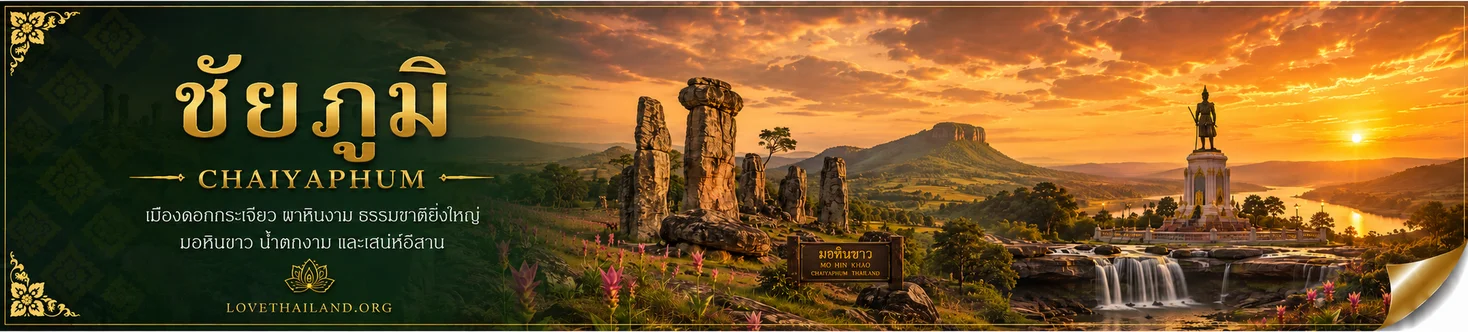
Phu Khieo Wildlife Sanctuary and Thung Kamang
Open Days: Daily
Opening Hours: 08.00 – 16.00
Phu Khieo Wildlife Sanctuary and Thung Kamang in Chaiyaphum Province form one of the most important wildlife conservation areas in northeastern Thailand. Covering forest areas across Khon San, Kaset Sombun, and Nong Bua Daeng districts, this protected landscape is dedicated to wildlife conservation, habitat restoration, breeding and reintroduction programs, and carefully controlled nature education. Its best-known area is Thung Kamang, a vast grassland in the heart of the sanctuary where visitors can observe deer, hog deer, muntjac, wild birds, forests, streams, waterfalls, and one of Thailand’s most impressive natural ecosystems.
Phu Khieo is not a typical tourist attraction. It is a wildlife sanctuary, which means the main purpose of the area is conservation rather than mass tourism. Visitors are allowed to enter selected zones for nature study under the supervision and rules of sanctuary staff. The area is especially suitable for students, researchers, birdwatchers, wildlife photographers, nature lovers, and travelers who understand low-impact travel. A visit here should be approached as a quiet learning experience, because every sound, movement, vehicle, and footstep can affect the behavior of wildlife.
The sanctuary is part of the Western Isan Forest Complex, a large ecological network connected with several important protected areas, including Nam Nao National Park, Tat Mok National Park, Phu Pha Man National Park, Phu Kradueng National Park, and nearby wildlife sanctuaries. This forest complex protects headwaters, wildlife corridors, highland forests, grasslands, wetlands, and limestone and sandstone landscapes. Phu Khieo itself contains mountain ridges, plateaus, cliffs, valleys, streams, natural ponds, open grasslands, and diverse forest types, creating ideal habitats for both small and large animals.
The conservation history of Phu Khieo is significant at the national level. The area was once a large, rich forest that faced pressure from forest encroachment, logging, hunting, and human settlement. The government later declared it a wildlife sanctuary to protect watershed forests and rare wildlife habitats. The Phu Khieo Wildlife Conservation Project, supported by royal initiatives, helped restore the surrounding environment, encourage local communities to protect forests and animals, and reintroduce wildlife into suitable natural habitats. Important wildlife releases took place at Thung Kamang, and the success of these efforts can still be seen today in the presence of deer, hog deer, muntjac, and many birds living freely in the grassland.
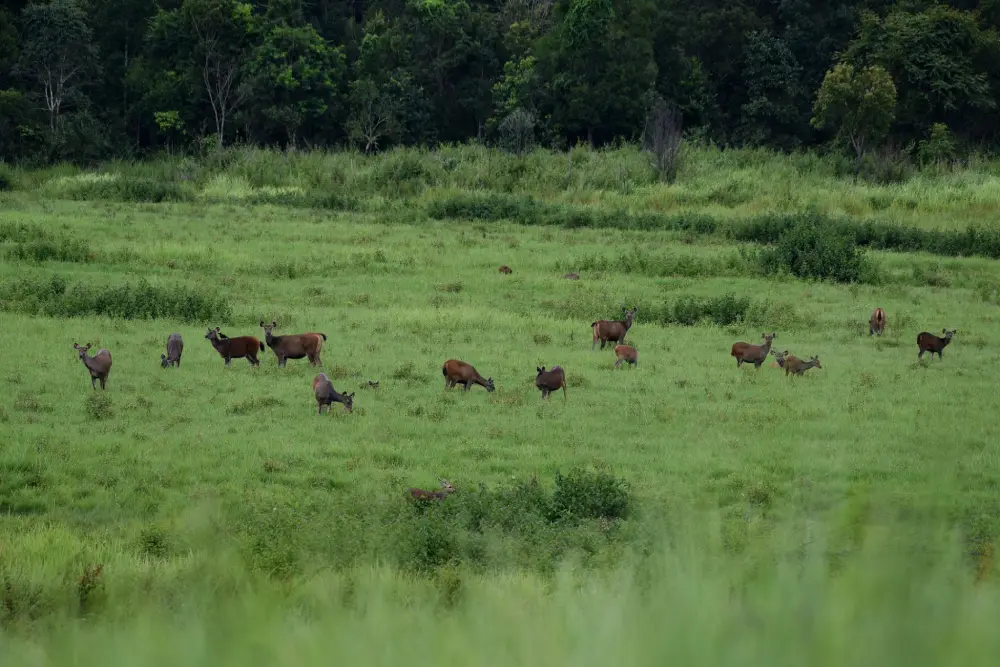
Thung Kamang is the heart of nature study within Phu Khieo Wildlife Sanctuary. It is a wide natural grassland surrounded by montane forest, pine stands, hill evergreen forest, and mixed woodland. The open field functions as an important feeding ground for herbivores such as muntjac, sambar deer, hog deer, and mouse deer. These animals come out to feed on grass, visit salt licks, move between forest edges, and use the open landscape when conditions are safe. The experience is very different from seeing animals in captivity; at Thung Kamang, visitors observe wildlife in its own habitat, on its own terms.
The sanctuary manages parts of Thung Kamang to support wildlife nutrition and habitat health. Salt licks are maintained so animals can obtain essential minerals, and grassland management helps produce fresh young grass during dry periods. This type of habitat work must be carried out carefully by trained staff, because the goal is not to create a show area for tourists but to maintain a balanced ecosystem that supports wildlife naturally. When food, water, forest cover, and quiet conditions are available, animals can survive, breed, and gradually rebuild their populations.
Thung Kamang is closely linked with the wildlife reintroduction efforts that took place in 1983 and 1992 under the Phu Khieo conservation program. Animals such as muntjac, deer, mouse deer, and several bird species were released back into the forest and grassland environment. The long-term value of these efforts lies in the fact that the animals were not simply released and forgotten; they were given a protected landscape where they could adapt, reproduce, and live as wild animals. Today, the grassland remains a visible symbol of successful conservation work in northeastern Thailand.
On a hill above Thung Kamang stands a royal residence area overlooking the water body and grassland. This place reflects the importance of Phu Khieo as a conservation project associated with royal concern for forests and wildlife. Around the grassland and viewpoint areas, early morning and late afternoon are the most suitable times for wildlife observation. In the cool season, mist often spreads over the field, and the atmosphere can be exceptionally peaceful. Visitors should remain quiet, keep their distance, and avoid sudden movement because wild animals are highly sensitive to noise and human presence.
Beyond Thung Kamang, the sanctuary contains an important water system known as Lam Nam Phrom. This river winds through the northern part of the sanctuary and supports forests, animals, aquatic life, and riparian plants. To the east, Huai Dat, also known as Lam Dok, contributes to the lower Phrom water system connected with the Chulabhorn Dam area. Lam Nam Phrom has water throughout the year, with deep pools, rock terraces, and shaded forest along its banks. This makes it a vital ecological corridor for both wildlife and plant communities in the sanctuary.
Lan Chan is one of the most beautiful natural sites along Lam Nam Phrom. It is a broad rock terrace where clear water flows across stone throughout the year. The surrounding area is shaded by large trees and rich with mosses, ferns, rattans, wild vines, and many moisture-loving plants. The beauty of Lan Chan is quiet and detailed rather than dramatic. It is a place for observing how water, stone, forest, humidity, and plant life work together. Walking along the stream leads to an area of reddish rock called Tat Hin Daeng, another peaceful natural spot within the sanctuary.
Bueng Paen is an important wetland inside Phu Khieo Wildlife Sanctuary. Covering about 4,000 rai and lying at an average elevation of around 900 meters above sea level, it has a grassland character similar to Thung Kamang but is flatter and located in a lower basin. During the rainy season, water spreads across the area, while in the dry season a central pond remains as an important water source. Animal tracks are often found around Bueng Paen, showing that wildlife uses this area for drinking, movement, and feeding. Highland wetlands like this are essential for wildlife survival during dry periods.
Tat Khro Waterfall is a large waterfall located south of Thung Kamang, near the Phu Khieo forest protection unit in Nong Bua Daeng District. Its water flows into Lam Nam Saphung, linking the waterfall to the southern watershed system of the sanctuary. Access to this area should be arranged with staff, because waterfalls inside a wildlife sanctuary are not managed like ordinary recreation sites. Trail conditions, rainfall, safety, and wildlife disturbance must all be considered before entering.
Huai Wai Waterfall is about 6 kilometers from Bueng Paen. It has 3 tiers, each about 20 meters high, and is located in a mountain pass between Phu Noi and Phu Khieo Yai. This is a forest waterfall that reflects the humidity and richness of the surrounding highland forest. Visitors should prepare for a real nature-study route rather than casual sightseeing. Proper footwear, rain protection, drinking water, and staff guidance are important for safe and responsible access.
Nakarat Waterfall lies between Sala Phrom and Thung Kamang. Around kilometer 11, visitors turn left and continue about 300 meters along a forest route. The waterfall is about 5 meters wide and descends in 3 levels: the first around 14 meters, the second around 10 meters, and the third around 6 meters. The name Nakarat comes from the abundance of wan phaya nakarat plants found around the waterfall. This makes the site interesting not only for its water and rock formations but also for the plant life associated with the area.
Pha Thewada is a long mountain formation stretching about 6 kilometers, with cliffs rising to around 1,000 meters above sea level. The rock has a pale color resembling limestone, and a clear stream known as Chi Phut flows through the area. Chi Phut is considered part of the headwater system of the Chi River, one of the major rivers of northeastern Thailand. The stream emerges south of Khao Thewada and continues toward Ban Lon. Its clear water, gravel banks, and dense forest surroundings make this area ecologically and hydrologically important.
The landscape around Pha Thewada, Chi Dan, and Chi Phut is complex. In some sections, the stream disappears into rock cavities and emerges again elsewhere. This forested area supports wildlife such as gaur, bears, porcupines, deer, elephants, and hornbills. Important tree species include takhian, yang, phayom, bamboo, rattan, and sugar palms. There is also a 7-tier limestone waterfall on the Thewada mountain range, with each tier about 15 – 20 meters high. The total height is about 200 meters, and the width is about 20 – 25 meters. Because of its ecological sensitivity, this area should only be visited with proper permission.
Wildlife diversity is one of the main reasons Phu Khieo is so important. The sanctuary supports mammals, birds, reptiles, amphibians, fish, insects, and many plant species. Around Thung Kamang, visitors may see deer, muntjac, hog deer, and various birds. Deeper forest areas provide habitat for larger and more elusive wildlife, including elephants, gaur, bears, serows, leopards, tigers, wild boar, langurs, gibbons, and hornbills. Wildlife sightings depend on season, time of day, weather, silence, and luck. Visitors should not expect guaranteed sightings but should appreciate the opportunity to observe a living forest ecosystem.
Suitable activities at Phu Khieo include wildlife watching, birdwatching, nature trail study, forest photography, plant observation, grassland scenery, mist viewing, and astronomy activities in the cool season. The sanctuary is also recognized as a dark-sky conservation area because of its wide open sky, quiet surroundings, and low light pollution. From November to January, it is suitable for stargazing, meteor shower watching, and astrophotography. Night activities and overnight stays must be arranged in advance because nighttime is when many animals are most active.
There are 2 main types of visits. For a same-day visit, travelers can request permission at Pang Muang Checkpoint before entering the sanctuary and must follow staff instructions. Entrance fees are 20 baht for Thai adults, 10 baht for Thai children or students, 200 baht for foreigners, 30 baht for cars, 10 baht for bicycles, 20 baht for motorcycles, and 100 baht for 6-wheel vehicles. For overnight stays or deeper nature-study routes, written permission must be requested in advance. The request should clearly state the purpose of the visit, number of visitors, dates, and intended route.
Visitors who want to stay overnight should contact Phu Khieo Wildlife Sanctuary in advance. Accommodation and camping space are limited, and this is not a commercial hotel system. The sanctuary has basic visitor accommodation, toilets, meeting rooms, a dining facility, staff support, and some observation equipment such as monoculars and binoculars for certain activities. Travelers should bring essential supplies, including flashlights, warm clothing, rain protection, personal medicine, drinking water, snacks, garbage bags, and proper outdoor shoes. Mobile reception is limited in some areas, so travel plans should be shared with someone outside the sanctuary before entering.
Getting There follows the same route as Chulabhorn Dam. From Khon San District, use Highway 2055 toward Chulabhorn Dam. About 3 kilometers before the dam, turn left at Pang Muang Checkpoint. From the checkpoint, continue about 24 kilometers through forest and mountain road to reach the sanctuary office and Thung Kamang. The road inside the protected area should be driven slowly and carefully, especially during rain, fog, or low light. Fuel, food, water, and essential supplies should be prepared in Khon San or nearby communities before entering the forest road.
The best time to visit is from the rainy season to the cool season. During the rainy season, the forest is lush, streams are active, and the grassland is green. During the cool season, the weather is pleasant, mist is common, and wildlife watching can be rewarding. Early morning and late afternoon are generally better for seeing animals than midday. Visitors should use binoculars or long camera lenses rather than trying to approach animals. Feeding wildlife, honking, flying drones without permission, using bright lights at night, or making loud noises should be strictly avoided.
Responsible behavior is essential at Thung Kamang. Visitors must not collect plants, catch animals, leave trash, bring pets, shout, leave vehicles in prohibited areas, or walk outside designated routes. This is a home for wildlife, not an animal display area. Seeing animals in the wild requires patience, silence, and respect. If every visitor follows the rules, Phu Khieo and Thung Kamang will remain a valuable nature-learning area for future generations.
In summary, Phu Khieo Wildlife Sanctuary and Thung Kamang are among the most valuable natural areas in Chaiyaphum and northeastern Thailand. The sanctuary combines grassland, reintroduced wildlife, the Lam Nam Phrom River, Lan Chan, Tat Hin Daeng, Bueng Paen, waterfalls, Pha Thewada, Chi Phut, highland forests, and a deep conservation history in one protected landscape. A visit here offers more than beautiful photographs. It teaches travelers how forests, animals, water, and people are connected, and why wildlife conservation requires patience, discipline, and respect for the land where wild animals live.
| Name | Phu Khieo Wildlife Sanctuary – Thung Kamang |
| Location | Thung Luilai Subdistrict, Khon San District, Chaiyaphum Province; covering forest areas in Khon San, Kaset Sombun, and Nong Bua Daeng districts |
| Address | Phu Khieo Wildlife Sanctuary, Thung Luilai Subdistrict, Khon San District, Chaiyaphum 36180, Thailand |
| Coordinates | 16.557721, 101.571350 |
| Highlights | Thung Kamang grassland, wildlife watching, deer, hog deer, muntjac, wild birds, Lam Nam Phrom, Lan Chan, Tat Hin Daeng, Bueng Paen, Pha Thewada, Chi Phut, and dark-sky activities |
| History | Declared as a wildlife sanctuary to protect forest, watersheds, and rare wildlife. It later became an important site for the Phu Khieo Wildlife Conservation Project under royal initiatives, with wildlife reintroduction activities at Thung Kamang in 1983 and 1992. |
| Name Origin | Phu Khieo refers to the green mountain forest, while Thung Kamang describes the wide bowl-like grassland in the middle of the forest. |
| Distinctive Features | Large protected forest landscape with dry evergreen forest, hill evergreen forest, dipterocarp forest, mixed deciduous forest, pine forest, grasslands, wetlands, streams, waterfalls, and diverse wildlife. |
| Travel Information | Use the same route as Chulabhorn Dam. About 3 km before the dam, turn left at Pang Muang Checkpoint and continue about 24 km to the sanctuary office and Thung Kamang. |
| Current Status | Open for controlled nature study under wildlife sanctuary rules. Overnight stays and remote-area access require advance permission. |
| Open Days | Daily |
| Opening Hours | 08.00 – 16.00; access to some internal areas follows staff instructions |
| Fees | Thai adults 20 baht, Thai children/students 10 baht / Foreigners 200 baht / Car 30 baht / Bicycle 10 baht / Motorcycle 20 baht / 6-wheel vehicle 100 baht |
| Facilities | Visitor accommodation, camping area, toilets, meeting room, dining facility, staff support, monoculars, and binoculars for selected nature-study activities |
| Main Areas / Zones | Pang Muang Checkpoint, Phu Khieo Wildlife Sanctuary Office, Thung Kamang, Lam Nam Phrom, Lan Chan, Tat Hin Daeng, Bueng Paen, Tat Khro Waterfall, Huai Wai Waterfall, Nakarat Waterfall, Pha Thewada, Chi Phut |
| Caretaker | Department of National Parks, Wildlife and Plant Conservation / Protected Area Regional Office 7 Nakhon Ratchasima / Phu Khieo Wildlife Sanctuary |
| Main Contact Number | 097-002-7290, 087-146-2777, 064-939-4663, DNP 0 2561 4292-3 ext. 711 |
| Email / Official Page | pkws2563@gmail.com / Phu Khieo Wildlife Sanctuary Official Facebook Page |
| Nearby Tourist Attractions | 1. Thung Kamang, about 0 km 2. Lan Chan and Tat Hin Daeng, about 5 km 3. Chulabhorn Dam, about 27 km 4. Phra Phutthasirirattarat Replica at Chulabhorn Dam, about 27 km 5. Chulabhorn Dam Garden, about 27 km 6. Nam Phut Thap Lao Arboretum, about 45 km 7. Phu Dan I Pong Viewpoint, about 60 km |
| Nearby Restaurants | 1. Phu Khieo Wildlife Sanctuary Dining Facility, about 0 km 2. Ruean Nam Phrom Restaurant, Chulabhorn Dam, about 27 km, Tel. 043-446-409, 085-419-4464, 087-951-8308 3. Coffee Haeng Sai Nam, Chulabhorn Dam, about 27 km, Tel. 043-446-409 4. Huen Kham Mak, Khon San, about 45 km, Tel. 081-975-5202 5. Puna Saen Suay @ Khon San, about 50 km, Tel. 080-449-4847, 095-806-9944, 092-532-6653 |
| Nearby Accommodations | 1. Phu Khieo Wildlife Sanctuary Bungalows, about 0 km, Tel. 097-002-7290 2. Phu Khieo Wildlife Sanctuary Camping Area, about 0 km, Tel. 097-002-7290 3. Chulabhorn Dam Guesthouse / Khun Saichon Villa, about 27 km, Tel. 085-419-4464, 087-951-8308 4. Ban Suan Khiang Phu Kru Ja, Khon San, about 60 km, Tel. 091-867-9880 5. Wanida Resort, Khon San, about 65 km, Tel. 086-899-1818, 087-770-1144 |
Frequently Asked Questions (FAQ)
Q: Where is Phu Khieo Wildlife Sanctuary and Thung Kamang located?
A: It is located in Thung Luilai Subdistrict, Khon San District, Chaiyaphum Province, and covers forest areas in Khon San, Kaset Sombun, and Nong Bua Daeng districts.
Q: What type of trip is Thung Kamang best for?
A: It is best for nature study, wildlife watching, birdwatching, forest photography, and learning about grassland and forest ecosystems. It is not a typical zoo or mass-tourism attraction.
Q: How much is the entrance fee?
A: The fee is 20 baht for Thai adults, 10 baht for Thai children or students, 200 baht for foreigners, 30 baht for cars, 10 baht for bicycles, 20 baht for motorcycles, and 100 baht for 6-wheel vehicles.
Q: Can visitors stay overnight inside the sanctuary?
A: Yes, but only with advance permission. Visitors should contact Phu Khieo Wildlife Sanctuary before traveling because accommodation and camping areas are limited.
Q: When is the best time to visit Thung Kamang?
A: The rainy season to the cool season is the best period. The rainy season offers lush green forest and grassland, while the cool season is ideal for mist, wildlife watching, birdwatching, and stargazing.
Q: How do travelers get to Phu Khieo Wildlife Sanctuary?
A: Follow the route to Chulabhorn Dam. About 3 km before the dam, turn left at Pang Muang Checkpoint and continue about 24 km to the sanctuary office and Thung Kamang.
Q: What wildlife can visitors see at Thung Kamang?
A: Visitors may see muntjac, deer, hog deer, mouse deer, peafowl, pheasants, woodpeckers, and many forest birds. Larger animals such as elephants, gaur, bears, and big cats live deeper in the forest and should never be approached.
Q: Is permission required before entering the sanctuary?
A: Same-day visitors must register with staff at Pang Muang Checkpoint. Overnight stays, remote-area access, and special nature-study routes require advance permission under wildlife sanctuary regulations.
 Category: ●Nature and Wildlife
 Group: ●National Parks and Marine Reserves
Last Update : 3 MonthAgo
 Last Update : 3 MonthAgo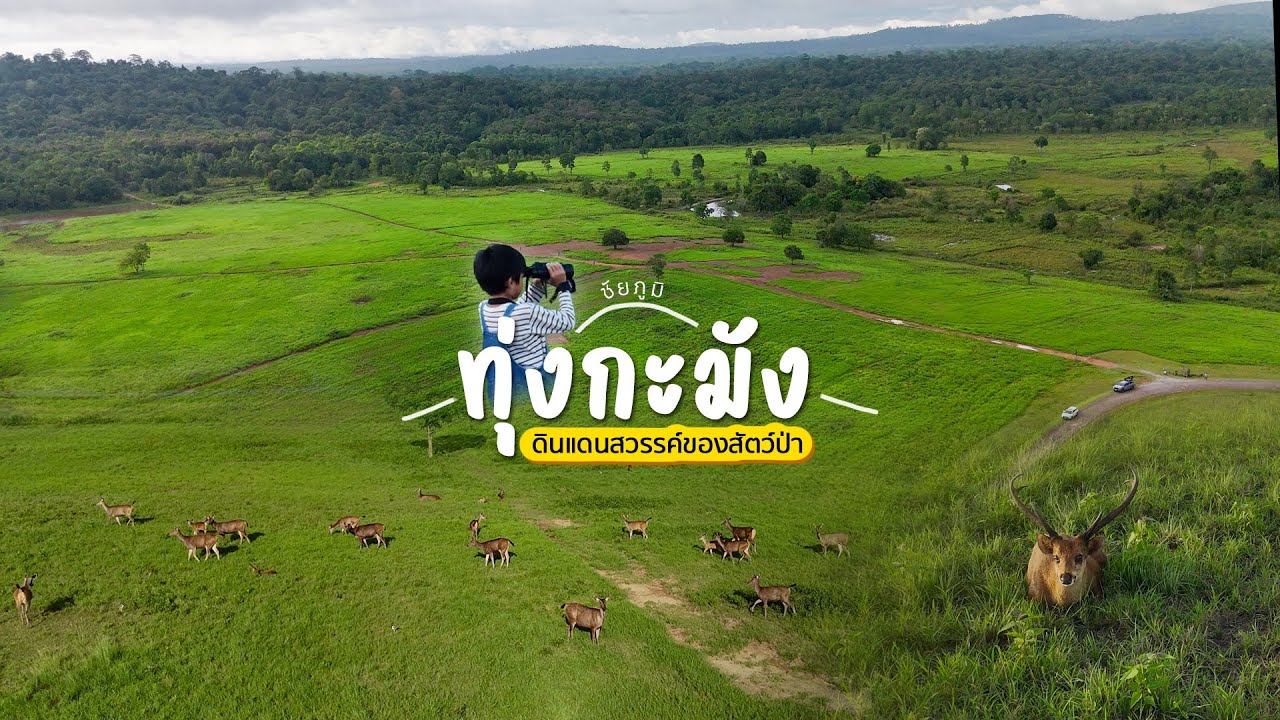
 Click to Access the Navigation Map GPS
Phu Khieo Wildlife Sanctuary and Thung Kamang Map
Recommend

 Art, Culture and Heritage
 Historical Sites and Monuments(1)
 Landmarks and Memorials(3)
 Royal Palace(1)
 Art, Craft Centres, Tradition(3)
 Educational Places
 Educational Gardens, Farm(1)
 Places of Worship
 Temple(141)
 Other Sacred Sites(7)
 Suburban Living
 Village, Community(4)
National Parks and Marine Reserves(7)
Village, Community(4)
National Parks and Marine Reserves(7)
 Mountain (Doi)(5)
 Dam, Reservoir, Lake(10)
 Waterfalls(15)
 Caves(5)
 River, Canal(4)
 Other natural attractions(1)
 Entertainment and Agricultural
 Farms, Parks and Ecotourism(2)


