
lovethailand home >Northeastern Travel Attractions >Chaiyaphum Travel Attractions >Thep Sathit >Pong Nok > Pa Hin Ngam National Park
TL;DR: Pa Hin Ngam National Park is located at Ban Rai Subdistrict, Thep Sathit District, Chaiyaphum Province, Thailand, open Daily, hours 06.00 – 18.00.

Pa Hin Ngam National Park
Open Days: Daily
Opening Hours: 06.00 – 18.00
Pa Hin Ngam National Park in Chaiyaphum Province is one of northeastern Thailand’s most distinctive natural attractions. Located on the Phang Hoei Mountain Range in Thep Sathit District, the park is best known for its seasonal Siam tulip fields, strangely shaped rock formations, highland viewpoints, monsoon waterfalls, and cool mountain atmosphere. The most popular time to visit is from June to August, when the pink-purple Siam tulips bloom across the grassland and morning mist often floats over the hills.
Pa Hin Ngam National Park is located in Ban Rai Subdistrict, Thep Sathit District, Chaiyaphum Province. The landscape lies on a complex mountain range with elevations of about 300 – 846 meters above sea level. The area includes rolling hills, cliffs, sandstone rock terraces, dry dipterocarp forest, dry evergreen forest, and mixed deciduous forest. This variety of terrain gives the park a different character from many other destinations in northeastern Thailand. It is not only a flower-viewing destination during the rainy season, but also a place where travelers can experience unusual geology, seasonal forests, mountain wind, and wide-open highland scenery in one trip.
The name “Pa Hin Ngam” means “beautiful stone forest,” and the name describes the park very well. Throughout the area, large sandstone boulders have been naturally shaped by long-term erosion caused by wind, rain, water flow, and changing weather. Softer soil and stone layers gradually disappeared, while harder sections remained as unusual rock forms. Some rocks look like a nail, a radar dish, a hen, or other imaginative shapes. Walking through the rock field feels like exploring an open-air natural sculpture park, where every visitor can interpret the shapes in a different way.
The park is ecologically important because it protects part of the Phang Hoei Mountain Range and its surrounding forest systems. Dry dipterocarp forest creates a bright and open atmosphere during some seasons, while dry evergreen and mixed deciduous forests add moisture and shade in valleys and stream areas. The park is home to many wildflowers and seasonal plants, including Dusita flowers, En-a flowers, orchids, and especially the Siam tulip, locally known as dok krachiao or bua sawan. The park also supports many wildlife groups, including birds, mammals, and reptiles, making it a valuable natural learning site for general visitors, photographers, and nature enthusiasts.
The most famous attraction in the park is the Siam Tulip Field, also known in Thai as Thung Dok Krachiao or Thung Bua Sawan. The Siam tulip is a herbaceous plant in the ginger family. When the rainy season arrives, its underground rhizomes produce colorful flower stalks that rise above the grass. The flowers are usually pink, purple, pale violet, or white, appearing among fresh green grass and open woodland. The best time to visit is early in the morning during the rainy season, especially from June to August, when the temperature is cooler, the light is softer, and mist may cover the field. The sight of Siam tulips blooming in the mist is the main reason many travelers come to Thep Sathit each year.
Visitors should stay on the designated walking paths when exploring the Siam tulip field. The flowers and ground vegetation are delicate, and stepping outside the trail can damage young plants and affect the next blooming season. The boardwalk and nature trail allow travelers to see the flowers closely enough for photography while helping protect the ecosystem. During the peak blooming season, the area can be crowded, so it is best to arrive early, wear shoes suitable for wet ground, and bring a light raincoat or umbrella. Weather in the rainy season can change quickly, especially in the mountains.
Another major attraction is Lan Hin Ngam, the beautiful rock field that gives the park its name. This area covers more than 10 rai and contains many large rocks in unusual shapes. It is one of the easiest and most enjoyable areas to explore in the park because visitors can walk around the boulders, take photos, and use their imagination to identify different forms. Some rocks have famous nicknames based on their shapes, while others invite visitors to create their own interpretations. Lan Hin Ngam is suitable for families, groups of friends, and travelers who prefer light nature walks rather than long or difficult trekking routes.
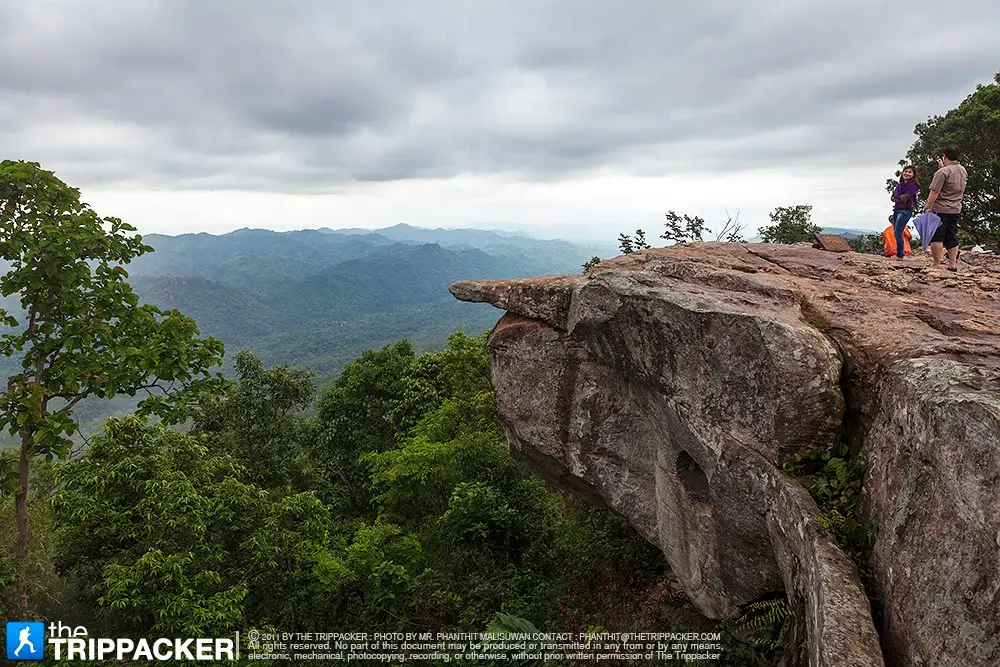
Pha Sut Phaen Din, or the “End of the Land” viewpoint, is another highlight of Pa Hin Ngam National Park. It is a steep cliff and one of the highest points of the Phang Hoei Mountain Range within the park, rising about 846 meters above sea level. The viewpoint is about 2 kilometers from the park office and is known as a symbolic boundary between central Thailand and northeastern Thailand. From this cliff, travelers can see layers of mountains stretching into the distance. On clear days, the view is broad and open, while rainy-season mornings may bring mist drifting through the valleys below.
Pha Sut Phaen Din is a popular stop after visiting the Siam tulip field because the main attractions inside the park are conveniently connected. Standing on the cliff, feeling the cool wind, and looking across the forested ridges gives visitors a strong sense of the park’s highland landscape. However, the viewpoint is a cliff area with strong wind and steep edges, so visitors should remain within the designated safe zone, avoid climbing outside marked areas, and closely supervise children.
The park also has seasonal waterfalls that reflect the natural water system of the Phang Hoei mountains. Thep Phana Waterfall lies east of the park office, about 7 kilometers away. It is a medium-sized waterfall formed by Huai Krachon, a stream flowing from the mountain range. The waterfall has 3 tiers. The upper and middle tiers are about 2 – 3 meters high, while the lower tier is about 6 meters high. Thep Phana Waterfall has water mainly during the rainy season, which makes it suitable to combine with a Siam tulip trip. Visitors should check weather and trail conditions before going, because rocks can be slippery and water levels can change after heavy rain.
Thep Prathan Waterfall is located in Ban Rai Subdistrict, about 7 kilometers before reaching the park office. It is a medium-sized waterfall with a broad, relatively flat rock platform. Large rock slabs descend in low steps, and some steeper sections create a natural layered landscape. The waterfall is most attractive during the rainy season, when water flows across the rocks and creates a peaceful forest atmosphere. As with other seasonal waterfalls, visitors should avoid entering the water during heavy rain and follow safety instructions from park staff.
Beyond the natural attractions inside the park, the Phang Hoei Mountain Range is also connected with local faith and culture. Phra Phutthabat Khao Yai Hom is located on a rocky hilltop in the area of Wat Phra Phutthabat Khao Yai Hom, Na Yang Klak Subdistrict. It is a red left-foot Buddha footprint impressed into a rock terrace, about 75 centimeters wide, 180 centimeters long, and 45 centimeters deep. The area is surrounded by 3 sacred ponds. It is about 63 kilometers southwest of Chaiyaphum city and about 8 kilometers north of Sap Yai District Office, making it a meaningful cultural extension for travelers who want to combine nature, faith, and local heritage in the same province.
The atmosphere of Pa Hin Ngam National Park changes throughout the year. The rainy season is the most vibrant period because the Siam tulips bloom and the forest turns lush green. The cool season offers pleasant temperatures, good conditions for camping, and a quieter mountain atmosphere. The dry season reveals the character of dry dipterocarp forest and the rock formations more clearly. Although the Siam tulips do not bloom outside the rainy season, travelers can still visit Lan Hin Ngam, Pha Sut Phaen Din, and other viewpoints depending on weather and park conditions. For flower photography, June to August is the best period; for a quieter visit, outside the festival season may be more comfortable.
The park provides accommodation and camping areas for visitors. The main service zone is near the park office, where travelers can find the visitor center, camping ground, welfare shop, toilets, parking areas, and access points to major attractions. During the Siam tulip festival season, park accommodation and nearby resorts are often booked quickly, especially on weekends and public holidays. Travelers who stay near the park can enter early in the morning, which is the best time for cool weather, soft light, and mist over the flower field.
Facilities at Pa Hin Ngam National Park are suitable for nature-based travel with essential services. The park has a visitor center, parking, toilets, welfare shops, camping areas, and park bungalows. During busy festival periods, internal shuttle services may operate to help manage traffic and move visitors between key sites. Travelers should carry some cash for entrance fees, vehicle fees, food, or local transport, as mobile signal and digital payment options may not be available at every point inside or around the park.
Getting There from Bangkok is straightforward by private car. The distance is about 270 kilometers. Take Highway 1 through Saraburi to Phu Khae Junction, then turn right onto Highway 21 and continue to Highway 205. From the Lam Narai area, continue for about 48 kilometers. About 1 kilometer before Thep Sathit District Office, turn left onto Highway 2354 toward Nong Bua Rawe District. Continue for about 15 kilometers, then turn left toward Ban Rai for about 14 kilometers to reach the park office. The final section includes local and mountain roads, so drivers should be careful during rain or foggy conditions.
Travelers using public transport can take a Bangkok – Thep Sathit – Chaiyaphum bus and get off at Ban Rai Junction, then hire a local motorcycle taxi or local transport to the park office. Another option is to take a Bangkok – Chaiyaphum bus and connect with local songthaew services from the Ban Watabaek area toward the market near the park. During the Siam tulip festival, local shuttle services often help visitors move between attractions inside the park. Public transport schedules can be limited, especially in the evening or outside the peak festival period, so return transport should be planned in advance.
A good itinerary for Pa Hin Ngam should begin early in the morning. Visitors who want to see the flowers should enter the park as soon as possible, then walk through the Siam tulip field, continue to Lan Hin Ngam, and finish with the Pha Sut Phaen Din viewpoint. A half-day trip is enough for the main highlights, while a full-day trip allows time for Thep Phana Waterfall, Thep Prathan Waterfall, local cafes, or restaurants in Ban Rai Subdistrict. Photographers should bring wide-angle lenses for the flower fields and mountain views, close-up lenses for the Siam tulips, and waterproof protection for cameras or phones.
Pa Hin Ngam National Park is suitable for many types of travelers. Families can enjoy easy walks along designated trails and rock fields. Older travelers should use shuttle services when available and avoid slippery paths after rain. Nature lovers can observe forests, seasonal plants, and highland ecosystems. Photographers can capture flowers, mist, rocks, cliffs, and forest scenery in one trip. Travelers interested in culture can extend the route to Phra Phutthabat Khao Yai Hom or other attractions in Chaiyaphum Province.
Responsible travel is essential in this park. Visitors should not pick Siam tulip flowers, step into flower beds, litter, disturb wildlife, climb unsafe rocks, or leave marked trails. The beauty of Pa Hin Ngam depends on cooperation between park staff and visitors. Respecting the rules helps ensure that the flowers return every year and that the ecosystem of the Phang Hoei Mountain Range remains healthy. Traveling responsibly is part of the experience, not separate from it.
In summary, Pa Hin Ngam National Park is a complete nature destination combining wildflower fields, unusual rock formations, highland viewpoints, seasonal waterfalls, and the cool atmosphere of the Phang Hoei mountains. It is one of the best places to visit in Chaiyaphum during the rainy season, especially for travelers who want to see the Siam tulip bloom. With good planning, early arrival, suitable footwear, and respect for park rules, Pa Hin Ngam can become one of the most memorable nature trips in northeastern Thailand.
| Name | Pa Hin Ngam National Park |
| Location | Ban Rai Subdistrict, Thep Sathit District, Chaiyaphum Province, Thailand |
| Address | Pa Hin Ngam National Park, P.O. Box 2, Thep Sathit Post Office, Thep Sathit District, Chaiyaphum 36230, Thailand |
| Coordinates | 15.632383, 101.394383 |
| Highlights | Siam Tulip Field, Lan Hin Ngam Rock Field, Pha Sut Phaen Din Viewpoint, Thep Phana Waterfall, Thep Prathan Waterfall, and Phang Hoei Mountain scenery |
| History | A natural mountain park on the Phang Hoei Range, known for sandstone formations, diverse forest types, seasonal wildflowers, and one of Thailand’s best-known Siam tulip viewing areas. |
| Name Origin | The name means “beautiful stone forest,” referring to the unusual and beautiful rock formations scattered throughout the forest area. |
| Distinctive Features | Mountain terrain at 300 – 846 meters above sea level, dry dipterocarp forest, dry evergreen forest, mixed deciduous forest, Siam tulips, wild orchids, Dusita flowers, and diverse wildlife. |
| Travel Information | From Bangkok, drive via Highway 1 through Saraburi, then Highway 21 and Highway 205 before connecting to Highway 2354 toward Nong Bua Rawe and Ban Rai. Total distance is about 270 km. Public bus travelers can get off at Ban Rai Junction and continue by local transport. |
| Current Status | Open to visitors, with current 2026 seasonal updates for the Siam tulip blooming period. |
| Open Days | Daily |
| Opening Hours | 06.00 – 18.00 |
| Fees | Thai adults 40 baht, Thai children 20 baht / Foreign adults 200 baht, foreign children 100 baht / Car fee 30 baht |
| Facilities | Visitor center, park bungalows, camping ground, welfare shop, toilets, parking area, and internal shuttle service during festival periods. |
| Main Areas / Zones | Park office and camping zone, Siam Tulip Field, Lan Hin Ngam Rock Field, Pha Sut Phaen Din Viewpoint, Thep Phana Waterfall, Thep Prathan Waterfall. |
| Caretaker | Department of National Parks, Wildlife and Plant Conservation / Protected Area Regional Office 7 Nakhon Ratchasima / Pa Hin Ngam National Park |
| Main Contact Number | +66 4405 6141-2, +66 82 131 3371, +66 4489 0105, DNP hotline +66 2562 0760 |
| Official Website / Official Page | www.dnp.go.th / Pa Hin Ngam National Park Official Facebook Page |
| Nearby Tourist Attractions | 1. Lan Hin Ngam Rock Field, about 1 km 2. Siam Tulip Field, about 1 km 3. Pha Sut Phaen Din Viewpoint, about 2 km 4. Thep Phana Waterfall, about 7 km 5. Thep Prathan Waterfall, about 7 km 6. Phra Phutthabat Khao Yai Hom, about 65 km |
| Nearby Restaurants | 1. Porn Restaurant, about 0.1 km 2. Pa Hin Ngam Welfare Shop, about 0.4 km 3. Krua Ja Jang Pa Hin Ngam Thep Sathit, about 0.6 km, Tel. 089-284-8874, 044-890-077 4. Ruean Thep, about 0.5 km 5. Avoka Cafe’, about 1.4 km 6. Suan Thep Na Learning Center, about 6.3 km, Tel. 081-989-2584 7. Suan Suay 168 Ban Rai, about 7 km, Tel. 089-425-7338 8. Suan Rak Khun, about 8 km, Tel. 096-194-3858 |
| Nearby Accommodations | 1. Pa Hin Ngam National Park Bungalows, about 0 km, Tel. 044-056141 2. Zalete Chalet, about 1.1 km, Tel. 081-815-1543 3. Baan Rai Ing Doi @ Thung Dok Krachiao, about 1 km, Tel. 089-123-3223 4. Sentang @LOVE Resort, about 3 km, Tel. 062-456-5979, 088-797-8951 5. Ban Thung Dok Krachiao Highland Resort, about 4 km, Tel. 081-900-5332 6. Phu Prom Dao Farmstay, about 6 km, Tel. 086-888-3636 7. Pa Din Hin Ngam Resort, about 8 km, Tel. 087-021-7000 |
Frequently Asked Questions (FAQ)
Q: Where is Pa Hin Ngam National Park located?
A: Pa Hin Ngam National Park is located in Ban Rai Subdistrict, Thep Sathit District, Chaiyaphum Province, on the Phang Hoei Mountain Range in northeastern Thailand.
Q: When is the best time to visit Pa Hin Ngam National Park?
A: The best time to visit for the Siam tulip bloom is from June to August, especially in the morning when the air is cool and mist may cover the flower field.
Q: How much is the entrance fee for Pa Hin Ngam National Park?
A: The entrance fee is 40 baht for Thai adults and 20 baht for Thai children. Foreign adults pay 200 baht and foreign children pay 100 baht. The car fee is 30 baht.
Q: Are there accommodations inside Pa Hin Ngam National Park?
A: Yes. The park has bungalows and a camping ground near the park office. Advance booking is recommended during the Siam tulip blooming season.
Q: What are the main attractions inside the park?
A: The main attractions are the Siam Tulip Field, Lan Hin Ngam Rock Field, Pha Sut Phaen Din Viewpoint, Thep Phana Waterfall, Thep Prathan Waterfall, and nature areas on the Phang Hoei Mountain Range.
Q: How can travelers get to Pa Hin Ngam National Park from Bangkok?
A: By car, take Highway 1 through Saraburi, continue to Highway 21 and Highway 205, then use Highway 2354 toward Nong Bua Rawe and Ban Rai. The total distance is about 270 km.
Q: What should visitors be careful about when visiting the Siam tulip field?
A: Visitors should stay on designated paths, avoid picking flowers, avoid stepping into flower beds, carry rain protection, and wear shoes suitable for wet ground.
Q: Who is Pa Hin Ngam National Park suitable for?
A: The park is suitable for families, nature lovers, photographers, wildflower enthusiasts, and travelers who want to experience mountain scenery, mist, rock formations, and rainy-season nature in Chaiyaphum.
 Category: ●Nature and Wildlife
 Group: ●National Parks and Marine Reserves
Last Update : 3 MonthAgo
 Last Update : 3 MonthAgo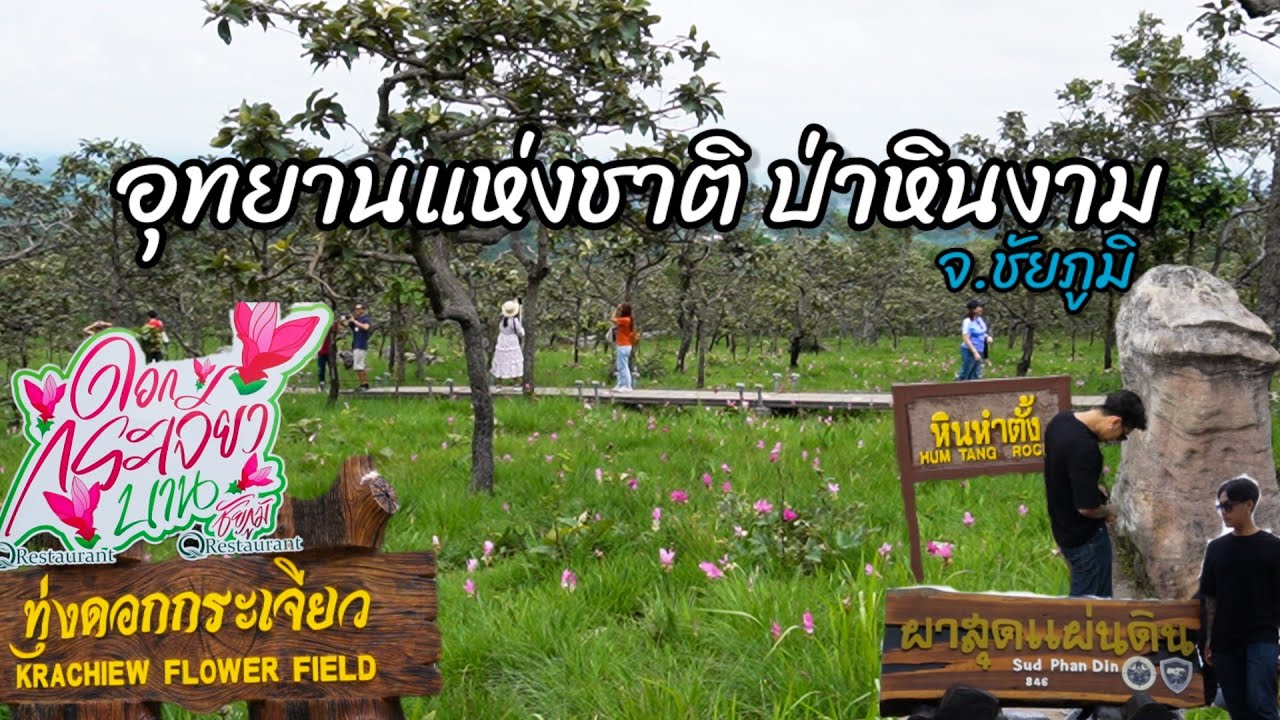
 Click to Access the Navigation Map GPS
Pa Hin Ngam National Park Map
Gellery
Recommend

 Art, Culture and Heritage
 Historical Sites and Monuments(1)
 Landmarks and Memorials(3)
 Royal Palace(1)
 Art, Craft Centres, Tradition(3)
 Educational Places
 Educational Gardens, Farm(1)
 Places of Worship
 Temple(141)
 Other Sacred Sites(7)
 Suburban Living
 Village, Community(4)
National Parks and Marine Reserves(7)
Village, Community(4)
National Parks and Marine Reserves(7)
 Mountain (Doi)(5)
 Dam, Reservoir, Lake(10)
 Waterfalls(15)
 Caves(5)
 River, Canal(4)
 Other natural attractions(1)
 Entertainment and Agricultural
 Farms, Parks and Ecotourism(2)


