
lovethailand home >Northeastern Travel Attractions >Chaiyaphum Travel Attractions >Kaset Sombun >Ban Yang > Phra That Kut Chok
TL;DR: Phra That Kut Chok is located at Ban Yang Noi, Moo 2, Ban Yang Subdistrict, Kaset Sombun District, Chaiyaphum Province, open Daily, hours 08.00 – 17.00 (Recommended Visiting And Worship Hours).
Phra That Kut Chok
Open Days: Daily
Opening Hours: 08.00 – 17.00 (Recommended Visiting And Worship Hours)
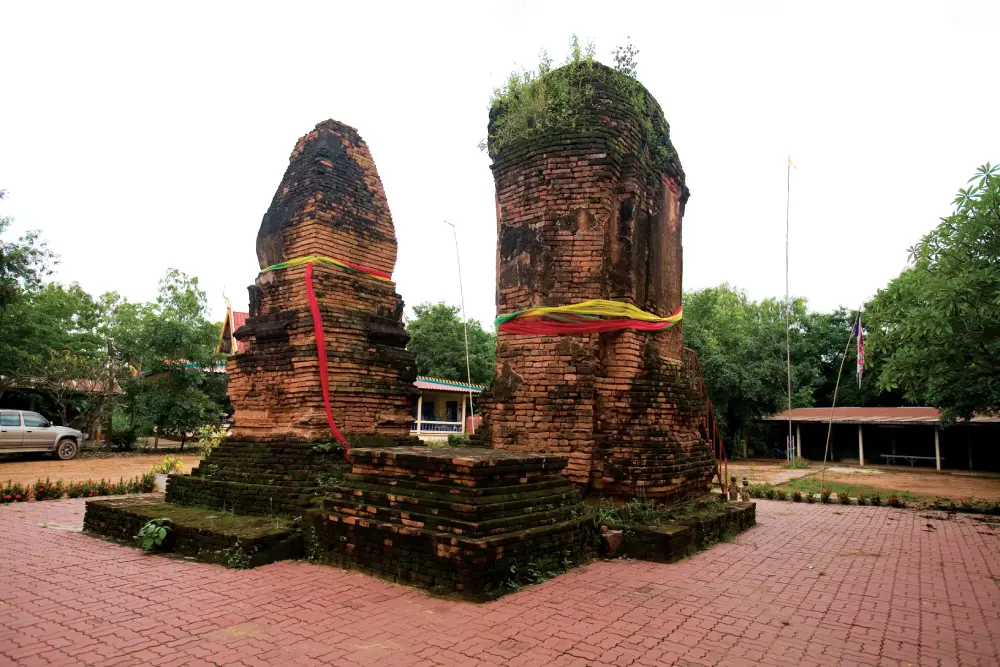
Phra That Kut Chok is located in Ban Yang Noi, Moo 2, Ban Yang Subdistrict, Kaset Sombun District, Chaiyaphum Province. It is an important ancient stupa site and sacred place for the local community. The site consists of two old brick stupas. The first stupa has a hollow central chamber containing a large limestone Buddha image and a sandstone Buddha image in the subduing Mara posture. Most of its upper section has collapsed. The second stupa has a tapering form similar to Phra That Phanom, with an approximately five-tiered base, projecting porches, and well-defined architectural corners. Both stupas reflect Lao-style Buddhist architecture and are dated to around the 19th-20th Buddhist centuries. Today, a monastic residence is located within the Phra That area, and local people continue to worship, make merit, and hold the annual water-pouring ceremony for the stupa.
For international travelers seeking the cultural and spiritual side of Chaiyaphum, Phra That Kut Chok is a meaningful destination. It is not a large commercial tourist attraction, but a quiet local sacred site where ancient architecture, Buddhist worship, community memory, and annual tradition remain closely connected. Visitors who come here will see not only old brick stupas, but also a living place of faith that still matters to the people of Ban Yang Noi and Kaset Sombun District.
The site is located close to Kaset Sombun town. From Kaset Sombun District center, visitors travel about 2 kilometers to Ban Yang Noi, then continue about 1 kilometer to the Phra That area. From Chaiyaphum city, the distance is about 78 kilometers. This makes Phra That Kut Chok suitable for a half-day or full-day cultural trip in northern Chaiyaphum, especially for travelers interested in ancient stupas, Lao Buddhist architecture, local rituals, and peaceful rural landscapes.
The name “Kut Chok” is connected with Huai Kut Chok, a local watercourse located near the stupa area to the north. In northeastern Thai usage, “kut” often refers to a water channel, bend, or pool, while “chok” became part of the local place name. The name therefore reflects the relationship between the ancient religious site, the surrounding water landscape, and the memory of the community. Phra That Kut Chok is not detached from its environment; it belongs to the land, water, and people around it.
The remaining brick stupas show the importance of Lao-style Buddhist architecture in Kaset Sombun. Their brick construction, hollow chamber, tiered base, projecting elements, and tapering form reflect a sacred architectural language that spread through many areas of the Northeast. Phra That Kut Chok is therefore valuable not only as a local shrine, but also as evidence of cultural exchange between local communities and the wider Lao Buddhist world.
The first stupa is especially notable for its hollow chamber. Inside are a large limestone Buddha image and a sandstone Buddha image in the subduing Mara posture. This gives the structure a strong devotional character. The subduing Mara posture represents the Buddha’s victory over temptation and the attainment of enlightenment. The presence of Buddha images inside the stupa makes the monument not only an architectural object, but also a sacred worship space.
The collapsed upper section of the first stupa reveals the passage of time. Its damaged condition does not reduce its value. Instead, it reminds visitors that ancient heritage is fragile and must be treated with respect. Old brick, weathered surfaces, and broken architectural parts all tell the story of centuries of change. Visitors should therefore avoid climbing, touching fragile sections, moving brick fragments, or causing any damage to the ancient structure.
The second stupa has a tapering shape similar to Phra That Phanom. Its five-tiered base raises the monument visually and gives it a sense of sacred height. The projecting porches and carefully shaped corners create a graceful architectural rhythm. This form reflects the importance of verticality in Lao Buddhist stupa design, symbolically lifting the mind from the earthly world toward sacred space.
The comparison with Phra That Phanom helps visitors understand the architectural character of the monument. Phra That Phanom is one of the most important models of Lao and Isan Buddhist stupa tradition. The tapering form, layered base, and sacred vertical emphasis seen at Phra That Kut Chok show how this tradition was adapted in a local community setting in Chaiyaphum.
Brick is the main construction material of Phra That Kut Chok. Brick allowed ancient builders to shape tiered bases, hollow chambers, projecting porches, corners, and tapering upper forms. Over time, the color, surface, and erosion of the brick have become part of the monument’s visual character. The weathered brickwork gives the site a strong sense of age and authenticity.
The monument is dated to around the 19th-20th Buddhist centuries in relation to Lao-style architecture. This period reflects the spread of Buddhist culture and stupa-building traditions through the region. The presence of such a monument in Kaset Sombun shows that the district has a deeper cultural history than its present-day rural landscape alone might suggest. Phra That Kut Chok is a physical reminder of the long continuity of Buddhist faith in the area.
In the wider cultural geography of Chaiyaphum, Phra That Kut Chok belongs to a network of religious and archaeological sites associated with Lao Buddhist culture. Other ancient stupas and sacred remains are found in Kaset Sombun and nearby districts. This pattern suggests that the area was part of a larger landscape of Buddhist settlement, ritual movement, and community devotion.
A monastic residence is now located within the Phra That area, and monks reside there to help care for the site. This is important because it keeps the ancient monument within a living Buddhist setting. Local people can come to make merit, pay respect, join ceremonies, and maintain a relationship with the sacred site throughout the year. The monument is therefore both ancient heritage and a living religious place.
The current care of Phra That Kut Chok involves the monastic residence, resident monks, the Ban Yang Noi community, and Ban Yang Subdistrict Municipality. This shared responsibility is essential because the site is both a cultural monument and a sacred community space. Preservation depends not only on physical conservation, but also on respect, local participation, and responsible visitor behavior.
The most important annual tradition connected with the site is the water-pouring ceremony for Phra That Kut Chok, held on the full moon day of the fifth lunar month. Villagers from Ban Yang Noi and nearby communities come to worship, make merit, pour water over the stupa, and continue the tradition that has been passed down for generations. In some years, the annual festival may include several days of community activities and celebration.
The water-pouring ceremony is meaningful on several levels. It expresses respect for the sacred stupa, purifies the mind, renews community faith, and brings villagers together. Elders pass on stories, younger generations learn ritual manners, and families return to the shared spiritual center of the village. Through this tradition, Phra That Kut Chok remains active in the cultural memory of the community.
Local legends connected with Huai Kut Chok are also part of the site’s cultural identity. Elders tell stories about the watercourse and sacred guardians of the area. Such stories show how local people understand the relationship between water, sacred places, and moral behavior. For visitors, these legends should be appreciated as part of the community’s memory and worldview.
Visitors should approach Phra That Kut Chok respectfully. Modest clothing is recommended. Voices should be kept low, and visitors should avoid disturbing monks, worshippers, or local ceremonies. Ancient brick structures should not be climbed or touched unnecessarily. Even small fragments may have cultural value, so nothing should be moved from the site.
A meaningful visit begins by observing the setting of the site, then looking closely at each stupa. Visitors should first notice the hollow chamber and Buddha images in the first stupa, then study the tapering form and tiered base of the second stupa. Observing these elements step by step helps travelers understand the site more deeply than simply taking a quick photograph.
The limestone and sandstone Buddha images inside the stupa add important artistic and religious meaning. The large limestone image reflects local devotional practice, while the sandstone Buddha in the subduing Mara posture expresses a central Buddhist theme: spiritual victory and enlightenment. Their presence inside the stupa makes the monument a place of worship as well as an architectural heritage site.
The main areas of the site include the first brick stupa, the second brick stupa, the hollow chamber, the Buddha image area, the monastic residence, the monks’ area, the worship courtyard, and the community festival space. These areas support both ordinary worship and the annual water-pouring ceremony. The site is therefore small but culturally complete.
Facilities at Phra That Kut Chok are those of a community sacred site and monastic residence. Visitors will find worship space, open areas for ceremonies, simple resting areas, and parking space nearby. Travelers should plan food, water, and transport in advance, especially on ordinary weekdays, because the site is primarily a local religious place rather than a commercial tourist complex.
Getting There is easiest by private car. From Kaset Sombun District center, travel about 2 kilometers to Ban Yang Noi, then continue about 1 kilometer to Phra That Kut Chok. From Chaiyaphum city, the distance is about 78 kilometers. Travelers may use the coordinates 16.2718254356, 101.941724689 for navigation.
The recommended visiting hours are from 08.00 to 17.00. Morning and late afternoon are comfortable for worship, walking around the site, and observing the brick stupas. Travelers visiting during the full moon of the fifth lunar month should allow extra time because the annual water-pouring ceremony may attract many villagers and visitors.
Phra That Kut Chok can be combined with other cultural sites in Kaset Sombun District. Nearby places include That Phiphuai or That Non Kok, Bai Sema Ban Phan Lam, Phra That Ta Pha Khao, Wat That Som Hong, That Ban Pueai or That Phu Om, and Pha Hua Nak Viewpoint in the wider Phu Laen Kha National Park route. These places help travelers understand the cultural and natural landscape of the district more fully.
That Phiphuai, also known as That Non Kok, is another important ancient stupa site in Kaset Sombun. Combining it with Phra That Kut Chok allows visitors to see that the district contains several sacred monuments linked with Lao and local Buddhist traditions. This makes the area suitable for travelers who want to explore lesser-known heritage routes in Chaiyaphum.
Pha Hua Nak Viewpoint and Phu Laen Kha National Park can be added for travelers who want to combine religious heritage with mountain scenery. A good route may begin with worship at Phra That Kut Chok in the morning and continue to natural viewpoints later in the day. This creates a balanced trip with faith, history, and landscape.
Restaurants and cafés around Kaset Sombun include local Thai restaurants, field-view cafés, coffee shops, and casual dining places. Nearby options include Tiwpha Cafe, Nahaow Cafe, Noo Nu Cafe, Tingly Moo Kratha, Warm House Bakery, Fah Cafe, and Ban Nok Cafe. These places make it convenient to combine a visit to the stupa with local food and coffee stops in the district.
Accommodation near Phra That Kut Chok is available in Kaset Sombun and Ban Yang Subdistrict. Options include KS Resort, Ban Pao Garden Home Resort, Ban Khao Rao Suk Resort, Zeya & C Resort, Namfon Resort, and Yada Phu View Farmstay. Travelers who prefer more hotel choices may stay in Chaiyaphum city or a nearby district and visit Phra That Kut Chok as a day trip.
Phra That Kut Chok is suitable for many types of travelers: those who wish to worship at an ancient sacred site, those interested in Lao Buddhist architecture, those studying local history, those who want to experience the annual water-pouring tradition, and those looking for a quieter side of Chaiyaphum beyond famous viewpoints and national parks.
Overall, Phra That Kut Chok is valuable in architecture, religion, history, and community life. Its two brick stupas, hollow chamber, Buddha images, Lao-style form, 19th-20th Buddhist century date, local legends, and annual water-pouring tradition all make it an important heritage site of Kaset Sombun District. The site is more than a place to worship; it is a living cultural memory of Ban Yang Noi.
For travelers who want to understand Chaiyaphum through local faith and ancient heritage, Phra That Kut Chok should not be overlooked. A visit here means paying respect to an old sacred monument, learning about Lao-style Buddhist architecture, observing a community monastic site, and supporting the continued preservation of a cultural legacy that still matters deeply to local people.
| Name | Phra That Kut Chok |
| Location | Ban Yang Noi, Moo 2, Ban Yang Subdistrict, Kaset Sombun District, Chaiyaphum Province |
| Address | Ban Yang Noi, Moo 2, Ban Yang Subdistrict, Kaset Sombun District, Chaiyaphum 36120, Thailand |
| Coordinates | 16.2718254356, 101.941724689 |
| Highlights | Ancient Lao-style brick stupas, Buddha images inside the hollow chamber, and the annual water-pouring ceremony of Ban Yang Noi community |
| History / Period | Associated with Lao-style Buddhist architecture, dated around the 19th-20th Buddhist centuries, and regarded as an important sacred monument of Kaset Sombun District |
| Stupa Features | Two old brick stupas; the first has a hollow chamber and a largely collapsed upper section, while the second has a tapering form similar to Phra That Phanom with an approximately five-tiered base and projecting architectural elements |
| Sacred Objects / Important Features | Large limestone Buddha image, sandstone Buddha image in the subduing Mara posture, old brick stupas, hollow chamber, and worship space within the monastic residence area |
| Name Origin | Named after Huai Kut Chok, a nearby local watercourse north of the stupa area, reflecting the link between the monument, landscape, and community memory |
| Architectural Style | Lao-style Buddhist architecture with brick construction, tiered base, projecting elements, tapering upper form, and a second stupa resembling the Phra That Phanom tradition |
| Main Areas / Zones | First stupa zone, second stupa zone, hollow chamber zone, Buddha image zone, monastic residence zone, monks’ residence area, worship courtyard, and annual water-pouring ceremony area |
| Facilities | Worship area, monastic residence courtyard, nearby parking area, quiet resting area, and restaurants in Kaset Sombun District nearby |
| Traditions / Main Activities | Annual water-pouring ceremony on the full moon day of the fifth lunar month, worship of Phra That Kut Chok, merit-making at the monastic residence, and community Buddhist activities of Ban Yang Noi |
| Caretaker | The monastic residence at Phra That Kut Chok, resident monks, Ban Yang Noi community, and Ban Yang Subdistrict Municipality |
| Open Days | Daily |
| Opening Hours | 08.00 – 17.00 (Recommended Visiting And Worship Hours) |
| Travel Information | From Kaset Sombun District center, travel about 2 km to Ban Yang Noi, then continue about 1 km to Phra That Kut Chok. The site is about 78 km from Chaiyaphum city. Use coordinates 16.2718254356, 101.941724689 for navigation |
| Current Status | An ancient sacred stupa site within a monastic residence area in Ban Yang Noi, still used for worship and the annual water-pouring ceremony by the local community |
| Local Administrative Contact | Ban Yang Subdistrict Municipality, Tel. 044-869-932 |
| Nearby Tourist Attractions | 1. Huai Kut Chok And Ban Yang Noi Community, about 0.5 km 2. Kaset Sombun District Center, about 3 km 3. That Phiphuai / That Non Kok, Sa Phon Thong Subdistrict, about 7 km 4. Bai Sema Ban Phan Lam, Sa Phon Thong Subdistrict, about 9 km 5. Phra That Ta Pha Khao, Sa Phon Thong Subdistrict, about 10 km 6. Wat That Som Hong, Sa Phon Thong Subdistrict, about 11 km 7. That Ban Pueai / That Phu Om, Non Kok Subdistrict, about 14 km 8. Pha Hua Nak Viewpoint, Phu Laen Kha National Park, about 30 km, Tel. 093-0939193 |
| Nearby Restaurants | 1. Tiwpha Cafe, about 4 km, Tel. 063-639-8791 2. Nahaow Cafe, about 4 km, Tel. 096-418-7365 3. Noo Nu Cafe Kaset Sombun, about 4 km, Tel. 086-543-2422 4. Tingly Moo Kratha Kaset Sombun, about 5 km, Tel. 089-940-3193 5. Warm House Bakery, about 8 km, Tel. 095-169-7569 6. Fah Cafe, about 12 km, Tel. 097-320-5496 7. Ban Nok Cafe, about 17 km, Tel. 096-418-7265 |
| Nearby Accommodations | 1. KS Resort, Ban Yang Subdistrict, about 3 km, Tel. 080-828-5361 2. Ban Pao Garden Home Resort, about 11 km, Tel. 082-882-6535 3. Ban Khao Rao Suk Resort, about 15 km, Tel. 089-779-1867 4. Zeya & C Resort, about 17 km, Tel. 061-462-4904 5. Namfon Resort, Kut Lo Subdistrict, about 18 km 6. Yada Phu View Farmstay, about 35 km, Tel. 099-632-7154 |
Frequently Asked Questions (FAQ)
Q: Where is Phra That Kut Chok located?
A: Phra That Kut Chok is located in Ban Yang Noi, Moo 2, Ban Yang Subdistrict, Kaset Sombun District, Chaiyaphum Province, about 3 km from Kaset Sombun District center and about 78 km from Chaiyaphum city.
Q: What are the main highlights of Phra That Kut Chok?
A: The main highlights are two old brick stupas. The first has a hollow chamber with Buddha images inside, while the second has a tapering form similar to Phra That Phanom with an approximately five-tiered base.
Q: What period does Phra That Kut Chok belong to?
A: The architecture is associated with Lao-style Buddhist art and is dated to around the 19th-20th Buddhist centuries.
Q: What sacred objects are found inside the stupa?
A: The hollow chamber contains a large limestone Buddha image and a sandstone Buddha image in the subduing Mara posture, together with the ancient brick stupa structure.
Q: When is the annual water-pouring ceremony held?
A: The water-pouring ceremony for Phra That Kut Chok is held every year on the full moon day of the fifth lunar month, when villagers come to worship, make merit, and continue the local tradition.
Q: How can travelers get to Phra That Kut Chok from Kaset Sombun?
A: From Kaset Sombun District center, travel about 2 km to Ban Yang Noi, then continue about 1 km to the stupa area. Travelers may also use coordinates 16.2718254356, 101.941724689.
Q: Who takes care of Phra That Kut Chok?
A: The site is cared for by the monastic residence at Phra That Kut Chok, resident monks, Ban Yang Noi community, and Ban Yang Subdistrict Municipality.
Q: What nearby attractions can be combined with a visit?
A: Nearby places include That Phiphuai, Bai Sema Ban Phan Lam, Phra That Ta Pha Khao, Wat That Som Hong, That Ban Pueai, and Pha Hua Nak Viewpoint in the Phu Laen Kha National Park route.
 Category: ●Places of Worship
 Group: ●Other Sacred Sites
Last Update : 2 MonthAgo
 Last Update : 2 MonthAgo
 Click to Access the Navigation Map GPS
Phra That Kut Chok Map
Recommend

 Art, Culture and Heritage
 Historical Sites and Monuments(1)
 Landmarks and Memorials(3)
 Royal Palace(1)
 Art, Craft Centres, Tradition(3)
 Educational Places
 Educational Gardens, Farm(1)
 Temple(141)
Other Sacred Sites(7)
Temple(141)
Other Sacred Sites(7)
 Suburban Living
 Village, Community(4)
 Nature and Wildlife
 National Parks and Marine Reserves(7)
 Mountain (Doi)(5)
 Dam, Reservoir, Lake(10)
 Waterfalls(15)
 Caves(5)
 River, Canal(4)
 Other natural attractions(1)
 Entertainment and Agricultural
 Farms, Parks and Ecotourism(2)


