
lovethailand home >Northeastern Travel Attractions >Chaiyaphum Travel Attractions >Nong Bua Daeng >Wang Chom Phu > Pha Koeng
TL;DR: Pha Koeng is located at Kut Chum Saeng Subdistrict, Nong Bua Daeng District, Chaiyaphum Province, open Daily, hours 08.00 – 17.00.

Pha Koeng
Open Days: Daily
Opening Hours: 08.00 – 17.00
Pha Koeng and Wat Chaiyaphum Phithak in Chaiyaphum Province form one of the most memorable cultural and scenic stops along Highway 2159, the route between Chaiyaphum city and Nong Bua Daeng District. The site is known for a high cliff that stretches out from the Phu Laen Kha mountain range like a crescent moon. Local people call it Pha Koeng; in the Isan dialect, “koeng” or “i-koeng” refers to the moon. This name gives the place a strong local identity, connecting the natural shape of the cliff with language, memory, and the way communities in northeastern Thailand read meaning from the landscape around them.
Pha Koeng is located in Kut Chum Saeng Subdistrict, Nong Bua Daeng District, Chaiyaphum Province, close to the Phu Laen Kha mountain area. It is roughly 33–36 km from Chaiyaphum city depending on the starting point. As travelers follow the road toward Nong Bua Daeng, the scenery gradually changes from flatter rural land into a more mountainous landscape. The road curves through elevated terrain, with cliffs, forested slopes, and open views appearing along the way. This approach makes the journey part of the experience, especially for visitors who want to see a quieter, more natural side of Chaiyaphum beyond the city center.
On the cliff stands Wat Chaiyaphum Phithak, also widely known as Wat Pha Koeng. The temple is both a Buddhist sanctuary and a scenic viewpoint. It attracts local worshippers, Thai travelers, and visitors interested in mountain temples, spiritual landmarks, and rural landscapes. The temple grounds combine religious architecture, a standing Buddha image, a sacred stupa, an antique museum, meditation areas, and panoramic viewpoints. From the front of the Buddha image, visitors can look out over rice fields, villages, and the rolling land below, creating a view that feels expansive and peaceful.
The most important sacred image at the temple is Phra Phuttha Chaiyaphum Phithak, a large standing Buddha image in the blessing posture. The golden image stands prominently near the cliff and has become a key symbol of the area. Its location gives it a powerful visual presence: the Buddha image faces the open landscape, while the cliff and sky frame the temple from behind. For many travelers, this is the defining image of Pha Koeng: a golden standing Buddha, a high mountain cliff, and the wide countryside of Chaiyaphum stretching out below.
The development of Pha Koeng as a Buddhist site is closely tied to the idea of preserving a beautiful natural area and transforming it into a place of faith, reflection, and public benefit. The cliff had long been a notable landmark in the local landscape. When the standing Buddha image was created on the high ground, the area gradually became a spiritual center and a recognized stop for people traveling between Chaiyaphum and Nong Bua Daeng. The temple therefore represents more than a built religious site; it is a meeting point between mountain geography, Buddhist devotion, and local identity.
The name “Pha Koeng” is one of the site’s strongest cultural details. In the Isan language, “koeng” refers to the moon. The cliff’s curved form, which projects from the mountain like a crescent, inspired local people to call it by this name. For foreign travelers, this local naming tradition helps explain how Thai regional landscapes often carry meanings that are not immediately visible on a map. The name preserves a visual memory: a moon-shaped cliff on the Phu Laen Kha range, recognized and passed down through everyday language.
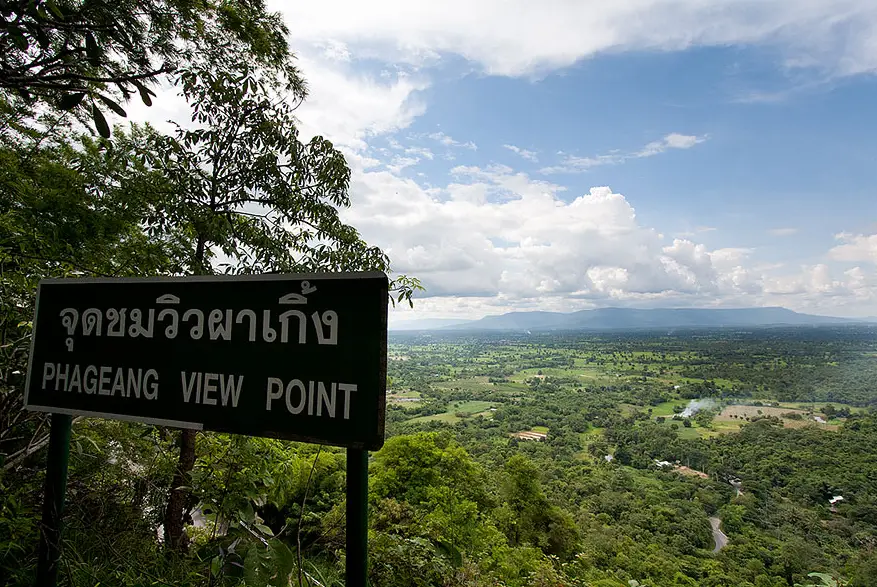
The viewpoint at Pha Koeng is especially beautiful because of its height and openness. In front of the Buddha image, visitors can see broad views of the fields and rural land below. On clear days, the scenery is wide and bright, with layers of mountains in the distance and green or golden rice fields depending on the season. During the rainy season and the early cool season, the surrounding landscape becomes especially fresh and vivid. This makes Pha Koeng a rewarding place for photography, quiet sightseeing, and slow travel.
For travelers who enjoy mountain temples, Wat Chaiyaphum Phithak offers a different atmosphere from temples located on flat land. The approach road, the elevated setting, and the cliffside viewpoint all create a sense of arrival. Once inside the temple area, the space feels both open and calm. On one side are Buddhist structures and places of worship; on another side are the sky, wind, and open scenery. This combination makes the temple suitable for merit-making, meditation, scenic photography, and simple rest during a road trip.
Another important feature within the temple is Phra Borommathat Pha Koeng, a sacred stupa and one of the main religious landmarks of the temple grounds. Visitors should not limit their visit only to the viewpoint or the standing Buddha image. Walking to the stupa area helps reveal the fuller structure of the temple as a place of worship, remembrance, and Buddhist practice. The stupa adds a more contemplative dimension to the visit, balancing the scenic character of the cliff with the spiritual role of the temple.
The temple also includes a museum of antiques, where visitors can see old objects connected with local history, community life, and Buddhist culture. A small museum inside a mountain temple may appear modest at first, but it gives the visit more depth. It allows travelers to understand that Pha Koeng is not only a viewpoint but also a place where local memory, faith, and material culture are preserved. For visitors interested in Thai cultural travel, this museum is an important part of the experience.
Wat Chaiyaphum Phithak is also associated with meditation and spiritual retreat. The quietness of the mountain setting, the breeze, and the natural surroundings make the temple a suitable place for people seeking calm. Visitors should move through the temple slowly and respectfully. The value of this place is not only in taking photographs, but also in spending time with the silence, the height of the landscape, and the gentle rhythm of temple life. This is especially meaningful for travelers who prefer reflective destinations over crowded attractions.
Pha Koeng is suitable for family travel as well. Older visitors can pay respect to the Buddha image and enjoy the view without needing an overly strenuous walk, while younger travelers can learn about geography, local language, Buddhism, and temple etiquette. The site offers a practical learning experience: a cliff named after the moon, a mountain temple, a large Buddha image, and a viewpoint that shows how nature and religion often exist together in Thai cultural landscapes.
The best times to visit are in the morning or late afternoon. The weather is more comfortable, the sunlight is softer, and the scenery is easier to photograph. In the morning, the atmosphere around the temple feels calm and fresh. In the late afternoon, the golden tones of the Buddha image and the warm light over the landscape create a memorable mood. During the rainy season or after rainfall, the surrounding greenery can be especially beautiful, but visitors should take extra care on roads, walkways, and sloped areas.
Traveling from Chaiyaphum city is most convenient by private car or rental car. Take Highway 2159 toward Nong Bua Daeng and continue to Kut Chum Saeng Subdistrict. The temple is located along the mountain road. Travelers should check a digital map before departure, keep fuel levels sufficient, and drive carefully on curves and slopes. Daytime travel is recommended for visitors unfamiliar with rural mountain roads, especially during the rainy season.
Because Wat Chaiyaphum Phithak is an active Buddhist temple, visitors should dress respectfully. Clothing should cover shoulders and knees, and footwear should be comfortable enough for uneven surfaces and walking around the temple grounds. Families with children and elderly visitors should be especially careful near viewpoints, slopes, and railings. Avoid climbing barriers or getting too close to cliff edges. Visitors should also keep voices low around worship areas and meditation spaces.
Photography is possible in many areas, including the standing Buddha image, the stupa, the cliff viewpoint, and the countryside below. To capture the identity of Pha Koeng, try composing images that include the Buddha image, cliff, and open sky together. Wide-angle shots work well for the panoramic view. During strong sunlight, a hat, sunglasses, and drinking water are useful because parts of the temple grounds are exposed to direct sun.
Pha Koeng is also a useful stop for travelers already driving between Chaiyaphum city and Nong Bua Daeng. It can be visited as the main destination of a half-day trip or as a meaningful stop along a broader Chaiyaphum itinerary. With careful planning, travelers can combine it with Phu Laen Kha National Park, Phra That Chaiyaphum, Tat Ton National Park, or attractions in Chaiyaphum city. A visit of 1–2 hours is usually enough to pay respect, enjoy the viewpoint, walk through key temple areas, and take photographs without rushing.
Culturally, Pha Koeng reflects the relationship between local people and the landscape. The name comes from the cliff’s shape, the dialect word for the moon, and the way the mountain has been transformed into a Buddhist place of meaning. Travelers should therefore see Pha Koeng not only as a viewpoint, but also as a spiritual and cultural landmark for the local community. Its importance comes from both natural beauty and the devotion of people who have maintained and respected the site over time.
A good way to explore the temple is to begin by paying respect to Phra Phuttha Chaiyaphum Phithak, then continue to the viewpoint and Phra Borommathat Pha Koeng. If time allows, visit the antique museum and other temple areas. This sequence creates a natural rhythm and helps visitors understand the site as more than a quick photo stop. Those seeking a quieter experience should visit outside peak hours and spend time simply looking at the view.
What makes Pha Koeng especially useful for travelers planning a Chaiyaphum trip is the clarity of its identity. It is easy to understand, easy to include in a road itinerary, and visually memorable. The site has a moon-shaped cliff, a golden standing Buddha image, a sacred stupa, a museum, and a panoramic viewpoint. These elements make it relevant for travelers interested in Buddhism, photography, rural scenery, regional language, and meaningful cultural travel.
Pha Koeng is not a large entertainment-style attraction, and that simplicity is part of its strength. It offers a calm, slow, and reflective experience. Visitors encounter a mountain temple shaped by faith, history, and landscape rather than commercial activity. For travelers who want to step away from crowded routes and see a quieter side of Chaiyaphum, Wat Chaiyaphum Phithak is a valuable destination.
Getting There is most practical from Chaiyaphum city by following Highway 2159 toward Nong Bua Daeng. The distance is about 36 km. The road passes through mountainous scenery, so visitors should drive at a suitable speed and be careful on bends and slopes. Plan at least 1–2 hours at the temple to pay respect to the Buddha image, enjoy the viewpoint, visit the stupa, and experience the calm atmosphere of the site.
For a one-day trip, travelers can leave Chaiyaphum city in the morning, visit Pha Koeng and Wat Chaiyaphum Phithak, then continue to other natural or cultural sites nearby. To keep the day comfortable, choose only 2–3 destinations and allow time for meals in Nong Bua Daeng or on the return route. With this kind of planning, Pha Koeng becomes more than a short stop; it becomes part of a deeper journey through the mountain landscapes, Buddhist landmarks, and local culture of Chaiyaphum.
In summary, Pha Koeng and Wat Chaiyaphum Phithak are among the most meaningful cultural and scenic places to visit in Chaiyaphum Province. The crescent-shaped cliff, the Isan meaning of the name, the golden standing Buddha image, Phra Borommathat Pha Koeng, the antique museum, and the wide viewpoint over rice fields all create a destination with history, culture, landscape, and spiritual atmosphere. For foreign travelers who want to understand Chaiyaphum beyond the usual highlights, Pha Koeng offers a calm and memorable introduction to the province’s mountain-temple heritage.
| Name | Pha Koeng, Wat Chaiyaphum Phithak |
| Location | Kut Chum Saeng Subdistrict, Nong Bua Daeng District, Chaiyaphum Province |
| Address | Along Highway 2159, Chaiyaphum–Nong Bua Daeng Route, Kut Chum Saeng Subdistrict, Nong Bua Daeng District, Chaiyaphum 36210, Thailand |
| Coordinates | Use digital navigation to Wat Chaiyaphum Phithak (Pha Koeng), Nong Bua Daeng District, Chaiyaphum Province |
| Highlights | Crescent-shaped cliff on the Phu Laen Kha range, Phra Phuttha Chaiyaphum Phithak, Phra Borommathat Pha Koeng, antique museum, and panoramic rice-field viewpoint |
| History | The Pha Koeng area was developed into an important Buddhist site on the Phu Laen Kha range. The construction of Phra Phuttha Chaiyaphum Phithak began in 1969 and was completed in 1973. |
| Name Origin | “Koeng” or “I-koeng” means moon in the Isan dialect. The name comes from the cliff’s crescent-like shape. |
| Distinctive Features | A mountain temple combining Buddhist worship areas, natural viewpoints, and meditation spaces in one location |
| Important Sacred Sites | Phra Phuttha Chaiyaphum Phithak, Phra Borommathat Pha Koeng, antique museum, Pha Koeng viewpoint, and meditation areas |
| Travel Information | From Chaiyaphum city, take Highway 2159 toward Nong Bua Daeng for about 36 km. Private car or rental car is the most convenient option. |
| Current Status | Open for visitors, worshippers, sightseeing, and temple visits during operating hours |
| Open Days | Daily |
| Opening Hours | 08.00 – 17.00 |
| Fees | No admission fee; donations are welcome |
| Facilities | Parking, toilets, worship areas, viewpoint, rest areas, and meditation spaces |
| Main Areas / Zones | Phra Phuttha Chaiyaphum Phithak Zone, Phra Borommathat Pha Koeng Zone, Antique Museum Zone, Pha Koeng Viewpoint, meditation areas, and temple worship areas |
| Abbot / Caretaker | Phra Tham Phawana Wachirakhun (Bunma Puññaphirato), Abbot of Wat Chaiyaphum Phithak |
| Main Contact Number | 092-647-1008 |
| Nearby Tourist Attractions | 1. Pha Koeng Viewpoint, about 0 km 2. Phu Laen Kha National Park, about 1 km 3. Phra That Chaiyaphum, about 30 km 4. Tat Ton National Park, about 35 km 5. Chao Pho Phraya Lae Monument, about 36 km 6. Mo Hin Khao, Phu Laen Kha National Park, about 45 km |
| Nearby Restaurants | 1. Warm House • Bakery, about 16 km, Tel. 081-757-9570, 092-516-5005 2. Tam Zaeb Bua Daeng, about 17 km, Tel. 093-364-0326 3. Mum Aroi Cafe, about 18 km, Tel. 082-206-3978 4. Suan Khonphon Restaurant, about 19 km, Tel. 081-074-6840 5. Tor Boon Coffee, Phra That Chaiyaphum, about 29 km, Tel. 081-933-8251 |
| Nearby Accommodations | 1. First Inn Resort, Nong Bua Daeng, about 18 km, Tel. 098-584-7787 2. Lee Resort Farm Stay Nong Bua Daeng, about 20 km, Tel. 093-725-6720, 088-915-2592 3. Rose Resort, Nong Bua Daeng, about 20 km, Tel. 081-593-5028, 087-870-8169 4. Chaiyaphum Monster Fishing Park & Resort, about 29 km, Tel. 081-957-7312 5. Chaiyaphum Park Hotel, Mueang Chaiyaphum, about 38 km, Tel. 044-816-567, 044-816-997 |
Frequently Asked Questions (FAQ)
Q: Where is Pha Koeng, Wat Chaiyaphum Phithak located?
A: It is located in Kut Chum Saeng Subdistrict, Nong Bua Daeng District, Chaiyaphum Province, along Highway 2159 between Chaiyaphum city and Nong Bua Daeng.
Q: Why is it called Pha Koeng?
A: The cliff resembles a crescent moon, and “koeng” or “i-koeng” means moon in the Isan dialect.
Q: What are the main highlights of Wat Chaiyaphum Phithak?
A: The main highlights are Phra Phuttha Chaiyaphum Phithak, Phra Borommathat Pha Koeng, the antique museum, the cliff viewpoint, and the peaceful mountain-temple atmosphere.
Q: What are the opening hours of Pha Koeng?
A: The site is open daily from 08.00 to 17.00.
Q: Is there an admission fee?
A: No admission fee is charged. Visitors may make donations according to their faith.
Q: What is the best way to get there?
A: The most convenient way is by private car or rental car from Chaiyaphum city via Highway 2159 toward Nong Bua Daeng, a distance of about 36 km.
Q: What is the best time of day to visit?
A: Morning and late afternoon are the best times because the weather is more comfortable, the light is better for photography, and the view is easier to enjoy.
Q: What should visitors be careful about?
A: Dress respectfully, walk carefully on slopes and viewpoint areas, avoid getting too close to cliff edges, and respect the temple’s meditation and worship spaces.
 Category: ●Nature and Wildlife
 Group: ●Mountain (Doi)
Last Update : 3 MonthAgo
 Last Update : 3 MonthAgo
 Click to Access the Navigation Map GPS
 Art, Culture and Heritage
 Historical Sites and Monuments(1)
 Landmarks and Memorials(3)
 Royal Palace(1)
 Art, Craft Centres, Tradition(3)
 Educational Places
 Educational Gardens, Farm(1)
 Places of Worship
 Temple(141)
 Other Sacred Sites(7)
 Suburban Living
 Village, Community(4)
 National Parks and Marine Reserves(7)
Mountain (Doi)(5)
National Parks and Marine Reserves(7)
Mountain (Doi)(5)
 Dam, Reservoir, Lake(10)
 Waterfalls(15)
 Caves(5)
 River, Canal(4)
 Other natural attractions(1)
 Entertainment and Agricultural
 Farms, Parks and Ecotourism(2)


