
lovethailand home >Northeastern Travel Attractions >Chaiyaphum Travel Attractions >Bamnet Narong >Khok Roengrom > Wat Pak Chap
TL;DR: Wat Pak Chap is located at Ban Pak Chap, Moo 3, Khok Roeng Rom Subdistrict, Bamnet Narong District, Chaiyaphum Province, open Daily, hours Daytime.

Wat Pak Chap
Open Days: Daily
Opening Hours: Daytime
Wat Pak Chap in Khok Roeng Rom Subdistrict, Bamnet Narong District, Chaiyaphum Province, is a local Buddhist temple with deep roots in village life. Established in 1918 and granted its official consecrated boundary, or Wisungkham Sima, on February 9, 1973, the temple represents more than a place of worship. It is a community institution where Buddhist practice, local traditions, moral education, and collective memory continue to meet in a quiet rural setting.
For travelers searching for Wat Pak Chap in Chaiyaphum, this temple is best understood as a living community temple rather than a major commercial tourist attraction. Its value lies in its calm atmosphere, long history, and ongoing role as a religious and cultural center for Ban Pak Chap and nearby villages. Visitors can come to make merit, pay respect to the Buddha, observe rural temple life, and understand how Buddhism remains closely connected to everyday community life in northeastern Thailand.
Wat Pak Chap is located at Ban Pak Chap, Moo 3, Khok Roeng Rom Subdistrict, Bamnet Narong District, Chaiyaphum Province. The temple grew from the faith and cooperation of local villagers. It was founded by Nai Proi Yanarak together with members of the community, and over time the temple developed its religious buildings and community spaces. This background makes Wat Pak Chap a meaningful example of a rural Thai temple that was not built as a tourist site, but as a spiritual foundation created and maintained by local people.
The importance of Wat Pak Chap can be seen in both religious and social dimensions. Religiously, it is a place where monks perform their monastic duties, chant, meditate, conduct ceremonies, and guide laypeople in Buddhist practice. Socially, it serves as a gathering place for villagers during merit-making events, ordinations, funerals, Kathin ceremonies, Buddhist holy days, and community traditions. In this sense, the temple functions as the heart of the village, linking family life, faith, education, and cultural identity.
The granting of Wisungkham Sima in 1973 marked an important stage in the temple’s religious development. A consecrated boundary gives the ordination hall its formal status for important monastic acts. At Wat Pak Chap, the consecrated boundary measures 20 meters wide and 40 meters long, corresponding with the ordination hall built in 1972. This ordination hall is one of the temple’s most important sacred areas, as it is directly connected with formal Buddhist ceremonies and the continuity of monastic discipline within the community.
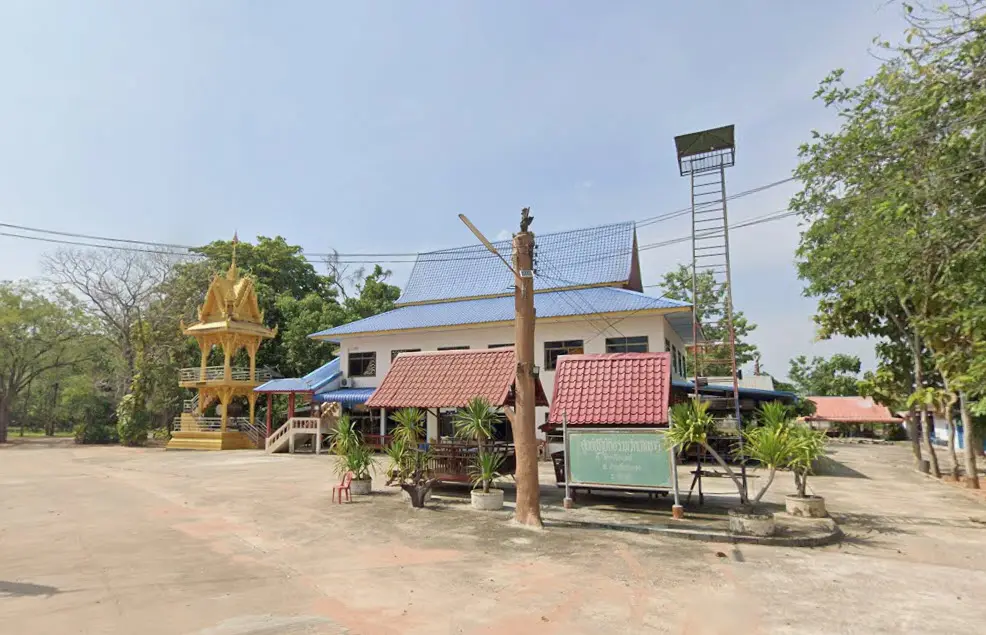
The temple’s buildings reflect its gradual growth over several generations. The sermon hall, built in 1937, is a wooden structure measuring 16 meters wide and 21 meters long. It has long served as a place for listening to sermons, gathering for community activities, and holding merit-making events. The temple also has an ordination hall, monks’ residence, multipurpose hall, library, and Dhamma study center for the subdistrict. Together, these spaces show that Wat Pak Chap has served not only as a sacred place, but also as a learning and community center.
The library and Dhamma study center add educational value to Wat Pak Chap. In many rural Thai communities, temples are not only places of worship; they also support moral learning and the transmission of Buddhist teachings. A Dhamma study center allows villagers and young people to learn about Buddhist principles, discipline, ethics, and local cultural values. Through this role, Wat Pak Chap helps connect the traditional relationship between home, temple, and school, a core pattern in Thai community life.
The known line of abbots at Wat Pak Chap includes Phra Daeng Asapho, Phra Klam Wiriyarambho, Phra Samphan Sawaro, and Phra Khru Thammachai Khet. The most recent verified information identifies Phra Khru Thammachai Khet, also known as Phra Khru Thammachai Khet (Rian Dhammanatho), as the abbot of Wat Pak Chap. The abbot plays an essential role in managing the temple, guiding monks and novices, coordinating with the village, and serving as a spiritual leader for Buddhist ceremonies and community events.
Wat Pak Chap offers the kind of quiet temple atmosphere that appeals to travelers who want to experience local culture with respect and patience. It is not a crowded sightseeing spot, and that is part of its value. Visitors can spend time paying respect, observing temple architecture, and appreciating how a rural temple supports village life. The experience is especially suitable for cultural travelers, researchers, families, and visitors who prefer meaningful local places over heavily promoted attractions.
The name Wat Pak Chap is directly associated with Ban Pak Chap, the village where the temple is located. This pattern is common in Thailand, where temples often take the name of the local community they serve. The name therefore preserves local identity and memory. For villagers, Wat Pak Chap is not simply a place on a map; it is where people gather for merit-making, ordinations, funerals, Buddhist festivals, seasonal traditions, and important moments in community life.
In cultural terms, Wat Pak Chap helps preserve Thai and Isan Buddhist traditions at the village level. Annual merit-making events, Buddhist holy days, the rains retreat, the end of Buddhist Lent, Kathin ceremonies, and other local religious practices bring villagers back to the temple. These events allow people to offer food to monks, listen to sermons, clean the temple grounds, support the Sangha, and strengthen social ties. Through these repeated practices, the temple remains active and relevant across generations.
The temple’s role in meditation and spiritual practice is also significant. Although Wat Pak Chap is not a large meditation retreat center, its calm rural setting makes it suitable for chanting, quiet reflection, and simple meditation. For local people, this kind of practice is often integrated into everyday life rather than separated into formal retreats. Travelers who visit should respect this quiet rhythm and understand that the temple’s spiritual value comes from simplicity, continuity, and the sincere faith of the community.
For cultural travelers, Wat Pak Chap can be included in a local route around Bamnet Narong District. Nearby places such as Wat Boon at Ban Pakho, Chao Pho Phra Ritthi Rachai Shrine, Bueng Chuan Public Park, Wat Bueng Chuan, and local cafés or restaurants in Ban Chuan and Ban Phet can be combined into a slow travel route. This kind of itinerary is best for visitors interested in local history, village faith, Buddhist culture, and the quieter side of Chaiyaphum Province.
Chao Pho Phra Ritthi Rachai Shrine is an important nearby landmark connected with the history of Bamnet Narong. Phra Ritthi Rachai is remembered as a significant local figure associated with courage, protection, and the origin of the district’s historical identity. A visit to the shrine after Wat Pak Chap helps travelers understand the wider cultural landscape of Bamnet Narong, where Buddhist temples, ancestral memory, local heroes, and annual traditions all form part of the same living heritage.
Wat Boon at Ban Pakho is another meaningful nearby temple, especially for visitors interested in sacred art and Buddhist devotion. The temple is known for Luang Pho To, an old principal Buddha image in the ordination hall that has been the focus of local reverence for generations. Combining Wat Pak Chap with Wat Boon gives travelers a richer understanding of Buddhist heritage in Bamnet Narong, from community temples to older sacred images connected with local identity.
Bueng Chuan Public Park and the central area of Bamnet Narong can add a relaxing stop to a visit to Wat Pak Chap. After making merit or paying respect at the temple, visitors can continue toward the district center for food, coffee, or a short rest. This makes the route practical for families, older travelers, and people who prefer a gentle pace. Rather than rushing from one famous attraction to another, this route allows travelers to experience the rhythm of a local district.
The landscape around Wat Pak Chap reflects rural northeastern Thailand. Visitors may see village roads, agricultural areas, local homes, and community spaces that remain closely connected to temple life. A visit here is therefore not only about entering temple grounds, but also about observing how Buddhism fits into the broader rural environment. The temple is part of the cultural landscape, and this relationship between village and temple is one of the most important reasons to visit respectfully.
When visiting Wat Pak Chap, travelers should dress modestly and behave respectfully. As an active Buddhist temple, it is used by monks and local people for real religious practice. Visitors should avoid loud noise, should not disturb monks or residents during ceremonies, and should take photos with discretion. If a religious event is taking place, it is best to observe from an appropriate distance unless invited to join. Respectful conduct helps protect the dignity of the temple and the comfort of the community.
Making merit at Wat Pak Chap may include offering alms, donating to temple maintenance, participating in Kathin, joining merit-making ceremonies, or supporting religious and educational activities. In a community temple, donations and participation have practical meaning. They help maintain sacred buildings, support monks, and keep the temple available as a shared space for the village. For visitors, even a small act of respect can contribute to the continuity of local Buddhist life.
For those interested in the history of Thai temples, Wat Pak Chap is a useful case study of a local temple in northeastern Thailand. Its founding year in 1918 shows that the temple has been part of the community for more than a century. Its consecrated boundary in 1973 confirms its formal religious development. Its sermon hall, ordination hall, monks’ residence, multipurpose hall, library, and Dhamma study center show how a village temple can serve multiple functions across time.
The temple’s main areas each have a specific role. The ordination hall is used for formal monastic ceremonies. The sermon hall supports Dhamma talks and community gatherings. The monks’ residence provides accommodation for the Sangha. The multipurpose hall can support larger merit-making events and village activities. The library and Dhamma study center serve educational purposes. These spaces make Wat Pak Chap a living institution, not merely a religious monument.
Over more than 100 years, Wat Pak Chap has witnessed changes in rural society, transportation, education, and local lifestyles. Yet its core role remains consistent. It is a place of faith, moral guidance, community support, and cultural continuity. This kind of temple may look simple compared with famous tourist temples, but its meaning is profound because it represents the everyday relationship between Buddhism and Thai village life.
Visitors who want to understand the site more deeply should pay attention to the relationship between the temple and Ban Pak Chap. The temple boundary, nearby community, public water area to the west, and arrangement of religious buildings all reveal how rural temples are integrated with local geography. Thai village temples are rarely isolated from everyday life; they are part of the same social and cultural fabric that supports the community.
Getting There is most convenient by private car or rental car. Travelers should head toward Bamnet Narong District in Chaiyaphum Province, continue to Khok Roeng Rom Subdistrict, and use the digital map coordinates 15.42533, 101.61148 for navigation. Because some sections are local roads, visiting during daylight is recommended. This makes it easier to find the entrance, observe the village surroundings, and continue to nearby attractions.
From central Bamnet Narong, Wat Pak Chap can be used as either the first or final stop of a cultural route. A practical plan is to visit Wat Pak Chap, continue to Chao Pho Phra Ritthi Rachai Shrine, stop at Wat Boon at Ban Pakho, and then rest at a local restaurant or café. This route gives travelers a balanced experience of temple life, district history, local faith, and daily community atmosphere.
Travelers coming from outside the district should allow enough time, as Wat Pak Chap is not located in the main tourist zone of Chaiyaphum. It is best suited to visitors who intentionally seek local cultural experiences, rural temples, and deeper stories of community heritage. The temple’s value is not in spectacle, but in authenticity, calmness, and the continuity of faith across generations.
The best time to visit is from morning to afternoon, when natural light is suitable for viewing the temple grounds and continuing to nearby places. Visitors who wish to experience religious activities may choose Buddhist holy days or major temple festivals. Those who prefer a quieter visit should come on ordinary weekdays, when the temple atmosphere is more peaceful and suited to reflection.
Wat Pak Chap is suitable for several types of travelers. Older visitors may appreciate its peaceful atmosphere for merit-making and prayer. Families can use the visit to teach children about Thai temple culture. Cultural travelers can observe the role of a village temple in local life. Researchers and temple-history enthusiasts can study its founding year, consecrated boundary, religious buildings, and abbot succession to understand its development more clearly.
One of the temple’s strengths is that it has not been overly commercialized. It remains primarily a religious and community space. Visitors should therefore approach it with expectations appropriate to an active rural temple. Facilities are simple, the atmosphere is quiet, and the experience is most rewarding for those who value sincerity over spectacle. This respectful approach helps tourism support the community without disturbing local life.
In summary, Wat Pak Chap is a historically rooted community temple in Bamnet Narong District, Chaiyaphum Province. It has a clear founding history, an official consecrated boundary, important religious buildings, a verified abbot, and a continuing role in Buddhist practice, local traditions, and community life. Its greatest value is its quiet connection with the people of Ban Pak Chap, making it a meaningful destination for travelers who want to understand Buddhism at the village level.
For anyone looking for a temple in Chaiyaphum that offers more than a quick check-in, Wat Pak Chap deserves attention. A visit here reveals how a local temple can carry history, faith, education, ritual, and community identity within one place. It is a quiet but important reminder that the strength of Thai Buddhism is not found only in famous landmarks, but also in the many village temples that continue to serve their communities every day.
| Name | Wat Pak Chap |
| Location | Ban Pak Chap, Moo 3, Khok Roeng Rom Subdistrict, Bamnet Narong District, Chaiyaphum Province |
| Address | Rural Road ChY. 3036, Ban Pak Chap, Khok Roeng Rom Subdistrict, Bamnet Narong District, Chaiyaphum 36160, Thailand |
| Coordinates | 15.42533, 101.61148 |
| Highlights | A historic local Mahayana-sector Thai temple under the Mahanikaya order, founded in 1918 and serving as a spiritual and cultural center for Ban Pak Chap community |
| History | Founded in 1918 by Nai Proi Yanarak together with local villagers; granted Wisungkham Sima on February 9, 1973 |
| Name Origin | The temple name is associated with Ban Pak Chap, the village where the temple is located |
| Distinctive Features | A community temple with an ordination hall, sermon hall, monks’ residence, multipurpose hall, library, and Dhamma study center for the subdistrict |
| Travel Information | Best reached by private car or rental car via Bamnet Narong District, then onward to Khok Roeng Rom Subdistrict and Ban Pak Chap; use coordinates 15.42533, 101.61148 for navigation |
| Current Status | An active Mahanikaya community temple used for Buddhist practice, ceremonies, and local activities |
| Open Days | Daily |
| Opening Hours | Daytime |
| Fees | No admission fee for temple visits, merit-making, and paying respect |
| Facilities | Ordination hall, sermon hall, monks’ residence, multipurpose hall, library, Dhamma study center, and community activity space |
| Main Areas / Zones | 1. Ordination Hall 2. Sermon Hall 3. Monks’ Residence 4. Multipurpose Hall 5. Library And Dhamma Study Center 6. Merit-Making And Community Activity Area |
| Abbot / Caretaker | Phra Khru Thammachai Khet (Rian Dhammanatho) |
| Nearby Tourist Attractions | 1. Wat Boon, Ban Pakho, about 12 km 2. Chao Pho Phra Ritthi Rachai Shrine, about 15 km 3. Bueng Chuan Public Park, about 16 km 4. Wat Bueng Chuan, about 17 km 5. Wat Ban Rai Luang Pho Khun, about 45 km |
| Nearby Restaurants | 1. 1996 Chalee’s Cafe, about 15 km, Tel. 099-063-4699 2. Rongmee Cafe’, about 20 km, Tel. 095-606-5424, 080-926-4265 3. Tatlada Cafe Specialty Coffee, about 19 km 4. Khun Jaew Ban Phet Ded Sarati, about 20 km 5. Ja Chart Korean BBQ Bamnet, about 16 km |
| Nearby Accommodations | 1. Thanthong Resort, about 20 km, Tel. 061-954-4474, 044-102211 2. Jongjaroen Resort, about 14 km, Tel. 062-996-2989 3. Touch The Wind, about 25 km 4. Fasuay Resort, about 30 km 5. Rai Aey Foon Resort, about 45 km |
Frequently Asked Questions (FAQ)
Q: Where is Wat Pak Chap located?
A: Wat Pak Chap is located at Ban Pak Chap, Moo 3, Khok Roeng Rom Subdistrict, Bamnet Narong District, Chaiyaphum Province, Thailand.
Q: When was Wat Pak Chap founded?
A: Wat Pak Chap was founded in 1918 by Nai Proi Yanarak together with local villagers, and it was granted Wisungkham Sima on February 9, 1973.
Q: Who is the abbot of Wat Pak Chap?
A: The verified abbot of Wat Pak Chap is Phra Khru Thammachai Khet, also known as Phra Khru Thammachai Khet (Rian Dhammanatho).
Q: Why is Wat Pak Chap important to the community?
A: The temple serves as a spiritual center for local people and is used for Buddhist ceremonies, meditation, merit-making, cultural traditions, and community activities.
Q: What important areas are found inside Wat Pak Chap?
A: The temple includes an ordination hall, sermon hall, monks’ residence, multipurpose hall, library, and Dhamma study center for the subdistrict.
Q: How can travelers get to Wat Pak Chap?
A: The most convenient way is by private car or rental car via Bamnet Narong District, continuing to Khok Roeng Rom Subdistrict and using the coordinates 15.42533, 101.61148 for navigation.
Q: Are there nearby attractions around Wat Pak Chap?
A: Nearby places include Wat Boon at Ban Pakho, Chao Pho Phra Ritthi Rachai Shrine, Bueng Chuan Public Park, Wat Bueng Chuan, and Wat Ban Rai Luang Pho Khun.
Q: What kind of travelers is Wat Pak Chap suitable for?
A: It is suitable for travelers interested in local Buddhist temples, quiet merit-making, rural culture, Thai community history, and meaningful cultural travel in Chaiyaphum.
 Category: ●Places of Worship
 Group: ●Temple
Last Update : 2 MonthAgo
 Last Update : 2 MonthAgo
 Click to Access the Navigation Map GPS
 Art, Culture and Heritage
 Historical Sites and Monuments(1)
 Landmarks and Memorials(3)
 Royal Palace(1)
 Art, Craft Centres, Tradition(3)
 Educational Places
 Educational Gardens, Farm(1)
Temple(141)
Educational Gardens, Farm(1)
Temple(141)
 Other Sacred Sites(7)
 Suburban Living
 Village, Community(4)
 Nature and Wildlife
 National Parks and Marine Reserves(7)
 Mountain (Doi)(5)
 Dam, Reservoir, Lake(10)
 Waterfalls(15)
 Caves(5)
 River, Canal(4)
 Other natural attractions(1)
 Entertainment and Agricultural
 Farms, Parks and Ecotourism(2)


