
lovethailand home >Northeastern Travel Attractions >Chaiyaphum Travel Attractions >Ban Klwao >Ban Klwao > Wat Sala Loi
TL;DR: Wat Sala Loi is located at Moo 2, Ban Khwao Subdistrict, Ban Khwao District, Chaiyaphum Province, open Daily, hours 08.00 – 17.00.
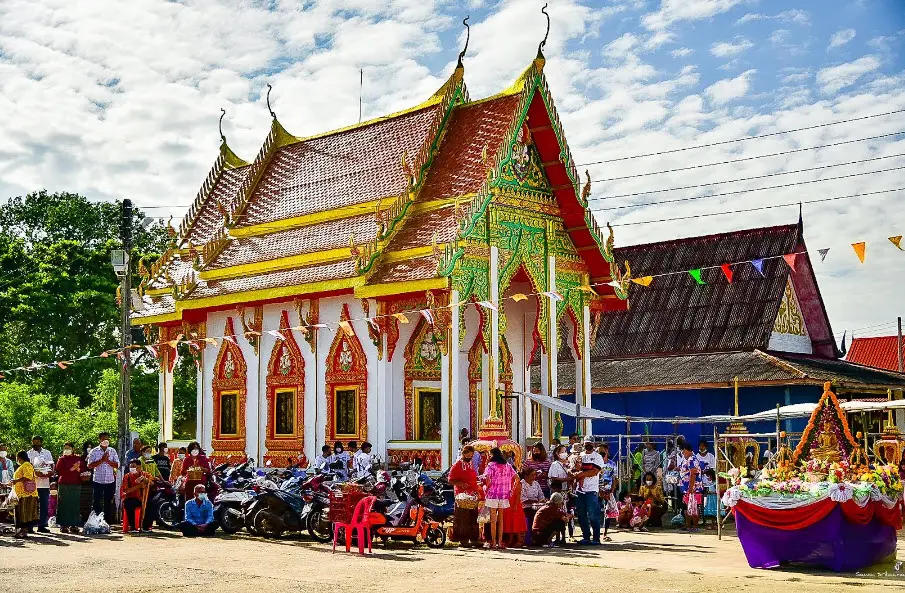
Wat Sala Loi
Open Days: Daily
Opening Hours: 08.00 – 17.00
Wat Sala Loi (Ban Khwao) in Moo 2, Ban Khwao Subdistrict, Ban Khwao District, Chaiyaphum Province, is an old and meaningful community temple in northeastern Thailand. Established in 1933 and granted Wisungkhamsima on 4 November 1966, the temple serves as a spiritual center for local residents, a place for Buddhist practice, a venue for ethical training, and a living cultural space where villagers continue to make merit and maintain Buddhist traditions. For foreign travelers who want to understand Chaiyaphum beyond major natural attractions, Wat Sala Loi offers a quiet and authentic introduction to rural Buddhist life in Ban Khwao.
The temple is located in Ban Khwao, a district known for mudmee silk, Isan traditions, village temples, and local craftsmanship. Wat Sala Loi is not a large tourist temple designed mainly for sightseeing. Its real value lies in its role as an active temple used by the community. Monks reside at the temple, villagers come to make merit, Buddhist ceremonies are held throughout the year, and the temple grounds continue to function as a shared religious and social space for people in the area.
The history of Wat Sala Loi gives it special importance. The temple was established in 1933, a period when temples in rural Thailand often served many roles at once. They were places of worship, centers of learning, meeting spaces, community shelters, and moral training grounds. Wat Sala Loi developed in this context and became closely connected with the growth of Ban Khwao as a local community. Its long history allows visitors to see how Buddhism has shaped the daily life of people in this part of Chaiyaphum for generations.
The granting of Wisungkhamsima on 4 November 1966 is another important milestone. In Thai Buddhist tradition, Wisungkhamsima refers to the official monastic boundary used for important Sangha ceremonies, especially those connected with the ordination hall. This means that Wat Sala Loi is not only a place where villagers worship, but also a formally recognized Buddhist temple with an important role in monastic practice and religious ceremonies.
Wat Sala Loi belongs to the Maha Nikaya order of Thai Buddhism. Historical temple information describes several important structures within the temple grounds, including the ordination hall, sermon hall, monks’ residence, multipurpose hall, administrative pavilion, funeral pavilion, and crematorium. These facilities show the full role of a community temple in Thailand. The temple supports religious ceremonies, meditation, moral education, family rites, community gatherings, and final-life rituals for local people.
The atmosphere of Wat Sala Loi is calm, modest, and deeply local. Visitors should not expect the scale or decoration of famous city temples. Instead, they will find a temple that is meaningful because it is still used in everyday life. The halls, open spaces, monks’ residences, and ceremonial areas are all part of a functioning Buddhist environment. This makes the temple especially suitable for travelers who want a deeper cultural experience rather than a quick photo stop.
One of the important spiritual features of Wat Sala Loi is its old Buddha image, which is respected by local people. In Thai community temples, an old Buddha image is more than a sacred object. It represents continuity, faith, protection, and the shared memory of the village. People come to pay respect, make merit, and pray before the image, especially on Buddhist holy days and during community festivals. For visitors, this is an opportunity to observe local devotion in a respectful and meaningful way.
The old Buddha image also gives the temple cultural depth. It reminds visitors that many rural temples preserve objects of faith that have been respected for decades. Such Buddha images often connect present-day villagers with their parents, grandparents, and ancestors. Even when detailed artistic records are not publicly available, the role of the image as a spiritual center remains clear. It is one of the reasons Wat Sala Loi continues to be cherished by the people of Ban Khwao.
Wat Sala Loi is also known as a place for meditation practice and ethical training. This role is important because it makes the temple a practical learning space for the community. Children, youth, adults, and elderly residents can come to learn Buddhist teachings, practice mindfulness, listen to sermons, and take part in activities that encourage generosity, respect, self-discipline, and social harmony. In a rural community, a temple like this often functions as a moral school for daily life.
For foreign travelers, this aspect of the temple is particularly interesting. It shows that Buddhism in Thailand is not only about monuments or ceremonies. It is also about everyday conduct, community responsibility, and the passing down of values. A visit to Wat Sala Loi can therefore help travelers understand how Buddhist principles are taught and practiced in a local Isan setting.
The temple plays an active role during important Buddhist days such as Makha Bucha, Visakha Bucha, Asalha Bucha, Buddhist Lent, the end of Buddhist Lent, and regular lunar holy days. On these occasions, villagers visit the temple to offer food to monks, donate necessities, listen to Dhamma teachings, chant, and make merit. These recurring activities keep the relationship between the temple and the community strong throughout the year.
The Kathin season is another important period for Wat Sala Loi. Kathin is a major annual Buddhist tradition after the end of Buddhist Lent, during which laypeople offer robes and donations to monks. Recent Kathin-related information lists Wat Sala Loi as an active temple with resident monks and an abbot. This confirms that the temple remains a living religious institution and continues to receive community support through annual merit-making activities.
Wat Sala Loi is also suitable for events such as Bun Mahachat, or the Great Birth Sermon festival, which focuses on the story of Vessantara Jataka and the virtue of generosity. When such merit-making activities take place in a local temple, the atmosphere is warm, community-based, and full of shared faith. Visitors who happen to be in Ban Khwao during a temple event may see a more vivid expression of Isan Buddhist culture.
A visit to Wat Sala Loi is best experienced slowly. Visitors can begin by paying respect to the Buddha image, walking around the temple grounds, observing the ordination hall and sermon hall, and spending a quiet moment in the temple atmosphere. The temple is not a place to rush through. Its value is found in its calm setting, its local role, and the sense of continuity between religion and community life.
Wat Sala Loi also works well as part of a cultural route through Ban Khwao. The district is well known for silk weaving, especially mudmee silk, and the Ban Khwao Silk Promotion Center is located nearby. Travelers can visit the temple first, then continue to the silk center to learn about local weaving, patterns, and textile heritage. This combination gives visitors a more complete understanding of Ban Khwao, linking Buddhism, craftsmanship, and community identity.
For travelers interested in local history, Ku Daeng at Wat Kut Yang is another nearby attraction. It is an ancient Khmer-style archaeological site in Ban Khwao District, with laterite remains and architectural traces that reflect the historical depth of the area. Visiting Wat Sala Loi together with Ku Daeng allows travelers to see both a living Buddhist temple and an older historical layer of the region.
Nature lovers can also combine Wat Sala Loi with Tat Roi Ru Waterfall, especially during the rainy season or when water conditions are suitable. The waterfall is located in Ban Khwao District and adds a natural element to a cultural trip. A half-day route can focus on the temple, silk center, and local food, while a full-day route can include Ku Daeng, Tat Roi Ru Waterfall, or Phu Laen Kha National Park.
Phu Laen Kha National Park is farther away but can be included in a broader Chaiyaphum travel plan. The park is known for its mountainous landscape, forest areas, viewpoints, and natural scenery. For travelers who want to explore both local culture and nature, Ban Khwao can serve as a meaningful stop before continuing to larger attractions in the province.
There are several local restaurants and cafés near Wat Sala Loi, including Rim Bueng Restaurant, Pa Ma Cafe, Jaew Hon Nai Phon, Ban Mulan Cafe, Steak Chill, and Khrua Mae Bueng. These places make it easy to plan a temple visit together with lunch, coffee, or a relaxed break in Ban Khwao. This is especially useful for travelers who want to spend more time in the district rather than simply passing through.
Nearby accommodation options include Ban Khwao Resort, Phumisap Resort, Chonnikan Resort, Ban Suan Bua Resort, and Ban Suan Rim Huai Resort. These local resorts are convenient for travelers who want to stay overnight in Ban Khwao or explore several attractions in Chaiyaphum over more than one day. Staying in the district also makes it easier to visit temples, silk-weaving communities, local restaurants, and natural sites at a slower pace.
Getting There is easiest by private car. From Chaiyaphum city, drive toward Ban Khwao District for about 20 – 25 km, then continue into Ban Khwao Subdistrict and Moo 2. The temple is located in the local community area and can be searched on navigation apps as “Wat Sala Loi Ban Khwao Chaiyaphum” or “วัดศาลาลอย บ้านเขว้า ชัยภูมิ.” Travelers without a private car can take local transport to Ban Khwao and then use a hired vehicle or local transport to reach the temple.
The best time to visit is usually in the morning or late afternoon, when the weather is more comfortable and the temple atmosphere is peaceful. During Buddhist holy days, Kathin season, or local temple events, the temple may be busier and more lively. Visitors should prepare for local traffic, parking conditions, and event arrangements during these periods.
As Wat Sala Loi is an active Buddhist temple, visitors should dress modestly and behave respectfully. Shoulders and knees should be covered where possible. Loud behavior should be avoided, especially near the ordination hall, sermon hall, monks’ residences, and meditation areas. Photography is generally acceptable in public areas, but it is polite to ask before taking close photos of monks, villagers, ceremonies, or private areas.
Visitors who wish to make merit can pay respect to the Buddha image, offer donations, or participate in temple activities according to personal faith. The temple is suitable for quiet reflection, cultural learning, and observing how Buddhism continues to shape daily life in rural Thailand. It is not a commercialized tourist attraction, and that is part of its value.
For travelers who want a deeper experience of Chaiyaphum, Wat Sala Loi is a meaningful stop. It reveals the cultural foundation of Ban Khwao through its history, Buddhist role, old Buddha image, meditation activities, ethical training, and connection with local silk-weaving heritage. The temple gives visitors a chance to see how faith, community, and tradition continue to live together in northeastern Thailand.
In summary, Wat Sala Loi (Ban Khwao) is an old community temple with strong religious and cultural value. Established in 1933 and granted Wisungkhamsima in 1966, the temple remains a spiritual center for Ban Khwao people. It is a place for merit-making, meditation, ethical education, and community ceremonies, and it preserves an old Buddha image that local residents continue to revere. For travelers seeking a quiet, authentic, and culturally meaningful temple visit in Chaiyaphum, Wat Sala Loi is a recommended destination.
| Name | Wat Sala Loi (Ban Khwao) |
| Location | Moo 2, Ban Khwao Subdistrict, Ban Khwao District, Chaiyaphum Province |
| Address | Ban Khwao, Sukhaphiban Road, Ban Khwao Subdistrict, Ban Khwao District, Chaiyaphum 36170, Thailand |
| Coordinates | QW75+5HQ, Ban Khwao Subdistrict, Ban Khwao District, Chaiyaphum Province |
| Highlights | An old community temple in Ban Khwao, serving as a spiritual center, meditation venue, ethical training space, and home to an old Buddha image revered by local residents |
| History | Established in 1933 and granted Wisungkhamsima on 4 November 1966 |
| Key Evidence | Temple establishment information, Wisungkhamsima record, temple-structure information, and recent Kathin activity information listing resident monks and the abbot |
| Name Origin | The name Wat Sala Loi reflects a community temple centered around halls and shared spaces used for Buddhist activities, merit-making, moral training, and local ceremonies |
| Distinctive Features | A living Isan community temple closely connected with Buddhism, meditation, ethical education, and local merit-making traditions in Ban Khwao |
| Travel Information | From Chaiyaphum city, drive toward Ban Khwao District for about 20 – 25 km, then continue to Moo 2, Ban Khwao Subdistrict. Private car is the most convenient option, while local transport and hired vehicles are also possible. |
| Current Status | An active Buddhist temple used for religious ceremonies, meditation practice, ethical training, and community merit-making activities |
| Open Days | Daily |
| Opening Hours | 08.00 – 17.00 |
| Fees | No Admission Fee For General Temple Visits |
| Facilities | Sermon Hall, Multipurpose Hall, Administrative Pavilion, Funeral Pavilion, Crematorium, Religious Activity Areas, And Parking Areas Within Or Near The Temple Depending On The Event Period |
| Main Areas / Zones | Ordination Hall, Sermon Hall, Monks’ Residence, Multipurpose Hall, Administrative Pavilion, Funeral Pavilion, Crematorium, Meditation Area, And Ethical Training Activity Area |
| Abbot / Caretaker | Phra Athikan Phongsak Aphassaro |
| Important Buddha Image | An old Buddha image revered by the local community |
| Related Traditions / Activities | Buddhist holy days, Kathin ceremony, Bun Mahachat, meditation practice, and ethical training activities for the community |
| Nearby Tourist Attractions | 1. Wat Matchimawat, About 1 km 2. Ban Khwao Silk Promotion Center, About 1 km, Tel. 044-891097 3. Wat Charoen Phon, About 2 km 4. Silk-Weaving Village, Non Daeng Subdistrict, About 12 km, Tel. 044-839286 5. Ku Daeng At Wat Kut Yang, About 15 km 6. Tat Roi Ru Waterfall, About 20 km 7. Phu Laen Kha National Park, About 35 km |
| Nearby Restaurants | 1. Rim Bueng Restaurant, About 1 km, Tel. 044-891118, 081-0647345 2. Pa Ma Cafe, About 1 km, Tel. 095-6219256, 061-1039365 3. Jaew Hon Nai Phon Restaurant, About 2 km, Tel. 095-7863988 4. Ban Mulan Cafe, About 2 km, Tel. 090-9245525 5. Steak Chill, About 3 km, Tel. 091-7919697 6. Khrua Mae Bueng, About 12 km, Tel. 093-3786993 |
| Nearby Accommodations | 1. Ban Khwao Resort, About 2 km, Tel. 087-2014009 2. Phumisap Resort, About 4 km, Tel. 081-7907747, 085-3088355 3. Chonnikan Resort, About 12 km, Tel. 093-3902828 4. Ban Suan Bua Resort, About 12 km, Tel. 085-0170638 5. Ban Suan Rim Huai Resort, About 15 km, Tel. 089-9496046 |
Frequently Asked Questions (FAQ)
Q: Where Is Wat Sala Loi (Ban Khwao) Located?
A: Wat Sala Loi is located in Moo 2, Ban Khwao Subdistrict, Ban Khwao District, Chaiyaphum Province. It is in the local community area and is close to the Ban Khwao Silk Promotion Center.
Q: Why Is Wat Sala Loi Historically Important?
A: The temple was established in 1933 and granted Wisungkhamsima on 4 November 1966, making it an important long-standing Buddhist temple of Ban Khwao.
Q: Who Is The Abbot Of Wat Sala Loi?
A: The abbot of Wat Sala Loi is Phra Athikan Phongsak Aphassaro.
Q: What Is The Main Sacred Object At Wat Sala Loi?
A: The temple has an old Buddha image that is highly respected by local residents and is suitable for respectful worship and merit-making.
Q: Is Wat Sala Loi Suitable For Foreign Travelers?
A: Yes. It is suitable for travelers interested in Thai Buddhism, rural Isan temples, local culture, meditation practice, and community-based travel in Chaiyaphum.
Q: Is There An Admission Fee At Wat Sala Loi?
A: There is no admission fee for general temple visits. Visitors may make donations according to personal faith.
Q: How Can Travelers Get To Wat Sala Loi From Chaiyaphum City?
A: Travelers can drive from Chaiyaphum city toward Ban Khwao District for about 20 – 25 km, then continue into Ban Khwao Subdistrict and Moo 2. Local transport and hired vehicles are also possible.
Q: What Nearby Places Can Be Visited With Wat Sala Loi?
A: Nearby places include Wat Matchimawat, Ban Khwao Silk Promotion Center, Wat Charoen Phon, the silk-weaving village in Non Daeng, Ku Daeng, Tat Roi Ru Waterfall, and Phu Laen Kha National Park.
 Category: ●Places of Worship
 Group: ●Temple
Last Update : 3 MonthAgo
 Last Update : 3 MonthAgo
 Click to Access the Navigation Map GPS
 Art, Culture and Heritage
 Historical Sites and Monuments(1)
 Landmarks and Memorials(3)
 Royal Palace(1)
 Art, Craft Centres, Tradition(3)
 Educational Places
 Educational Gardens, Farm(1)
Temple(141)
Educational Gardens, Farm(1)
Temple(141)
 Other Sacred Sites(7)
 Suburban Living
 Village, Community(4)
 Nature and Wildlife
 National Parks and Marine Reserves(7)
 Mountain (Doi)(5)
 Dam, Reservoir, Lake(10)
 Waterfalls(15)
 Caves(5)
 River, Canal(4)
 Other natural attractions(1)
 Entertainment and Agricultural
 Farms, Parks and Ecotourism(2)


