
lovethailand home >Northeastern Travel Attractions >Chaiyaphum Travel Attractions >Ban Klwao >Talat Raeng > Wat Si Maha Pho
TL;DR: Wat Si Maha Pho is located at Ban Lup Pho, Moo 5, Talat Raeng Subdistrict, Ban Khwao District, Chaiyaphum Province, open Daily, hours 08.00 – 17.00.
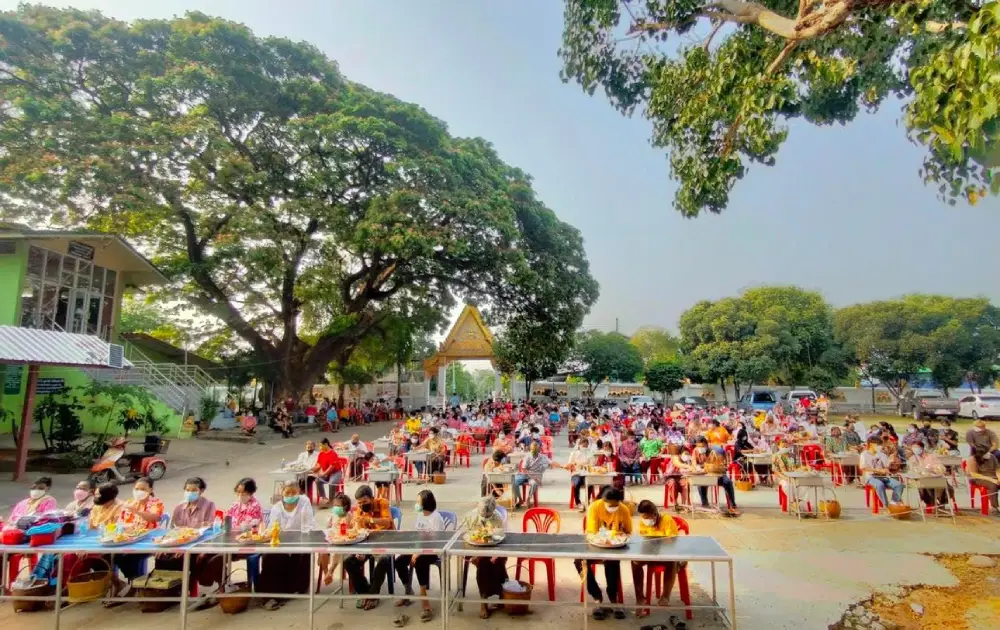
Wat Si Maha Pho
Open Days: Daily
Opening Hours: 08.00 – 17.00
Wat Si Maha Pho in Moo 5, Talat Raeng Subdistrict, Ban Khwao District, Chaiyaphum Province, is an important local Buddhist temple of Ban Lup Pho with a long history and a continuing role in the life of the community. Founded in 1921 and granted Wisungkhamsima on November 21, 1989, the temple serves as a spiritual center for local people, a place for Buddhist ceremonies, a pre-primary child training center within the temple, a meditation center, a place for moral and ethical training, and an ecclesiastical office for Ban Khwao District. For foreign travelers interested in authentic local Buddhism in Northeastern Thailand, Wat Si Maha Pho offers a meaningful view of how a village temple can support faith, education, community life, and Buddhist administration at the same time.
The importance of Wat Si Maha Pho begins with its long connection to the people of Talat Raeng Subdistrict. The temple was established in 1921, during a time when rural temples in Northeastern Thailand were still the main spiritual and public centers of village life. A temple was not only a place for worship. It was also a place for sermons, merit-making, ceremonies, traditional festivals, community gatherings, education, and moral guidance. Wat Si Maha Pho grew from this social and religious context and has remained closely connected with Ban Lup Pho for more than a century.
The granting of Wisungkhamsima on November 21, 1989 was an important milestone in the temple’s religious development. In Thai Buddhism, Wisungkhamsima refers to the officially designated sacred boundary used for important monastic acts, especially ordination and formal Sangha ceremonies. This status strengthened Wat Si Maha Pho as a complete religious site and allowed it to support Buddhist ceremonies, ordination-related functions, and community merit-making events in a proper and recognized way.
The name “Si Maha Pho” carries a graceful Buddhist meaning. “Si” suggests auspiciousness, dignity, and prosperity, while “Maha Pho” evokes the sacred Bodhi tree associated with the enlightenment of the Buddha. The name therefore suggests a place of wisdom, spiritual clarity, and auspicious faith. For visitors, the name itself reflects the temple’s identity as a place of calm, moral learning, and community devotion.
Wat Si Maha Pho is located in Ban Lup Pho, Moo 5, Talat Raeng Subdistrict, Ban Khwao District, Chaiyaphum Province, near the Chaiyaphum–Ban Khwao route. Its location allows convenient travel to Ban Khwao town, Ku Daeng, Ban Khwao silk attractions, and Chaiyaphum city. The temple stands within a rural community setting where the relationship between home, temple, and daily life remains strong. Visiting the temple gives travelers a real view of a functioning Isan village temple rather than a site separated from local life.
Wat Si Maha Pho is a local Buddhist temple with resident monks and active community activities. Current temple activity information records 7 resident monks, and the abbot is Phra Khru Sangharak Somchai Somachitto. The abbot plays an important role in caring for the temple, guiding Buddhist activities, coordinating with lay supporters, preserving temple order, and maintaining the continuity of local traditions. A temple with several social and religious roles depends on steady monastic leadership and close cooperation with the community.
One of the temple’s distinctive roles is its function as an ecclesiastical office for Ban Khwao District. This gives Wat Si Maha Pho a broader importance beyond the village level. Ban Khwao District has many temples spread across several subdistricts and villages, so an ecclesiastical working space helps support Buddhist coordination, monastic administration, and religious activities at the district level. Wat Si Maha Pho therefore has significance not only for Ban Lup Pho, but also for the wider Buddhist network of Ban Khwao District.
Another important role of Wat Si Maha Pho is the pre-primary child training center located within the temple. This reflects the traditional and continuing role of Thai temples as community learning spaces. Young children grow up in an environment connected with calmness, respect, discipline, and local culture. The temple is therefore not only a place for adults or elderly devotees. It is also part of the early development environment for children in the community.
A child training center within a temple shows how religious space can support social development. The temple is a trusted and familiar place for local families. It connects children, parents, monks, teachers, and the wider community. Children learn basic manners, social discipline, respect, and cultural values within a setting shaped by Buddhist principles. This makes Wat Si Maha Pho valuable not only as a religious site, but also as a community institution that supports the growth of younger generations.
Wat Si Maha Pho also functions as a meditation center and a place for moral and ethical training. This role allows local people and visitors to practice mindfulness, listen to Dhamma teachings, chant, meditate, and reflect on principles that can be applied in daily life. Meditation practice at a village temple may be simple and informal, but it can be deeply meaningful. It helps people return to calmness, generosity, gratitude, discipline, and self-awareness.
Moral and ethical training is especially important in a community context. Through temple activities, people learn honesty, responsibility, respect for elders, gratitude, generosity, and cooperation. Wat Si Maha Pho gives local people a space to return to these values through Buddhist practice, merit-making, sermons, and community participation. This is one reason why the temple continues to be relevant in contemporary community life.
The temple supports many Buddhist activities throughout the year. These include merit-making, food offerings to monks, sermons, chanting, candlelight processions, Kathin ceremonies, forest robe offerings, Makha Bucha Day, Visakha Bucha Day, Asalha Bucha Day, Buddhist Lent, and the end of Buddhist Lent. These events keep the temple active and make Buddhism visible through shared action. For local residents, the temple is where faith becomes part of everyday and seasonal life.
The communal Kathin ceremony is one of the most important annual events connected with the temple. It takes place after the Buddhist Lent period and requires cooperation among monks, villagers, supporters, and coordinators. Kathin is not only a robe-offering ceremony. It is also a community event that brings people together to support the temple, prepare food, organize the grounds, welcome guests, and renew the relationship between the temple and lay supporters. This shows the continuing strength of community faith at Wat Si Maha Pho.
The temple compound can be understood through its main functional areas. These include the ordination hall or sacred monastic ceremony area, the temple hall or sermon hall for merit-making and community activities, the temple courtyard for festivals and gatherings, the pre-primary child training center, the meditation center, the moral and ethical training area, the ecclesiastical office area, and the monks’ residence area. These areas allow the temple to support religious, educational, social, cultural, and administrative functions in one place.
The ordination hall is the most important area for formal monastic activities. It is connected with the Wisungkhamsima boundary and should be treated with special respect. Visitors should begin by paying respect to the Buddha image, calming the mind, and observing the space quietly. The temple hall or sermon hall is a familiar community area used for sermons, merit-making, meetings, and Buddhist activities. In many village temples, this hall is the heart of daily interaction between monks and laypeople.
The temple courtyard is a flexible community space. It supports annual ceremonies, merit-making events, gatherings, and local activities. During major Buddhist or community events, the courtyard becomes a place where villagers work together, prepare offerings, cook food, welcome guests, and organize the event. This space is therefore more than an open area; it is a living social space that reflects cooperation and community identity.
Talat Raeng Subdistrict has several temples across its villages, including Wat Ku Daeng, Wat Khlong Phai Lom, Wat Pa Rerai, Wat Maha Khongkha, and Wat Si Maha Pho. This pattern reflects the traditional structure of rural Isan communities, where each village has its own temple as a spiritual center. Wat Si Maha Pho is part of this wider sacred landscape and helps visitors understand how Buddhism is organized across local communities in Ban Khwao District.
Wat Si Maha Pho can also be included in a cultural travel route around Ban Khwao District. One important nearby destination is Ku Daeng at Wat Kut Yang, an archaeological site associated with ancient Khmer culture in the upper Chi River basin. Visiting Ku Daeng together with Wat Si Maha Pho allows travelers to see different layers of local sacred history, from ancient cultural remains to a living village temple that continues to serve the Buddhist community today.
Ban Khwao District is also well known for silk weaving, especially mudmee silk. Travelers visiting Wat Si Maha Pho can continue to Ban Khwao Silk Promotion Center and Ban Khwao Silk Village to learn about mulberry cultivation, sericulture, silk reeling, dyeing, pattern making, and weaving. This route connects Buddhism, local education, craft knowledge, community economy, and cultural identity in one meaningful journey.
A practical half-day itinerary can begin at Wat Si Maha Pho in the morning. Visitors can spend about 45 minutes to 1 hour paying respect, walking quietly, and learning about the temple’s community roles. After that, they can continue to Ku Daeng at Wat Kut Yang, then head to Ban Khwao town for the silk promotion center, silk village, a café, or a local restaurant. Travelers with more time can continue to Chaiyaphum city for Phraya Phakdi Chumphon Monument, Prang Ku Chaiyaphum, or an overnight stay.
Getting There is convenient by private car, motorcycle, rental car, or local hired vehicle. From Chaiyaphum city, travel toward Ban Khwao District and continue into Talat Raeng Subdistrict and Ban Lup Pho. The GPS coordinates 15.797335, 101.869879 can be used for navigation. Travelers should search for “Wat Si Maha Pho Ban Lup Pho Talat Raeng Ban Khwao Chaiyaphum” rather than only “Wat Si Maha Pho,” because temples with the same name exist in other areas. Checking the village, subdistrict, district, and province before departure helps avoid confusion.
Travelers starting from Ban Khwao town will have a shorter journey and can easily combine the temple with silk-related attractions and local restaurants. Those traveling from Chaiyaphum city should allow extra time, especially if planning to visit several sites in Talat Raeng Subdistrict. Roads around the area are local community roads, so careful driving is recommended, particularly during the rainy season or on days when the temple hosts community events.
The best time to visit is in the morning or late afternoon, when the weather is more comfortable and the temple atmosphere is calm. On Buddhist holy days, major Buddhist festivals, or community merit-making events, the temple may be busier than usual. Visitors should remain respectful, dress modestly, avoid disturbing ceremonies, and take photographs only in appropriate areas. Photography should not interfere with monks, children, local residents, or religious activities.
Proper temple etiquette is important at Wat Si Maha Pho. Visitors should wear modest clothing, avoid sleeveless shirts and overly short clothing, remove shoes where required, speak softly, avoid littering, and avoid touching sacred objects unnecessarily. They should also avoid entering monks’ residence areas, office spaces, or child training areas without permission. These manners are especially important at a temple with multiple community functions because the space is both sacred and actively used by monks, children, residents, and Buddhist administrators.
Wat Si Maha Pho is suitable for several types of travelers. Buddhist visitors can come to make merit and pay respect. Cultural travelers can study the role of a village temple in rural Chaiyaphum. Visitors interested in community education can learn about the child training center and moral training role of the temple. Travelers interested in local culture can combine the temple with Ku Daeng and Ban Khwao silk attractions. The temple is therefore a useful starting point for a deeper cultural route in Ban Khwao District.
From a community perspective, Wat Si Maha Pho is more than a place for ceremonies. It preserves memories of several generations. Elderly residents may remember attending temple events here as children, working adults may return for annual merit-making, young children may pass through the temple’s training center, and local people continue to learn respect, generosity, gratitude, and cooperation through temple activities. The temple therefore works as a living cultural space that connects many stages of life.
The appeal of Wat Si Maha Pho lies in its combination of roles. It is an old local temple, a spiritual center, a meditation center, a place for moral and ethical training, a child training center, and an ecclesiastical office for Ban Khwao District. These roles make the temple more than a place for occasional ceremonies. It is a social, educational, cultural, and religious center for the people of Ban Lup Pho and the wider Ban Khwao area.
Overall, Wat Si Maha Pho is an important Buddhist temple of Ban Lup Pho in Talat Raeng Subdistrict. Founded in 1921 and granted Wisungkhamsima in 1989, it continues to support Buddhist ceremonies, meditation practice, moral training, child development, local traditions, and community unity. A visit here is not only about seeing a temple; it is about understanding how a Thai village temple continues to support faith, learning, culture, and daily life in Chaiyaphum Province.
| Name | Wat Si Maha Pho |
| Location | Ban Lup Pho, Moo 5, Talat Raeng Subdistrict, Ban Khwao District, Chaiyaphum Province |
| Address | Moo 5, Ban Lup Pho, Talat Raeng Subdistrict, Ban Khwao District, Chaiyaphum Province 36170, Thailand |
| Coordinates | 15.797335, 101.869879 |
| Temple Type | Local Buddhist Temple |
| Highlights | An old local temple of Ban Lup Pho, founded in 1921, serving as a spiritual center, pre-primary child training center, meditation center, moral and ethical training space, and ecclesiastical office for Ban Khwao District |
| History / Period | Founded in 1921 and granted Wisungkhamsima on November 21, 1989 |
| Name Origin | The name suggests auspiciousness and the Buddhist symbolism of the Bodhi tree, representing wisdom, spiritual clarity, and community faith |
| Main Areas / Zones | Ordination Hall or sacred area for monastic ceremonies Temple hall / sermon hall Temple courtyard for community activities and merit-making events Pre-primary child training center within the temple Meditation center Moral and ethical training area Ecclesiastical office for Ban Khwao District Monks’ residence area |
| Abbot / Caretaker | Phra Khru Sangharak Somchai Somachitto |
| Resident Monks | 7 monks |
| Community Role | A spiritual center for local people, a place for Buddhist ceremonies, a pre-primary child training center, a meditation center, a moral and ethical training space, and an ecclesiastical office for Ban Khwao District |
| Traditions / Main Activities | Communal Kathin ceremonies, forest robe offerings, Buddhist holy days, Makha Bucha Day, Visakha Bucha Day, Asalha Bucha Day, Buddhist Lent, the end of Buddhist Lent, moral and ethical training, and local merit-making events |
| Travel Information | Travel from Chaiyaphum city or Ban Khwao District into Talat Raeng Subdistrict and Ban Lup Pho. Use the coordinates 15.797335, 101.869879 or search with Ban Lup Pho, Talat Raeng, Ban Khwao, and Chaiyaphum to avoid confusion with temples of the same name |
| Current Status | Open for worship, merit-making, meditation practice, moral training, and Buddhist community activities |
| Open Days | Daily |
| Opening Hours | 08.00 – 17.00 |
| Contact Number | 091-065-3023 |
| Facilities | Temple courtyard, temple hall, pre-primary child training area, meditation area, and space for Buddhist community activities |
| Nearby Tourist Attractions | 1. Ku Daeng at Wat Kut Yang, Talat Raeng Subdistrict, about 4 km 2. Wat Khlong Phai Lom, Ban Kut Phai, about 4 km 3. Wat Pa Rerai (Talat Raeng), about 4 km 4. Wat Maha Khongkha, Ban Kut Hu Ling, about 6 km 5. Ban Khwao Silk Promotion Center, about 9 km 6. Ban Khwao Silk Village, about 9 km 7. Wat Khok Sawang, Chee Bon Subdistrict, about 13 km 8. Phraya Phakdi Chumphon Monument, about 32 km 9. Prang Ku Chaiyaphum, about 33 km |
| Nearby Restaurants | 1. Baan Mulan Cafe, about 9 km, Tel. 090-924-5525 2. Baan Rak Na Restaurant, Ban Khwao, about 9 km, Tel. 087-879-7694, 089-424-8003 3. THE MOUSSE Cafe Ban Khwao, about 9 km 4. Jungle Cafe Ban Khwao Chaiyaphum, about 10 km 5. De Nua Ban Khwao, about 10 km 6. MATA Cuisine Chaiyaphum, about 34 km, Tel. 093-448-2999 |
| Nearby Accommodations | 1. Ban Khwao Resort, about 9 km, Tel. 087-201-4009 2. Phumisap Resort, about 9 km, Tel. 081-790-7747, 085-308-8355 3. HOP INN Chaiyaphum, about 33 km, Tel. 065-950-4681 4. Lertnimit Hotel Chaiyaphum, about 34 km, Tel. 044-811-522, 080-165-9494 5. Siam River Resort, about 34 km, Tel. 044-811-999 |
Frequently Asked Questions (FAQ)
Q: Where is Wat Si Maha Pho located?
A: Wat Si Maha Pho is located in Ban Lup Pho, Moo 5, Talat Raeng Subdistrict, Ban Khwao District, Chaiyaphum Province.
Q: When was Wat Si Maha Pho founded?
A: Wat Si Maha Pho was founded in 1921 and received Wisungkhamsima on November 21, 1989.
Q: Why is Wat Si Maha Pho important?
A: It is a spiritual center for local people, a place for Buddhist ceremonies, a pre-primary child training center, a meditation center, a moral and ethical training space, and an ecclesiastical office for Ban Khwao District.
Q: Who is the abbot of Wat Si Maha Pho?
A: The abbot of Wat Si Maha Pho is Phra Khru Sangharak Somchai Somachitto.
Q: What are the opening days and hours of Wat Si Maha Pho?
A: Wat Si Maha Pho is open daily from 08.00 to 17.00.
Q: How can travelers get to Wat Si Maha Pho?
A: Travelers can drive from Chaiyaphum city or Ban Khwao District into Talat Raeng Subdistrict and Ban Lup Pho. The GPS coordinates 15.797335, 101.869879 can be used for navigation.
Q: What nearby attractions can be visited with Wat Si Maha Pho?
A: Nearby attractions include Ku Daeng at Wat Kut Yang, Wat Khlong Phai Lom, Wat Pa Rerai, Wat Maha Khongkha, Ban Khwao Silk Promotion Center, Ban Khwao Silk Village, Phraya Phakdi Chumphon Monument, and Prang Ku Chaiyaphum.
Q: Who is Wat Si Maha Pho suitable for?
A: The temple is suitable for visitors who want to make merit, practice meditation, experience a local village temple, learn about Buddhist moral training, and explore a cultural route around Ban Khwao District.
 Category: ●Places of Worship
 Group: ●Temple
Last Update : 3 MonthAgo
 Last Update : 3 MonthAgo
 Click to Access the Navigation Map GPS
 Art, Culture and Heritage
 Historical Sites and Monuments(1)
 Landmarks and Memorials(3)
 Royal Palace(1)
 Art, Craft Centres, Tradition(3)
 Educational Places
 Educational Gardens, Farm(1)
Temple(141)
Educational Gardens, Farm(1)
Temple(141)
 Other Sacred Sites(7)
 Suburban Living
 Village, Community(4)
 Nature and Wildlife
 National Parks and Marine Reserves(7)
 Mountain (Doi)(5)
 Dam, Reservoir, Lake(10)
 Waterfalls(15)
 Caves(5)
 River, Canal(4)
 Other natural attractions(1)
 Entertainment and Agricultural
 Farms, Parks and Ecotourism(2)


