
lovethailand home >Northeastern Travel Attractions >Chaiyaphum Travel Attractions >Noen Sanga >Ta Noen > Wat Bueng Boriboon
TL;DR: Wat Bueng Boriboon is located at Ta Noen Subdistrict, Noen Sa-nga District, Chaiyaphum Province, open Daily, hours 06.00 – 18.00 (recommended visiting hours for merit-making and temple visits).
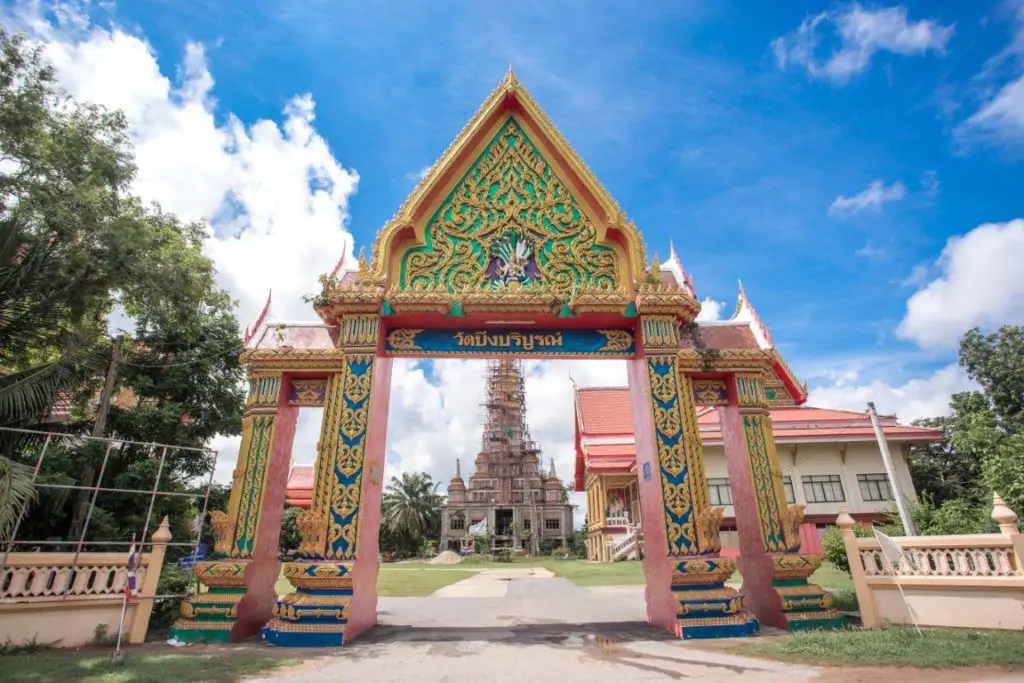
Wat Bueng Boriboon
Open Days: Daily
Opening Hours: 06.00 – 18.00 (recommended visiting hours for merit-making and temple visits)
Wat Bueng Boriboon in Ta Noen Subdistrict, Noen Sa-nga District, Chaiyaphum Province, is a long-established community Buddhist temple with a history dating back to 1912. The temple received its royal boundary for monastic rites on 13 May 1985 and continues to serve as a religious, cultural, and spiritual center for monks, local Buddhist devotees, villagers, and visitors. It is a place for merit-making, Buddhist ceremonies, meditation, local traditions, and community gatherings.
For international travelers who want to understand Chaiyaphum beyond major natural attractions, Wat Bueng Boriboon offers a quiet and authentic view of rural Buddhist life in northeastern Thailand. This is not a large commercial tourist temple, but a living community temple deeply connected with the people of Ban Ta Noen. Its value lies in its origin near a fertile pond, its long history, its continuing role in local merit-making, and its annual Bun Duean Sam tradition, which brings the community together through Buddhist faith and cultural memory.
Ta Noen Subdistrict is a rural community area in Chaiyaphum where the relationship between temple, village, and local life remains strong. Wat Bueng Boriboon is located in Moo 1, Ta Noen Subdistrict, Noen Sa-nga District, Chaiyaphum 36130. The surrounding area includes village roads, community spaces, and the pond that gave the temple its name. The temple is therefore not separated from daily life; it is part of the social and spiritual structure of the community, where people come to make merit, join ceremonies, meet neighbors, and preserve local customs.
The history of Wat Bueng Boriboon began in 1912. Nai Nak and Phra Achan Yang Hanwichachai were important figures in the early establishment of the temple. They requested land from Luang Thanarat near a large natural pond surrounded by bamboo groves. The area had previously been associated with royal elephant grazing before the temple was founded. The first structure was a simple monastic shelter, created so that monks could stay there and villagers could have a place to make merit. This beginning reflects the way many rural temples in Thailand grew from local faith, practical need, and community cooperation.
The name “Bueng Boriboon” is closely tied to the natural pond near the temple. In Thai, “bueng” means a pond or marsh, while “boriboon” suggests fullness, abundance, and completeness. The pond was known for being fertile and not drying easily, so local people called it Bueng Boriboon. When the temple was established nearby, the same name was adopted for the temple. The name therefore preserves both the physical landscape and the community’s memory of water, fertility, and rural life in the area.
The granting of the royal boundary for monastic rites on 13 May 1985 marked an important milestone in the temple’s development. In Thai Buddhism, this boundary allows the ordination hall to be used for important monastic acts in accordance with Buddhist discipline. Wat Bueng Boriboon’s boundary measures 7 meters wide and 20.75 meters long, while the temple compound covers 6 rai, 3 ngan, and 20 square wah. These details show that the temple developed from a local monastic shelter into a recognized Buddhist temple serving the religious needs of the community.
Wat Bueng Boriboon is a privately supported community temple under the Mahanikaya order. As a community temple, it is closely linked with local people rather than with large-scale tourism. It functions as a place for Buddhist ceremonies, moral learning, merit-making, annual festivals, meditation, and spiritual support. The temple’s importance should not be measured only by its size or architecture, but by the role it plays in sustaining faith, social bonds, and cultural continuity within Ban Ta Noen.
The boundaries of the temple also reflect its relationship with the surrounding landscape. To the north, it connects with the public road between Ta Noen and Cho Raka. To the south and east, it borders Bueng Boriboon pond. To the west, it connects with the community market area of Ban Noen Sombun. This location places the temple between a road, a water source, and a village area, making it a natural center of movement, livelihood, and religious life. Visitors can sense how the temple is embedded in the geography and daily rhythm of the local community.
Several buildings and permanent structures inside the temple show how it developed over time. The original ordination hall was built in 1927. Two monks’ residences were built in 1945 and 1953. The sermon hall was built in 1950. The bell tower was built in 1957, the entrance arch in 1971, the kitchen and boundary wall in 1999, and the restrooms in 2009. These gradual additions demonstrate how the temple expanded according to the needs of monks, devotees, and community activities over many decades.
The ordination hall is one of the most important sacred spaces in the temple. It is used for monastic ceremonies and houses the principal Buddha image, where devotees pay respect and calm their minds. For visitors, this is the best place to begin a temple visit. Paying respect to the Buddha image helps create a mindful and respectful atmosphere before exploring the rest of the compound. The ordination hall also represents the temple’s full religious status after receiving its royal boundary.
The sermon hall, built in 1950, is another central part of Wat Bueng Boriboon. In rural Thai temples, a sermon hall is more than a building. It is a shared space for listening to Dhamma talks, making merit, hosting village activities, gathering during festivals, and sharing meals after religious ceremonies. At Wat Bueng Boriboon, the sermon hall connects monks and laypeople in a practical and meaningful way, allowing Buddhist practice and community life to come together naturally.
The monks’ residences and the abbot’s residence are essential to the living monastic side of the temple. They allow monks to reside at the temple, perform daily chanting, observe Buddhist discipline, study Dhamma, and support villagers during important ceremonies. The fact that monks’ residences were built in the mid-20th century shows that the local community continued to support the temple long after its founding. A temple with resident monks can remain active throughout the year, not only during major festivals.
Other structures such as the bell tower, entrance arch, kitchen, boundary wall, and restrooms are practical but meaningful features. The bell tower symbolizes the rhythm of temple life and the sound of Buddhist practice. The entrance arch marks the transition from ordinary village space into the temple compound. The kitchen is especially important during merit-making festivals, when food is prepared for monks and participants. Restrooms and boundary walls help the temple accommodate visitors and organize activities more comfortably.
Chedi Si Noen Sa-nga is another important feature within the temple grounds. In Thai Buddhism, a chedi often represents reverence, remembrance, and spiritual aspiration. At Wat Bueng Boriboon, the chedi adds a quiet sacred focus to the temple compound. Visitors can pause here, pay respect, and reflect on the teachings of Buddhism. Although the temple is modest and community-based, the chedi gives the space a distinct spiritual presence.
Wat Bueng Boriboon also serves as a place for Buddhist practice. In a rural community temple, spiritual practice is not limited to formal meditation retreats. It includes chanting, observing precepts, listening to sermons, offering food to monks, helping with temple work, and practicing generosity. Through these everyday activities, the temple becomes a living school of Buddhist values. Elders find peace and familiarity here, working adults find a place to renew their minds, and younger generations learn manners, respect, and community responsibility through participation.
One of the most important traditions associated with Wat Bueng Boriboon is Bun Duean Sam, the third lunar month merit-making festival. This annual community event includes paying homage and applying gold leaf to a replica of the Buddha’s footprint. The tradition has both religious and cultural meaning. It allows villagers to make merit together, honor the Buddha, gather with relatives and neighbors, and pass on local customs to younger generations. The festival shows that the temple remains a living center of culture, not merely a historical site.
Applying gold leaf to a replica of the Buddha’s footprint carries deep symbolic meaning in Thai Buddhism. The Buddha’s footprint represents the path of the Buddha and the Dhamma that followers aspire to follow. By applying gold leaf, devotees express reverence, gratitude, and a wish for spiritual blessing. During Bun Duean Sam, this act becomes both personal and communal. It allows individuals to make merit while also reinforcing the shared identity of the village.
The Bun Duean Sam festival is also important as a form of cultural transmission. Traditions survive not only through ritual, but through participation. When elders, children, local schools, community leaders, and villagers gather at the temple to help prepare the event, cook food, organize the area, join ceremonies, and welcome visitors, the tradition becomes a living classroom. Young people learn by watching and helping. They see how religion, cooperation, and local identity are connected within the temple space.
In addition to Bun Duean Sam, Wat Bueng Boriboon hosts regular Buddhist activities such as merit-making on Buddhist holy days, food offerings, Dhamma listening, robe-offering ceremonies, Kathin, and observances on important Buddhist dates. These activities keep the temple active throughout the year. For local people, the temple is not a place visited only once a year; it is a recurring part of religious and social life.
The administrative history of the temple includes many monks who helped maintain and guide Wat Bueng Boriboon across different periods. Phra Achan Yang Hanwichachai was important from the founding period, followed by other monks who carried on the temple’s religious role. In the present period, Phra Khru Atthathamkoson serves as the abbot of Wat Bueng Boriboon and is an important senior monk in Noen Sa-nga District. The continuity of monastic leadership is one reason the temple remains active and meaningful to the community.
The abbot’s role in a rural Thai temple is broader than building management. He is a religious leader, a ceremonial guide, a spiritual adviser, and a coordinator of community faith. At Wat Bueng Boriboon, Phra Khru Atthathamkoson helps sustain Buddhist activities, temple traditions, and community trust. A temple like this depends not only on buildings, but on the relationship between monks and villagers. This relationship allows the temple to remain a living center of faith rather than a static monument.
For cultural travelers, the appeal of Wat Bueng Boriboon lies in its authenticity. This is a real community temple used by local people. Visitors will not find the atmosphere of a major tourist attraction, but they will find a calm and sincere religious environment. The temple offers a chance to understand how Buddhism functions at the village level in northeastern Thailand. It shows how a temple can support ceremonies, community memories, annual festivals, and everyday spiritual life at the same time.
The atmosphere inside the temple is suitable for quiet worship and respectful walking. Visitors should begin by paying respect to the principal Buddha image in the ordination hall. If monks or villagers are engaged in ceremonies, visitors should observe respectfully from a distance and avoid disturbing them. Because the temple is still actively used by the local community, travelers should avoid loud behavior, inappropriate photography, climbing on structures, or interrupting religious activities.
Modest dress is recommended when visiting Wat Bueng Boriboon. Shirts should cover the shoulders, and trousers or skirts should be appropriate for a religious site. Shoes should be removed before entering sacred buildings such as the ordination hall. Photography should be done with care, especially during ceremonies or when monks and worshippers are present. Respectful behavior helps preserve the dignity of the temple and makes the visit more meaningful.
Getting There is most convenient by private car. Travelers can drive to Ta Noen Subdistrict in Noen Sa-nga District, Chaiyaphum Province, and navigate to coordinates 15.5649111, 102.0238933 or map code H27F+XH6. Roads in the area pass through local communities and rural routes, so it is useful to plan ahead. During Bun Duean Sam, Kathin, or major Buddhist days, travelers should allow extra time for local traffic and parking near the temple.
The recommended visiting period is from morning to early evening, around 06.00 to 18.00. This time is suitable for merit-making, paying respect to the Buddha image, and walking quietly around the temple. Travelers who wish to join specific events such as Bun Duean Sam, Kathin, or other Buddhist ceremonies should check local schedules before traveling, because annual temple events may follow the lunar calendar and can vary from year to year.
A visit to Wat Bueng Boriboon can be combined with nearby attractions in Noen Sa-nga and Chatturat districts. Mae Fah Noen Sa-nga Water Park is close to the temple and suitable for families. The Red Lotus Field at Bueng Lahan in Chatturat District is a well-known natural attraction where visitors can enjoy lotus scenery and a large freshwater lake. Travelers with more time can continue toward Mueang Chaiyaphum District to visit Chao Pho Phraya Lae Monument and Prang Ku Chaiyaphum, creating a route that combines Buddhism, nature, history, and local culture.
Restaurants around Noen Sa-nga include local Isan food, som tam shops, jaew hon hot pot, small cafés, and community restaurants. Visitors can stop for lunch or dinner after making merit at the temple. Because many local restaurants may adjust their hours according to the day and customer flow, it is wise to check before visiting. Eating locally also supports the community economy and makes the trip more connected with the everyday life of the area.
Accommodation near Wat Bueng Boriboon is mostly in the form of small resorts and local lodging in Noen Sa-nga and nearby districts. These places are suitable for travelers who want to stay near local communities and explore Chaiyaphum at a relaxed pace. Visitors who prefer a wider range of hotels can also stay in Mueang Chaiyaphum District and visit the temple as a day trip. The choice depends on whether the traveler wants convenience, quietness, or access to more city services.
Wat Bueng Boriboon is also valuable as a local history learning site. Its story connects water resources, village settlement, Buddhist faith, changing administrative boundaries, and the gradual development of rural religious architecture. For travelers interested in local history, the temple helps explain how many northeastern Thai communities used temples as centers of order, memory, and cooperation. A temple is not only a place of ritual; it is also a framework through which community life is organized and remembered.
As a faith-based destination, Wat Bueng Boriboon is ideal for visitors who appreciate peaceful, community-rooted places. It is not a temple of spectacle, but a temple of continuity. Its value comes from its founding in 1912, its name linked to a fertile pond, its royal boundary granted in 1985, its annual Bun Duean Sam festival, and its continuing role under the care of its abbot and local devotees. These elements make it an important cultural and religious landmark of Ta Noen community.
For anyone exploring Chaiyaphum beyond mainstream tourist routes, Wat Bueng Boriboon offers a deeper understanding of the province. It reveals how a rural temple can preserve faith, support local traditions, connect generations, and remain meaningful for more than a century. A visit here is not only about seeing a temple; it is about encountering the quiet relationship between Buddhism, water, community, and everyday life in northeastern Thailand.
| Name | Wat Bueng Boriboon |
| Location | Ta Noen Subdistrict, Noen Sa-nga District, Chaiyaphum Province |
| Address | Moo 1, Ta Noen Subdistrict, Noen Sa-nga District, Chaiyaphum 36130, Thailand |
| Coordinates | 15.5649111, 102.0238933 / Map Code H27F+XH6 |
| Highlights | A historic community Buddhist temple in Ban Ta Noen, serving as a spiritual center, merit-making place, meditation site, and venue for local traditions |
| History | Founded in 1912 and granted its royal boundary for monastic rites on 13 May 1985 |
| Name Origin | Named after Bueng Boriboon, a fertile natural pond near the temple known for its abundance and lasting water |
| Distinctive Features | A rural Buddhist temple closely connected with a pond, local merit-making traditions, and the everyday life of Ban Ta Noen community |
| Temple Area | 6 rai, 3 ngan, and 20 square wah |
| Royal Boundary | 7 meters wide and 20.75 meters long |
| Boundaries | North: Ta Noen-Cho Raka public road; South: Bueng Boriboon pond; East: Bueng Boriboon pond; West: Ban Noen Sombun community market |
| Sacred Objects / Important Features | Ordination hall, principal Buddha image, sermon hall, monks’ residences, abbot’s residence, and Chedi Si Noen Sa-nga |
| Main Areas / Zones | Ordination hall, sermon hall, monks’ residences, abbot’s residence, bell tower, entrance arch, kitchen, restrooms, Chedi Si Noen Sa-nga, Bueng Boriboon pond area, and community activity area |
| Facilities | Sermon hall, kitchen, restrooms, and religious activity spaces |
| Traditions / Main Activities | Bun Duean Sam, homage and gold-leaf offering to the Buddha’s footprint replica, Buddhist holy day merit-making, robe-offering ceremonies, Kathin, and major Buddhist observances |
| Abbot / Caretaker | Phra Khru Atthathamkoson, Abbot of Wat Bueng Boriboon |
| Open Days | Daily |
| Opening Hours | 06.00 – 18.00 (recommended visiting hours for merit-making and temple visits) |
| Travel Information | Best reached by private car. Navigate to Ta Noen Subdistrict, Noen Sa-nga District, using coordinates 15.5649111, 102.0238933 or map code H27F+XH6 |
| Current Status | A community Buddhist temple in Ta Noen Subdistrict, Noen Sa-nga District, Chaiyaphum Province, still used for religious ceremonies, merit-making, and community activities |
| Local Administrative Contact | Ta Noen Subdistrict Administrative Organization, Tel. 044-056455 |
| Nearby Tourist Attractions | 1. Mae Fah Noen Sa-nga Water Park, about 2 km, Tel. 091-019-8292 2. Wat Sutthiwanaram, about 7 km 3. Red Lotus Field, Don La Nam, Bueng Lahan, Chatturat District, about 15 km, Tel. 044-812350 4. Wooden Bridge at Red Lotus Field, Bueng Lahan, Ban Makluea, about 20 km 5. Wat Pathum Chat, Chatturat District, about 22 km 6. Chao Pho Phraya Lae Monument, Mueang Chaiyaphum District, about 32 km 7. Prang Ku Chaiyaphum, Mueang Chaiyaphum District, about 33 km |
| Nearby Restaurants | 1. Justin Zaap Ban Ta Noen, about 2 km, Tel. 082-008-9777 2. Sara Yum Zaap, about 2 km, Tel. 080-026-8606 3. Pakasit Restaurant and Fishing Pond, about 9 km, Tel. 086-618-3338 4. Cho Kab Chin Jaew Hon, about 9 km, Tel. 096-019-2560 5. Coffee Cafe, about 9 km, Tel. 088-706-7406 6. Som Tam Nai Soi, about 10 km, Tel. 090-275-0035 7. Lang Lao Mala, about 18 km, Tel. 092-798-5284 |
| Nearby Accommodations | 1. Tawit Resort, about 3 km, Tel. 081-999-0893 2. Home Resort Noen Sa-nga, about 9 km, Tel. 084-388-6201 3. Noen Sa-nga Resort, about 12 km 4. Pawadee Resort, about 14 km, Tel. 080-170-0508, 044-899-299 5. Khotchasan Thong Resort, about 15 km, Tel. 044-800319, 081-876-9314, 081-878-9134 |
Frequently Asked Questions (FAQ)
Q: Where is Wat Bueng Boriboon located?
A: Wat Bueng Boriboon is located in Moo 1, Ta Noen Subdistrict, Noen Sa-nga District, Chaiyaphum Province, northeastern Thailand.
Q: When was Wat Bueng Boriboon founded?
A: The temple was founded in 1912 and received its royal boundary for monastic rites on 13 May 1985.
Q: What does the name Wat Bueng Boriboon mean?
A: The name comes from Bueng Boriboon, a fertile natural pond near the temple known for its abundance and lasting water.
Q: Who is the abbot of Wat Bueng Boriboon?
A: The abbot of Wat Bueng Boriboon is Phra Khru Atthathamkoson, an important senior monk in Noen Sa-nga District.
Q: What important local tradition is associated with Wat Bueng Boriboon?
A: The temple is associated with Bun Duean Sam, a third lunar month merit-making festival that includes paying homage and applying gold leaf to a replica of the Buddha’s footprint.
Q: What can visitors see inside Wat Bueng Boriboon?
A: Visitors can see the ordination hall, principal Buddha image, sermon hall, monks’ residences, abbot’s residence, bell tower, entrance arch, kitchen, restrooms, and Chedi Si Noen Sa-nga.
Q: How can travelers get to Wat Bueng Boriboon?
A: The temple is best reached by private car. Travelers can navigate to coordinates 15.5649111, 102.0238933 or use map code H27F+XH6.
Q: What nearby attractions can be combined with a visit?
A: Nearby places include Mae Fah Noen Sa-nga Water Park, Wat Sutthiwanaram, the Red Lotus Field at Bueng Lahan, Chao Pho Phraya Lae Monument, and Prang Ku Chaiyaphum.
 Category: ●Places of Worship
 Group: ●Temple
Last Update : 3 MonthAgo
 Last Update : 3 MonthAgo
 Click to Access the Navigation Map GPS
 Art, Culture and Heritage
 Historical Sites and Monuments(1)
 Landmarks and Memorials(3)
 Royal Palace(1)
 Art, Craft Centres, Tradition(3)
 Educational Places
 Educational Gardens, Farm(1)
Temple(141)
Educational Gardens, Farm(1)
Temple(141)
 Other Sacred Sites(7)
 Suburban Living
 Village, Community(4)
 Nature and Wildlife
 National Parks and Marine Reserves(7)
 Mountain (Doi)(5)
 Dam, Reservoir, Lake(10)
 Waterfalls(15)
 Caves(5)
 River, Canal(4)
 Other natural attractions(1)
 Entertainment and Agricultural
 Farms, Parks and Ecotourism(2)


