
lovethailand home >Northeastern Travel Attractions >Chaiyaphum Travel Attractions >Thep Sathit >Na Yang Klak > Wat Nam Lat
TL;DR: Wat Nam Lat is located at Ban Nam Lat, Moo 4, Na Yang Klak Subdistrict, Thep Sathit District, Chaiyaphum Province, open Daily, hours Daytime.

Wat Nam Lat
Open Days: Daily
Opening Hours: Daytime
Wat Nam Lat is located at Ban Nam Lat, Moo 4, Na Yang Klak Subdistrict, Thep Sathit District, Chaiyaphum Province. According to local temple history, the temple was established in 1940 and has long served as a religious, cultural, and spiritual center for the Ban Nam Lat community. It is a place where monks perform Buddhist duties, villagers make merit, local traditions are preserved, and people from the village and nearby areas gather for worship, meditation, and community activities.
For foreign travelers who want to understand Thai Buddhism beyond well-known tourist temples, Wat Nam Lat offers a sincere view of a rural community temple in northeastern Thailand. It is not a commercial tourist attraction. Its value comes from its active role in village life, its connection with local history, its simple religious buildings, and its relationship with the people of Ban Nam Lat. Visitors can come here to pay respect, make merit, observe local temple life, and understand how a Buddhist temple helps shape community identity.
Ban Nam Lat is a community in Na Yang Klak Subdistrict, Thep Sathit District. The village is known for the coexistence of several cultural groups, including Chaobon, Thai Lao, and Thai Korat people. These groups have different languages, customs, beliefs, clothing traditions, and rituals. Within this culturally diverse setting, Wat Nam Lat functions as a shared Buddhist space where people from different backgrounds can meet, make merit, join ceremonies, and maintain community harmony.
The name Nam Lat comes from the natural geography of the village. In the past, the area was known as Khok Nam Lat because the western side of the village was higher and gradually sloped down toward the east, where a flat rock area and stream were located. During the rainy season, rainwater flowed down from the higher ground across the rock surface and into the Nam Lat stream. This natural movement of water gave the village its name, and the temple name is directly connected with that landscape and community memory.
The relationship between Wat Nam Lat and the village is especially meaningful because, in the past, Ban Nam Lat did not have its own temple. Villagers had to walk about 5 kilometers to make merit at Wat Khok Sa-at. In earlier times, when roads and transportation were not convenient, this distance mattered greatly. The creation of a temple within Ban Nam Lat made Buddhist practice much more accessible to villagers and allowed local ceremonies, merit-making, and community gatherings to take place closer to home.
Community records describe that a monk from Udon Thani, Phra Achan Ui, came to Ban Nam Lat and encouraged villagers to build a temple pavilion. After Phra Achan Ui passed away, Phra Achan Bunliang Dhammachiro appeared in community records as the abbot of Wat Ban Nam Lat in 1983. Over time, the temple gradually developed from a local pavilion built through faith and cooperation into a functioning Buddhist temple used by monks and villagers throughout the year.
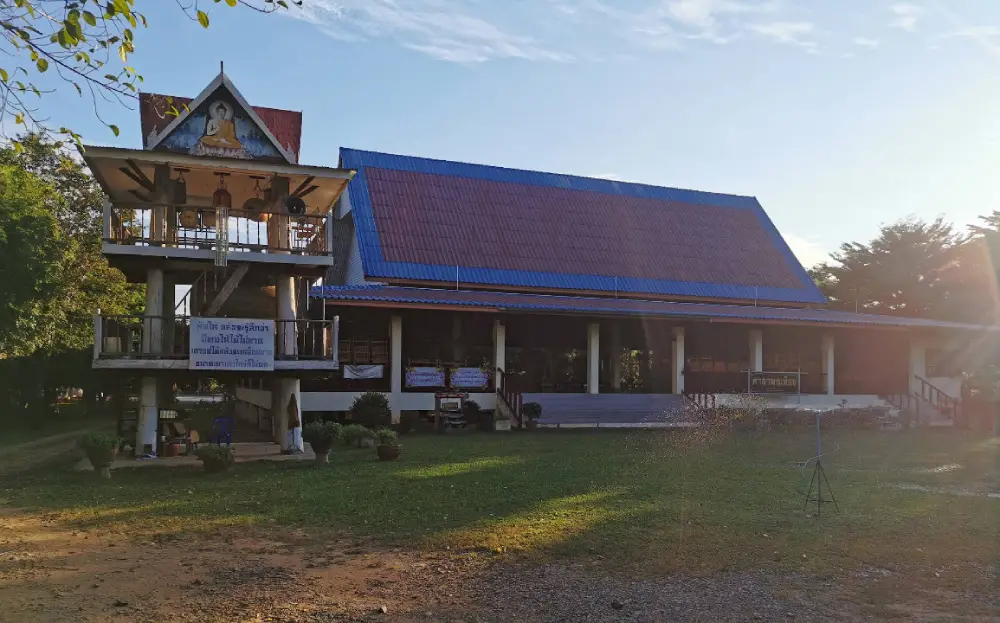
Important structures within Wat Nam Lat include a temple pavilion, a bell tower, monks’ residences, and a sim nam, or water-surrounded ordination-style structure. The pavilion supports merit-making, chanting, Dhamma listening, and community gatherings. The bell tower is a familiar symbol of temple life. The monks’ residences support the monks who live and practice in the temple. The sim nam is especially interesting because it reflects both local Buddhist faith and community craftsmanship.
The sim nam at Wat Nam Lat is a distinctive feature of the temple. It is built in the middle of a pond, creating a sacred space separated gently from the ordinary ground by water. This setting gives the structure a calm and contemplative atmosphere. The construction of the sim also reflects the cooperation of monks and villagers, who helped gather materials and contribute labor. For travelers interested in local Buddhist architecture, this feature shows how community faith can create a sacred structure that belongs deeply to its environment.
The bell tower represents another meaningful part of the temple. In Thai Buddhist culture, a bell is not only used to mark time. Its sound reminds people of mindfulness, impermanence, and the need to return to calmness. In a rural community, the bell can also call villagers to gather for religious activities, merit-making, or important temple events. The bell tower at Wat Nam Lat therefore connects sound, faith, and community rhythm.
The monks’ residences are essential to the temple’s living religious role. Resident monks chant, study Buddhist discipline, perform daily duties, receive invitations from villagers, and guide the community spiritually. Community information records that Wat Ban Nam Lat has nine monks in residence. The presence of monks means that the temple remains active, not merely as a historical place, but as a living Buddhist institution that continues to serve local people.
Wat Nam Lat serves as a center for Buddhist activities in the village. On Buddhist holy days, villagers can offer food to monks, observe precepts, listen to Dhamma, and chant together. On major Buddhist occasions such as Makha Bucha, Visakha Bucha, Asalha Bucha, the beginning and end of the Rains Retreat, Kathin, and Pha Pa ceremonies, the temple becomes a shared space for families, elders, youth, monks, and lay devotees.
Kathin and Pha Pa ceremonies are especially important in local temple life because they bring the community together to support the temple. Villagers help prepare food, organize the ceremony, welcome guests, make donations, and maintain temple buildings. These activities are not only acts of religious giving. They also strengthen social ties and allow people who have moved away to return to the village and reconnect with family, faith, and community memory.
As a place for meditation and spiritual rest, Wat Nam Lat is suitable for visitors who want a quiet rural temple atmosphere. It is not crowded like major tourist destinations, and its simplicity allows visitors to focus on prayer, chanting, reflection, and calmness. Many rural Thai temples are meaningful because spiritual practice remains close to daily life. Wat Nam Lat shows this clearly: Dhamma practice is not separated from the community, but woven into ordinary village rhythms.
The temple also plays a role in connecting different cultural groups in Ban Nam Lat. Because Chaobon, Thai Lao, and Thai Korat residents have different backgrounds and traditions, a shared Buddhist temple helps create common ground. Through merit-making, funerals, memorial ceremonies, Buddhist holy days, and village events, the temple allows different groups to participate in shared rituals. This role makes Wat Nam Lat important not only religiously, but also socially and culturally.
Rituals connected with life and death show the temple’s role even more clearly. In the past, different ethnic groups in the village may have had different ways of dealing with death and ancestral beliefs. As the village temple became more central, many rituals gradually adapted and became shared community practices. The temple therefore helped reduce separation between groups and created a place where villagers could mourn, remember, and make merit together.
The landscape around Ban Nam Lat is closely connected with water, stone, forest, and local livelihood. The Nam Lat stream, sloping ground, rock surfaces, and water sources have shaped how people live in the area. Water is important for daily use, agriculture, animals, and the community environment. The name Nam Lat therefore records both geography and memory. A visit to the temple gives travelers a way to understand how place names, landscapes, and Buddhist community life are connected.
Near the temple area, Ban Nam Lat Waterfall is an important local natural attraction. Because it is located in Moo 4, Na Yang Klak Subdistrict, it can be visited together with Wat Nam Lat in the same route. Travelers can pay respect at the temple, observe the community atmosphere, and continue to the waterfall for a nature stop. This combination is especially pleasant during the rainy season and early cool season, when streams, trees, and surrounding landscapes become fresher.
Ban Nam Lat Waterfall also helps visitors understand the origin of the village name. The flow of water across stone and natural ground reflects the same landscape character that gave Nam Lat its identity. Visiting the temple and the waterfall together provides both spiritual and environmental context. This is a good route for travelers who prefer quiet local experiences rather than crowded commercial attractions.
Other nearby places in Na Yang Klak Subdistrict include Wat Phra Phutthabat Khao Yai Hom, Chom Nang Waterfall, Ban Khok Sa-at, Ban Na Yang Klak, and routes toward Pa Hin Ngam National Park. These places allow travelers to experience religion, nature, village culture, and local history in one area. Wat Nam Lat can serve as a calm starting point for exploring this wider cultural and natural landscape.
Wat Phra Phutthabat Khao Yai Hom is an important nearby Buddhist site connected with the Buddha’s Footprint tradition. Travelers interested in a merit-making route can begin at Wat Nam Lat and continue to Wat Phra Phutthabat Khao Yai Hom to pay respect and experience another important layer of local faith. This combination helps foreign visitors understand that Na Yang Klak is not only a rural area, but also a landscape shaped by Buddhist devotion.
Chom Nang Waterfall at Ban Saliang Thong is another natural stop that can be combined with the temple visit. The Na Yang Klak area is linked with hills, streams, and rural forest landscapes. Visiting Wat Nam Lat together with waterfalls creates a balanced route: the temple offers faith and community meaning, while the waterfalls offer nature and quiet outdoor scenery. This kind of travel is best approached slowly and respectfully.
Travelers with more time can continue toward Pa Hin Ngam National Park, one of the most famous attractions in Thep Sathit District. The park is known for Siam tulip fields, Lan Hin Ngam rock formations, and Pha Sut Phaen Din viewpoint. However, the national park is farther from Ban Nam Lat than nearby community attractions, so visitors should plan enough time or stay overnight in Thep Sathit or near the park if they want a relaxed trip.
Ban Nam Lat itself is culturally interesting because of its ethnic diversity and local traditions. Chaobon traditions, local beliefs, Songkran customs, folk games, and ancestral practices have all contributed to the identity of the village. As Buddhism became more deeply connected with village life through Wat Nam Lat, older traditions and Buddhist practices gradually interacted. The temple therefore provides insight into cultural adaptation and shared community life.
The temple’s role as the spiritual center of Ban Nam Lat developed through long-term memory and repeated participation. Children grow up seeing parents and grandparents visit the temple. Elders use the temple for merit-making and Dhamma listening. Families gather there during important occasions. People who move away often return for ceremonies. Over time, the temple becomes both a sacred site and a shared memory space for the community.
Visitors from outside the area should see Wat Nam Lat as a living community temple, not a commercial check-in point. It may not have large tourist facilities or elaborate decoration, but it offers authenticity. Visitors can see a temple used by monks and villagers in ordinary life, with a pavilion, bell tower, monks’ residences, sim nam, and temple courtyard that support real community activities.
Proper temple etiquette is important. Visitors should dress modestly, covering shoulders and knees. Voices should be kept low, and visitors should avoid disturbing monks, villagers, or people who are praying or meditating. If a ceremony is taking place, it is best to observe respectfully from an appropriate distance unless invited to join. Photography should be done with dignity, especially around the pavilion, sim nam, and areas where monks or villagers are conducting religious activities.
Merit-making at Wat Nam Lat can include offering food to monks, offering basic supplies, donating to temple maintenance, joining Kathin or Pha Pa ceremonies, and supporting Buddhist community activities. In a local temple, even simple offerings can have practical value because they help maintain temple buildings, support resident monks, and allow the temple to continue serving villagers.
The best time to visit is from morning to afternoon, when travel is convenient and the temple atmosphere is suitable for paying respect. Those who want to experience local merit-making may visit on Buddhist holy days or during Kathin season after the Rains Retreat. Those who prefer a quiet visit should come on ordinary weekdays, when there are fewer activities and more opportunity for prayer, reflection, and peaceful observation.
Travelers should plan the route in advance because Na Yang Klak Subdistrict is some distance from central Thep Sathit, and local attractions are spread across different villages. A private car or rental car is the most convenient option. A practical route can include Wat Nam Lat, Ban Nam Lat Waterfall, Ban Na Yang Klak, Wat Phra Phutthabat Khao Yai Hom, and Chom Nang Waterfall, depending on available time.
Getting There is easiest by private car or rental car. Travelers should head toward Thep Sathit District in Chaiyaphum Province, continue to Na Yang Klak Subdistrict, and proceed to Ban Nam Lat, Moo 4. Searching for Wat Nam Lat, Ban Nam Lat, or using the community-area coordinates 15.71559, 101.45339 can help with navigation. Daytime travel is recommended because it is easier to see village roads, junctions, and the temple entrance clearly.
Nearby food options include local eateries in Ban Nam Lat and nearby villages, Jungle Cafe Na Yang Klak Branch, Krua Pa Wan at Ban Hua Saphan, Baan Suan Cafe & Camp, and Touch The Wind Restaurant. Opening hours may vary, especially for rural restaurants, so travelers should check directly before visiting. Simple local food is often the most practical choice when traveling through this part of Chaiyaphum.
For accommodation, visitors may stay in Thep Sathit District, near the Pa Hin Ngam route, or in nearby districts. Options include Baan Rai Ing Doi Resort, Rai Aeifoon Resort, Touch The Wind, and local accommodations around Thep Sathit and Pa Hin Ngam National Park. Staying overnight is useful for travelers who want to combine temples, waterfalls, village culture, and the national park without rushing.
Overall, Wat Nam Lat is a meaningful community temple that reflects the relationship between Buddhism, ethnic diversity, rural life, and natural landscape in Na Yang Klak Subdistrict. With its history from 1940, its pavilion, bell tower, monks’ residences, sim nam, resident monks, and role in community ceremonies, the temple remains a living spiritual center for Ban Nam Lat.
In summary, Wat Nam Lat is more than a temple in a village. It is a place where community history, shared faith, cultural adaptation, and Buddhist practice continue through everyday life. Visitors who come here can see how a rural temple supports local people through merit-making, chanting, meditation, ceremonies, social cooperation, and shared memory. For a quiet and authentic cultural stop in Chaiyaphum, Wat Nam Lat deserves a place in a Na Yang Klak travel route.
| Name | Wat Nam Lat |
| Location | Ban Nam Lat, Moo 4, Na Yang Klak Subdistrict, Thep Sathit District, Chaiyaphum Province |
| Address | Ban Nam Lat, Moo 4, Na Yang Klak Subdistrict, Thep Sathit District, Chaiyaphum 36230, Thailand |
| Coordinates | 15.71559, 101.45339 (Ban Nam Lat community-area coordinates, useful for navigation near the temple) |
| Highlights | A community Buddhist temple with a pavilion, bell tower, monks’ residences, sim nam, and an important role in connecting Buddhist practice with the multicultural life of Ban Nam Lat |
| History | Established in 1940 according to local temple history and later developed through community cooperation into a functioning village temple |
| Name Origin | The name is connected with Ban Nam Lat, whose landscape slopes down toward a rock surface and the Nam Lat stream |
| Distinctive Features | A local temple serving Chaobon, Thai Lao, and Thai Korat communities through Buddhist ceremonies, merit-making, meditation, and cultural activities |
| Important Features | Temple pavilion, bell tower, monks’ residences, and the sim nam built in the middle of a pond |
| Travel Information | Best reached by private car or rental car via Thep Sathit District, continuing to Na Yang Klak Subdistrict and Ban Nam Lat, Moo 4; use Wat Nam Lat, Ban Nam Lat, or coordinates 15.71559, 101.45339 for navigation |
| Current Status | An active community temple used for Buddhist ceremonies, merit-making, local traditions, meditation, and community gatherings |
| Open Days | Daily |
| Opening Hours | Daytime |
| Facilities | Temple pavilion, bell tower, monks’ residences, sim nam, temple courtyard, and areas for Buddhist ceremonies and community merit-making |
| Main Areas / Zones | 1. Temple Pavilion For Merit-Making And Dhamma Listening 2. Bell Tower 3. Monks’ Residences 4. Sim Nam In The Pond 5. Temple Courtyard For Merit-Making And Community Events 6. Prayer And Meditation Area On Appropriate Occasions 7. Community Ritual Area |
| Abbot / Caretaker According To Community Records | Phra Achan Bunliang Dhammachiro appears in community records as abbot of Wat Ban Nam Lat in 1983 |
| Resident Monks | Community information records nine monks at Wat Ban Nam Lat |
| Nearby Tourist Attractions | 1. Ban Nam Lat Waterfall, about 1 km 2. Ban Nam Lat Community, about 1 km 3. Wat Khok Sa-at (Wat Khiri Wong), about 5 km 4. Wat Phra Phutthabat Khao Yai Hom, about 18 km 5. Chom Nang Waterfall, Ban Saliang Thong, about 20 km 6. Ban Na Yang Klak, about 14 km 7. Pa Hin Ngam National Park, about 45 km |
| Nearby Restaurants | 1. Local Eateries In Ban Nam Lat, about 1 km 2. Local Eateries In Ban Nam Lat / Ban Sap Hong Area, about 1-3 km 3. Jungle Cafe Na Yang Klak Branch, about 14 km, Tel. 095-601-3499 4. Krua Pa Wan, Ban Hua Saphan, about 20 km, Tel. 093-285-2504 5. Baan Suan Cafe & Camp Thep Sathit, about 38 km, Tel. 099-303-2989 6. Touch The Wind Restaurant, about 50 km, Tel. 092-889-1004 |
| Nearby Accommodations | 1. Local Accommodations In Thep Sathit District, about 35 km 2. Baan Rai Ing Doi Resort, about 45 km, Tel. 089-123-3223, 087-868-3223 3. Rai Aeifoon Resort, about 45 km 4. Touch The Wind, about 50 km, Tel. 092-889-1004 5. Accommodations Near Pa Hin Ngam National Park, about 45 km |
Frequently Asked Questions (FAQ)
Q: Where is Wat Nam Lat located?
A: Wat Nam Lat is located at Ban Nam Lat, Moo 4, Na Yang Klak Subdistrict, Thep Sathit District, Chaiyaphum Province, Thailand.
Q: When was Wat Nam Lat established?
A: Wat Nam Lat was established in 1940 according to local temple history and later developed through community cooperation.
Q: Why is Wat Nam Lat important to the community?
A: The temple serves as a center for Buddhist ceremonies, meditation, local traditions, cultural activities, and community unity in Ban Nam Lat.
Q: What important areas are found inside Wat Nam Lat?
A: Important areas include the temple pavilion, bell tower, monks’ residences, sim nam, temple courtyard, and community ritual areas.
Q: Who is the abbot of Wat Nam Lat?
A: Community records identify Phra Achan Bunliang Dhammachiro as abbot of Wat Ban Nam Lat in 1983.
Q: How is Wat Nam Lat connected with local ethnic communities?
A: Ban Nam Lat includes Chaobon, Thai Lao, and Thai Korat residents, and the temple serves as a shared Buddhist space that helps connect different traditions and community rituals.
Q: Are there nearby attractions around Wat Nam Lat?
A: Nearby places include Ban Nam Lat Waterfall, Wat Khok Sa-at, Wat Phra Phutthabat Khao Yai Hom, Chom Nang Waterfall, Ban Na Yang Klak, and Pa Hin Ngam National Park.
Q: What kind of travelers is Wat Nam Lat suitable for?
A: It is suitable for travelers who want to make merit, visit a local Isan temple, learn about rural Buddhist culture, meditate quietly, and explore Ban Nam Lat and Na Yang Klak community life.
 Category: ●Places of Worship
 Group: ●Temple
Last Update : 3 MonthAgo
 Last Update : 3 MonthAgo
 Click to Access the Navigation Map GPS
 Art, Culture and Heritage
 Historical Sites and Monuments(1)
 Landmarks and Memorials(3)
 Royal Palace(1)
 Art, Craft Centres, Tradition(3)
 Educational Places
 Educational Gardens, Farm(1)
Temple(141)
Educational Gardens, Farm(1)
Temple(141)
 Other Sacred Sites(7)
 Suburban Living
 Village, Community(4)
 Nature and Wildlife
 National Parks and Marine Reserves(7)
 Mountain (Doi)(5)
 Dam, Reservoir, Lake(10)
 Waterfalls(15)
 Caves(5)
 River, Canal(4)
 Other natural attractions(1)
 Entertainment and Agricultural
 Farms, Parks and Ecotourism(2)


