
lovethailand home >Northeastern Travel Attractions >Chaiyaphum Travel Attractions >Thep Sathit >Na Yang Klak > Wat Khok Sa-at (Wat Khiri Wong)
TL;DR: Wat Khok Sa-at (Wat Khiri Wong) is located at Ban Khok Sa-at, Moo 6, Na Yang Klak Subdistrict, Thep Sathit District, Chaiyaphum Province, open Daily, hours Daytime.
Wat Khok Sa-at (Wat Khiri Wong)
Open Days: Daily
Opening Hours: Daytime
Wat Khok Sa-at (Wat Khiri Wong) is located at Ban Khok Sa-at, Moo 6, Na Yang Klak Subdistrict, Thep Sathit District, Chaiyaphum Province. Established in 1939, this local Mahanikaya Buddhist temple has long served as a religious, cultural, and spiritual center for the Ban Khok Sa-at community. It is a place where monks perform Buddhist duties, villagers make merit, local traditions are preserved, and people from the village and nearby areas gather for worship, meditation, and community activities.
For foreign travelers who want to understand Thai Buddhism beyond famous tourist temples, Wat Khok Sa-at offers an authentic view of a rural temple in northeastern Thailand. It is not a large commercial attraction. Its value lies in its active community role, its long history, its simple religious buildings, and its close relationship with local people. Visitors can come here to pay respect, make merit, observe village temple life, and understand how Buddhist temples continue to shape social and cultural life in Thai communities.
Ban Khok Sa-at is part of Na Yang Klak Subdistrict in Thep Sathit District, Chaiyaphum Province. The area is connected with rural landscapes, agricultural land, local roads, and the wider natural attractions of Thep Sathit. Within this setting, the temple acts as a central place where everyday life and Buddhist practice meet. Villagers use the temple for Buddhist holy days, merit-making ceremonies, Kathin, Pha Pa, ordinations, funeral rites, and local cultural events throughout the year.
The name Wat Khok Sa-at is closely connected with the village where the temple is located. In Thai, “khok” often refers to slightly raised ground or a dry elevated area, while “sa-at” means clean, pure, or orderly. Together, the name suggests a calm and proper place suitable for Buddhist practice. The alternate name Wat Khiri Wong carries a meaning connected with hills and community surroundings, giving the temple a broader cultural association with the landscape of rural Chaiyaphum.
Wat Khok Sa-at was officially registered by the authorities using its founding evidence from 1939. This confirms its status as a recognized Buddhist temple and supports its continuing role as a local religious institution. Although the temple is not widely promoted as a major tourist destination, it remains important to the people of Ban Khok Sa-at because it is where religious life, community memory, and local identity are preserved.
In social terms, Wat Khok Sa-at is a shared community space. On Buddhist holy days, villagers may come to offer food to monks, observe precepts, listen to sermons, and pray. During important occasions such as Makha Bucha, Visakha Bucha, Asalha Bucha, the Rains Retreat, the end of Buddhist Lent, Kathin, and Pha Pa ceremonies, the temple becomes a gathering place for families, relatives, monks, and lay devotees from both the village and nearby communities.
Local temples like Wat Khok Sa-at are built and maintained through community faith. Villagers support the temple through donations, labor, food offerings, and participation in ceremonies. Religious buildings inside the temple are used for real community needs: chanting, Dhamma listening, merit-making, community gatherings, monastic residence, and cultural events. The temple is therefore not merely a place for occasional worship; it is a living institution that supports village life across generations.
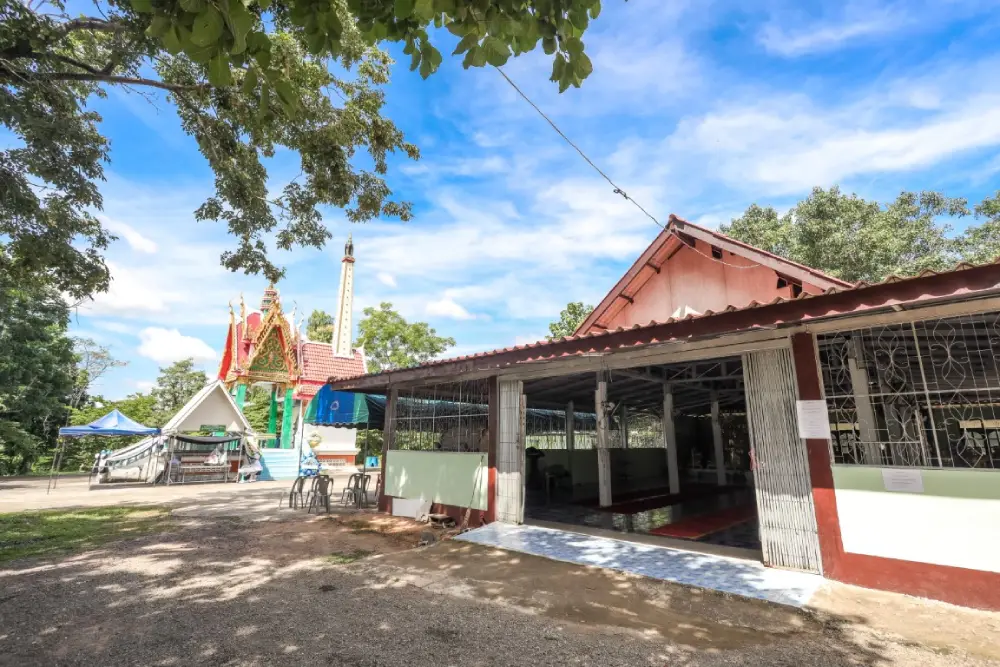
The temple’s important facilities include a sermon hall and monks’ residences. The sermon hall is a central space for Dhamma talks, group activities, and merit-making ceremonies. In rural Thai temples, the sermon hall is often the most familiar place for villagers because it hosts many community gatherings. When a merit-making event is held, people help prepare food, arrange the space, listen to Buddhist teachings, and participate in religious activities together.
The monks’ residences allow resident monks to live and practice within the temple. A monk’s residence is more than a place to rest. It supports monastic discipline, Dhamma study, meditation, and daily Buddhist practice. The presence of resident monks keeps the temple active throughout the year. It also allows villagers to invite monks for ceremonies, ask for guidance, and maintain a continuing relationship with the Sangha.
The most recent verified information identifies the abbot of Wat Khok Sa-at as Phra Khru Sutthikittisan Kittisaro. The abbot plays a central role in caring for the temple, guiding the monks, coordinating with local people, and leading Buddhist activities. In a rural Thai temple, the abbot often serves not only as a religious leader but also as a trusted figure who helps maintain community unity, order, and moral direction.
Wat Khok Sa-at is also important as a place for meditation and spiritual rest. Although it is not a large formal retreat center, the quiet atmosphere of a village temple makes it suitable for prayer, chanting, reflection, and simple meditation. For local people, Buddhist practice is closely connected with daily life. Visitors who come respectfully can experience this gentle rhythm and see how Dhamma practice is integrated into the life of the community.
The temple helps preserve Buddhist and local traditions at the village level. Annual events such as Kathin, Pha Pa, Buddhist holy days, ordinations, funeral ceremonies, and memorial merit-making all bring people back to the temple. Through these repeated activities, local customs are passed from elders to younger generations. The temple therefore functions as a cultural classroom where people learn faith, gratitude, cooperation, and respect through shared practice.
Kathin is one of the most meaningful traditions associated with community temples. During Kathin season, villagers and supporters offer robes and donations to monks who have completed the Rains Retreat. This event also supports the maintenance and development of the temple. In a village context, Kathin is not only a religious ceremony; it is also a time when people return home, meet relatives, help prepare food, and strengthen community bonds.
The temple’s role as the spiritual center of Ban Khok Sa-at has developed through long-term memory and repeated participation. Many villagers grow up visiting the temple with their parents and grandparents. They learn how to bow, make offerings, listen to monks, join ceremonies, and respect sacred spaces. Over time, the temple becomes both a sacred place and a shared memory of the community.
For travelers visiting Thep Sathit District, Wat Khok Sa-at can be included in a local cultural route around Na Yang Klak Subdistrict. Nearby places include Ban Khok Sa-at, Ban Na Yang Klak, Wat Phra Phutthabat Khao Yai Hom, Ban Nam Lat Waterfall, Chom Nang Waterfall, and other community sites. This kind of route is suitable for visitors who prefer slow cultural travel and want to experience Chaiyaphum beyond the usual tourist highlights.
Wat Phra Phutthabat Khao Yai Hom is an important nearby Buddhist site that can be combined with Wat Khok Sa-at. Travelers who visit Wat Khok Sa-at for merit-making can continue to Wat Phra Phutthabat Khao Yai Hom to pay respect to the Buddha’s Footprint and experience another layer of local faith in Na Yang Klak. This route helps visitors understand the Buddhist landscape of the subdistrict more fully.
Ban Nam Lat Waterfall and Chom Nang Waterfall are suitable natural stops for travelers who want to add a nature experience to the temple visit. The Na Yang Klak area is connected with hills, streams, rural landscapes, and forested terrain. Visiting a community temple together with waterfalls gives travelers both spiritual and natural dimensions of Thep Sathit. The rainy season and early cool season are especially pleasant for exploring this area.
Ban Na Yang Klak and nearby villages also have cultural value. The subdistrict is associated with local crafts and rural life, including the broader identity of Thep Sathit as a destination connected with the Siam tulip flower. A visit to Wat Khok Sa-at can therefore serve as a starting point for learning about religion, village life, local food, seasonal travel, and the wider cultural landscape of southern Chaiyaphum.
Although Wat Khok Sa-at is not a commercialized tourism site, this is part of its charm. Visitors can experience a real village temple that serves local people rather than large tourist crowds. The quiet and simple atmosphere makes the visit more meaningful for travelers who are interested in Buddhism, rural culture, and the everyday role of temples in Thai society.
Visitors should follow proper temple etiquette. Modest clothing is recommended, covering shoulders and knees. Voices should be kept low, and visitors should avoid disturbing monks or villagers during religious activities. If a ceremony is taking place, it is best to observe respectfully from an appropriate distance unless invited to join. Photography should be done with dignity and should not treat the temple merely as a photo backdrop.
Merit-making at Wat Khok Sa-at can include offering food to monks, donating to temple maintenance, joining Kathin or Pha Pa ceremonies, offering basic supplies, and supporting religious or community activities. In a local temple, these acts have practical meaning. They help maintain buildings, support resident monks, and allow the temple to continue serving the village.
The best time to visit is from morning to afternoon, when travel is convenient and the temple atmosphere is suitable for paying respect. Those who want to experience community merit-making may choose Buddhist holy days or the Kathin season after the Rains Retreat. Travelers who prefer a quiet visit should come on ordinary weekdays when there are fewer activities and more opportunity for prayer, reflection, and observation.
From a local historical perspective, a temple founded in 1939 has witnessed more than 80 years of community change. It has passed through periods when village temples were central to nearly all social activities and continues to function in an era of roads, local administration, schools, and modern mobility. Wat Khok Sa-at therefore represents continuity: the continued importance of Buddhist temples in rural Thai life.
The use of the village name in the temple name shows how closely the temple and community are connected. In Thailand, temples named after their villages often carry strong emotional meaning for local people. The name is not only a location label; it preserves community identity. For villagers, Wat Khok Sa-at is the temple where families make merit, hold ceremonies, and share memories across generations.
For cultural travelers, Wat Khok Sa-at is a good example of a temple whose importance comes from function rather than grandeur. The buildings may be simple, but each has a purpose. The sermon hall supports Dhamma talks and community events. The monks’ residences support monastic life. The temple grounds support merit-making, ceremonies, and local gatherings. These functions make the temple a living part of the village.
Visitors from outside Chaiyaphum should see Wat Khok Sa-at as a place to learn about real rural Thai temple life. It may not have large signs, decorative tourist facilities, or a busy visitor infrastructure, but it offers sincerity. Visitors can see how monks, villagers, temple spaces, and community activities operate in a natural rhythm. This authenticity is one of the strongest reasons to visit.
Traveling around Na Yang Klak Subdistrict requires some planning because local sites are spread across different village roads. A private car or rental car is the most convenient option. Visitors can combine Wat Khok Sa-at with Wat Phra Phutthabat Khao Yai Hom, Ban Nam Lat Waterfall, Ban Na Yang Klak community areas, and the route toward Pa Hin Ngam National Park. A half-day or full-day plan works best for a relaxed visit.
Getting There is most convenient by private car or rental car. Travelers should head toward Thep Sathit District in Chaiyaphum Province, continue to Na Yang Klak Subdistrict, and then proceed to Ban Khok Sa-at, Moo 6. Searching for Wat Khok Sa-at or Ban Khok Sa-at in a digital map can help with navigation. Daytime travel is recommended because it is easier to see village roads, junctions, and the temple entrance clearly.
From central Thep Sathit, travelers can follow local roads toward Na Yang Klak Subdistrict and continue to Ban Khok Sa-at. Road conditions and travel time should be checked before departure, especially during the rainy season. Those planning a wider route can combine the temple with nearby food stops, waterfalls, local villages, and the Pa Hin Ngam travel route for a more complete experience of Thep Sathit.
Nearby food options include local eateries in Ban Khok Sa-at and Ban Na Yang Klak, Jungle Cafe Na Yang Klak Branch, Krua Pa Wan at Ban Hua Saphan, and Baan Suan Cafe & Camp in Thep Sathit. Opening hours may vary in rural areas, so travelers should check directly before visiting. Simple local meals are often the most practical choice when traveling through this part of Chaiyaphum.
For accommodation, visitors may stay in Thep Sathit District or along the Pa Hin Ngam route. Options include Rai Aeifoon Resort, Baan Rai Ing Doi Resort, Touch The Wind, and local accommodations near Pa Hin Ngam National Park. Staying overnight is suitable for travelers who want to combine temples, waterfalls, local communities, and the national park without rushing, especially during the Siam tulip season.
Overall, Wat Khok Sa-at (Wat Khiri Wong) is a meaningful community temple in Na Yang Klak Subdistrict. It is a place for merit-making, meditation, Buddhist ceremonies, local traditions, and community unity. With its founding history from 1939, resident monks, an active abbot, and its continuing role in village life, the temple remains an important spiritual center for local people.
In summary, Wat Khok Sa-at is more than a temple in Thep Sathit District. It is a place where local history, Buddhist faith, and Thai community culture are preserved through daily practice. Visitors who come here can see how a rural temple supports local life through merit-making, chanting, cultural events, moral learning, and shared memory. For a quiet and authentic cultural stop in Chaiyaphum, Wat Khok Sa-at (Wat Khiri Wong) deserves a place in the travel route.
| Name | Wat Khok Sa-at (Wat Khiri Wong) |
| Location | Ban Khok Sa-at, Moo 6, Na Yang Klak Subdistrict, Thep Sathit District, Chaiyaphum Province |
| Address | Na Yang Klak Subdistrict, Thep Sathit District, Chaiyaphum 36230, Thailand |
| Highlights | A local Mahanikaya Buddhist temple in Ban Khok Sa-at, established in 1939 and serving as a center for merit-making, meditation, Buddhist traditions, cultural activities, and community life |
| History | Established in 1939 and officially registered as a Buddhist temple using its founding evidence from that year |
| Name Origin | The name is associated with Ban Khok Sa-at, the village where the temple is located; the alternate name Wat Khiri Wong carries a meaning connected with hills and community surroundings |
| Distinctive Features | A community temple with a sermon hall and monks’ residences supporting Buddhist activities, merit-making, and village gatherings |
| Travel Information | Best reached by private car or rental car via Thep Sathit District, continuing to Na Yang Klak Subdistrict and Ban Khok Sa-at, Moo 6 |
| Current Status | An active Mahanikaya community temple used for Buddhist ceremonies, Kathin, local traditions, community activities, and meditation |
| Open Days | Daily |
| Opening Hours | Daytime |
| Facilities | Sermon hall, monks’ residences, temple courtyard, and areas for Buddhist ceremonies and community merit-making |
| Main Areas / Zones | 1. Sermon Hall 2. Monks’ Residences 3. Buddhist Activity Area 4. Temple Courtyard For Merit-Making And Community Events 5. Prayer And Meditation Area On Appropriate Occasions |
| Abbot / Caretaker | Phra Khru Sutthikittisan Kittisaro |
| Nearby Tourist Attractions | 1. Ban Khok Sa-at, about 1 km 2. Ban Na Yang Klak, about 8 km 3. Ban Nam Lat Waterfall, about 8 km 4. Wat Phra Phutthabat Khao Yai Hom, about 14 km 5. Chom Nang Waterfall, Ban Saliang Thong, about 16 km 6. Pa Hin Ngam National Park, about 45 km |
| Nearby Restaurants | 1. Local Restaurants In Ban Khok Sa-at, about 1 km 2. Jungle Cafe Na Yang Klak Branch, about 8 km, Tel. 095-601-3499 3. Krua Pa Wan, Ban Hua Saphan, about 12 km 4. Local Restaurants In Ban Hua Saphan, about 12 km 5. Baan Suan Cafe & Camp Thep Sathit, about 30 km, Tel. 099-303-2989 |
| Nearby Accommodations | 1. Local Accommodations In Thep Sathit District, about 35 km 2. Rai Aeifoon Resort, about 38 km 3. Baan Rai Ing Doi Resort, about 38 km, Tel. 089-123-3223, 087-868-3223 4. Touch The Wind, about 45 km, Tel. 092-889-1004 5. Accommodations Near Pa Hin Ngam National Park, about 45 km |
Frequently Asked Questions (FAQ)
Q: Where is Wat Khok Sa-at (Wat Khiri Wong) located?
A: Wat Khok Sa-at (Wat Khiri Wong) is located at Ban Khok Sa-at, Moo 6, Na Yang Klak Subdistrict, Thep Sathit District, Chaiyaphum Province, Thailand.
Q: When was Wat Khok Sa-at established?
A: Wat Khok Sa-at was established in 1939 and is a local Mahanikaya Buddhist temple.
Q: Who is the abbot of Wat Khok Sa-at?
A: The most recent verified information identifies Phra Khru Sutthikittisan Kittisaro as the abbot of Wat Khok Sa-at.
Q: Why is Wat Khok Sa-at important to the community?
A: The temple serves as a center for Buddhist ceremonies, meditation, local traditions, Kathin, cultural activities, and community gathering in Ban Khok Sa-at.
Q: What important areas are found inside the temple?
A: The temple includes a sermon hall, monks’ residences, a temple courtyard, and areas used for Buddhist ceremonies, merit-making, and community activities.
Q: How can travelers get to Wat Khok Sa-at?
A: The most convenient way is by private car or rental car via Thep Sathit District, continuing to Na Yang Klak Subdistrict and Ban Khok Sa-at, Moo 6.
Q: Are there nearby attractions around Wat Khok Sa-at?
A: Nearby places include Ban Khok Sa-at, Ban Na Yang Klak, Ban Nam Lat Waterfall, Wat Phra Phutthabat Khao Yai Hom, Chom Nang Waterfall, and Pa Hin Ngam National Park.
Q: What kind of travelers is Wat Khok Sa-at suitable for?
A: It is suitable for travelers who want to make merit, visit a local Isan temple, learn about rural Buddhist culture, meditate quietly, and explore the Na Yang Klak community.
 Category: ●Places of Worship
 Group: ●Temple
Last Update : 3 MonthAgo
 Last Update : 3 MonthAgo
 Click to Access the Navigation Map GPS
Wat Khok Sa-at (Wat Khiri Wong) Map
Recommend

 Art, Culture and Heritage
 Historical Sites and Monuments(1)
 Landmarks and Memorials(3)
 Royal Palace(1)
 Art, Craft Centres, Tradition(3)
 Educational Places
 Educational Gardens, Farm(1)
Temple(141)
Educational Gardens, Farm(1)
Temple(141)
 Other Sacred Sites(7)
 Suburban Living
 Village, Community(4)
 Nature and Wildlife
 National Parks and Marine Reserves(7)
 Mountain (Doi)(5)
 Dam, Reservoir, Lake(10)
 Waterfalls(15)
 Caves(5)
 River, Canal(4)
 Other natural attractions(1)
 Entertainment and Agricultural
 Farms, Parks and Ecotourism(2)


